
TL;DR:
- Not all gold has the same quality; purity levels significantly influence its valuation, liquidity, and regulatory standing.
- Accredited testing methods like fire assay and XRF are crucial for verifying purity, especially in institutional transactions.
Not all gold is created equal, and that gap in quality can cost institutional investors far more than they expect. A bar stamped “gold” and a bar certified at 99.99% purity are not the same asset, even though they look identical. Gold purity levels, the testing methods used to verify them, and the documentation supporting those claims directly shape asset valuation, liquidity, and regulatory standing. This guide cuts through the confusion, explains what gold purity actually means for your portfolio, and shows you which testing standards belong in every serious institutional due diligence process.
Table of Contents
- Understanding gold purity: Definitions and standards
- Gold purity testing methods: Accuracy and practical considerations
- Implications of gold purity for investment decisions
- Best practices for certifying gold purity
- Why gold purity is the hidden driver of successful investments
- Explore reliable gold trading and investment solutions
- Frequently asked questions
Key Takeaways
| Point | Details |
|---|---|
| Gold purity defines value | Gold purity directly impacts valuation, liquidity, and trust when investing. |
| Fire assay is the gold standard | Fire assay remains the most accurate and trusted method for verifying gold purity. |
| Testing accuracy affects risk | Differences in testing methods can shift asset value and risk exposures. |
| Certification drives investment integrity | Institutional investors require certified purity for compliance and transaction security. |
| Best practices optimize outcomes | Using rigorous certification and risk management practices results in higher investment confidence. |
Understanding gold purity: Definitions and standards
Gold purity is a measure of how much actual gold exists in a given piece or bar relative to other metals. Refineries and traders express this in two systems: the karat system and the fineness (percentage) system. Both systems describe the same thing but communicate it differently depending on the market context.
The karat system divides gold content into 24 parts. Pure gold is 24 karats (24K), meaning all 24 parts are gold. A 22K bar contains 22 parts gold and 2 parts alloy metal. The fineness system is more precise and favored in institutional and refinery settings. It expresses purity as parts per thousand. So 24K gold is labeled .999 or .9999, while 18K gold reads as .750. Understanding this investment terminology is foundational before entering any significant physical gold transaction.
Here is how common purity standards break down across both systems:
| Karat | Fineness | Gold content (%) | Common use |
|---|---|---|---|
| 24K | .9999 | 99.99% | Investment bars, institutional trading |
| 22K | .916 | 91.6% | Bullion coins (e.g., Krugerrand) |
| 18K | .750 | 75.0% | Jewelry, some industrial use |
| 14K | .585 | 58.5% | Commercial jewelry |
| 10K | .417 | 41.7% | Entry-level retail jewelry |
For institutional investors, only 24K (.9999) or 22K (.916) assets typically qualify for investment grade holdings. Refineries accredited by the London Bullion Market Association (LBMA) must meet a minimum standard of .995 fineness for gold bars eligible for LBMA delivery.
Key terms every investor should know when reviewing purity documentation:
- Assay certificate: A formal document issued by an accredited laboratory confirming gold content after testing
- Hallmark: A stamp on a bar or coin from a recognized authority certifying the purity at the point of production
- Alloy metals: Metals such as silver, copper, or zinc added to gold to improve hardness or reduce cost
- Fineness variance: The acceptable margin of error between stated and actual gold content, which varies by testing method
Pro Tip: Always request documentation verifying purity before completing any gold transaction. An assay certificate from an LBMA-accredited refinery or an internationally recognized laboratory is the minimum acceptable standard for institutional purchases.
Purity testing methodologies span a range of approaches, from fire assay (destructive testing with ±0.01% accuracy, considered the gold standard for refineries) to X-ray fluorescence or XRF (non-destructive, with accuracy of ±0.03 to 0.5%, ideal for commercial screening). Knowing which method produced your documentation is as important as the documentation itself.
Gold purity testing methods: Accuracy and practical considerations
Knowing the definitions and standards, the next step is understanding how purity is actually measured. The two dominant methods in the industry are fire assay and XRF analysis. Each has a specific role, and choosing the wrong method for a high-value transaction can expose investors to significant risk.
Fire assay is the oldest and most accurate method in existence. The process works by dissolving a gold sample in a flux mixture, heating it to extreme temperatures (around 1,000°C), and separating impurities through a process called cupellation, where base metals are absorbed into a porous cupel. What remains is nearly pure gold that can be weighed precisely. The accuracy of fire assay reaches ±0.01% precision, making it the benchmark for refinery certification and dispute resolution. The major trade-off is that the test destroys the sample, meaning it cannot be applied to finished bars without removing a portion of material.

XRF analysis uses X-rays directed at the gold surface to measure the fluorescence emitted by different elements. The instrument identifies the composition of the surface layer within seconds, non-destructively. This makes XRF the preferred tool for rapid commercial screening at trading desks and refineries processing high volumes. However, XRF only reads a few microns below the surface, making it vulnerable to surface plating where a base metal is coated with gold to pass cursory checks.
Here is a direct comparison of both methods:
| Feature | Fire assay | XRF analysis |
|---|---|---|
| Accuracy | ±0.01% | ±0.03 to 0.5% |
| Sample destruction | Yes | No |
| Test speed | Hours to days | Seconds to minutes |
| Best use case | Certification, disputes | Screening, high-volume sorting |
| Surface sensitivity | No | Yes (limited depth) |
| Cost | Higher | Lower |
| Industry adoption | Refineries, arbitration | Trading desks, commercial labs |
The step-by-step flow for institutional gold testing typically looks like this:
- Initial intake screening: Run XRF on all incoming material to flag anomalies or obvious discrepancies from the stated purity
- Sample selection: Pull representative samples from each lot for more rigorous testing, following LBMA or ISO sampling protocols
- Fire assay on selected samples: Submit samples to an accredited lab for fire assay, with cupellation producing an exact gold content figure
- Documentation review: Cross-reference assay results with the seller’s documentation, hallmarks, and chain of custody records
- Decision point: If results match, proceed. If discrepancies appear, trigger a formal dispute process backed by fire assay as the referee method
“Fire assay remains the referee method despite XRF convenience. Use XRF for screening and fire assay for disputes or high-value transactions.”
This sequenced approach protects investors without slowing down routine operations. When evaluating gold traders, ask directly which testing method they use for final certification. A professional trader should have no hesitation pointing to fire assay as the definitive authority for high-value lots. Refer to a detailed gold trading guide if you need further context on how these steps integrate into a full acquisition process.
Implications of gold purity for investment decisions
Once you know how purity is tested, the real question is: How does this affect your investment decisions? The answer touches on valuation, liquidity, regulatory compliance, and counterparty risk simultaneously.
Asset valuation: Gold spot prices are quoted for .999 fine gold. Any deviation below that standard directly reduces the value of the asset on a proportional basis. A 100-troy-ounce bar with a stated purity of .999 but actual purity of .995 represents a 0.4% shortfall. At a spot price of $3,000 per ounce, that equals a $1,200 discrepancy on a single bar. Scale that across a significant institutional position and the financial impact becomes material very quickly. The difference between ±0.01% accuracy from fire assay versus ±0.5% from a less calibrated XRF device is not trivial at institutional scale.
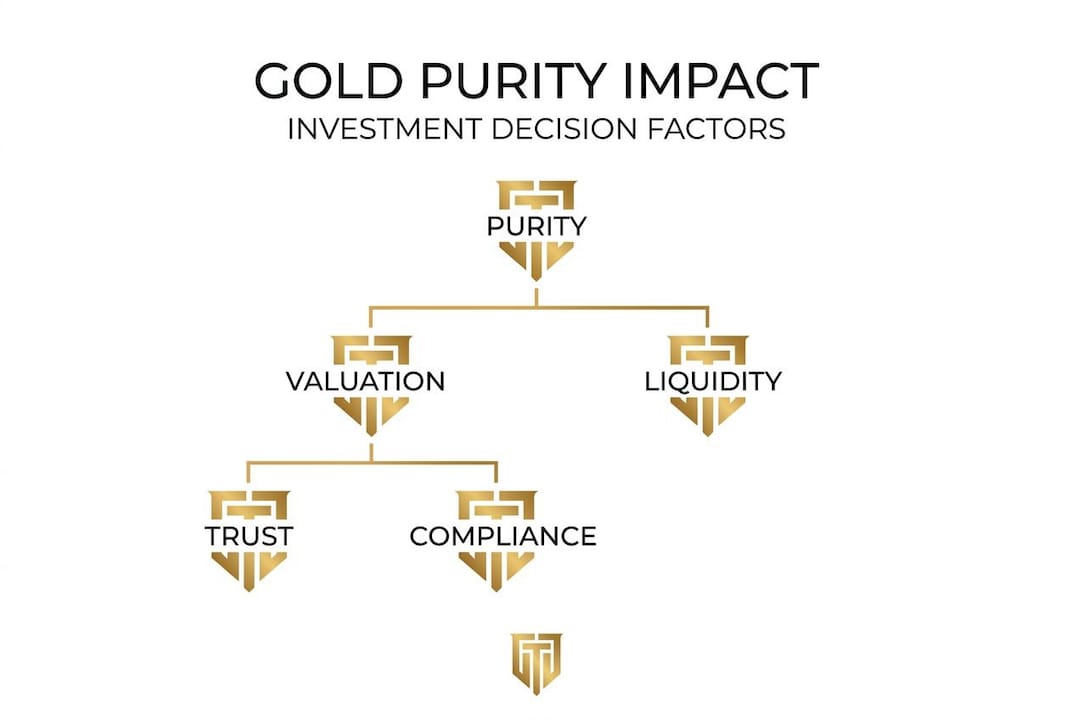
Liquidity risk: Gold bars that cannot be readily verified through accepted testing and documentation face real liquidity constraints. LBMA-approved vaults and major bullion banks require assay documentation before accepting deposits. If your gold cannot pass their standards, you cannot access the primary wholesale market without incurring refining costs. Understanding trading standards expected by institutional counterparties saves significant cost and delay.
Regulatory compliance: Institutional investors operating under custodial mandates, pension frameworks, or AML (anti-money laundering) regulations must maintain documentation proving the legitimacy and quality of gold holdings. Purity records form part of that compliance trail. Gaps in assay documentation create regulatory exposure and complicate audits.
Key risks to manage when purity verification is weak:
- Accepting surface-plated material that passes XRF screening but fails fire assay
- Overpaying for gold that does not meet stated purity specifications
- Losing access to institutional markets due to documentation gaps
- Counterparty disputes with no referee method to resolve them objectively
- Regulatory penalties tied to inadequate provenance or quality records
Understanding gold investing risks extends well beyond price volatility. Purity risk is an operational and structural risk that many financial professionals underestimate until they encounter it firsthand during a transaction dispute or audit.
Best practices for certifying gold purity
To apply these standards in your own investments, follow established certification and risk management best practices. Institutions that build rigorous purity certification into their acquisition workflow protect themselves at every stage.
Step-by-step certification process for institutions:
- Require documentation upfront: Before any trade is agreed upon, request the assay certificate, refinery name, bar serial numbers, and hallmark details
- Verify refinery accreditation: Confirm the refinery is on the LBMA Good Delivery List or an equivalent recognized authority for your jurisdiction
- Conduct independent XRF screening: Run your own XRF on a representative sample immediately upon receipt, not just the seller’s testing
- Commission fire assay for high-value lots: For transactions above your institution’s defined threshold, commission an independent fire assay from an accredited third-party lab
- Reconcile results before settlement: Do not release payment until all assay results reconcile with stated documentation and the chain of custody is verified
- Archive all records: Store all assay certificates, testing reports, and chain of custody records as part of the asset file for the duration of holding
Pro Tip: Verify the testing method and documentation before agreeing to any transaction terms. A counterparty unwilling to disclose the testing methodology or who provides only XRF results for a high-value lot is a counterparty worth reconsidering.
Common mistakes that create purity risk in institutional settings:
- Accepting verbal assurances or informal documentation in place of certified assay reports
- Relying exclusively on XRF results for large or high-value purchases
- Skipping independent verification because the seller is “trusted” or established
- Failing to confirm the testing lab’s accreditation status before accepting results
- Not specifying in contract terms which testing method governs in case of dispute
A simple checklist for maintaining transaction integrity:
- Assay certificate from an accredited lab: confirmed
- Refinery listed on LBMA Good Delivery List or equivalent: confirmed
- Bar serial numbers match documentation: confirmed
- Independent XRF screening completed on receipt: confirmed
- Fire assay commissioned for lots above threshold value: confirmed
- Chain of custody documentation complete: confirmed
- All records archived in asset file: confirmed
The XRF vs fire assay decision should never default to convenience. Use a platform built on trading platform trust and verified processes. Strong risk management and transparency from your trading counterparty means they welcome independent verification, not resist it.
Why gold purity is the hidden driver of successful investments
Most financial professionals focus on price charts, macroeconomic signals, and allocation percentages when building a gold position. Purity is treated as a background variable, something assumed to be correct because the seller said so or because a bar looks legitimate. This is a significant blind spot.
Here is what years of physical gold trading reveals: price timing matters far less than asset quality for institutional outcomes. A position built on properly certified, high-purity gold retains liquidity and negotiating power across all market conditions. A position built on poorly documented or inconsistently tested gold becomes illiquid precisely when you need to move it, often during periods of market stress when speed of execution is critical.
The deeper issue is that purity problems rarely surface at acquisition. They appear during disposition, refinancing, or audits, moments when the institution is under pressure. An improperly verified bar that sat in a vault for three years does not become easier to dispute when you are trying to liquidate in a volatile market.
We believe the institutional trust guide on this topic points to a fundamental truth: auditable purity assessment is not just due diligence protocol, it is the foundation of the asset’s integrity as a store of value. Without it, you are holding paper-thin certainty wrapped in metal. In gold investment, purity is more than a technicality. It is what separates a reliable store of value from a liability wearing the appearance of one.
Explore reliable gold trading and investment solutions
For institutions and investors ready to apply rigorous gold purity standards, the right trading partner makes all the difference.
Galami Gold operates with a commitment to certified purity, disciplined execution, and documented chain of custody across every transaction. Our physical gold supply is sourced through well-established supply chains where assay verification is standard, not optional. Investors can explore our risk-managed programs through our investment risk disclosure documentation, which outlines how we manage purity and valuation risk at the institutional level. For corporate entities and financial professionals, the institutional trading benefits page details how our operational standards support your compliance, liquidity, and audit requirements from day one.
Frequently asked questions
What is the most accurate method for measuring gold purity?
Fire assay offers ±0.01% accuracy and is the accepted gold standard for purity measurement in accredited refineries and dispute resolution processes.
Why does gold purity testing matter for institutional investors?
Accurate purity testing reduces valuation risk and supports regulatory compliance, both of which are non-negotiable for institutions managing large physical gold positions. The referee method in any dispute remains fire assay, which is why its documentation carries the most legal and financial weight.
Can XRF replace fire assay for gold purity certification?
XRF is effective for rapid commercial screening, but fire assay is still required for dispute resolution and final certification of high-value gold lots at institutional standards.
How does gold purity affect the asset’s value?
Even a small variation in gold purity can materially shift market value and affect trading confidence, particularly at institutional scale where volume amplifies small percentage differences. Purity testing accuracy determines how reliably that value can be stated and defended.
Recommended
- Institutional Gold Broker Checklist: 2026 Vetting Guide
- Gold Market Dynamics Explained: What Investors Need to Know
- Why gold attracts high-net-worth investors: 18% allocation
- Gold as an asset class: Risk, diversification, and strategy
- How to Value Your Gold at Home (UK Edition) – blackwellonline
Ready to invest in physical gold trade finance?
Both the Zambia–Dubai and Sierra Leone–Dubai programs are open to qualified investors. Minimum investments from $115,000 USD or €125,000 EUR.
Zambia–Dubai Program Sierra Leone–Dubai Program