
For most institutional allocators, the right starting point is a small strategic sleeve in allocated physical bullion, held with a segregated, insured custodian that provides audited proof-of-reserves. That combination gives you genuine title to metal, clear audit trails, and the insurance properties gold actually delivers without overweighting a volatile asset.
Before you execute, confirm three things:
- LBMA Good Delivery bar standard compliance from your counterparty
- Segregated, insured vaulting with independent audit access
- Documented KYC/AML procedures and settlement counterparty credit controls
Pro Tip: Request the custodian’s most recent proof-of-reserves report and reconciliation schedule before signing any custody agreement. Institutions that skip this step during onboarding often discover reporting gaps only after their first internal audit.
Table of Contents
- What does a capital management guide say about gold’s role in a portfolio?
- Which exposure path fits your institution’s capital allocation principles?
- How should you structure custody and execution for US institutional gold?
- How do you size, rebalance, and govern a gold allocation inside a fiduciary framework?
- What are the US tax and regulatory rules that affect institutional gold holdings?
- What does institutional gold deployment actually cost, and how long does it take?
- What questions should you ask every prospective trading and custody partner?
- Key Takeaways
- What the execution data actually tells you about deploying gold mandates
- Galamigold delivers institutional gold execution with full transparency
- Useful sources and references
What does a capital management guide say about gold’s role in a portfolio?
Gold is portfolio insurance. J.P. Morgan Asset Management is direct about this: gold acts as an insurance asset but is not a direct substitute for core bonds. Its realized volatility over the last 10 years has been roughly twice that of U.S. government bonds, which has a concrete sizing implication. A portfolio that treats gold like a bond replacement will carry significantly more volatility than its risk model assumes.
Where gold earns its place is in geopolitical shock months and currency-stress episodes, when equity and bond correlations tend to converge and gold often moves independently. During prolonged bond-led risk-off periods, gold can underperform. That asymmetry is the point: you hold it for the scenarios where everything else fails simultaneously.
Central bank demand context: J.P. Morgan reports that official gold buying has been materially elevated in the most recent period cited, with central bank holdings increased substantially. That structural demand underpins the asset’s reserve-diversification rationale.
Practical sizing follows from the volatility reality. A 2–5% allocation in a diversified institutional portfolio contributes meaningful insurance without distorting overall portfolio volatility. Schroders’ institutional research supports a structural allocation to gold as a dedicated sleeve rather than a tactical overlay, precisely because tactical timing of gold is notoriously difficult. Keep it in the strategic sleeve, rebalance mechanically, and let the insurance logic do its work.
Key portfolio roles to document in your IPS:
- Geopolitical and tail-risk hedge
- Inflation-hedge candidate within a broader real-assets sleeve
- Reserve diversification away from sovereign credit exposure
- Low-correlation diversifier during equity drawdowns
Which exposure path fits your institution’s capital allocation principles?
Allocated physical bullion is the right answer for long-term holdings where auditability and title clarity matter. For short-term liquidity or tactical trading, pooled/unallocated accounts or exchange-traded products serve better, but they carry different risk profiles.
| Dimension | Allocated physical | Pooled/unallocated | Gold ETFs | Futures/forwards |
|---|---|---|---|---|
| Custody model | Segregated, titled to client | Pooled, custodian’s balance sheet | Fund structure, custodied by trustee | No physical custody |
| Counterparty credit risk | Minimal (title held) | High (unsecured creditor) | Low-to-moderate | Clearing member/exchange |
| Auditability | Full (bar-level reconciliation) | Limited | Fund-level audit | Mark-to-market only |
| Cost profile | Higher upfront, lower ongoing | Lower upfront | Management fee + spread | Margin, roll costs |
| Settlement finality | Physical delivery, T+2 typical | Book-entry, same-day | T+1 exchange settlement | Cash or physical at expiry |
Pros and cons by path:
- Allocated bullion: Full title, auditable, LBMA Good Delivery eligible. Higher custody and insurance costs; less liquid intraday.
- Pooled/unallocated: Lower cost, faster settlement. You are an unsecured creditor of the custodian. Counterparty failure risk is real.
- Gold ETFs: Liquid, exchange-traded, low operational burden. No direct title to metal; fund structure adds a layer of counterparty exposure.
- Futures/forwards: Efficient for hedging and tactical exposure. Roll costs accumulate; physical delivery at expiry requires separate custody arrangements.
Converting pooled/unallocated to allocated physical typically takes one to three London business days, subject to custodian allocation cutoffs. Custody agreements commonly require identification of whole bars, and custodians may select specific bars for withdrawal, which can create minor weight adjustments at delivery. Budget for that friction when modeling liquidity timelines. For a broader look at gold asset exposure options, the tradeoffs across formats are worth reviewing before finalizing your mandate.
How should you structure custody and execution for US institutional gold?
Segregated allocated custody is the baseline for any institution that needs auditable title. Book-entry unallocated accounts are acceptable for short-term settlement float, but long-term holdings should be allocated and titled.
LBMA Good Delivery bars are the recognized standard: minimum 350 troy ounces, maximum 430 troy ounces, minimum 99.5% fineness. Custody agreements tied to LBMA member custodians define allocation procedures, withdrawal timelines, and the mechanics of moving between unallocated and allocated accounts.
| Custody path | Typical settlement | Required documentation | Reporting cadence |
|---|---|---|---|
| Allocated physical | T+2 (London business days) | Trade confirm, bar list, custody agreement | Monthly bar-level reconciliation |
| Unallocated pooled | Same day to T+1 | Account agreement, trade confirm | Daily balance statement |
| ETF (exchange) | T+1 | Brokerage confirm | Daily NAV |
| Futures (CME) | physical T+2 at expiry | Futures contract, delivery notice | Daily mark-to-market |
Operational controls to require from every custodian:
- Insured vault with named-peril coverage and disclosed policy limits
- Independent annual audit with bar-level reconciliation
- SWIFT or SFTP reporting feeds for daily balance confirmation
- Insured transit for any physical movement between vaults
- Documented chain-of-custody logs for every bar movement
- Proof-of-reserves reporting on a schedule you specify in the custody agreement
Market practice, confirmed by institutional audit expectations, requires audited custody, proof-of-reserves reporting, and frequent reconciliations as baseline trust signals.
How do you size, rebalance, and govern a gold allocation inside a fiduciary framework?
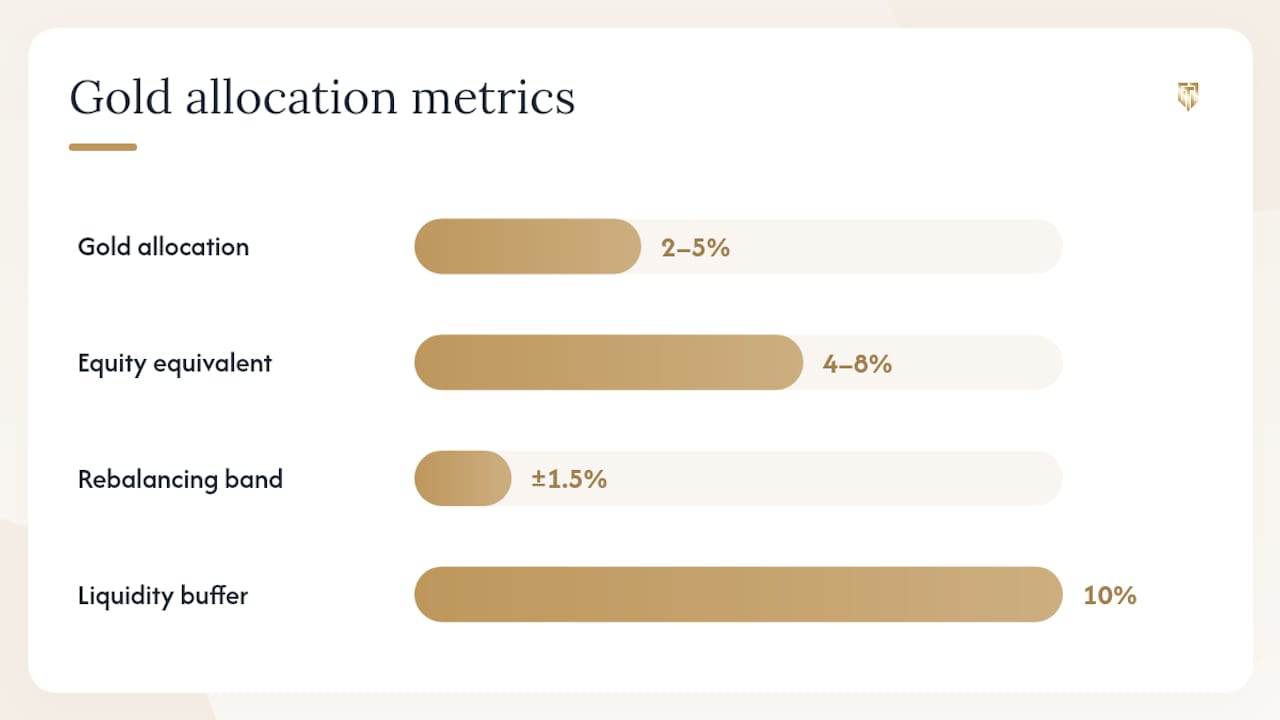
Size the gold sleeve at roughly half the volatility budget you would assign to an equivalent equity position. Given gold’s realized volatility at approximately twice that of US government bonds, a 2–5% allocation typically contributes a volatility footprint similar to a 4–8% equity position. That math should drive your IPS language.
Rebalancing and liquidity rules:
- Set a rebalancing band of ±1.5% around the target weight; trigger a review when breached
- Maintain a liquidity buffer of at least 10% of the gold sleeve in unallocated or ETF form for same-week redemptions
- Document rebalancing triggers in the IPS and require investment committee sign-off for out-of-band moves
Counterparty and operational controls:
- Cap single-custodian exposure at a defined percentage of total gold holdings
- Require segregated title documentation and annual proof-of-reserves
- Run quarterly reconciliation between internal records and custodian statements
- Maintain chain-of-custody logs for every bar movement and insured transit certificate for every shipment
Regulatory and compliance governance:
- Document KYC/AML procedures for every counterparty, including dealers and custodians
- Retain trade records, custody agreements, and audit reports for a minimum of seven years
- Review SEC custody rule developments annually; the SEC’s proposed safeguarding rule explicitly contemplates physical assets and would require qualified-custodian-level protections for advisers holding physical metals on behalf of clients
Pro Tip: Set settlement cutoff rules in your custody agreement that account for London and New York time zone differences. A trade executed at 3:00 PM ET may miss the London allocation cutoff, pushing physical delivery to the next business day. That one-day slip can affect your cash and margin planning if you have not modeled it.
For more on gold portfolio risk management and rebalancing frameworks, Galamigold’s institutional guidance covers current sizing approaches in detail.
What are the US tax and regulatory rules that affect institutional gold holdings?
The most material US tax point for institutional entities holding physical gold is classification. The IRS treats physical gold as a collectible, which affects long-term capital gains tax treatment for certain entity types. Institutions should confirm their specific tax treatment with counsel before structuring a mandate.
For retirement-account-adjacent structures, IRC Section 408(m)(3)(B) sets minimum fineness thresholds commonly interpreted as 99.5% for eligible bullion, and IRA-held gold must be stored in an IRS-approved depository. Home storage is not permitted. LBMA Good Delivery bars at 99.5% fineness meet this threshold.
“The SEC’s proposed amendments to adviser custody rules explicitly contemplate the inclusion of physical assets, including precious metals, in the scope of assets requiring safeguards and qualified custodians.” — SEC Proposed Rule: Safeguarding Advisory Client Assets
For registered investment advisers, the SEC’s proposed safeguarding rule would widen custody coverage to include physical assets and require minimum protections including custody by a qualified custodian and segregation where applicable. Advisers with physical gold on behalf of clients should monitor this rule’s finalization closely.
Compliance checklist for institutional gold holdings:
- Confirm entity-level tax treatment of physical gold with tax counsel
- Verify 99.5% minimum fineness for any retirement-account-adjacent structure
- Use IRS-approved depositories for IRA-held metals
- Maintain segregated title documentation to avoid commingling exposure
- Retain audited reconciliation records to satisfy custody and tax audit requirements
This section is general information, not tax or legal advice. Confirm current rules with a qualified tax professional and the relevant primary sources.
What does institutional gold deployment actually cost, and how long does it take?
Total cost of ownership for allocated physical gold typically includes dealer premium, custody and insurance fees, audit costs, and settlement fees. The principal cost drivers are the dealer premium over spot, custody and insurance fees, audit costs, and settlement fees.
| Cost component | Typical institutional range | Notes |
|---|---|---|
| Dealer premium over spot | per transaction fees vary by custodian | Institutional bars lower per-ounce than coins |
| Annual custody and storage | 0.10–0.25% of AUM | Varies by vault location and segregation level |
| Insurance | Included or small percentage fees | Confirm named-peril coverage limits |
| Independent audit | Fixed fee, varies by vault | Budget annually; required for institutional compliance |
| Settlement fees | Negotiated per transaction | Typically modest for large bar trades |
Deployment timeline (numbered steps):
- Mandate approval (Week 1): Investment committee approves allocation band and IPS language
- Counterparty due diligence (Weeks 2–4): RFP to trading and custody partners; review audit reports, custody agreements, and insurance certificates
- Legal agreements (Weeks 3–5): Execute custody agreement, trading master agreement, and KYC/AML documentation
- Trade execution (Week 5–6): Execute purchase at agreed premium over COMEX spot; confirm LBMA Good Delivery bar specifications
- Delivery and allocation (T+2 from trade date): Physical bars allocated to segregated account; bar list confirmed
- Initial reconciliation (Week 7): Reconcile internal records against custodian bar list; confirm insurance coverage is active
Budget cash for the full settlement amount plus fees at T+2. Unallocated float during the settlement window carries custodian credit exposure, so minimize the window.
What questions should you ask every prospective trading and custody partner?
The single most important capability to verify is audited custody combined with transparent, live-quoted pricing and insured vaulting. A counterparty that cannot provide all three is not ready for institutional business.
Due-diligence checklist:
- Request the most recent independent audit report and proof-of-reserves documentation
- Confirm segregated title options and the legal basis for client ownership of specific bars
- Review the custody agreement for allocation timing, withdrawal procedures, and bar-selection rights
- Verify insurance policy limits, named-peril coverage, and insured transit terms
- Confirm settlement SLAs and the counterparty’s LBMA Good Delivery accreditation
- Review reporting channels: SWIFT, SFTP, or eBTS feeds for daily reconciliation
- Confirm KYC/AML procedures and the counterparty’s regulatory status
Questions to ask directly:
- “What is your allocation cutoff time, and how does it interact with New York settlement?”
- “Can you deliver Good Delivery bars on demand, and what is the typical lead time?”
- “How do you handle weight discrepancies when allocating whole bars?”
- “What is your dispute resolution process for custody disagreements?”
Red flags to watch for:
- Custodian and dealer are the same unconflicted entity with no independent audit
- Premiums quoted without reference to a live COMEX or LBMA spot benchmark
- No independent audit report available or audit conducted by a related party
- Vague or absent insurance documentation
Key Takeaways
Institutional physical gold allocation works when it is sized for its actual volatility, held in audited segregated custody, and governed by documented rebalancing and compliance rules.
| Point | Details |
|---|---|
| Starting allocation range | A 2–5% strategic sleeve in allocated physical bullion is the recommended starting point for most institutional portfolios. |
| Volatility sizing | Gold’s realized volatility is roughly twice that of US government bonds, so size accordingly and document the rationale in your IPS. |
| Custody baseline | Require segregated title, insured vaulting, independent annual audit, and proof-of-reserves before signing any custody agreement. |
| Cost budgeting | Total annual cost of ownership includes dealer premium, custody, insurance, and audit fees. |
| Galamigold | Galamigold works upstream of custody, sourcing, assaying and refining physical gold, with independent audits every 90 days. It is not a custodian and does not provide insured vaulting. |
What the execution data actually tells you about deploying gold mandates
The most common failure mode in institutional gold mandates is not the allocation decision. It is the gap between signing a custody agreement and actually having allocated, audited, insured metal on the books. Desks that treat the T+2 settlement window as a formality routinely discover that allocation cutoff times, whole-bar weight adjustments, and insurance activation each add friction that was not modeled in the original deployment timeline.

The governance checkpoint that matters most is the first reconciliation, not the trade confirmation. A trade confirm tells you the price. The bar-level reconciliation tells you whether you actually own what you think you own, in the vault you specified, under the insurance policy you reviewed. Run that reconciliation within five business days of delivery, not at the end of the quarter.
One practical note on settlement timing: coordinate your trade execution to land before the London allocation cutoff, which typically falls in the early afternoon London time. A New York desk executing late in the US morning can easily miss that window and push physical allocation to the next business day, creating an overnight unallocated exposure that most IPS documents do not explicitly authorize.
Galamigold delivers institutional gold execution with full transparency
Institutions that have worked through this guide now know what they need: allocated physical bullion, segregated insured custody, transparent spot-referenced pricing, and a counterparty that provides audited custody reports on request.

Galamigold works upstream of custody: it sources physical gold from Africa, has it assayed and refined in Dubai, and has its operations independently audited every 90 days. It is not a custodian and does not provide insured vaulting, so the custody and insurance checks in this guide apply to whichever vault you use. To understand how Galamigold's programs work, read about institutional gold trading and the risk disclosure, or contact investor relations.
For institutions ready to move from allocation decision to executed mandate, the next step is a direct engagement. Contact Galamigold through galamigold.com to request a due diligence packet, custody agreement terms, and a live pricing demonstration tailored to your mandate size.
Useful sources and references
The sources below back the key claims in this guide and are suitable for citation in internal governance memos and investment committee presentations.
- Understanding gold and its role in portfolios | J.P. Morgan Asset Management — Primary source for the volatility comparison (~2x US government bonds) and central bank demand data. Recommended for IPS language on gold’s role.
- SEC Proposed Rule: Safeguarding Advisory Client Assets (IA-6240) — Authoritative source on custody obligations for advisers holding physical assets. Cite in governance and compliance sections of internal memos.
- The case for a structural allocation to gold | Schroders — Policy-level justification for a dedicated gold sleeve in institutional portfolios.
For governance memos: The J.P. Morgan volatility finding and the SEC proposed rule are the two most citable sources for investment committee and compliance audiences. Quote them directly with the source URLs above to establish the institutional rationale and regulatory context for your gold custody framework.
Recommended
- Top benefits of physical gold for institutional investors
- Top institutional gold trading benefits for portfolio growth
- Step by Step Gold Transaction Process: 2026 Guide
- What Is Bulk Gold Trading: Investor's 2026 Guide
Ready to invest in physical gold trade finance?
Both the Zambia–Dubai and Sierra Leone–Dubai programs are open to qualified investors. Minimum investments from $115,000 USD or €125,000 EUR.
Zambia–Dubai Program Sierra Leone–Dubai Program