
TL;DR:
- Bulk gold trading involves high-volume transactions at near-spot prices, primarily serving institutional investors.
- The industry relies on standards like LBMA Good Delivery bars, with compliance and liquidity crucial for secure trades.
- Asian markets are shifting dominance, with infrastructure developments shaping global gold liquidity pathways.
Bulk gold trading is the practice of buying and selling large volumes of physical gold at wholesale prices close to the metal’s actual spot market value, making it one of the most capital-efficient ways to gain direct exposure to gold as an asset. Unlike retail purchases of coins or small bars, bulk transactions involve institutional-grade bars traded through professional channels, where pricing, compliance, and logistics operate at a completely different scale. The global physical gold market is valued at approximately US$14 trillion as of Q2 2026, with daily trading volumes averaging US$361 billion. That figure tells you this is not a niche corner of finance. It is one of the most liquid asset markets on the planet, and bulk trading sits at its core.
What is bulk gold trading and how does it work?
Bulk gold trading refers to high-volume transactions in physical gold, typically conducted between institutional buyers, refiners, bullion banks, and sophisticated investors through over-the-counter (OTC) markets or recognized exchanges. The industry term for this activity is wholesale gold trading, and it operates under a set of internationally recognized standards that distinguish it sharply from retail gold purchasing. Where a retail buyer might pay a 3% to 8% premium above spot price for a one-ounce coin, a wholesale buyer transacting in 400-ounce bars pays a fraction of that premium, often measured in basis points.

The mechanics are straightforward. A buyer agrees on a price tied to the London spot fix or a futures reference, arranges payment through a bullion bank or clearing system, and takes delivery of bars that meet certified purity and weight standards. Settlement can happen on an allocated basis, where specific numbered bars are assigned to the buyer, or on an unallocated basis, where the buyer holds a claim against a pool of gold rather than specific bars. The distinction between these two structures carries significant financial and risk implications, which we cover in detail below.
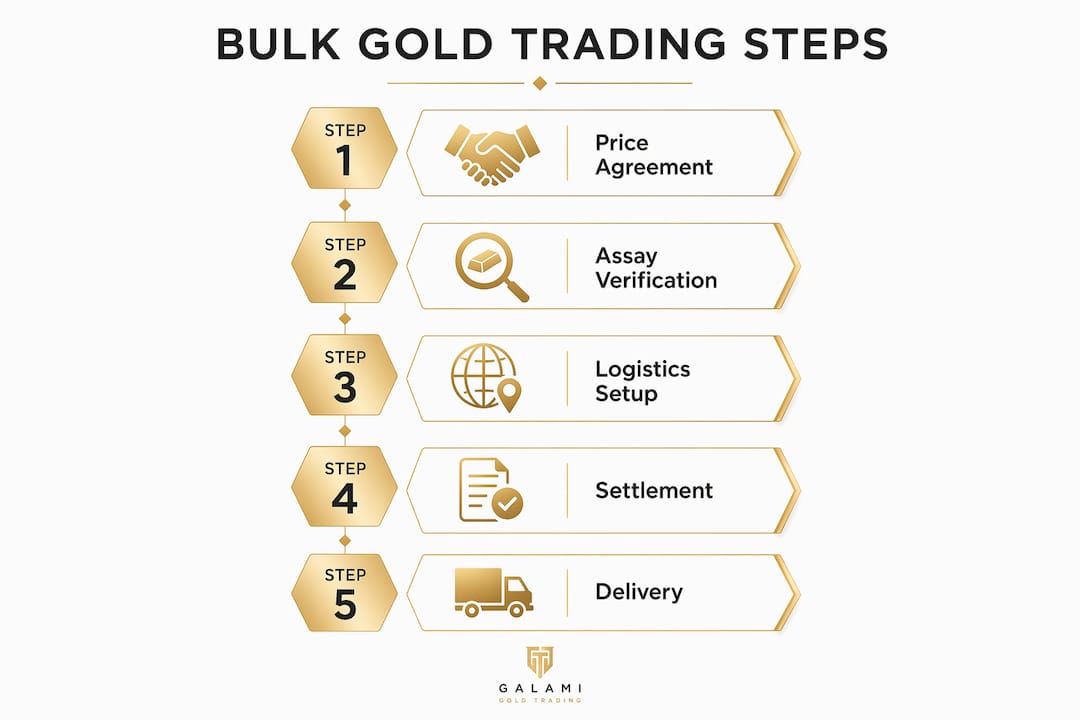
Major trading hubs include the London OTC market, the Shanghai Gold Exchange (SGE), and the COMEX futures exchange in New York. Each serves a different function in the global price discovery and settlement ecosystem.
What formats and standards define bulk gold trading?
The foundation of institutional gold trading is the LBMA Good Delivery standard, which requires a minimum fineness of 995.0 parts per thousand. This standard, set by the London Bullion Market Association, is the benchmark that institutional buyers, central banks, and sovereign wealth funds rely on when transacting in bulk. A bar that does not meet Good Delivery criteria cannot be freely traded in the major OTC markets, which immediately limits its liquidity and financing value.
The most common bar sizes in bulk trading are:
- 400-troy-ounce bars (approximately 12.4 kg): the standard unit in London OTC and central bank transactions
- 1-kilogram bars: widely used across Asian markets, particularly on the Shanghai Gold Exchange
- 100-gram and 50-gram bars: used by institutional-grade retail programs such as those offered by Cebuana Lhuillier in the Philippines
Beyond size and purity, every bar in a legitimate bulk transaction carries an assay certificate from an LBMA-accredited refiner, a serial number, and a documented chain of custody. These records are not bureaucratic formalities. They are what allow a bar to move through the global supply chain without being re-assayed at every step, which directly protects your liquidity.
Pro Tip: When evaluating a bulk gold purchase, always confirm that bars carry assay certification from an LBMA-listed refiner. Bars without this documentation may trade at a discount and face rejection at major clearing houses, locking up your capital.
Allocated accounts assign specific bars to you by serial number. Unallocated accounts give you a claim on gold held in a pool. Institutional investors prefer allocated holdings for balance sheet clarity and financing purposes, while unallocated accounts are used for rapid trading and settlement.
| Account type | Ownership | Liquidity | Counterparty risk |
|---|---|---|---|
| Allocated | Specific bars assigned to buyer | Slightly lower | Minimal |
| Unallocated | Claim on pooled gold | High | Present |
How does pricing work compared to retail gold buying?
The price you pay in bulk gold trading has two components: the spot price and the premium above it. Spot price is set by the global market through mechanisms like the LBMA Gold Price auction, which runs twice daily in London. The premium covers refining, logistics, insurance, and dealer margin. In retail, that premium is substantial. In bulk, it compresses dramatically.
Tiered pricing structures lower the premium per unit as order size increases, improving cost efficiency for larger buyers. A buyer purchasing 10 kilograms pays a lower per-gram premium than a buyer purchasing 100 grams. This is the core economic argument for bulk gold purchasing: the larger your position, the closer you get to the actual metal value.
Global daily gold trading volumes averaged US$361 billion per day in 2025, with London OTC markets alone accounting for approximately US$180 billion daily. That volume exceeds the daily trading of UK Gilts and German Bunds combined, confirming gold’s status as one of the world’s most liquid assets.
The London OTC volume of roughly $180 billion per day means that large positions can be entered and exited without moving the market, a critical advantage for institutional investors managing sizable allocations. Retail gold markets simply cannot offer this. The depth of liquidity in wholesale gold trading is what makes it a genuine portfolio tool rather than a speculative side position.
Where is bulk gold traded globally?
The global infrastructure for wholesale gold trading spans three primary centers, each with a distinct role.
- London OTC market: The world’s dominant gold trading hub, operated through the LBMA framework. Bullion banks including HSBC, JPMorgan, and ICBC Standard Bank act as market makers, providing continuous bid and ask prices for large transactions.
- Shanghai Gold Exchange (SGE): China’s primary physical gold trading venue, handling enormous volumes driven by domestic consumption and industrial demand. The SGE operates in Chinese yuan and has become the price reference for Asian physical gold.
- COMEX (New York): Primarily a futures and derivatives exchange rather than a physical delivery venue, but critical for price discovery and hedging by producers, refiners, and institutional traders.
The shift of gold trading toward Asia is accelerating as China and India increase consumption and build regional trading infrastructure. Hong Kong is developing a government-owned gold clearing system modeled directly on London’s LBMA infrastructure, with operations targeted for mid-2026. This is a structural change, not a trend. It means price-setting power and liquidity are gradually redistributing eastward.
Hong Kong and Singapore are differentiating their roles within this shift. Singapore offers extensive storage capacity exceeding 2,000 tonnes, positioning itself as the region’s secure wealth vault. Hong Kong is building out trading and refining capacity, targeting the active transaction flow that London currently dominates.
Pro Tip: If you are sourcing physical gold for delivery in Asia, understanding which hub handles trading versus storage matters for both cost and speed. Hong Kong is the better choice for active trading and refining; Singapore is better for long-term secure storage.
| Hub | Primary function | Key infrastructure |
|---|---|---|
| London | OTC trading, price discovery | LBMA, bullion banks |
| Shanghai | Physical delivery, domestic pricing | SGE, yuan-denominated contracts |
| Hong Kong | Trading, refining (expanding) | New clearing system (2026) |
| Singapore | Storage, wealth security | 2,000+ tonne vault capacity |
What compliance and risk considerations apply to bulk gold trading?
Bulk gold trading is not a gray market. It operates under formal compliance frameworks that any serious investor must understand before transacting. Mandatory compliance for institutional trading covers Know Your Customer (KYC) verification, Anti-Money Laundering (AML) screening, and sanctions checks against lists maintained by bodies like the U.S. Office of Foreign Assets Control (OFAC) and the United Nations.
The key compliance requirements in bulk gold transactions include:
- KYC documentation: Proof of identity, beneficial ownership disclosure, and source-of-funds verification
- AML screening: Transaction monitoring against known money laundering typologies
- Sanctions screening: Real-time checks against OFAC, EU, and UN sanctions lists
- Chain-of-custody records: Full documentation from mine or refinery to final buyer
Failure to meet these requirements does not just create legal exposure. It can freeze a transaction entirely, leaving capital locked while compliance issues are resolved. The AML penalties in gold trading have increased sharply in 2026, making compliance a financial priority, not just a legal one.
Unallocated gold accounts increase liquidity but add counterparty risk because the metal is not segregated. If the institution holding the pooled gold fails, your claim ranks as an unsecured creditor position. For investors prioritizing capital preservation, allocated accounts eliminate this risk entirely, though they carry slightly higher storage and administration costs.
Pro Tip: When evaluating a gold trading platform or dealer, ask specifically whether they offer allocated storage, what their buyback terms are, and which compliance framework they operate under. A dealer who cannot answer these questions clearly is a dealer you should avoid. Galamigold’s guide on evaluating gold traders covers the specific questions worth asking.
How can individual investors participate in bulk gold trading?
Individual investors can access wholesale gold trading through several practical pathways, each with different capital requirements and operational considerations.
Direct participation through a bullion bank requires substantial minimum positions, often 100 ounces or more, and a formal account relationship. This route suits high-net-worth individuals and family offices with the capital and compliance infrastructure to operate at that level.
Bullion dealers and institutional-grade programs offer a more accessible entry point. Cebuana Lhuillier, for example, offers institutional-grade 50g and 100g bars with strict KYC requirements and a buyback program guaranteeing 90% of current market value. This structure gives individual investors the pricing efficiency of bulk trading with a defined exit mechanism, which is exactly what most retail gold products lack.
Reliable buyback programs enhance liquidity for both institutional and individual investors by providing clear exit strategies and price transparency. Without a buyback guarantee, you are dependent on finding a buyer in the open market, which introduces timing risk and price uncertainty.
The practical benefits of bulk gold investment for individual investors include:
- Lower premiums per gram compared to coins or small bars
- Easier portfolio consolidation through standardized bar formats
- Access to professional storage and insurance arrangements
- Clearer asset valuation for financing or estate planning purposes
The challenges are equally real. Minimum capital requirements can be significant. Storage and insurance add ongoing costs. And the compliance process, while straightforward for legitimate investors, requires documentation that some buyers find burdensome. For investors who want to learn more about the full institutional framework, Galamigold’s guide on institutional gold trading provides a detailed breakdown of how these programs are structured.
Key takeaways
Bulk gold trading delivers cost efficiency, liquidity, and compliance-grade transparency that retail gold purchases cannot match, making it the preferred structure for serious capital allocation in physical gold.
| Point | Details |
|---|---|
| Definition and scale | Bulk gold trading involves wholesale physical gold transactions at near-spot prices, within a US$14 trillion global market. |
| Standards matter | LBMA Good Delivery certification at 995.0 fineness is the baseline for tradeable, financeable gold bars. |
| Pricing advantage | Tiered pricing reduces per-unit premiums as order size increases, directly improving investment returns. |
| Global infrastructure | London dominates OTC trading, but Hong Kong’s new clearing system signals a structural shift toward Asia. |
| Compliance is non-negotiable | KYC, AML, and sanctions screening are mandatory, and allocated accounts eliminate counterparty risk in storage. |
Why the infrastructure shift matters more than the gold price
Most investors focus on the gold price. I focus on the infrastructure underneath it. The build-out of Hong Kong’s clearing system, the SGE’s growing yuan-denominated volume, and Singapore’s vault expansion are not just regional stories. They represent a fundamental redistribution of where gold liquidity is created and where price authority will sit in the next decade.
What this means practically is that investors who understand the infrastructure will be better positioned to access tighter spreads, faster settlement, and more counterparty options as Asian markets mature. The investors who ignore it will continue paying London-centric premiums on transactions that could be executed more efficiently through emerging Asian channels.
The compliance piece is equally underappreciated. I have seen investors treat KYC and AML as friction. They are not. They are the filter that keeps bulk gold markets functioning with institutional-grade counterparties. A market without that filter degrades quickly into one where pricing and counterparty quality become unpredictable. The liquidity risk framework that professional traders apply to digital assets is increasingly relevant to physical gold as well, particularly for investors managing exit timing across allocated and unallocated positions.
My honest recommendation: prioritize allocated holdings, work only with dealers who operate under recognized compliance frameworks, and pay close attention to buyback terms before you commit capital. The gold price will do what it does. Your job is to make sure the structure around your position is sound.
— Galami
How Galamigold supports bulk gold investors

Galamigold operates as a physical gold trading platform built around disciplined execution, supply chain transparency, and compliance-grade processes. For investors looking to deploy capital in wholesale gold, Galamigold provides access to institutional-grade bars, documented chain-of-custody records, and a trading program designed for both individual high-net-worth investors and corporate entities. The platform’s focus on physical gold supply and verified trading operations means you are working with a counterparty that treats compliance and transparency as core functions, not afterthoughts. If you are evaluating bulk gold investment options for 2026, Galamigold’s trading program is worth a direct conversation.
FAQ
What is the minimum size for a bulk gold trade?
There is no universal minimum, but institutional OTC markets typically require positions of 100 troy ounces or more. Institutional-grade dealer programs, such as those offered by Cebuana Lhuillier, can start at 50 grams with formal KYC requirements.
What does LBMA Good Delivery mean for investors?
LBMA Good Delivery bars meet a minimum fineness of 995.0 parts per thousand and carry assay certification from an accredited refiner. Bars meeting this standard are accepted across all major global trading hubs without re-assay, which protects your liquidity.
What is the difference between allocated and unallocated gold?
Allocated gold assigns specific numbered bars to you, eliminating counterparty risk. Unallocated gold gives you a claim on a pooled holding, which increases settlement speed but exposes you to the financial health of the institution holding the pool.
How does bulk gold trading reduce costs compared to retail buying?
Tiered pricing structures lower the premium per unit as order size increases. A buyer transacting in 400-ounce bars pays a fraction of the premium that a retail coin buyer pays, with the difference representing direct savings on every gram purchased.
Is bulk gold trading regulated?
Yes. Institutional bulk gold trading requires KYC verification, AML screening, and sanctions checks as mandatory compliance steps. Platforms operating without these controls are not operating in recognized institutional markets and carry significant counterparty and legal risk.
Recommended
- Gold trading risk management: strategies for institutions
- Step by Step Gold Transaction Process: 2026 Guide
- ISO 4217 XAU Explained: What the Gold Code Means
- Capital Deployment Guide to Gold for Institutional Investors
Ready to invest in physical gold trade finance?
Both the Zambia–Dubai and Sierra Leone–Dubai programs are open to qualified investors. Minimum investments from $115,000 USD or €125,000 EUR.
Zambia–Dubai Program Sierra Leone–Dubai Program