
TL;DR:
- AML ensures both liquidity and reputation protection in physical gold investing by verifying provenance and screening transactions. It requires documented supply chains, independent assay reports, and ongoing compliance checks to prevent laundering risks. Institutional investors should demand clear AML programs, enforce contractual protections, and verify operational controls before allocating to gold counterparts.
AML is the primary control that preserves portfolio integrity in physical gold investing by protecting provenance, liquidity, and reputational exposure. For institutional investors and wealth managers, anti-money laundering compliance is not a regulatory checkbox — it is the operational backbone that determines whether a gold allocation is defensible, liquid, and exit-ready.
Here is what AML actually does for institutional gold portfolios:
- Provenance verification: Confirms that metal originated from a legitimate, documented source and has not been remelted to obscure its history.
- Transaction transparency: Creates an auditable record of every transfer, assay, and custody movement from source to vault.
- Sanctions and counterparty screening: Flags connections to OFAC-designated entities, high-risk jurisdictions, or politically exposed persons before capital is deployed.
- Suspicious activity reporting (SAR): Provides a structured escalation path when trade patterns deviate from expected norms.
Galamigold’s institutional trading program is built around these four functions. The U.S. regulatory anchor is the Bank Secrecy Act (BSA), administered by FinCEN, which sets minimum AML program requirements for dealers under 31 CFR Part 1027. LBMA market standards reinforce these at the supply-chain level.
TL;DR for portfolio managers: Any physical gold counterparty that cannot produce a written AML program, chain-of-custody documentation, and third-party assay reports should not receive an allocation.
Pro Tip: Before onboarding any gold trading counterparty, request their named AML compliance officer and a copy of their most recent independent AML audit. If either is missing, treat it as a material risk flag.

Table of Contents
- Why does physical gold carry unique money laundering risks?
- What U.S. compliance obligations apply to gold dealers and their counterparties?
- What AML program elements should an institutional platform provide?
- How do operational controls protect the chain of custody?
- What typologies and red flags should you monitor in gold trading?
- What documents should you request when vetting a gold trading counterparty?
- What contractual protections should institutional investors demand?
- How long does AML onboarding typically take, and what drives the cost?
- How do you integrate AML into portfolio risk management?
- Key Takeaways
- AML as a competitive capability, not a compliance cost
- Galamigold’s institutional offering for compliance-focused investors
- Authoritative sources and primary references to consult
Why does physical gold carry unique money laundering risks?
Gold’s physical properties create AML vulnerabilities that simply do not exist in financial assets. A wire transfer leaves a permanent digital record. A kilogram bar, once melted and recast, loses its entire provenance history. That single fact drives most of the AML complexity in this market.
The FATF-APG joint report identifies gold’s stable value, anonymity, and ease of transformation as the core features criminals exploit. The specific risk mechanics for institutional investors:
- Remelting and provenance loss: A refinery processing mixed or scrap metal can give illicit gold a clean commercial identity. Once recast, the original source is gone.
- Cross-border portability: High value in small mass means gold moves across borders with minimal detection compared to equivalent cash.
- Cash intensity at the supply chain’s base: Mining and artisanal sourcing often involve cash payments, creating opacity before metal reaches a refiner.
- False invoicing and trade-based laundering: Over- or under-invoicing gold shipments lets parties move value across borders while disguising its origin.
- Circular trade: Gold sold and repurchased between related parties generates artificial transaction volume and apparent legitimacy.
For investors, each risk maps to a concrete portfolio outcome. Provenance loss creates exit risk — a buyer conducting their own due diligence may refuse metal with a broken chain of custody. Circular trade and false invoicing expose your counterparty to regulatory enforcement, which can freeze assets and impair liquidity. Reputational risk follows from any association with a sanctioned supply chain.
Pro Tip: LBMA guidance frames AML in precious metals through the lens of supply-chain transparency, not just financial flows. Adopt that same lens when reviewing counterparty documentation.
What U.S. compliance obligations apply to gold dealers and their counterparties?
The primary U.S. framework is the BSA, with FinCEN as the administering authority. For gold specifically, 31 CFR Part 1027 prescribes minimum AML program elements, recordkeeping requirements, and reporting obligations for dealers in precious metals.
Key regulatory touchpoints your due diligence team should verify:
- Written AML program: Required under 31 CFR Part 1027; must include internal policies, a designated compliance officer, ongoing training, and independent testing.
- Dealer definition and thresholds: FinCEN’s FAQs clarify the threshold that triggers dealer classification and the four minimum program elements.
- OFAC sanctions screening: Counterparties must screen against OFAC’s Specially Designated Nationals list before and during any transaction.
- SAR filing: Dealers must file Suspicious Activity Reports when transactions meet defined criteria; recordkeeping obligations attach to covered transactions.
- State-level requirements: Some states layer additional licensing or reporting obligations on precious metals dealers; verify the counterparty’s state standing.
- Regulatory enforcement: Regulators have suspended refineries and imposed penalties for AML violations, making a counterparty’s regulatory history a material diligence item.
This is a high-level summary for informational purposes only. Consult qualified legal counsel for binding interpretation of your specific obligations.
Pro Tip: Request a counterparty’s most recent independent AML audit report and ask whether they have received any FinCEN or state regulatory inquiries. A clean record is a verifiable trust signal; evasiveness is not.
What AML program elements should an institutional platform provide?
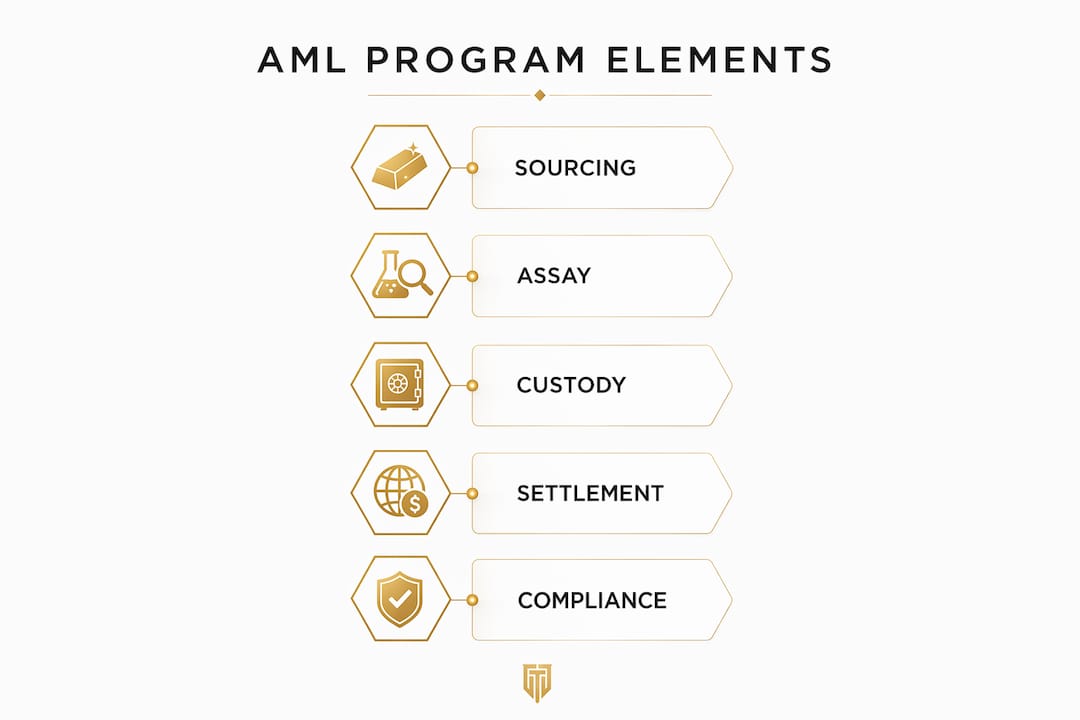
A risk-based AML program for gold must be tailored to the specific counterparty profile, transaction size, and geographic corridor — not applied uniformly. Institutional-grade platforms combine compliance processes with continuous, behavior-based monitoring that catches anomalous trade patterns static rule sets miss.
Core program components to demand from any counterparty:
- Risk assessment: Documented evaluation of product types, customer base, distribution channels, and high-risk jurisdictions per 31 CFR Part 1027 requirements.
- CDD/KYC and beneficial ownership: Full identification of the counterparty’s ultimate beneficial owners, not just the legal entity.
- Enhanced due diligence (EDD): Applied to high-value consignments, politically exposed persons, and transactions involving high-risk jurisdictions.
- Source-of-goods verification: The most critical control for gold. Supplier provenance, refinery history, and chain-of-custody documentation must accompany every consignment.
- Transaction monitoring: Behavior-based systems that flag circular trade patterns, rapid inbound/outbound wires, and unusual volume spikes.
- SAR processes: A documented escalation playbook from initial flag to SAR filing.
- Recordkeeping and audit trail: Every transfer, assay, and vault movement recorded and retrievable.
The information flow that makes these controls work runs: sourcing → independent assay → custody receipt → settlement confirmation. A gap at any stage breaks the audit trail and undermines every downstream control.
How do operational controls protect the chain of custody?
An unbroken, auditable chain of custody from source to vault is what separates institutional-grade AML from a retail-facing compliance checklist. Every transfer, assay, and vault movement must be recorded and independently verifiable.
Operational controls to require:
- Independent assayer reports and hallmarking certificates from accredited labs for every consignment.
- Auditable custody receipts issued at each transfer point, with timestamps and counterparty signatures.
- Segregated (not pooled) storage in insured vaults, with regular third-party audits confirming holdings.
- Insured transport contracts with verified carriers and tamper-evident packaging on every shipment.
- SOC-type audit reports from vault operators confirming access controls and inventory reconciliation.
- Affirmative insurance certificates covering transit and storage, naming the investor as an additional insured where possible.
During onboarding, request a sample custody receipt and the vault operator’s most recent audit report. On periodic review, reconcile custody receipts against the vault operator’s independent confirmation. Any discrepancy between the two is an immediate escalation trigger.
Pro Tip: Supply-chain transparency practices — including documented supplier onboarding and third-party assay at each stage — are the operational equivalent of a continuous audit. Platforms that cannot produce these records on request are not operating at institutional grade.
What typologies and red flags should you monitor in gold trading?
The primary laundering typologies in the gold market are circular trade, trade-based money laundering via false invoicing, shell-company layering, and rapid remelting to obscure origin. ACFCS research confirms that refineries are a particularly high-risk node because transforming scrap or mixed metal into refined product can give illicit gold a clean commercial identity.
Red flags for onboarding and ongoing monitoring:
- Invoices that are inconsistent with market pricing or contain vague descriptions of metal origin.
- Rapid same-day inbound and outbound wire transfers with no clear commercial rationale.
- Counterparties using newly formed companies with no trading history or audited financials.
- High cash payment requests or unusual payment routing through unrelated third parties.
- Multiple quick returns or exchanges of physical metal without documented commercial purpose.
- Unexplained routing through high-risk jurisdictions or corridors flagged by FINTRAC operational briefs.
- Reluctance to provide source-of-goods documentation or beneficial ownership records.
When a red flag appears, the response should follow a defined escalation path: request additional provenance documentation, apply EDD, and if the concern is not resolved, file a SAR and consider suspending the relationship. Add persistent patterns to your internal watchlist and include them in counterparty scorecard reviews.
What documents should you request when vetting a gold trading counterparty?
Verify provenance, custody integrity, compliance program strength, and operational attestations before committing capital. The gold trading standards institutional investors should apply are specific and document-driven.
| Dimension | Institutional-grade response | Minimal/retail response |
|---|---|---|
| AML program | Written program, named officer, independent audit | Verbal assurance, no documentation |
| Beneficial ownership | Full UBO disclosure with supporting ID | Entity name only |
| Source of goods | Refinery certificates, provenance chain | Invoice only |
| Custody | Segregated vault, SOC audit, insurance cert | Pooled storage, no audit |
| Sanctions screening | Documented OFAC process, screening logs | No documented process |
| SAR escalation | Written playbook with escalation triggers | No formal process |
If documentation is incomplete, do not simply decline the relationship. Consider conditional allocation with escrow settlement until documentation is provided, additional contractual indemnities for undisclosed provenance issues, and a defined cure period with termination rights if documentation is not produced.
What contractual protections should institutional investors demand?
Contractual and custody protections convert operational AML assurances into legally enforceable investor rights. Operational promises without contract teeth are not protections.
Key clauses to negotiate:
- Audit and inspection rights: The right to commission an independent assay or custody audit at any time, at reasonable notice.
- Provenance representations and warranties: Seller warrants that metal originates from a documented, sanctions-clean supply chain.
- Indemnities for undisclosed source-of-goods issues: Full indemnity if metal is later found to have a tainted provenance not disclosed at closing.
- Escrow settlement triggers: Funds held in escrow pending independent custody confirmation and provenance sign-off.
- Termination and buyback mechanics: Defined exit rights if the counterparty’s AML program is suspended or regulatory action is taken.
- Insured transport obligations: Counterparty contractually required to maintain and evidence transit insurance.
At the portfolio level, set concentration limits by counterparty, include AML incident history as an ongoing KPI in counterparty scorecards, and build exit planning into every allocation from day one. Coordinate all clause drafting with qualified legal counsel.
Pro Tip: Request a sample escrow instruction and a copy of the counterparty’s standard provenance warranty before term sheet stage. How quickly and completely they respond tells you more about their compliance culture than any questionnaire.
How long does AML onboarding typically take, and what drives the cost?
Onboarding timing ranges from a few days for document-complete, trusted counterparties to several weeks for complex provenance verification or multi-jurisdictional checks. The drivers are predictable once you know what to look for.
Main cost and timeline drivers:
- Scope and depth of provenance checks (number of supply chain nodes, refinery history).
- Use of third-party assayers and independent auditors (fees plus scheduling lead times).
- Cross-border transport logistics and customs documentation.
- EDD requirements for high-risk jurisdictions or politically exposed counterparties.
- Sanctions screening complexity across multiple registries (OFAC, UN, EU).
- Legal review of contract clauses, especially indemnities and escrow mechanics.
A typical institutional onboarding cadence runs: (1) document collection and AML program review, (2) provenance verification and assay confirmation, (3) custody arrangement confirmation and vault audit review, (4) contractual close including escrow setup, (5) sanctions screening sign-off, (6) settlement readiness confirmation.
Budget for third-party assay fees, independent audit costs, insurance premiums, and legal review. The return-on-risk rationale is straightforward: the cost of proper onboarding is a fraction of the potential loss from a tainted allocation that cannot be exited cleanly.
How do you integrate AML into portfolio risk management?
Treat AML as a continuous risk factor in counterparty scoring, allocation limits, and exit planning — not a one-time onboarding gate. Institutional gold investing best practices consistently show that portfolios with active AML governance outperform on exit liquidity and reputational resilience.
Integration steps:
- Embed AML compliance metrics (program currency, audit status, SAR history) in counterparty scorecards reviewed monthly.
- Include provenance KPIs (percentage of holdings with current chain-of-custody documentation) in portfolio reporting.
- Set documentation refresh cycles: require updated assay reports and custody confirmations at defined intervals.
- Report AML incidents and near-misses as part of risk-adjusted return analysis.
- Assign a named AML owner on the portfolio team with defined escalation authority.
One practical example: if a counterparty’s refinery certification lapses or their independent audit is overdue, that triggers a hold on new allocations until documentation is refreshed. That is not a compliance reaction — it is a liquidity management decision, because metal with a broken provenance chain is harder to sell at full value.
Key Takeaways
AML in physical gold trading is a portfolio discipline, not a compliance formality: investors who embed provenance verification, custody controls, and counterparty AML scoring into their allocation process protect both capital and exit liquidity.
| Point | Details |
|---|---|
| Verify chain of custody first | Demand independent assay reports, custody receipts, and vault audit confirmation before allocating capital. |
| U.S. regulatory anchor is BSA/FinCEN | Counterparties must have a written AML program under 31 CFR Part 1027, a named officer, and documented OFAC screening. |
| Source-of-goods beats basic KYC | Provenance documentation and refinery history are more critical than entity identification alone for high-value gold transactions. |
| Contractual protections are non-negotiable | Audit rights, provenance warranties, escrow triggers, and indemnities convert operational assurances into enforceable rights. |
| Galamigold operates at institutional grade | Galamigold provides audited supply-chain verification, third-party assay, segregated custody, and a named AML contact for institutional diligence requests. |
AML as a competitive capability, not a compliance cost
The conventional view treats AML as a cost center — something you do because regulators require it. That framing misses the point entirely for institutional gold investors.
Platforms that invest in genuine AML infrastructure are, in practice, offering a different product. When a counterparty can produce an unbroken chain-of-custody record, a current independent assay, and a clean OFAC screening log, they are offering metal that is liquid, defensible, and exit-ready. A counterparty that cannot produce those records is offering metal with embedded risk that will surface at the worst possible moment: when you need to sell.
Galamigold’s approach treats AML as a supply-chain discipline. Every consignment moves through documented sourcing, independent third-party assay, and audited transfer records. A named AML compliance officer oversees the program, and independent audit results are available to institutional counterparties on request. That structure is not just regulatory compliance — it is the operational foundation that makes Galamigold’s gold allocatable to institutional portfolios with genuine governance standards.
Investors who want to explore Galamigold’s audited documentation or discuss institutional diligence requirements are welcome to reach out directly.
Galamigold’s institutional offering for compliance-focused investors
Institutional investors who need a physical gold trading partner with documented AML controls and audited custody do not have to build that infrastructure themselves.

Galamigold provides institutional-grade execution backed by the compliance documentation your governance team requires:
- Audited supply-chain verification with documented sourcing and refinery provenance.
- Third-party assay reports and hallmarking certificates for every consignment.
- Segregated, insured vaulting with independent custody audits.
- Documented OFAC and sanctions screening process with screening logs available on request.
- Named AML compliance officer accessible for institutional diligence inquiries.
- SOC-type audit reports and independent testing available to qualified counterparties.
The next step is straightforward: request Galamigold’s institutional documentation package or schedule a platform walkthrough with the compliance team. Visit Galamigold’s institutional trading platform to initiate an inquiry, or review the risk disclosure and program details before your first conversation.
This article is general information, not legal or compliance advice. Confirm current regulatory requirements with qualified legal counsel and the relevant primary sources for your specific situation.
Authoritative sources and primary references to consult
Compliance teams drafting counterparty questionnaires or internal memos should consult these primary references directly:
- 31 CFR Part 1027 — Rules for dealers in precious metals, precious stones, or jewels (U.S. minimum AML program requirements, recordkeeping, and reporting thresholds for dealers).
- FinCEN FAQs for dealers in precious metals, precious stones, and jewels (dealer definition, thresholds, and four minimum program elements).
- FATF guidance on the risk-based approach for dealers in precious metals and stones (international standard for risk-based AML program design).
- FATF-APG report: Money laundering and terrorist financing risks in gold (case studies and red flag indicators for the gold market).
- LBMA: Melt, Move, Repeat — Applying AML Frameworks in the Precious Metals Market (supply-chain AML expectations and provenance controls for institutional bullion).
- FINTRAC Operational Brief: Risks and indicators for dealers in precious metals and stones (red flag indicators and ML risk factors for precious metals dealers).
- ACFCS: How launderers exploit retail jewelry, bullion trading, and refineries (typologies, refinery vulnerabilities, and enforcement context).
Recommended
- Gold Market News & Analysis | Galami Gold Blog
- Top institutional gold trading benefits for portfolio growth
- Bullion Explained: A Practical Guide for U.S. Investors
- Step by Step Gold Transaction Process: 2026 Guide
Ready to invest in physical gold trade finance?
Both the Zambia–Dubai and Sierra Leone–Dubai programs are open to qualified investors. Minimum investments from $115,000 USD or €125,000 EUR.
Zambia–Dubai Program Sierra Leone–Dubai Program