
TL;DR:
- Selecting gold trading partners requires verifying operational legitimacy, supply chain transparency, and compliance before investment.
- A tiered, documentation-driven approach ensures efficient onboarding, aligned with LBMA 2026 standards and ongoing AML screening.
Selecting gold trading partners is defined as the process of verifying a counterparty’s operational legitimacy, supply chain transparency, and regulatory compliance before committing institutional capital. For wealth managers and institutional investors, this process now centers on three non-negotiable pillars: LBMA 2026 disclosure requirements, anti-money laundering controls, and risk-tiered onboarding. Getting this right protects your portfolio from conflict gold exposure, regulatory penalties, and counterparty failure. Getting it wrong can mean holding assets with unverifiable provenance in an environment where regulators are tightening scrutiny fast.
How to select gold partners: prerequisites and documentation
The first step in choosing gold partners is confirming that a counterparty can prove who they are, where their gold comes from, and that they hold the legal authority to trade it. This sounds straightforward. In practice, documentation gaps are the most common reason institutional onboarding stalls or fails.
Before any engagement, you need the following verified:
- Legal entity verification: Certificate of incorporation, current registered address, and proof of active trading status
- Beneficial ownership (UBO): Full disclosure of ultimate beneficial owners, with supporting identity documents for any individual holding more than 25% ownership
- Authorized signatories: Confirmed list of individuals empowered to execute trades on behalf of the entity
- Operating permissions: Relevant licenses for precious metals trading in the partner’s jurisdiction
- Banking consistency: Confirmation that settlement accounts match the registered entity, not third-party accounts
Due diligence controls for gold partners must cover all five of these areas to manage counterparty risk effectively. Any weak signal in one area, such as a mismatch between the registered entity and the settlement bank, should trigger elevated risk treatment or a pause in the relationship.
The LBMA’s 2026 Disclosure Guidance adds a layer of supply chain documentation that goes beyond entity verification. Under these rules, refiners must publicly disclose intermediate refiners, local exporters operating in red-flag locations, and mine-of-origin details. This means your gold partner must be able to produce traceable, audited documentation aligned with OECD guidance for conflict-affected and high-risk areas (CAHRAs). If they cannot, that is a disqualifying gap.

For AML screening, use recognized sanctions databases before onboarding begins. The Open Supply Hub is one tool used to cross-reference supplier identities against known risk networks. AML compliance requires both enterprise-wide and transaction-level risk assessments, with mandatory screening against terrorist financing and sanctions lists prior to any trade execution.
Pro Tip: Request a sample of a partner’s existing supply chain documentation before formal onboarding. A partner who can produce batch-level provenance records quickly is demonstrating operational maturity, not just compliance theater.
| Document Type | Purpose |
|---|---|
| Certificate of Incorporation | Confirms legal entity existence and jurisdiction |
| UBO Declaration | Identifies controlling individuals behind the entity |
| Trading License | Verifies legal authority to trade precious metals |
| LBMA-aligned Origin Disclosure | Confirms mine-of-origin and refiner identity |
| AML Screening Certificate | Documents sanctions and PEP checks completed |
How does a tiered risk approach improve partner selection?
A tiered onboarding approach segments counterparties by risk level and role, which accelerates approvals for low-risk partners while concentrating expert review where it matters most. Applying a single universal checklist to every counterparty wastes compliance resources on routine relationships and simultaneously under-scrutinizes genuinely complex ones.
The four tiers used in professional precious metals onboarding are:
- Low risk: Established institutional counterparties in low-risk jurisdictions with long trading histories. Require standard entity verification and AML screening only.
- Standard risk: Mid-market traders or newer entities in stable jurisdictions. Require full documentation, UBO disclosure, and supply chain summary.
- Enhanced risk: Entities in CAHRAs, high-volume traders, or those with complex ownership structures. Require independent audit reports, full origin traceability, and senior compliance sign-off.
- Restricted: Counterparties flagged for sanctions exposure, opaque ownership, or unverifiable supply chains. Require a formal hold pending resolution or disqualification.
Tier assignment is driven by four criteria: entity type, jurisdiction risk, trade size, and specific risk indicators such as third-party settlement requests or inconsistent documentation. A refiner operating in a CAHRA jurisdiction automatically moves to enhanced tier regardless of trade size. A well-documented institutional buyer in Switzerland moves to low or standard tier unless other flags exist.
“Counterparty onboarding programs succeed when controls are role-specific and risk-tiered, avoiding delays and missing critical risk failures.” — Counterparty Onboarding for Precious-Metals Trading
The practical benefit of this structure is speed without sacrifice. Low-risk partners can be onboarded in days. Enhanced-risk partners receive the scrutiny their profile demands. Compliance teams avoid the fatigue that comes from treating a sovereign wealth fund the same as an unknown refiner in a conflict-affected region.
Pro Tip: Build your tier assignment criteria into a scoring matrix before you start evaluating partners. Jurisdiction risk, entity type, and trade size should each carry weighted scores. This removes subjectivity from the process and creates an auditable decision trail.
What steps should you follow to evaluate a gold partner’s compliance?
Evaluating a gold trading partner’s compliance is a structured process, not a document collection exercise. The goal is to confirm that the partner’s operational reality matches their paperwork.
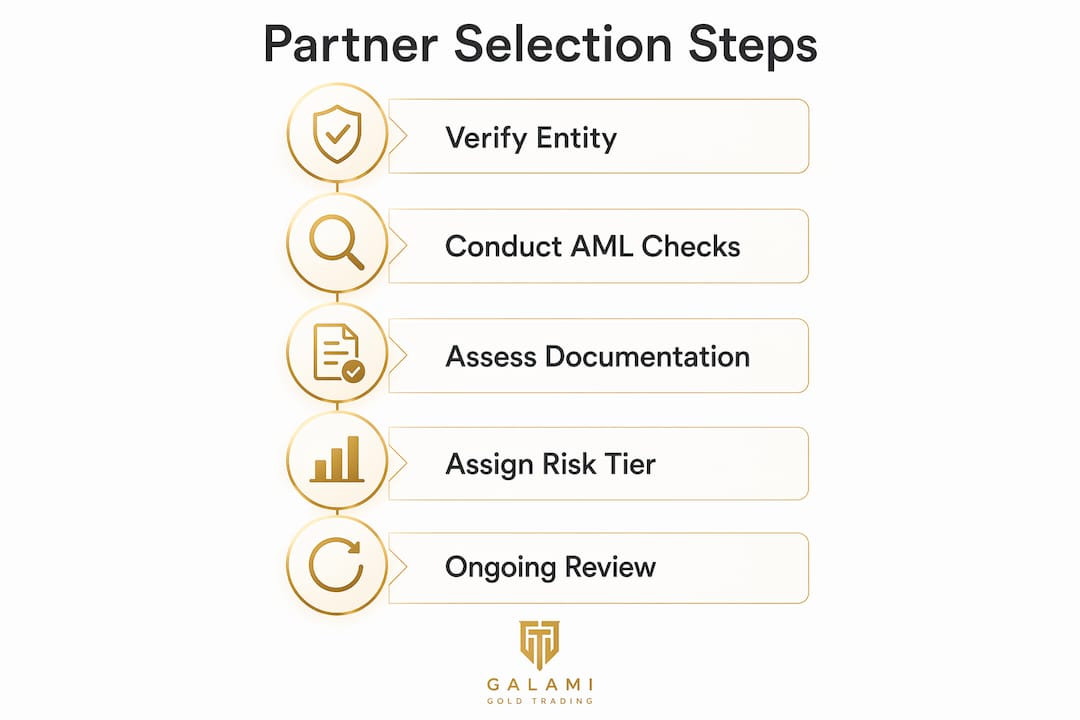
Follow this sequence:
- Collect and verify core documentation covering entity registration, UBO, authorized signatories, and trading licenses.
- Run AML and sanctions screening against current databases before any further engagement. Do not proceed if a match is found without senior compliance review.
- Request supply chain disclosure aligned with LBMA 2026 standards, including refiner identity, exporter details in red-flag locations, and mine-of-origin records.
- Assess documentation quality. Batch-level traceability is the standard that matters. A PDF summary of provenance is not sufficient. Auditable records at the shipment or batch level provide the assurance that regulators and institutional boards require.
- Conduct operational due diligence. Verify that the partner’s physical infrastructure, storage facilities, and logistics networks are consistent with their stated trading volumes.
- Obtain or review independent audit reports. Third-party certifications from recognized auditors carry more weight than self-reported compliance statements.
Red flags to watch for during this process include:
- Supply chain documentation that references only the last processor, obscuring origin
- Settlement instructions routed through third-party or offshore accounts
- Refusal to provide batch-level records or auditor contact details
- Jurisdictional mismatches between the registered entity and the operating location
- Unusually high trading volumes relative to the entity’s documented infrastructure
The Switzerland-UAE corridor deserves specific attention. Swiss imports from UAE surged in 2025, exposing a regulatory loophole where last-processor rules allow origin obfuscation. A partner routing gold through this corridor without full upstream documentation warrants enhanced scrutiny regardless of their LBMA status.
| Evaluation Method | What It Confirms | Limitation |
|---|---|---|
| Document review | Entity identity, legal authority | Only as reliable as the documents themselves |
| AML screening | Sanctions and PEP exposure | Requires current database access |
| Batch-level audit trail | Supply chain provenance | Requires partner cooperation and system access |
| Independent audit report | Operational compliance | Dependent on auditor quality and scope |
How to avoid common mistakes when selecting gold partners
The most costly mistake institutional investors make when finding gold partners is treating LBMA Good Delivery List status as a proxy for responsible sourcing. GDL certification alone does not guarantee conflict-free origin. Failures in refinery compliance and regulatory gaps mean that enhanced scrutiny beyond GDL status is required to manage conflict gold risks.
Three other mistakes appear consistently across institutional onboarding programs:
Accepting narrative disclosures instead of auditable records. A partner who describes their supply chain in general terms without producing traceable documentation is presenting a story, not evidence. Supply chain transparency reforms require auditable evidence, not just narratives, to ensure trustworthy gold sourcing. Require batch-level records as a condition of onboarding.
Skipping ongoing monitoring after initial approval. Partner risk profiles change. A counterparty that passed screening in 2024 may have changed ownership, expanded into higher-risk jurisdictions, or acquired a new refinery supplier with unverified origins. Build annual reassessment into your partner management program.
Underestimating CAHRA exposure in certified supply chains. Conflict-affected and high-risk areas generate gold that enters certified supply chains through transit jurisdictions. A partner with no direct CAHRA operations can still carry CAHRA exposure through their upstream suppliers. Verify the full chain, not just the immediate counterparty.
- Require country-of-origin documentation for every shipment, not just at onboarding
- Verify that declared volumes are consistent with the partner’s documented production or trading capacity
- Cross-reference refiner identities against KYC and AML policy frameworks that cover precious metals specifically
- Flag any change in settlement account details for immediate review
Pro Tip: Set a calendar trigger for annual partner reassessment tied to your fiscal year. Include a check on any regulatory changes in the partner’s jurisdiction since the last review. Regulatory environments in key gold-trading hubs shift faster than most compliance calendars account for.
Key takeaways
Selecting reliable gold trading partners requires a tiered, documentation-driven process that combines LBMA 2026 compliance, AML screening, and batch-level supply chain verification from the first point of contact.
| Point | Details |
|---|---|
| Documentation is the baseline | Verify entity identity, UBO, trading licenses, and banking consistency before any engagement. |
| Tiered onboarding saves time and reduces risk | Assign counterparties to low, standard, enhanced, or restricted tiers based on jurisdiction, entity type, and trade size. |
| GDL status is not enough | Demand country-of-origin documentation and batch-level audit trails beyond LBMA Good Delivery List certification. |
| AML screening must be ongoing | Screen partners at onboarding and monitor transactions continuously, with annual reassessment of risk profiles. |
| Auditable records beat narrative disclosures | Batch-level traceability systems provide the assurance that regulators and institutional boards require. |
What institutional experience teaches about gold partner selection
The part of gold partner selection that most guides skip is the gap between what a partner presents and what their operations actually support. I have seen counterparties with flawless documentation packages and supply chains that could not withstand a single batch-level audit request. The paperwork was real. The traceability was not.
The tiered onboarding model works precisely because it forces you to match scrutiny to actual risk rather than to the quality of a partner’s presentation. A well-prepared pitch deck from a refiner in a high-risk corridor should raise your alert level, not lower it. Sophisticated presentation is not a risk signal in either direction. Auditable records are.
The 2026 LBMA disclosure requirements are a genuine shift in what the market will accept. Partners who cannot meet these standards will face growing pressure from institutional clients, regulators, and downstream buyers simultaneously. The investors who build their counterparty risk programs around these standards now will be ahead of the compliance curve when enforcement tightens.
My practical advice: prioritize partners who volunteer documentation before you ask for it. That behavior signals an organization that has built transparency into its operations, not one that produces compliance documents on demand. The difference matters when markets move fast and you need to act on a counterparty’s reliability without time for a full review cycle.
— Galami
How Galamigold supports compliant gold trading partnerships
Galamigold operates with the exact framework this guide describes: audited physical gold supply, strict counterparty screening, and full alignment with 2026 LBMA disclosure standards. Every partner relationship Galamigold maintains is built on verified documentation, batch-level supply chain records, and ongoing AML monitoring.

For institutional investors and wealth managers who want a gold trading partner that meets the criteria outlined here, Galamigold provides the transparency and operational discipline your portfolio requires. The physical gold trading program covers disciplined execution, audited sourcing, and risk-managed capital deployment across established supply chains. Contact Galamigold to discuss how a compliant partnership structure can support your 2026 investment objectives and satisfy your board’s due diligence requirements.
FAQ
What is the first step in selecting a gold trading partner?
The first step is legal entity verification, which confirms that the counterparty exists as a registered business with the authority to trade precious metals. This must be completed before any AML screening or supply chain review begins.
Does LBMA good delivery status guarantee responsible sourcing?
No. LBMA Good Delivery List certification does not guarantee conflict-free origin. Institutional investors must demand country-of-origin documentation and verify trading volumes independently to manage conflict gold risks.
What does the LBMA 2026 disclosure guidance require from gold partners?
The LBMA 2026 Disclosure Guidance requires refiners to publicly disclose intermediate refiners, local exporters in red-flag locations, and mine-of-origin details. Partners who cannot produce this documentation fail the transparency standard.
How often should gold partners be reassessed after onboarding?
Gold partners should be reassessed at least annually, with immediate review triggered by any change in ownership, settlement accounts, or operating jurisdiction. Risk profiles change, and a one-time approval does not constitute ongoing due diligence.
What is the biggest red flag when evaluating a gold partner’s supply chain?
The biggest red flag is documentation that references only the last processor in the supply chain, which obscures upstream origin. Batch-level traceability records are the standard; anything less warrants enhanced scrutiny or disqualification.
Recommended
- Step by Step Gold Transaction Process: 2026 Guide
- Gold Market News & Analysis | Galami Gold Blog
- Physical Gold Capital Management Guide for Institutions
- How to Ensure Transparency in Institutional Gold Trading
Ready to invest in physical gold trade finance?
Both the Zambia–Dubai and Sierra Leone–Dubai programs are open to qualified investors. Minimum investments from $115,000 USD or €125,000 EUR.
Zambia–Dubai Program Sierra Leone–Dubai Program