
TL;DR:
- Gold’s low correlation and safe-haven status make it valuable for portfolio diversification and crisis protection.
- Institutional gold allocation typically ranges from 2 to 20 percent, tailored to risk objectives.
- Effective risk management involves ongoing monitoring, appropriate instrument selection, and dynamic rebalancing.
Gold’s price swings in recent years have exposed how quickly unmanaged exposure can erode institutional capital. Central banks bought 863 tonnes in 2025 alone, and global investment demand hit a record 2,175 tonnes, signaling that sophisticated allocators are treating gold with renewed seriousness. Yet buying gold and managing gold risk are two very different disciplines. This guide walks institutional investors and corporate treasury teams through the complete framework: understanding gold’s true risk profile, calibrating allocation levels, selecting the right instruments, and maintaining the ongoing controls that separate disciplined programs from reactive ones.
Table of Contents
- Understanding gold’s risk profile in institutional portfolios
- Setting risk parameters and gold allocation levels
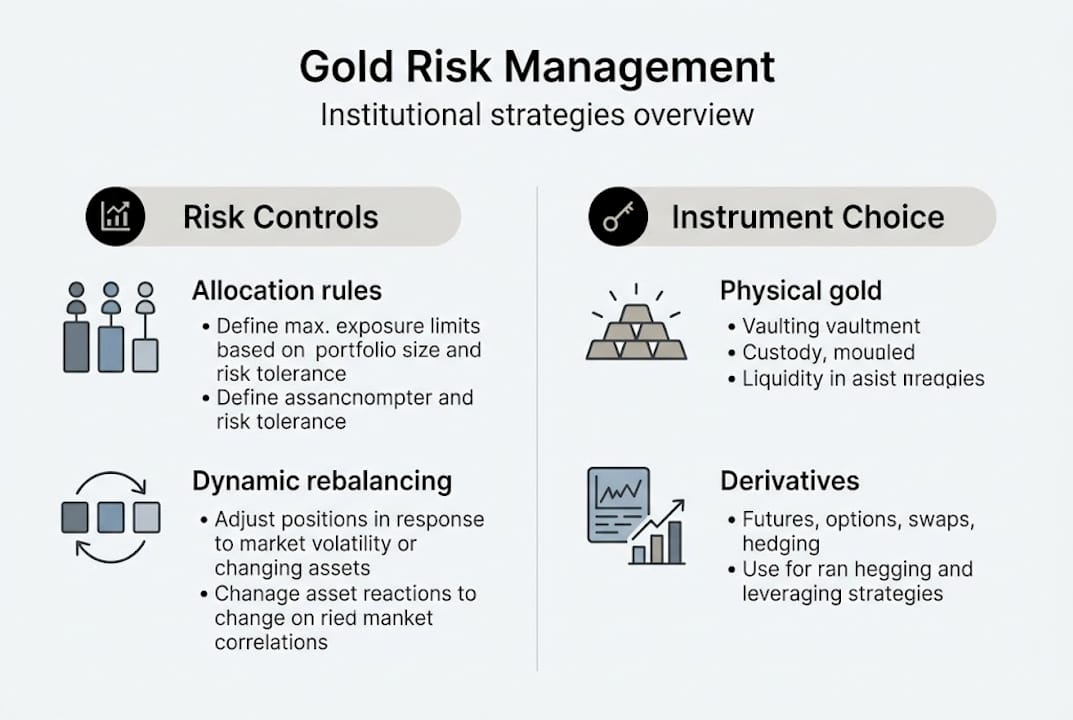
- Selecting instruments: Physical gold, ETFs, and derivatives
- Implementing and monitoring dynamic risk controls
- Our perspective: Rethinking gold’s role in institutional risk management
- Take your gold risk management further with Galami Gold
- Frequently asked questions
Key Takeaways
| Point | Details |
|---|---|
| Gold enhances portfolio stability | Gold’s low correlation with stocks and bonds helps smooth volatility in institutional portfolios. |
| Set allocations by risk profile | Effective institutions adjust gold exposure from 2% to 20%, matching risk tolerance and strategy needs. |
| Choose the right gold instruments | Physical, ETFs, and derivatives each have unique benefits and risks—select them based on liquidity and oversight requirements. |
| Rebalance dynamically | Risk parameters must be reviewed regularly and adjusted for market triggers to maintain optimal gold exposure. |
Understanding gold’s risk profile in institutional portfolios
Gold occupies a genuinely unusual position in modern portfolio theory. It generates no cash flow, carries no credit risk, and responds to a different set of macro drivers than equities or fixed income. That combination makes it both valuable and misunderstood in institutional settings.
Historically, gold’s annualized volatility sits around 15 to 18 percent, which is higher than investment-grade bonds but lower than most equity indices during crisis periods. The critical insight is correlation. Gold’s correlation with the S&P 500 hovers near zero over long periods and turns sharply negative during equity drawdowns. That asymmetry is exactly what portfolio construction needs.
Common institutional rationales for gold allocation include:
- Tail-risk protection during equity market dislocations
- Currency debasement hedge when central banks expand balance sheets aggressively
- Portfolio volatility reduction through low correlation to traditional assets
- Liquidity reserve in physical form for balance sheet resilience
- Geopolitical risk buffer during periods of sovereign stress
Here is how gold compares to other major asset classes on key risk and return dimensions:
| Asset class | Annualized volatility | Correlation to equities | Crisis behavior |
|---|---|---|---|
| Gold | 15 to 18% | Near zero to negative | Strong safe-haven demand |
| US equities | 18 to 22% | 1.0 (benchmark) | High drawdown risk |
| Investment-grade bonds | 5 to 8% | Negative to low | Moderate safe haven |
| Commodities (broad) | 20 to 25% | Moderate positive | Mixed, cyclical |
Research consistently shows that adding gold improves risk-adjusted returns and reduces overall portfolio volatility, specifically because of that low correlation to equities and bonds.
Important distinction: Gold functions as a reliable safe-haven asset during acute crises, but its behavior reverts after peaks. Research confirms gold is a reliable hedge and diversifier over full cycles, yet an unreliable short-term inflation hedge due to equity-like volatility in certain regimes.
The practical takeaway: do not build your gold thesis around inflation protection alone. Build it around correlation benefits and crisis optionality. That framing changes how you size positions and how you manage risk with gold across different market regimes.
Setting risk parameters and gold allocation levels
Knowing gold’s risk merits is one thing. Translating that into a defensible allocation policy that survives board scrutiny is another challenge entirely.

Empirical practice across institutional allocators suggests a tiered framework based on risk tolerance:
| Risk profile | Recommended gold allocation | Primary rationale |
|---|---|---|
| Conservative (pension, endowment) | 2 to 5% | Volatility reduction, modest diversification |
| Balanced (sovereign wealth, multi-asset) | 5 to 10% | Diversification plus tail-risk coverage |
| Aggressive / tail-risk focused | 10 to 20% | Active crisis hedging, macro positioning |
Research on gold allocation ranges confirms that a 2 to 20 percent range is appropriate depending on risk profile, with conservative mandates sitting at 2 to 5 percent and tail-risk-focused programs running up to 20 percent.
Here is a practical process for setting institutional allocation policy:
- Define your risk objective. Is gold serving as a volatility dampener, a crisis hedge, or a currency hedge? Each objective implies a different sizing logic.
- Run correlation analysis on your existing portfolio against gold over at least two full market cycles, including 2008, 2020, and 2022.
- Model the allocation impact on your portfolio’s Sharpe ratio, maximum drawdown, and Value at Risk at the 95th and 99th percentile.
- Set rebalancing triggers in advance. Define the specific conditions (CPI surprise above a threshold, equity drawdown exceeding 15 percent) that prompt reallocation.
- Document the policy formally and get investment committee sign-off before execution.
Key questions your investment committee should answer before approving a gold allocation:
- What is our primary risk objective for this allocation?
- What is the maximum acceptable tracking error versus our benchmark?
- Which instruments are permitted under our investment policy statement?
- What are our liquidity requirements over a 30, 90, and 365-day horizon?
- How will we measure whether the allocation is achieving its stated objective?
Pro Tip: Build dynamic rebalancing into your policy from day one. Static allocations set annually underperform policies that rebalance on macro triggers. Review your risk management strategies and link rebalancing rules to observable data points, not calendar dates. This approach also makes portfolio risk management far more defensible to stakeholders.
Selecting instruments: Physical gold, ETFs, and derivatives
With allocation targets defined, the implementation decision is where many institutions make costly errors. Each instrument carries a distinct risk and operational profile.
| Instrument | Liquidity | Counterparty risk | Tracking error | Best use case |
|---|---|---|---|---|
| Physical gold (allocated) | Low to moderate | Minimal | None | Long-term reserves, balance sheet |
| Gold ETFs (GLD, IAU) | Very high | Low (fund structure) | Very low | Tactical allocation, reporting ease |
| Gold futures | Very high | Exchange-cleared | Low | Short-term hedging, leverage |
| Gold options | High | Exchange-cleared | Variable | Tail-risk insurance, asymmetric payoff |
Institutions use physical and ETF instruments for core allocations and futures or options for tail protection, depending on mandate constraints and reporting requirements.
A structured selection process for institutional instrument due diligence:
- Review your investment policy statement for permitted instruments, custody requirements, and counterparty restrictions.
- Assess total cost of ownership including storage, management fees, bid-ask spreads, and rollover costs for futures.
- Evaluate custody arrangements for physical gold, including segregated versus pooled accounts and audit rights.
- Match instrument to time horizon. Physical gold suits multi-year strategic allocations. Futures suit tactical hedges with defined expiry.
- Stress-test liquidity at each instrument level under a scenario where you need to liquidate 50 percent of the position within 48 hours.
Pro Tip: Use options as tail-risk insurance rather than a primary exposure vehicle. A modest allocation to out-of-the-money gold call options can provide asymmetric upside during acute crises without the drag of carrying a large physical or futures position. Pair this with your broader gold trading strategies to optimize investment strategies across different volatility regimes.
Implementing and monitoring dynamic risk controls
You have set your allocation, chosen your instruments, and documented your policy. The real test is whether your controls hold up when markets move against you.
A disciplined monitoring process follows these steps:
- Establish baseline metrics. Record your starting allocation percentage, instrument mix, and portfolio-level risk statistics before going live.
- Set trigger thresholds. Define specific rebalancing triggers: CPI prints exceeding expectations by more than 50 basis points, equity index drawdowns beyond 10 percent, or gold allocation drifting more than 2 percentage points from target.
- Run monthly scenario analysis. Stress-test your gold position against a 2008-style credit crisis, a 2013-style gold selloff, and a 2020-style liquidity shock.
- Conduct independent stress testing quarterly. Use a risk team or external advisor separate from the portfolio manager to validate assumptions.
- Review allocation effectiveness semi-annually against your stated objective, not just against gold’s price performance.
Key controls and reporting practices every institution should maintain:
- Daily mark-to-market reporting for all gold positions
- Weekly correlation monitoring against the rest of the portfolio
- Monthly VaR attribution that isolates gold’s contribution to total portfolio risk
- Quarterly counterparty and custody audits for physical holdings
- Annual policy review with investment committee documentation
Research confirms that 5 to 10 percent allocations enhance Sharpe ratios during stress periods, but over-reliance is a real risk since gold is expected to generate zero real return over the very long term.
Warning: The most common institutional errors are over-allocation during peak sentiment, treating gold as a static hedge that never needs review, and ignoring mean reversion cycles after extended rallies. These mistakes compound each other. Review key tips for gold traders to build habits that prevent these patterns from taking root in your program.
Our perspective: Rethinking gold’s role in institutional risk management
After working through concrete allocation steps and instrument selection, the harder conversation is about what gold cannot do. Most institutions that struggle with gold do so because they built their thesis on a single narrative, usually inflation protection, and then held that assumption static through multiple market regimes.
Gold is a reliable hedge and diversifier over full cycles, but it is mean-reverting after peaks and genuinely unreliable as a short-term inflation hedge. That is not a flaw. It is simply the asset’s nature. The error is expecting it to behave otherwise.
The institutions that use gold most effectively treat it as a dynamic tool, not a permanent conviction. They revisit sizing when macro conditions shift. They acknowledge when gold has already priced in the risk they were trying to hedge. They build safer portfolio strategies by combining gold with other uncorrelated assets rather than relying on gold alone.
The uncomfortable truth is that discipline in gold risk management is rarer than the asset itself. Generic models applied without customization consistently underperform adaptive, evidence-based frameworks. Ongoing re-evaluation is not optional. It is the entire job.
Take your gold risk management further with Galami Gold
Translating a rigorous gold risk management framework into actual portfolio results requires more than a policy document. It requires a partner with operational depth in physical gold markets and a commitment to transparent execution.

Galami Gold works with institutional investors and corporate entities to structure gold allocations that align with specific risk mandates, reporting requirements, and capital deployment objectives. From reviewing your risk disclosure for gold investment to accessing physical gold trading solutions built for institutional scale, Galami brings the operational rigor your program demands. Explore invest in gold programs designed for sophisticated allocators who require both discipline and transparency at every stage of execution.
Frequently asked questions
What is the optimal gold allocation for institutional portfolios?
A 2 to 20 percent allocation is standard practice, with 5 to 10 percent delivering the strongest risk-adjusted return improvements for most institutional mandates.
Does gold reliably hedge against inflation for institutions?
Gold is a strong long-term diversifier and crisis hedge, but short-term inflation hedging is unreliable because gold can exhibit equity-like volatility that overwhelms any inflation premium.
Which instruments are best for institutional gold exposure?
Physical gold, ETFs, and futures and options each serve different purposes; the optimal choice depends on your liquidity needs, custody constraints, and whether you are seeking core exposure or tail-risk protection.
How often should risk parameters be reviewed in gold trading?
Continuous monitoring is essential, with formal rebalancing triggered by CPI surprises or drawdowns rather than fixed calendar schedules, ensuring your allocation stays aligned with actual market conditions.
Recommended
- Operational Risk in Gold Trading: What You Must Know
- Red Flags in Gold Trading: Investor Warning Guide
- Physical Gold Capital Management Guide for Institutions
- Gold hedging explained: strategies for institutional portfolio stability
Ready to invest in physical gold trade finance?
Both the Zambia–Dubai and Sierra Leone–Dubai programs are open to qualified investors. Minimum investments from $115,000 USD or €125,000 EUR.
Zambia–Dubai Program Sierra Leone–Dubai Program