
TL;DR:
- Gold is a distinct asset class with unique drivers, serving a more sophisticated role in portfolios than simple hedging. It includes various vehicles like physical gold, unallocated claims, ETFs, futures, and mining equities, each with separate risk profiles and valuation methods. Its value in diversified portfolios proves regime-dependent, requiring careful sizing, benchmark awareness, and understanding of market infrastructure for effective risk management.
Gold is not simply a hedge against inflation or a panic button for crisis periods. Treated as a distinct category of investable holdings with unique price drivers and risk/return characteristics, gold occupies a more sophisticated role in institutional portfolios than popular narratives suggest. For corporate treasury managers, family offices, and multi-asset allocators, understanding the structural mechanics of gold as an asset class, how it prices, how it behaves under stress, and what risks it carries across different investment vehicles, is the foundation for deploying it with discipline rather than instinct.
Table of Contents
- What defines gold as an asset class?
- Gold market infrastructure and benchmarking
- Gold in diversified portfolios: Empirical evidence and allocation frameworks
- Risks, volatility, and expert caution: Gold’s limits and practical sizing
- Gold asset class: Beyond the safe-haven cliché
- Explore institutional gold trading and capital preservation solutions
- Frequently asked questions
Key Takeaways
| Point | Details |
|---|---|
| Gold is a distinct asset class | Gold offers unique risk, return, and diversification characteristics apart from equities and bonds. |
| Market infrastructure supports gold | A large, liquid global market underpins gold’s role, with pricing benchmarks like LBMA Gold Price. |
| Diversification and risk benefits | Adding gold can enhance portfolio resilience but optimal sizing depends on market correlations. |
| Risks and volatility require caution | Gold’s volatility and mean-reversion tendencies mean careful allocation and instrument choice is critical. |
| Strategic role, not universal hedge | Gold complements other assets and can preserve capital, but is not a guaranteed safe-haven in every crisis. |
What defines gold as an asset class?
To classify gold properly, start with how allocation frameworks treat it. An asset class, in institutional terms, is a group of instruments with shared economic drivers, similar return characteristics, and distinct behavior relative to other groups. Gold fits this definition precisely. It is modeled alongside equities and bonds in portfolio construction, not as an afterthought, but as a core allocation input with its own correlation structure and volatility profile.
The universe of gold asset class examples available to institutional investors is broader than most assume:
- Physical bullion and coins: Direct ownership with full custody responsibility. Zero counterparty risk, but significant logistics and storage costs.
- Unallocated gold (OTC): The dominant institutional form. You hold a claim against a bank for a quantity of gold without owning specific bars. Highly liquid, but introduces credit/counterparty risk.
- Gold ETFs and ETPs: Exchange-traded exposure to gold prices, either physically backed or synthetic. Liquidity is high during normal markets, but redemption mechanics vary significantly.
- Gold futures and derivatives: Margin-based, leveraged instruments traded on exchanges like COMEX. Subject to roll costs, basis risk, and margin calls that can distort performance versus spot.
- Mining equities: Indirect exposure with amplified beta to gold prices, plus company-specific operational risk.
Each vehicle carries its own risk profile. An unallocated position at a bullion bank is fundamentally different from a physically backed ETF, which is fundamentally different from a leveraged futures position. Understanding which vehicle you hold matters as much as the gold exposure itself.
According to the World Gold Council, the total investible gold market spans bars, coins, ETFs, OTC instruments, and derivatives, with total market size estimated between US$1.5 trillion (derivatives open interest) and US$15 trillion (all investible segments combined). This scale places gold firmly in the same conversation as sovereign bond markets.
“Gold as an asset class” covers bullion, unallocated exposure, ETFs, and derivatives, with allocation frameworks built around diversification, liquidity, and crisis behavior. For investors navigating this space, understanding gold’s profile as a safe-haven asset class and its portfolio risk management function is the starting point.
Gold market infrastructure and benchmarking
With the definition established, understanding gold’s institutional infrastructure is crucial for risk-aware investors. You cannot model gold exposure rigorously without understanding how the market prices, settles, and references value.
The LBMA Gold Price is the global benchmark for unallocated gold delivered in London, supporting both spot and derivative transactions worldwide. Administered by ICE Benchmark Administration, it is determined twice daily through an electronic auction process involving major bullion banks. Every gold ETF net asset value, every OTC forward contract, and most physical supply agreements reference this benchmark directly or indirectly.
The broader market structure reflects this benchmark’s centrality:
| Segment | Instrument type | Estimated size | Key risk |
|---|---|---|---|
| Physical gold | Bars, coins, jewelry | ~US$5tn | Custody, liquidity |
| OTC unallocated | Forwards, spot | ~US$8tn+ | Counterparty/credit |
| Gold ETFs/ETPs | Exchange-traded | ~US$300bn+ | Tracking error, redemption |
| Derivatives | Futures, options | ~US$1.5tn open interest | Leverage, roll, basis |
| Mining equities | Listed companies | ~US$500bn+ | Operational, equity beta |
The total investible gold market is estimated at approximately US$15 trillion by the World Gold Council, making it one of the most liquid alternative asset classes globally. Daily OTC trading volumes often exceed US$100 billion, placing gold’s liquidity profile above many sovereign bond markets during stress periods.
Pro Tip: When modeling gold exposure in a portfolio, always identify which benchmark your instrument references. Instruments referencing the LBMA Gold Price directly carry less basis risk than those referencing regional benchmarks or futures settlement prices. Check gold price benchmark data carefully when reconciling valuations across instruments.
Understanding the market’s depth also matters for execution quality. For institutional allocators seeking gold trading standards, the difference between a disciplined OTC execution and a retail-grade product can translate into meaningful basis points at scale.
Gold in diversified portfolios: Empirical evidence and allocation frameworks
Now let’s explore how gold functions in dynamic, diversified portfolios alongside equities and bonds. The theoretical case for gold diversification is well known. The empirical evidence is more nuanced and more compelling.
Research from State Street Global Advisors confirms that gold delivers long-term returns, improves diversification, and provides liquidity in portfolios that hold both equities and bonds. What makes gold particularly valuable is not its average return, but its behavior precisely when other assets fail. During the 2008 financial crisis, gold gained roughly 5% while equities lost over 30%. During the March 2020 COVID shock, gold held stable while credit markets seized.
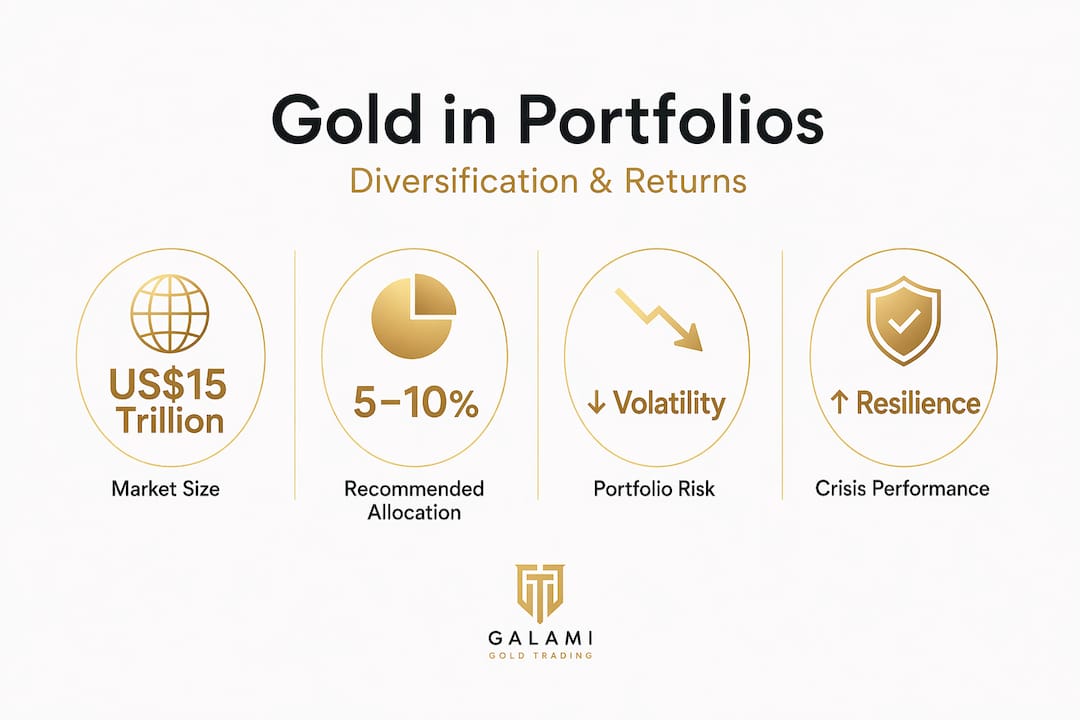
| Portfolio characteristic | Without gold | With 5-10% gold allocation |
|---|---|---|
| Annualized volatility (mixed portfolio) | Higher | Measurably lower |
| Maximum drawdown (stress period) | Deeper | Reduced |
| Liquidity during equity sell-offs | Constrained | Supported |
| Correlation to equities | Benchmark | Negative to near-zero |
| Long-run return profile | Equity-driven | Better risk-adjusted |
The optimal allocation for gold depends heavily on the prevailing correlation regime between bonds and equities. In periods when bonds and equities are positively correlated (both falling together, as in 2022), gold’s negative correlation to both becomes especially valuable. When bonds provide effective diversification against equities, gold’s optimal weight is lower. When that relationship breaks down, gold’s portfolio weight should rise.
Steps for determining gold allocation in a multi-asset portfolio:
- Map your current correlation structure. Run a rolling 12-month correlation between your equity and bond holdings. If the correlation is rising toward positive territory, gold’s diversification value increases.
- Define your risk budget. Gold’s volatility is meaningful (around 15-17% annualized historically), so your risk budget must accommodate this before sizing the position.
- Select the appropriate instrument. Match vehicle choice (physical, ETF, OTC) to your liquidity needs, custody capacity, and counterparty risk tolerance.
- Backtest against stress scenarios. Test the allocation against 2008, 2011, 2018, and 2022 specifically, since each represents a different macro regime.
- Set rebalancing triggers. Define explicit thresholds for rebalancing back to target weight, since gold can drift significantly during trend periods.
- Review instrument basis and costs. ETF expense ratios, OTC spread costs, and futures roll costs all erode returns over time. Model these explicitly.
For a practical look at portfolio diversification examples and structured approaches to securing portfolio diversification, institutional frameworks offer better guidance than rules of thumb. Most sophisticated allocators find that gold for portfolio stability works best when it is sized thoughtfully within a broader risk framework rather than treated as a standalone conviction.
Risks, volatility, and expert caution: Gold’s limits and practical sizing
This leads us to the crucial nuances around risk: gold’s limits and volatility must not be overlooked. The same properties that make gold attractive during stress periods also mean it can underperform significantly during risk-on environments when equities run hard.

Morningstar research has explicitly warned that gold can underperform, be volatile, and its forward performance is uncertain, particularly after periods of strong price appreciation. Buying gold at peak valuations introduces sequencing risk, where the asset mean-reverts sharply just as you need it to preserve capital.
Common risks by gold investment vehicle:
- Physical bullion: Storage and insurance costs erode net returns over time; liquidation in large size can be logistically complex.
- Unallocated OTC positions: Counterparty default risk is real, particularly during systemic banking stress (the exact scenario where you most want gold exposure to function).
- Gold ETFs: Tracking error, authorized participant mechanics, and suspension of redemptions in extreme stress are underappreciated risks. Not all ETFs are created equal.
- Futures and derivatives: Leverage amplifies both gains and losses; margin calls can force liquidation at the worst moments; roll costs during contango markets persistently erode returns.
- Mining equities: Operational risk, management quality, geopolitical exposure, and cost inflation all create divergence from gold spot prices, sometimes dramatically.
Gold’s monthly volatility can exceed that of US equities during certain regimes. Over the long run, annualized gold volatility sits around 15%, roughly comparable to large-cap equities. But the distribution of those returns differs: gold can sit flat for extended periods, then move sharply in short windows. That profile rewards disciplined entry points and punishes reactive allocation.
Pro Tip: Avoid allocating to gold as a percentage of portfolio value after a major price run. Instead, define your gold weight based on your risk budget and rebalance mechanically. Chasing gold after a 30% move is precisely the behavior that produces poor outcomes.
For a detailed breakdown of gold investment risks specific to institutional vehicles, mapping each risk type to the instrument before allocation is the only defensible approach.
Gold asset class: Beyond the safe-haven cliché
Here is where the conventional wisdom deserves real scrutiny. Gold’s reputation as a safe haven has become so embedded in popular finance narratives that many allocators treat it as a fixed, reliable hedge rather than a dynamic, regime-sensitive asset. That framing can lead to meaningful portfolio mistakes.
Research from the World Gold Council on gold’s safe-haven role is explicit: gold’s portfolio role is not synonymous with guaranteed protection. Its performance is regime-dependent, meaning it works well during certain types of stress and poorly during others. In a liquidity crisis where investors are forced to sell everything for cash, gold can fall alongside equities in the short term. In an inflationary stagflation scenario, it tends to outperform. In a deflationary shock, its behavior varies.
Gold is a complement to a well-structured portfolio, not an all-weather shield.
The practical implications for gold’s diversification benefits are significant. Rather than asking “should we hold gold?”, the more productive question is “under what macro regimes does our current gold instrument provide the exposure we need, and are those the regimes we are most concerned about?” That reframe shifts gold allocation from a conviction call to a structured risk management decision.
We also believe that instrument selection is systematically underweighted in most gold allocation discussions. The difference between holding an unallocated OTC position and a physically backed ETF is not trivial when the banking system is under stress. Those details matter at institutional scale.
Pro Tip: Re-evaluate gold’s role in your portfolio any time the bond-equity correlation shifts materially. That single variable has more influence on gold’s optimal weight than almost any other factor in a multi-asset framework.
Explore institutional gold trading and capital preservation solutions
For those looking to take the next step or deepen their institutional gold exposure, here is where to begin.
The insights covered in this article, from benchmarking and vehicle selection to correlation-aware sizing, reflect the kind of disciplined framework that Galami Gold brings to every client engagement.

Galami Gold provides institutional-grade access to physical gold supply and structured trading programs designed for sophisticated investors and corporate entities. Whether you are assessing the institutional gold trading benefits of direct market access, reviewing our gold risk disclosure documentation before committing capital, or exploring how physical gold supply integrates with your treasury or investment mandate, our platform is built around transparency, disciplined execution, and well-established supply chains. Reach out to explore how our trading program can support your capital preservation and risk management objectives.
Frequently asked questions
How does gold compare to other asset classes such as equities and bonds?
Gold offers unique risk-return and diversification properties, often improving portfolio resilience and liquidity. Research confirms that gold delivers long-term returns, improves diversification, and provides liquidity alongside stocks and bonds, particularly during stress events.
What benchmarks are used for gold asset class modeling and pricing?
The LBMA Gold Price is the global benchmark for unallocated gold delivered in London, used for pricing, valuation, and settlement across spot and derivative instruments. Most institutional gold instruments reference it directly.
What are the main risks associated with investing in gold?
Gold carries volatility, mean-reversion tendencies, and vehicle-specific risks including custody, credit, liquidity, and leverage. Gold can underperform significantly after price peaks, making entry point and instrument selection critical.
How large is the global investible gold market?
The total investible gold market is estimated at approximately US$15 trillion, spanning physical gold, OTC instruments, ETFs, and derivatives, placing it among the most liquid global asset markets.
Does gold always act as a safe-haven asset?
No. Gold’s safe-haven role is regime-dependent and not guaranteed across all crisis types. It functions as a complement during specific stress scenarios, particularly inflation and currency debasement, but can underperform during acute liquidity crises.
Recommended
- Top Gold Asset Examples for Portfolio Diversification | Galami Gold
- Gold hedging explained: strategies for institutional portfolio stability
- Why Gold Secures Portfolio Diversification | Galami Gold
Ready to invest in physical gold trade finance?
Both the Zambia–Dubai and Sierra Leone–Dubai programs are open to qualified investors. Minimum investments from $115,000 USD or €125,000 EUR.
Zambia–Dubai Program Sierra Leone–Dubai Program