
TL;DR:
- Gold is a proven safe haven that increases during crises due to its structural independence from credit risk and negative correlation with equities. Central banks are rapidly accumulating gold reserves, surpassing US Treasuries, signaling a shift in global reserve strategies. Investors should consider maintaining 2.5% to 10% allocation in gold as a long-term safeguard, integrated through physical holdings or regulated trading platforms.
Gold is widely misunderstood. Most investors treat it as either a panic trade or a relic, something you buy when everything else is on fire and sell when confidence returns. That framing is wrong, and the data makes it clear. During the 2007-2009 Global Financial Crisis, gold rose approximately 21% while equities, real estate, hedge funds, and commodities all declined. Understanding why gold is a safe haven asset, not just during crises but as a structural portfolio anchor, is one of the most consequential decisions a sophisticated investor can make in 2026.
Table of Contents
- Gold’s historic performance in times of crisis and market volatility
- Central banks and sovereign wealth funds: gold’s global reserve role
- The complex relationship between gold, inflation, and real yields
- Gold versus other precious metals: unique features as a safe haven
- Practical strategies to incorporate gold for portfolio safety and growth
- Rethinking gold’s role: a multi-generational anchor amid uncertainty
- Explore physical gold investment with Galami Gold
- Frequently asked questions
Gold’s historic performance in times of crisis and market volatility
Why gold is a safe haven comes down to how it actually behaves when portfolios are under pressure. The evidence is not ambiguous. Gold has risen in every major liquidity crisis since the 1970s, not because of sentiment but because of its structural separation from credit and counterparty risk.
The World Gold Council’s 2026 research confirms that gold rose 21% in the GFC while every major risk asset category fell, and that its correlation to equities turned sharply negative during the 2022 and 2025 drawdowns. That negative correlation is the key feature. Most diversifiers fail precisely when you need them most. Gold does the opposite.
Several structural reasons explain this pattern:
- Dual demand base. Gold is simultaneously an investment asset and a consumer product. Jewelry, technology, and central bank purchases all support price during periods when investment demand weakens, providing a floor that purely financial instruments lack.
- Deep market liquidity. The gold market trades roughly $150-200 billion daily across spot, futures, and OTC instruments. During equity panics, gold does not seize up the way credit or real estate markets do. Investors can exit at scale without material slippage.
- No counterparty risk. Physical gold carries no issuer, no credit rating, no covenant. It cannot default. That feature becomes invaluable in systemic stress when counterparty chains are the source of contagion.
- Crisis-driven negative correlation. As gold portfolio diversification research shows, gold’s correlation to equities in normal markets is near zero, but turns meaningfully negative during sharp sell-offs, precisely when correlation properties matter most.
“The most dangerous portfolio assumption an institutional investor can make is that your diversifiers will actually diversify under stress. Gold’s track record of delivering when it is needed most is more consistent than any other asset in this category.” — A perspective grounded in 15+ years of crisis-period portfolio analysis.
For a deeper look at how this plays out in practice, gold in portfolio risk management covers modern frameworks for sizing and timing gold positions to capture these benefits.
Central banks and sovereign wealth funds: gold’s global reserve role
When the largest and most sophisticated pools of capital on earth increase a specific allocation, that behavior is worth studying. Central banks are not sentiment traders. Their gold buying reflects long-horizon strategic calculations about reserve asset security, currency risk, and geopolitical fragmentation.

The numbers in 2026 are striking. Global central banks hold about 40,000 tons of gold, representing roughly 17% of all global foreign reserves, and they purchased 863 tons in 2025 alone. That purchasing pace reflects a deliberate, policy-driven shift, not a trend driven by retail momentum.
More telling than the tonnage is the valuation milestone. Global central bank gold reserves reached approximately $4 trillion in early April 2026, surpassing U.S. Treasury holdings for the first time in 30 years. That is not a footnote. It signals a structural reordering of reserve asset preferences at the sovereign level.
| Reserve asset | Approximate global holdings (2026) | Primary function |
|---|---|---|
| Gold | ~$4 trillion (40,000 tons) | Store of value, geopolitical hedge |
| U.S. Treasuries | ~$3.9 trillion | Liquidity, dollar exposure |
| Other FX reserves | Variable | Trade settlement, currency defense |
The drivers behind central bank buying are worth naming directly. Emerging market central banks, particularly across BRICS nations, are reducing dollar dependency as part of deliberate de-dollarization strategies. Gold is the only reserve asset that is simultaneously liquid, globally accepted, and carries zero political risk from a sanctioning adversary.
Pro Tip: When assessing gold market stability, track the World Gold Council’s quarterly central bank demand data. Sustained net buying above 700 tons annually has historically preceded multi-year bull markets in gold.
For those building institutional exposure, a gold investment strategy guide and a review of top gold asset examples provide a useful framework for structuring positions across physical, ETF, and futures products.
The complex relationship between gold, inflation, and real yields
Here is where most investors get confused, and where the confusion costs them money. Gold is often described as an inflation hedge, which is partially true but dangerously incomplete. The more precise and actionable relationship is between gold and real yields, which are nominal interest rates minus inflation.
When real yields fall below zero, the opportunity cost of holding gold (which pays no coupon) effectively disappears. Capital flows into gold not because inflation is high, but because the alternative of holding bonds offers a negative real return. Understanding this distinction changes how you time gold exposure.
The key framework for positioning:
- Monitor the 10-year TIPS yield. Gold prices move inversely to real yields, and when the 10-year TIPS yield falls below approximately 1.5%, conditions are broadly constructive for gold. Above 2%, headwinds build.
- Separate inflation type from inflation level. Demand-pull inflation often triggers rate hikes that temporarily strengthen the dollar and weigh on gold. Supply-driven shocks (energy crises, supply chain disruptions) can actually hurt gold short-term if they push the dollar up.
- Watch for geopolitical decoupling. From 2022 through 2026, central bank buying and geopolitical risk kept gold elevated even as real yields rose, a temporary decoupling from historical patterns. This does not invalidate the real yield framework; it shows when structural demand can override it.
- Understand dollar dynamics. As ING’s analysis from May 2026 shows, gold performs best in financial crises or growth shocks where real yields fall and the dollar weakens simultaneously, but supply-driven energy shocks that strengthen the dollar can weigh on gold short-term even during broad market stress.
Pro Tip: Do not use CPI data alone to time gold. Pull the real-time 10-year TIPS yield from the St. Louis Fed’s FRED database and track its trend rather than its level. Momentum in real yields matters as much as the absolute number.
Gold versus other precious metals: unique features as a safe haven
Is gold a secure asset in the same way silver or platinum might be? The short answer is no, and the distinction matters enormously for institutional portfolio construction.
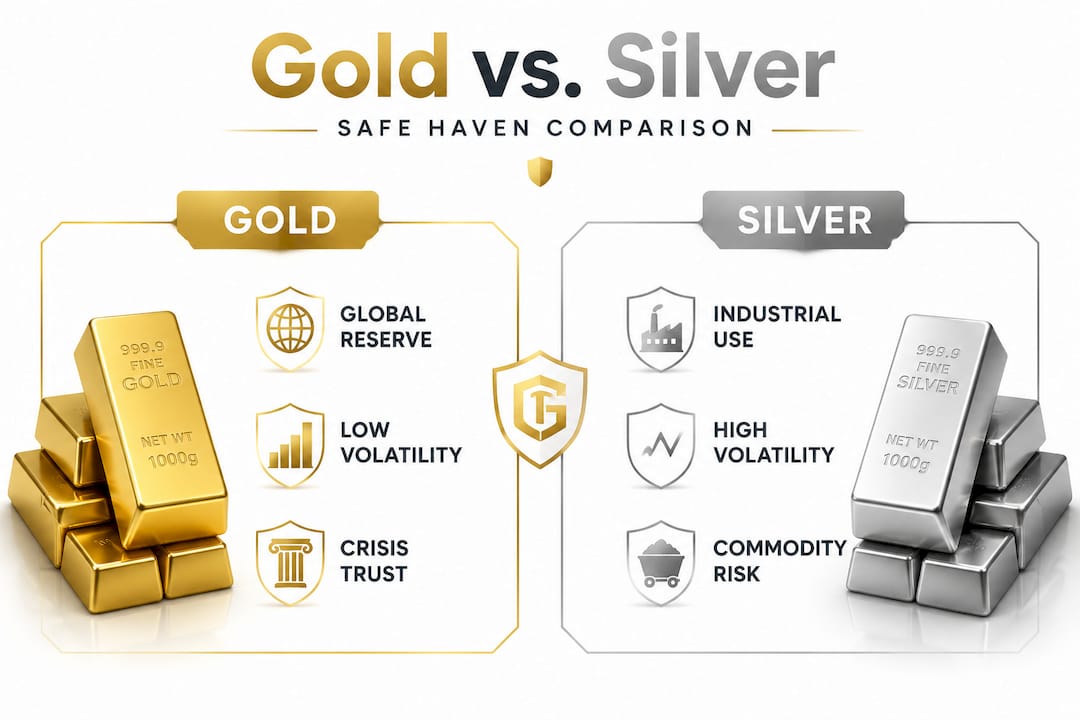
Silver is frequently positioned alongside gold as a precious metals hedge. In practice, silver behaves more like an industrial commodity with a monetary premium layered on top. Roughly half of global silver demand comes from industrial applications including solar panels, electronics, and medical devices. When industrial production slows in a recession, silver demand falls with it. Gold’s demand base does not have this vulnerability.
The World Gold Council’s direct comparison of gold and silver is unambiguous: gold provides steadier diversification during stress with materially lower volatility, while silver acts as a higher-beta complement that amplifies moves in both directions. For institutional investors focused on capital preservation and risk-adjusted returns, that distinction is decisive.
Key differences that matter in practice:
- Liquidity depth. Gold’s spot and futures markets are among the deepest in the world. Silver’s market is smaller and more susceptible to price gaps during periods of stress.
- Volatility profile. Silver historically exhibits two to three times the price volatility of gold on an annualized basis. That is not a hedge characteristic. That is speculation with a precious metals wrapper.
- Portfolio behavior under stress. During equity drawdowns, gold’s correlation to equities turns negative. Silver’s behavior is more variable, sometimes moving with risk assets rather than against them.
- Spread and custody costs. Physical silver requires significantly more storage space per dollar of value. For large institutional positions, custody and logistics costs are meaningfully higher.
Reviewing the advantages of gold trading in an institutional context clarifies how these structural differences translate into practical operational and return advantages.
Practical strategies to incorporate gold for portfolio safety and growth
Knowing that gold is a recession hedge is useful. Knowing exactly how much to own, in what form, and under what conditions is what separates a well-constructed position from a reactive trade.
On allocation sizing, the World Gold Council’s 2026 institutional research is specific: allocating 2.5% to 10% to gold in a traditional institutional portfolio increases risk-adjusted returns, reduces portfolio volatility, and lowers maximum drawdowns. Counterintuitively, the stabilizing effect is more pronounced in higher-risk portfolios, not just conservative ones.
Practical considerations for building and managing your position:
- Physical gold is the purest expression of the safe haven thesis, carrying zero counterparty risk. It requires secure custody and insurance but is the preferred vehicle for geopolitical and systemic hedging.
- Gold ETFs offer liquidity and operational simplicity but introduce custodian and counterparty layers. Appropriate for tactical or liquid sleeve allocations.
- Gold futures allow precise exposure management and hedging but require active management, margin monitoring, and rollover discipline.
- Entry timing. Use real yield trends as the primary timing signal. Geopolitical escalation events and central bank buying announcements are secondary signals worth tracking.
Pro Tip: Custody and counterparty risk are often overlooked until they matter. If you are allocating more than 5% of a portfolio to physical gold, segregated, audited vault storage with a non-bank custodian in a politically stable jurisdiction is worth the additional cost over standard allocated accounts at large banks.
For a full framework on building a position from first principles, investing in gold for diversification covers allocation sizing, product selection, and custody considerations in detail.
Rethinking gold’s role: a multi-generational anchor amid uncertainty
Most institutional commentary on gold frames it as a tactical hedge, something you tilt into when the macro environment looks threatening and reduce when confidence returns. We think that framing undersells gold’s actual role by a significant margin.
Ray Dalio’s 2026 assessment states it plainly: gold is the safest money with the best long-run track record of preserving purchasing power, with lower confiscation risk than other assets and no dependency on any third party for its value. That is not a crisis trade thesis. That is a structural portfolio allocation thesis.
The investors who have consistently generated and preserved multi-generational wealth share one trait: they maintain some gold exposure permanently, not as a bet on crisis but as insurance against the failure modes of every other asset class simultaneously. Currencies can be debased. Bonds can be restructured. Real estate can be confiscated or regulated into illiquidity. Equities can be wiped out by systemic failure. Gold has survived every one of those scenarios across centuries and across geopolitical systems.
There is also an emerging angle that most institutional frameworks have not yet absorbed. ESG-focused allocators increasingly recognize gold’s advantages over alternatives like Bitcoin, which carries enormous energy consumption costs, or commodities extraction plays with significant environmental liabilities. Gold’s carbon footprint per dollar of value stored is lower than most alternatives, and responsible sourcing standards have improved significantly. This is not the primary reason to own gold, but it removes a common objection for ESG-constrained mandates.
The deeper lesson is this: gold is not the thing you buy when you are scared. It is the portfolio safeguard you maintain so that you never need to be scared about a systemic breakdown rendering your other assets unreliable.
Explore physical gold investment with Galami Gold
Understanding gold’s safe haven mechanics is only half of the equation. The other half is execution: getting into the right product, at the right allocation, with the right custody structure behind it.

Galami Gold operates as a physical gold trading platform built specifically for institutional investors and high-net-worth individuals who want disciplined, transparent access to gold markets. Our program covers audited physical gold products, expert capital deployment across established supply chains, and market intelligence resources to help you build and manage gold positions with confidence. We are regulated and operational in Dubai, one of the world’s most active gold trading centers, and we maintain the counterparty standards and custody transparency that sophisticated capital requires. If you are ready to translate the case for gold into a concrete portfolio position, explore our gold trading program to learn how we can support your allocation goals.
Frequently asked questions
Why is gold considered a safe haven asset for institutional investors?
Gold holds value independently of any government or counterparty, maintains low to negative correlation with equities during crises, and trades in one of the world’s deepest markets, giving institutions the ability to size into and out of positions at scale. The World Gold Council confirms gold rose approximately 21% during the Global Financial Crisis while equities declined.
Does gold always increase in value during inflationary periods?
Gold does not automatically rise with inflation. Its performance depends primarily on real yields, and when real yields rise sharply in response to inflation, gold can face short-term headwinds even as CPI climbs.
How much gold should I allocate in a diversified institutional portfolio?
A 2.5% to 10% gold allocation is supported by World Gold Council research as the range that meaningfully improves risk-adjusted returns and reduces maximum drawdowns without sacrificing portfolio growth.
How does gold compare to silver as a safe haven asset?
Gold is the more reliable safe haven due to its deeper liquidity, lower volatility, and more balanced demand base. Silver’s higher industrial exposure makes it more cyclical and less consistent as a defensive allocation during market stress.
Recommended
- Why Gold Remains a Powerful Inflation Hedge in 2026
- Gold as an asset class: Risk, diversification, and strategy
- Why gold secures portfolio diversification and reduces risk
- Gold hedging explained: strategies for institutional portfolio stability
Ready to invest in physical gold trade finance?
Both the Zambia–Dubai and Sierra Leone–Dubai programs are open to qualified investors. Minimum investments from $115,000 USD or €125,000 EUR.
Zambia–Dubai Program Sierra Leone–Dubai Program