
TL;DR:
- Gold provides long-term inflation hedge but often shows weak short-term correlation with CPI.
- Its role is as a tail-risk asset, not a precise inflation index, protecting during crises.
- Optimal gold allocation is typically 5-10%, used to diversify against regime shifts and extreme shocks.
Gold is widely treated as the ultimate inflation hedge, but the reality is more complicated than the narrative suggests. In 2022, gold was essentially flat while the Consumer Price Index (CPI) hit 9.1%, leaving many institutional investors questioning their assumptions. That disconnect does not disqualify gold from a serious portfolio, but it does demand a more rigorous framework for understanding when and why gold works. This guide separates the evidence from the myth, examines both short-term and long-term performance, and shows how sophisticated allocators use gold as part of a broader inflation-protection strategy.
Table of Contents
- The historical relationship between gold and inflation
- Gold’s short-term versus long-term inflation performance
- Portfolio construction: Where gold fits in a modern inflation strategy
- Limits and risks: When gold doesn’t protect against inflation
- A contrarian view: The enduring, but imperfect, role of gold
- Explore institutional-strength gold solutions
- Frequently asked questions
Key Takeaways
| Point | Details |
|---|---|
| Gold’s long-run inflation edge | Over two centuries, gold has fully hedged inflation, preserving purchasing power. |
| Short-term mismatches happen | Gold can diverge from inflation trends over months or even years, including recent spikes. |
| Use gold for tail-risk protection | Gold’s strongest value is during regime change, currency shocks, or systemic crises. |
| Blend assets for robust hedging | Institutional portfolios pair gold with TIPS, stocks, and alternatives to smooth performance. |
The historical relationship between gold and inflation
Gold’s reputation as a store of value is not marketing. It is grounded in centuries of monetary history. Across regimes, wars, and currency collapses, gold has preserved purchasing power in ways that paper assets simply cannot replicate. That track record forms the foundation of every serious institutional allocation to the metal.
The empirical case is strong over long horizons. Research covering the period from 1791 to 2010 confirms that gold fully hedges CPI, including headline, expected, and core inflation, through a statistical relationship called cointegration. Cointegration means two variables move together over time even if they diverge in the short run. For gold and CPI, this relationship holds most reliably in the United States, and somewhat less so in the United Kingdom, where currency and monetary policy differences alter the dynamic.
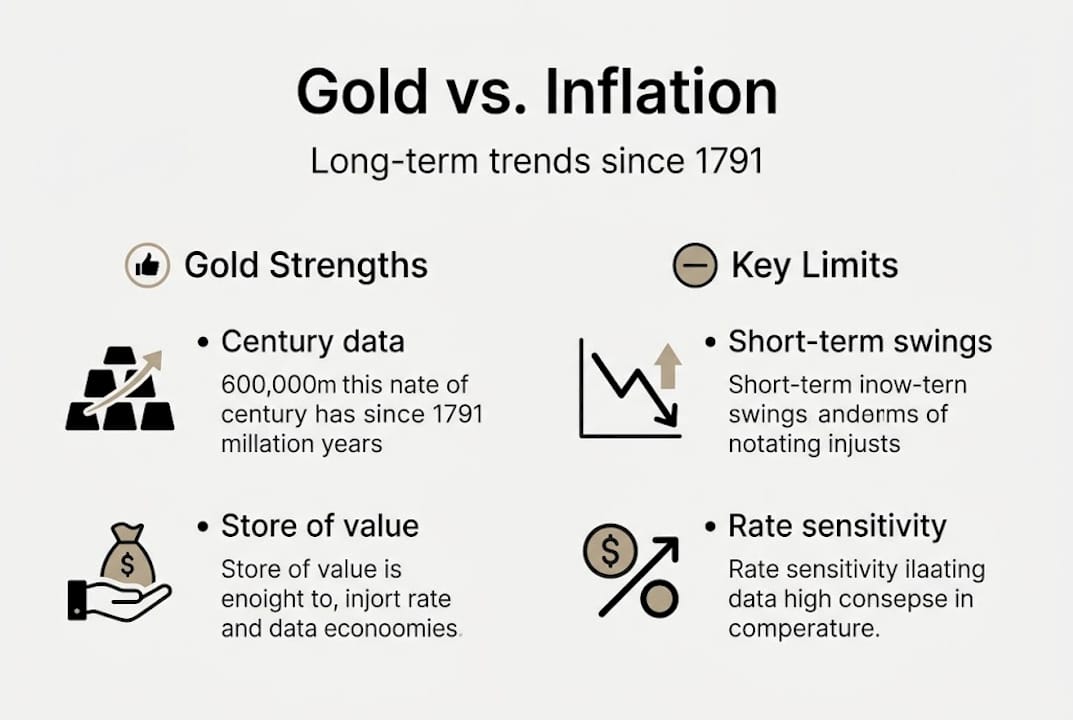
The table below illustrates how gold has performed across distinct inflationary eras:
| Era | Average CPI | Gold performance |
|---|---|---|
| 1970s stagflation | ~8% annually | Strong positive real returns |
| 1980s disinflation | Declining | Significant drawdown |
| 2000s commodity boom | ~3% annually | Outperformed inflation |
| 2022 post-pandemic spike | 9.1% | Essentially flat |
Several factors explain why the relationship is stronger in some periods than others:
- Currency regime: Under the Bretton Woods system, gold was fixed in price, which suppressed its inflation-tracking ability.
- Real interest rates: When real yields rise sharply, gold’s opportunity cost increases and prices often fall.
- Dollar strength: Gold is priced in US dollars, so a strong dollar can offset inflationary tailwinds.
- Market sentiment: Geopolitical risk and financial stress often drive gold independently of CPI.
“The cointegration evidence suggests gold is a hedge against inflation in the long run, particularly in the US, but investors should not expect a tight short-term correlation.”
For investors focused on gold portfolio diversification, understanding this distinction between long-run cointegration and short-run noise is the starting point for every allocation decision.
Gold’s short-term versus long-term inflation performance
The 2022 episode is instructive precisely because it was so surprising to so many investors. CPI hit its highest level in four decades. Gold, which many expected to surge, delivered returns that were essentially flat. Stocks also struggled, but Treasury Inflation-Protected Securities (TIPS), which are bonds indexed directly to CPI, delivered the precise inflation compensation they were designed to provide.

This is not an isolated anomaly. Gold’s short-term CPI correlation is weak and inconsistent. Over a 50-year horizon, equities have outperformed gold, though they falter badly during extreme inflationary spikes. TIPS offer more mechanical precision for CPI-linked objectives. Gold, by contrast, responds to a broader set of drivers.
Here is how the three main inflation-hedging instruments compare across time horizons:
| Asset | Short-term CPI correlation | Long-term protection | Tail-risk behavior |
|---|---|---|---|
| Gold | Weak | Strong (cointegrated) | Excellent |
| TIPS | Strong (direct link) | Moderate | Limited upside |
| Equities | Variable | Strong | Poor in severe inflation |
For institutional allocators, the practical implications follow a clear sequence:
- Define your objective. If you need precise, short-term CPI tracking, TIPS are the more appropriate instrument.
- Assess your time horizon. Gold’s hedging properties strengthen materially over multi-decade holding periods.
- Stress-test your assumptions. Gold outperforms in scenarios where inflation is unexpected, severe, or accompanied by currency instability.
- Avoid over-concentration. Relying solely on gold for inflation protection introduces volatility that most institutional mandates cannot absorb.
Pro Tip: Do not size your gold allocation based on near-term inflation forecasts. Size it based on the scenarios where your other assets are most likely to fail simultaneously. Gold earns its place as a safe-haven asset precisely in those tail scenarios, not in routine inflationary cycles.
Exploring gold asset examples across different portfolio structures can help clarify where physical gold fits relative to paper alternatives in your specific mandate.
Portfolio construction: Where gold fits in a modern inflation strategy
Sophisticated allocators do not use gold to track CPI. They use it to protect the portfolio when every other assumption breaks down. That is a fundamentally different objective, and it changes how you size, time, and rebalance the position.
The structural case for gold in 2026 is reinforced by central bank activity. Sustained central bank buying and ongoing fiscal uncertainty continue to support long-term gold allocations, with some analysts projecting prices above $5,000 per ounce over the medium term. Central banks do not buy gold for yield. They buy it for reserve diversification and as a hedge against dollar-denominated system risk.
For institutional and high-net-worth portfolios, gold serves several distinct roles:
- Tail-risk anchor: Gold tends to appreciate when equities and credit suffer simultaneously, providing genuine diversification when correlations among other assets spike.
- Currency debasement hedge: When fiscal deficits expand and monetary policy remains accommodative, gold preserves real purchasing power better than most financial assets.
- Geopolitical buffer: Gold responds to geopolitical stress independently of economic fundamentals, adding a layer of protection that quantitative models often miss.
- Liquidity in crisis: Physical gold markets remain liquid even when financial markets seize, a property that proved its value during the 2008 and 2020 crises.
A well-constructed inflation strategy blends gold with TIPS for near-term CPI precision, equities for long-run real growth, and real assets like infrastructure or commodities for additional diversification. Gold is the backbone in stressed scenarios, not the primary CPI-tracking instrument.
Pro Tip: Review your gold allocation in the context of your full portfolio risk management framework. A 5% to 10% allocation is common, but the right number depends on how much tail-risk exposure already exists elsewhere in the book.
Research consistently shows that even modest gold allocations reduce portfolio risk meaningfully, particularly during equity drawdowns and credit stress events.
Limits and risks: When gold doesn’t protect against inflation
No asset is a perfect hedge, and gold has well-documented failure modes that every serious investor should understand before committing capital.
The most significant challenge comes from rising real yields. When the Federal Reserve tightens monetary policy aggressively, real interest rates rise and gold’s opportunity cost increases sharply. Investors holding gold forgo the yield available in bonds and money markets, which creates selling pressure regardless of what CPI is doing. This is exactly what happened in 2022: the Fed’s rate hikes pushed real yields higher, and gold stalled even as inflation ran hot.
TIPS provide more precise CPI correlation than gold for investors with specific inflation-linked liability matching needs, and equities have outperformed gold over 50-year periods, except during severe inflation spikes. That evidence matters for portfolio design.
Here are the key scenarios where gold underperforms as an inflation hedge:
- Rising real interest rates: The Fed tightening cycle of 2022 to 2023 is the clearest recent example.
- Strong US dollar environments: Dollar appreciation suppresses gold prices in USD terms, even when local inflation is elevated.
- Moderate, expected inflation: When inflation is anticipated and priced into markets, gold offers little additional premium.
- Short holding periods: Investors with a 12 to 24 month horizon may find TIPS or inflation-linked equities more reliable.
“Diversification across inflation-hedging instruments is not a compromise. It is the only intellectually honest response to the uncertainty in any single asset’s correlation to CPI.”
Understanding why gold matters for institutional portfolios requires accepting these limits alongside the strengths. A strategy that acknowledges gold’s failure modes is more durable than one built on the assumption that gold always rises with prices. Pairing gold with other tools, as explored in research on how diversification cuts risk, produces more consistent inflation protection across varied economic regimes.
A contrarian view: The enduring, but imperfect, role of gold
The biggest mistake we see from institutional allocators is expecting gold to behave like a CPI index fund. It does not, and it was never designed to. Gold is a monetary asset with a 5,000-year track record of surviving regime changes, currency collapses, and sovereign defaults. That is a different value proposition than tracking a government price index.
The real alpha from gold comes from holding it through the periods when your other models stop working. Currency wobbles, unexpected inflation surges, geopolitical shocks, these are the environments where gold earns its allocation. Quantitative models that dismiss gold because its short-term CPI correlation is low are measuring the wrong thing entirely.
We believe the investment strategy guide that works is one that treats gold as a regime-shift asset, not a precision inflation instrument. Allocate to it for resilience, not for short-term gains, and you will find it consistently earns its place in a well-constructed portfolio.
Explore institutional-strength gold solutions
Putting these principles into practice requires access to physical gold markets and trading programs built for institutional scale. Understanding the theory is only half the work. The other half is execution.

At Galami Gold, we specialize in physical bullion trading and bespoke capital deployment programs designed for sophisticated investors and corporate entities. Whether you are seeking direct bullion exposure or a structured trading program, our Sierra Leone to Dubai Trading Program offers a transparent, disciplined pathway to gold allocation at institutional scale. Contact us to explore how our solutions align with your inflation-hedging objectives and portfolio construction goals.
Frequently asked questions
Does gold always protect against inflation?
Long-term data confirm that gold fully hedges inflation over multi-decade horizons, but its short-term performance can diverge significantly from CPI movements.
What happened to gold during recent high inflation years?
In 2022, gold’s return was flat despite CPI reaching 9.1%, demonstrating that short-term inflation spikes do not automatically translate into gold price gains.
Are there better assets for hedging inflation than gold?
TIPS offer more precise CPI correlation for short-term objectives, and equities outperform gold over long periods, except during severe inflationary episodes.
How much gold should a diversified portfolio include for inflation protection?
Most institutional strategies recommend a 5% to 10% gold allocation, though the optimal amount depends on your specific risk profile, liability structure, and the inflation scenarios you are most concerned about.
Recommended
- Gold trading risk management: strategies for institutions
- Why gold is a safe haven asset: the investor's guide
- Gold hedging explained: strategies for institutional portfolio stability
- Top benefits of physical gold for institutional investors
Ready to invest in physical gold trade finance?
Both the Zambia–Dubai and Sierra Leone–Dubai programs are open to qualified investors. Minimum investments from $115,000 USD or €125,000 EUR.
Zambia–Dubai Program Sierra Leone–Dubai Program