
TL;DR:
- Gold acts as a targeted hedge during crises but offers near-zero long-term returns.
- Its effectiveness depends on macro regimes, performing best with negative real yields and during drawdowns.
- Successful hedging requires active management, proper vehicle choice, and disciplined allocation adjustments.
Gold is widely treated as a reflexive safe haven, but empirical data tells a more complicated story. Institutions that allocate to gold without a clear strategic framework often discover that the metal behaves quite differently depending on market regime, rate environment, and portfolio construction. Research published by Quantpedia reveals that gold’s real long-run return hovers near 0%, which is exactly what you should expect from a true hedge asset, not a return engine. For institutional investors and wealth managers, separating gold’s genuine hedging utility from its mythologized reputation is not academic. It is a prerequisite for disciplined portfolio management in 2026.
Table of Contents
- Understanding gold hedging: Definition and financial rationale
- The empirical case for gold: When and how does it actually hedge?
- Strategic considerations: When gold hedging works—and when it doesn’t
- Implementing gold hedging: Approaches and institutional best practices
- Why the gold hedge requires more discipline—and less faith—than most believe
- Partner with experts for smarter gold hedging
- Frequently asked questions
Key Takeaways
| Point | Details |
|---|---|
| Gold’s unique hedge behavior | Gold provides a partial hedge in low-yield or crisis regimes but is not a catch-all solution for every market environment. |
| Empirical, not faith-based strategy | Successful institutional gold hedging relies on ongoing review of real-world data, not reputation or past performance alone. |
| Right tool, right context | The effectiveness of gold in portfolio risk management depends on market conditions, allocation discipline, and vehicle selection. |
| Avoid over-hedging mistakes | Overexposure to gold can limit portfolio upside and underperform in tightening or bull market regimes. |
Understanding gold hedging: Definition and financial rationale
With these misconceptions in mind, it is crucial to start with a clear, institution-focused definition of gold hedging. In institutional investing, gold hedging means deliberately allocating portfolio exposure to gold assets to offset anticipated losses in other holdings, particularly during equity drawdowns, credit stress, or inflationary regimes. This is fundamentally different from diversification, which spreads risk across uncorrelated assets to reduce overall volatility. Gold hedging is more intentional. It is a targeted risk management tool, not a passive portfolio filler.
It is also distinct from purchasing put options or holding long-duration bonds as protection. The theoretical case for gold rests on three pillars: low or negative correlation with equities, strong performance during financial crises, and a long-run real return near zero. That last point deserves emphasis. A real return near zero is not a failure; it is confirmation that gold behaves as a hedge rather than a growth asset. Investors who chase gold for returns are misusing the tool entirely.
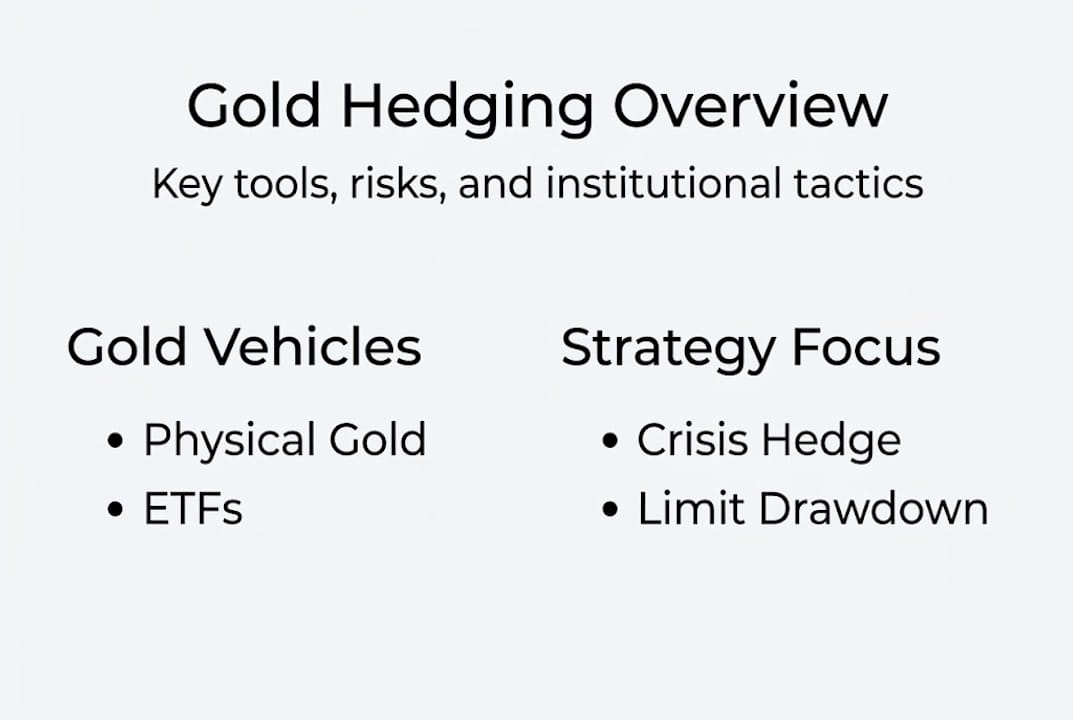
For portfolio risk management at the institutional level, the key question is not whether gold will generate alpha, but whether it will preserve capital when other assets fail. The advantages of gold trading become clearest during systemic stress, not during calm markets.
Key reasons institutions deploy gold as a hedge:
- Crisis performance: Gold tends to hold or gain value when equities and credit markets deteriorate sharply.
- Currency debasement protection: Gold maintains purchasing power across long cycles when fiat currencies weaken.
- Low correlation to risk assets: Gold’s correlation with the S&P 500 is typically low or negative during drawdowns.
- Regulatory capital efficiency: Under certain frameworks, physical gold qualifies as a Tier 1 asset.
- Geopolitical resilience: Gold retains value across political regimes and jurisdictions.
Empirical benchmark: Gold as a safe haven asset outperformed both bonds and put options in 8 out of 11 major stock drawdowns, making it one of the most consistent crisis-period hedges in institutional portfolios.
The empirical case for gold: When and how does it actually hedge?
Having defined gold hedging, let’s explore what the data actually says about gold’s hedge behavior through market cycles. The first thing experienced allocators notice is that gold’s effectiveness is deeply regime-dependent. It does not hedge uniformly across all market conditions.
Gold’s beta turns negative in stress regimes, measured at approximately -0.08, meaning it moves inversely to equities precisely when institutional portfolios are most vulnerable. However, its volatility is similar in magnitude to the S&P 500, and its R-squared in standard CAPM regressions is very low. This means gold’s behavior is largely independent of equity market factors, which is powerful in a crisis but creates noise in calm periods.
When real yields are low and inflation expectations are rising, gold tends to perform strongly. When central banks are tightening aggressively and real yields are rising, gold often struggles. This regime sensitivity is the central challenge for portfolio teams trying to size gold exposure correctly.
| Scenario | Gold performance | Bond performance | Put options |
|---|---|---|---|
| Severe equity drawdown | Strong | Moderate | Strong |
| Low real yield environment | Strong | Strong | Neutral |
| Tightening cycle | Weak | Weak | Neutral |
| High short-term inflation | Inconsistent | Weak | Neutral |
| Geopolitical shock | Strong | Moderate | Variable |
The reducing portfolio risk value of gold shows up most clearly in the severe drawdown row above. In 8 of 11 major market crashes studied, gold outperformed both bonds and put options. That is a meaningful track record, but it is not perfect. Three of those events saw gold fail to provide meaningful protection, a reality that should temper overconfidence.
Statistical callout: Gold’s real long-run return of ~0% confirms its classification as a hedge asset, not a return-generating vehicle. Institutions that benchmark gold against equity returns are measuring the wrong thing entirely.
Your gold and diversification strategy must account for the fact that gold’s correlation with agricultural commodities and other real assets also shifts with the inflation and tightening cycle, adding a layer of complexity that many portfolio models underestimate.
Strategic considerations: When gold hedging works—and when it doesn’t
The numbers reveal a mixed picture. Next, it is vital to understand the specific contexts and errors that drive gold hedging success or failure. Gold hedging performs best in three identifiable scenarios: when real yields are deeply negative, when a severe equity drawdown is underway, and when geopolitical risk is materially elevated. In these environments, gold’s low or negative equity correlation becomes a genuine portfolio stabilizer.
However, there are equally identifiable scenarios where gold disappoints, and regime-dependent hedge effectiveness is something every institutional allocator must internalize:
- Aggressive tightening cycles: Rising real yields suppress gold prices as the opportunity cost of holding non-yielding assets increases.
- Strong equity bull markets: Gold tends to lag significantly, and over-allocation caps overall portfolio returns.
- Short-term inflation surges: Gold is inconsistent in the near term; its volatility can exceed the inflationary gain it is meant to offset.
- Post-peak price periods: Institutions that buy at or near all-time highs face prolonged drawdown periods with limited protection.
- Dollar-strengthening cycles: A strong U.S. dollar typically pressures gold prices, regardless of inflation conditions.
Gold’s importance for institutions is not in question, but the timing and sizing of exposure matters enormously. The most common error we observe is treating gold as a static allocation that requires no active oversight.

Pro Tip: Avoid allocating more than 10 to 15 percent of a portfolio to gold in expectation of consistent outperformance. Gold hedging is most powerful as a structural, not tactical, position. Over-hedging in gold during equity bull runs creates a measurable return drag that compounding amplifies over time.
Gold’s correlation with agricultural commodities also warrants attention. During inflationary regimes, these correlations tend to rise, reducing the diversification benefit precisely when you need it most. This is why single-asset hedge strategies are rarely sufficient. Gold should be part of a multi-layered risk management architecture.
Implementing gold hedging: Approaches and institutional best practices
Understanding when gold hedging is appropriate leads naturally to the question of how actual institutions structure and implement gold exposure. Execution quality matters as much as allocation decisions. Even well-timed gold hedges can underperform if implemented through the wrong vehicle, at poor cost, or without adequate oversight.
| Vehicle | Liquidity | Cost | Counterparty risk | Best use case |
|---|---|---|---|---|
| Physical gold | Low to moderate | Storage + insurance | Minimal | Long-term structural hedge |
| Gold ETFs | High | Low expense ratio | Fund counterparty | Liquid tactical exposure |
| Futures and forwards | High | Margin + roll cost | Exchange or broker | Short-term hedging, leverage |
| Gold options | Moderate | Premium cost | Exchange or OTC | Defined-risk downside protection |
| Gold-related equities | High | Market beta exposure | Company-specific | Growth with commodity correlation |
Basel III regulatory requirements have elevated physical gold’s standing as a Tier 1 asset for qualifying institutions, and gold ETFs drove demand in the financialization era, but that demand dynamic is maturing. Institutions relying heavily on ETF-driven price appreciation should recalibrate expectations.
For investing in gold at scale, best practices include periodic rebalancing tied to regime signals rather than calendar dates, multi-asset integration where gold is one component of a broader real asset sleeve, and transparent auditing of physical holdings with third-party verification.
Pro Tip: Monitor the financialization premium in gold prices carefully. When ETF inflows have driven prices significantly above fundamental levels, forward-looking expected returns from gold fall sharply. This is a particularly important consideration when reviewing portfolio gold assets after extended bull runs.
Counterparty risk management is non-negotiable. Institutions using OTC derivatives for gold exposure must apply rigorous counterparty screening and margin discipline, particularly during the stress periods when gold hedges are most needed and counterparty failures are most likely.
Why the gold hedge requires more discipline—and less faith—than most believe
While best practices set the foundation, a candid perspective on the real-world discipline required for gold hedging is essential. The most persistent mistake we see among sophisticated institutional investors is treating gold as passive insurance: buy it, hold it, and trust that it will protect you. That mindset is precisely what gets portfolios into trouble.
Gold is not a set-and-forget position. Its hedge effectiveness is conditional, time-varying, and sensitive to macroeconomic regime. Institutions that review their gold allocation only during annual rebalancing are operating on faith, not evidence. The data is clear: regimes shift, and gold’s correlation profile shifts with them.
We advocate for dynamic, evidence-based allocation informed by real yield trends, inflation breakevens, and cross-asset correlation monitoring. This is harder than holding a fixed percentage. It requires internal conviction and the willingness to reduce gold exposure when the regime argues against it, even when gold has recently performed well. That contrarian discipline is what strategic gold trading at the institutional level actually demands. The institutions that do this well treat gold like any other risk position: earned, monitored, and adjusted.
Partner with experts for smarter gold hedging
Armed with a clearer picture of what truly makes gold hedging effective, here’s how your firm can implement these principles with specialist support.
Galami Gold provides institutional-grade physical gold supply solutions built around disciplined execution, transparent supply chain auditing, and rigorous risk oversight. Our trading programs are designed for sophisticated investors who understand that gold hedging is a structured discipline, not a passive bet.

Whether you are building a structural gold sleeve, rebalancing existing exposure, or evaluating gold vehicles for the first time, our team brings operational depth and capital management experience to every engagement. Review our risk disclosure and explore available gold trading programs to see how Galami Gold can support your institutional hedging objectives with the transparency and integrity your stakeholders expect.
Frequently asked questions
What does it mean to hedge with gold?
To hedge with gold means allocating portfolio exposure to gold assets to reduce losses during equity market downturns or periods of financial stress. Gold can outperform during drawdowns due to its low or negative correlation with equities, making it a valuable crisis-period tool.
Is gold a reliable short-term inflation hedge?
Gold is not a reliable short-term inflation hedge due to its volatility and regime dependence. It performs more consistently as a long-term hedge in sustained inflationary environments than in short, sharp price surges.
How much gold should an institutional investor allocate for hedging?
Optimal allocation depends on portfolio context, liability structure, and regime conditions. Over-hedging limits upside in rising markets, so most institutional frameworks recommend starting with a 5 to 15 percent range and adjusting based on real yield signals.
What vehicles are commonly used for gold hedging?
Institutions use physical gold, ETFs, futures, options, and gold-related equities depending on liquidity needs and strategy objectives. ETFs drove demand during the financialization era, but physical gold remains the preferred vehicle for long-term structural hedges with minimal counterparty risk.
Recommended
- Gold trading risk management: strategies for institutions
- Bullion Explained: A Practical Guide for U.S. Investors
- Gold Market Dynamics Explained: What Investors Need to Know
- Top Institutional Gold Trading Benefits | Galami Gold
Ready to invest in physical gold trade finance?
Both the Zambia–Dubai and Sierra Leone–Dubai programs are open to qualified investors. Minimum investments from $115,000 USD or €125,000 EUR.
Zambia–Dubai Program Sierra Leone–Dubai Program