
TL;DR:
- Gold’s role as a crisis hedge requires disciplined capital deployment based on macro signals and appropriate timing. Proper allocation depends on risk profile, with vehicles like physical gold, ETFs, or futures suited for different horizons and liquidity needs. Verification of custody and systematic sizing within gold’s volatility band are essential for safeguarding investment performance.
Gold sits at the intersection of currency, commodity, and crisis hedge. Yet most institutional portfolios treat it like an afterthought rather than a precision allocation. A disciplined capital deployment guide gold investors can actually use must address the full spectrum: pre-deployment analysis, execution technique, risk verification, and vehicle selection. Done wrong, gold adds noise without return. Done right, it reduces portfolio drawdowns and holds value when other assets correlate into trouble.
Table of Contents
- Key takeaways
- Capital deployment guide: gold pre-deployment essentials
- Execution strategies for institutional gold deployment
- Risk management and verification practices
- Comparing capital deployment approaches
- What I’ve learned deploying capital in gold at scale
- Deploy capital in gold with Galamigold
- FAQ
Key takeaways
| Point | Details |
|---|---|
| Allocate with risk profile in mind | Conservative portfolios warrant 10-15% gold; balanced allocations typically sit at 5-10%. |
| Macro signals drive timing | Real yields and USD strength are the primary timing signals for gold entry decisions. |
| Size to the noise band | Gold’s daily volatility range of $15-$50 means equity-style position sizing will trigger stops prematurely. |
| Verify before you commit | Audit trails, fee schedules, and buyback policies must be confirmed before any capital is placed. |
| Match the vehicle to the horizon | Physical gold preserves long-term value; ETFs and futures serve tactical and liquidity needs. |
Capital deployment guide: gold pre-deployment essentials
Before a single dollar moves into gold, the groundwork determines whether the allocation performs or underperforms. Most capital deployment mistakes in gold happen at this stage. Specifically, they happen when institutions apply frameworks built for equities without accounting for gold’s fundamentally different price drivers.
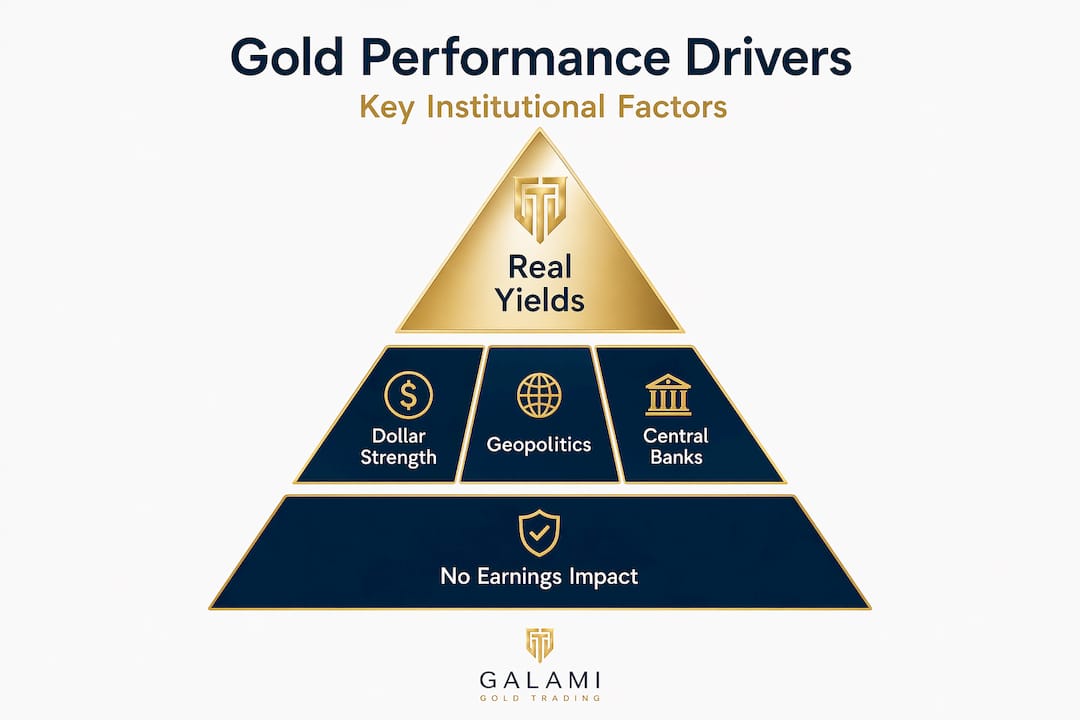
Gold does not respond to earnings. It responds to real yields, dollar strength, geopolitical stress, and central bank demand. Gold’s price is structurally driven by 10-year TIPS real yields and the U.S. Dollar Index. When real yields fall, gold tends to rise. When the DXY weakens, gold strengthens. These relationships are not incidental. They are the architecture of gold price action at the institutional level.
Setting allocation targets
Recommended institutional gold allocations range from 5% to 15% depending on portfolio risk profile. Conservative mandates typically target 10-15%, balanced portfolios run 5-10%, and more growth-oriented books may hold 0-5%. Your target band should be set before selecting any investment vehicle, not after.
The allocation decision also requires clarity on time horizon and liquidity obligations. A sovereign wealth fund with a 20-year horizon has different requirements than a hedge fund managing quarterly redemptions. These objectives directly determine which gold instrument fits.
Choosing the right investment vehicle
The four primary vehicles each carry distinct cost, liquidity, and risk profiles:
- Physical gold (bars and coins): Offers direct ownership and no counterparty risk. Physical bars carry the lowest premiums but come with storage and custody costs typically between 0.33% and 0.5% annually. Liquidity is slower than paper markets.
- Gold ETFs: Provide institutional-scale liquidity with transparent fee structures, often under 0.55%. The SPDR Gold Shares ETF held over 39.5 million ounces at approximately $167 billion as of late 2025, demonstrating the depth available for large positions.
- Gold futures: Suitable for tactical exposure and hedging. High leverage, mark-to-market settlement, and roll costs require active management and deep operational infrastructure.
- Allocated storage accounts and structured products: Used for specific mandates, these carry custodial and contractual risks that require independent legal review.
| Vehicle | Liquidity | Cost structure | Best horizon |
|---|---|---|---|
| Physical gold bars | Low to moderate | Storage + insurance (0.33-0.5% p.a.) | Long-term preservation |
| Gold ETFs | High | Management fee (under 0.55% p.a.) | Tactical to medium-term |
| Gold futures | Very high | Roll costs + margin | Short-term and hedging |
| Allocated accounts | Moderate | Negotiated, provider-dependent | Strategic institutional |
Pro Tip: Before selecting a custodian or dealer, request a full fee schedule in writing. Verify that storage is segregated, insured, and subject to independent audit. Opaque cost structures in gold custody erode net returns silently. For detailed screening criteria, see Galamigold’s guidance on evaluating gold traders.
Execution strategies for institutional gold deployment
Getting the allocation right means nothing if execution is careless. Gold’s daily volatility creates real friction for large capital deployments, and the wrong entry methodology can cost significant basis points before the position even has a chance to work.
The case for staggered deployment
Dollar-cost averaging is the standard method for managing timing risk in gold. Gold’s intraday price swings typically range $15 to $50 on normal days and can spike well beyond that during macro announcements. Deploying a full institutional position in a single session exposes the portfolio to that full range of slippage.
A staggered deployment schedule, spread across four to eight weeks depending on position size, captures a more representative average price and reduces the probability of being fully invested at a local peak. This is not a passive approach. It requires active monitoring of macro conditions throughout the deployment window.
Timing entries with macro signals
Here is the framework that experienced institutional traders use, and it is not built on chart patterns:
- Monitor real yield direction. A falling or negative real yield environment is structurally supportive for gold. Check the 10-year TIPS yield daily. If real yields are declining, the macro tailwind is in place.
- Assess USD momentum. A weakening DXY historically correlates with rising gold prices. Cross-reference USD trends against gold positioning before deploying capital.
- Map geopolitical risk. Elevated geopolitical stress increases safe-haven flows to gold. Factor current conditions into the entry urgency and position size.
- Identify pullback zones. Even in bullish macro environments, using macro-flow confluence frameworks for pullback entries reduces average cost and improves risk-reward on each tranche.
- Pause around major announcements. FOMC meetings, CPI releases, and non-farm payrolls create outsized volatility windows. Suspend deployment tranches in the 24 hours surrounding these events unless the position is specifically timed to a macro catalyst.
Pro Tip: Avoid deploying large tranches immediately following a gold price spike driven by a single news catalyst. Price tends to revert partially after shock-driven moves. Let the price settle before committing the next tranche.
Position sizing for gold’s volatility regime
Institutional sizing for gold positions must be calibrated to the asset’s volatility noise band rather than fixed dollar amounts. What works for an equity position will produce premature stop-outs in gold because the daily noise range is simply wider. On a standard day, gold moves $15 to $25. On announcement days, that range expands to $30 to $50 or beyond.

Size each tranche so that a full noise-band move against you remains within your pre-defined risk budget. This keeps the position alive long enough for the macro thesis to play out.
Risk management and verification practices
Capital preservation in gold investing requires more than market analysis. It requires operational discipline and systematic verification of every counterparty in the chain.
Gold markets are not immune to manipulation risk. Protecting investments from market manipulation requires verified physical backing, thorough due diligence on counterparties, and clear understanding of how market participants behave during stress. These are not theoretical concerns. Custodians have failed, allocated accounts have been found unallocated, and ETF audits have surfaced discrepancies.
Specific practices that institutional gold investors must maintain include:
- Verify physical backing independently. For ETFs and custodial arrangements, review independent audit reports, not just prospectus summaries. Confirm that gold listed on trust statements is actually allocated and audited by a credible third party.
- Scrutinize custody contracts. Contractual risk in custody arrangements can match or exceed market risk in tail scenarios. Legal terms around ownership, rehypothecation rights, and access during counterparty insolvency must be reviewed by independent counsel.
- Diversify jurisdictions. Holding gold across multiple jurisdictions reduces exposure to single-country political risk, regulatory seizure, or local market disruptions.
- Maintain transparency checklists. Financial professionals who prioritize transparency require itemized fee schedules, clear audit verification timelines, and explicit buyback policies. Document all of these before capital is committed.
- Rebalance against the risk budget. As gold prices move, the allocation percentage shifts. Quarterly rebalancing maintains the intended risk contribution of gold within the total portfolio.
Transparency and audit verification are non-negotiable for institutional gold investors. The cost of neglecting verification is not just financial. It is reputational, legal, and structural.
Pro Tip: When assessing a new gold custodian, request the most recent third-party audit letter and ask specifically whether the gold is held in a fully allocated, segregated account. Any hesitation or vague response is disqualifying.
Comparing capital deployment approaches
Not every deployment model produces the same outcome. Understanding the tradeoffs across approaches is what separates reactive gold investors from those with deliberate gold capital strategies.
| Approach | Deployment method | Cost efficiency | Risk profile | Best for |
|---|---|---|---|---|
| Lump-sum | Single tranche | High if timed well | High timing risk | Tactical catalyst plays |
| Dollar-cost averaging | Staggered tranches | Moderate | Low timing risk | Core strategic allocations |
| Physical bar accumulation | Incremental purchases | Lowest premium | Storage and liquidity risk | Long-term preservation mandates |
| ETF allocation | Exchange-traded | High, low fees | Counterparty and fund structure | Tactical and liquid allocations |
For core long-term allocations within institutional portfolios, gold asset management tips consistently point to a staggered physical or ETF approach with allocations in the 5-15% range. This band delivers meaningful diversification benefits without concentrating the portfolio into a single non-yield-bearing asset.
The impact on portfolio performance is well documented. Gold’s low correlation to equities and bonds means that gold allocations can improve risk-adjusted returns even during periods of flat or slightly negative gold price performance. The diversification benefit shows up most clearly in drawdown reduction during equity bear markets.
For a deeper view on why this asset class warrants dedicated attention in modern institutional portfolios, Galamigold’s analysis of gold’s role for institutions covers the structural case in detail.
What I’ve learned deploying capital in gold at scale
I’ve seen institutional investors make two recurring mistakes with gold, and both are avoidable.
The first is treating gold like a slow equity. They apply the same position sizing logic, the same entry triggers based on technical breakouts, and the same liquidity assumptions. Gold’s daily noise band is simply wider than most equities, and applying equity-style sizing to gold positions produces stops that trigger before the macro thesis has time to play out. The fix is simple once you accept that gold operates on different mechanics.
The second mistake is underestimating the importance of counterparty verification. Physical gold custody is not a commodity service. Contracts matter. Audit frequency matters. Whether the account is truly allocated matters enormously. I’ve seen portfolios where the reported gold holding and the audited physical backing did not match, which is a risk that due diligence should catch before capital is committed.
My recommendation for any institution approaching gold for the first time or scaling an existing allocation: treat the verification process as equal in importance to the market analysis. The best gold market analysis guide in the world does not protect you from a custodian failure or an unallocated account sold as allocated.
Understanding gold investment at the institutional level means accepting that the work happens before the trade, not just during it. Macro cross-asset context drives timing. Noise-band-aware sizing protects the position. Verified custody protects the capital.
— Galami
Deploy capital in gold with Galamigold
If the frameworks in this article reflect how you think about gold, Galamigold is built for exactly this type of investor.

Galamigold operates as a physical gold trading platform with a direct focus on transparency, audited supply chains, and disciplined execution. Every position facilitated through Galamigold is backed by independently verified physical gold, with clear fee structures and custody documentation available to institutional clients. Whether you are establishing a new gold allocation, scaling an existing position, or evaluating custodial options, Galamigold provides the operational and verification framework that institutional capital deployment demands. Explore the platform and connect with the Galamigold team at galamigold.com.
FAQ
What is the recommended gold allocation for institutional portfolios?
Institutional gold allocations typically range from 5% to 15%, with conservative mandates targeting 10-15% and balanced portfolios holding 5-10%.
Why is dollar-cost averaging used for gold capital deployment?
Gold’s intraday volatility of $15 to $50 per day makes single-tranche entry risky. Staggered deployment reduces timing exposure across the full position.
How do real yields affect the timing of gold investment entries?
Gold prices are inversely correlated with real yields. When 10-year TIPS yields decline, gold typically appreciates, making falling real yield environments the preferred macro setup for new gold allocation entries.
What is the key risk in physical gold custody?
Contractual and custodial risks include rehypothecation, unallocated accounts sold as allocated, and counterparty insolvency. Independent audit verification before capital commitment is the primary mitigation.
How does gold ETF access compare to physical gold for institutional investors?
Gold ETFs offer institutional-scale liquidity and fees under 0.55%, while physical gold ownership structures serve long-term preservation with direct ownership and no counterparty exposure at the asset level.
Recommended
- Physical Gold Capital Management Guide for Institutions
- Step by Step Gold Transaction Process: 2026 Guide
- Top benefits of physical gold for institutional investors
- Top institutional gold trading benefits for portfolio growth
Ready to invest in physical gold trade finance?
Both the Zambia–Dubai and Sierra Leone–Dubai programs are open to qualified investors. Minimum investments from $115,000 USD or €125,000 EUR.
Zambia–Dubai Program Sierra Leone–Dubai Program