
TL;DR:
- A gold transaction follows a set of verified, compliant steps from authentication to secure delivery. Proper preparation and documentation help prevent fraud, overpayment, and legal issues. Patience and disciplined processes are essential for long-term, successful gold investing.
A gold transaction is a structured sequence of steps that moves physical gold from seller to buyer through verified, compliant, and documented procedures. The step by step gold transaction process covers everything from confirming purity and negotiating price to signing contracts, processing payment, and securing delivery. Regulators including the Financial Action Task Force (FATF) and national AML authorities require that every stage of this process meets Know Your Customer (KYC) and Anti-Money Laundering (AML) standards. Galamigold operates within these frameworks, making transparency and disciplined execution the foundation of every deal.
What do you need before starting a gold transaction?
Preparation separates a smooth deal from a costly mistake. Before any money changes hands, you need to understand what you are buying, what it is worth, and what paperwork the law requires.

Know your gold types and purity
Gold trades in several forms: bars, coins, and rounds. Purity is measured in karatage (24k being 99.9% pure) or fineness (999.9 for investment-grade bullion). The form you choose affects both the premium you pay and the ease of resale. A 1oz government coin is easier to resell than a 100g bar from a lesser-known refiner.
Gather your market data
The spot price is the real-time benchmark for gold. Dealers add a premium above spot to cover their costs and profit. Fair market premiums vary by form: 1oz government coins carry 4–7%, while 1g bars often carry 10–15%. Knowing these ranges before you call a dealer gives you a clear baseline for negotiation.
Prepare your documentation
Both buyers and sellers need government-issued photo ID, proof of address, and, for business transactions, entity registration documents. Sellers also need proof of ownership, such as original purchase receipts or certificates of authenticity. Assay certificates from recognized refiners like PAMP Suisse or the Perth Mint confirm purity independently.
- Government-issued photo ID (passport or driver’s license)
- Proof of address (utility bill or bank statement, dated within 90 days)
- Proof of ownership or purchase invoice for sellers
- Assay certificate or certificate of authenticity for the gold
- Entity documents for corporate buyers or sellers
Pro Tip: Request the assay certificate before agreeing to any price. A dealer who cannot produce one for bars over 1oz is a dealer worth avoiding.
AML and KYC compliance is not optional. Verifying dealer licensing and maintaining transaction records is a legal requirement in most jurisdictions. Skipping this step exposes both parties to regulatory penalties.
What are the step-by-step procedures in buying and selling physical gold?
The gold purchase process follows six defined stages. Each stage has a specific purpose and a clear output. Skipping any stage increases the risk of fraud, overpayment, or delivery failure.
-
Verify authenticity and purity. Use an assay kit, electronic gold tester, or third-party assay service to confirm the gold’s fineness. For bars, check the serial number against the refiner’s database. For coins, verify weight and dimensions against published government mint specifications.
-
Negotiate price. Start with the current spot price from a real-time source such as the London Bullion Market Association (LBMA) daily fix. Add the dealer’s published premium. Any price above the expected premium range warrants a written explanation from the dealer.
-
Draft and sign a purchase agreement. The contract must state the gold’s form, weight, purity, total price, payment method, delivery terms, and return policy. Both parties sign before any payment is initiated. For business transactions, legal review of the contract is standard practice.
-
Process payment. Wire transfer or check is the most cost-effective method. Credit card payments add 3–4% in processing fees, which can erase the premium savings you negotiated. Confirm the payment has cleared before releasing or accepting the gold.
-
Arrange secure delivery and receipt. Insured shipping through a specialist precious metals carrier is the standard for transactions above a few thousand dollars. The buyer confirms receipt in writing, noting the condition of packaging and the gold itself. Any discrepancy triggers the dispute clause in the purchase agreement.
-
Post-transaction recordkeeping. Thorough documentation of purchase agreements, receipts, and identification supports tax compliance, future audits, and resale. Store digital copies in a secure, backed-up location.
The table below summarizes each step with its key output.
| Step | Action | Key Output |
|---|---|---|
| 1. Verify authenticity | Assay test or refiner database check | Confirmed purity and weight |
| 2. Negotiate price | Spot price plus dealer premium | Agreed total price in writing |
| 3. Sign contract | Purchase agreement with full terms | Legally binding document |
| 4. Process payment | Wire transfer or check | Payment confirmation receipt |
| 5. Confirm delivery | Insured shipping with receipt sign-off | Delivery confirmation record |
| 6. Record keeping | File all documents digitally and physically | Audit-ready transaction file |
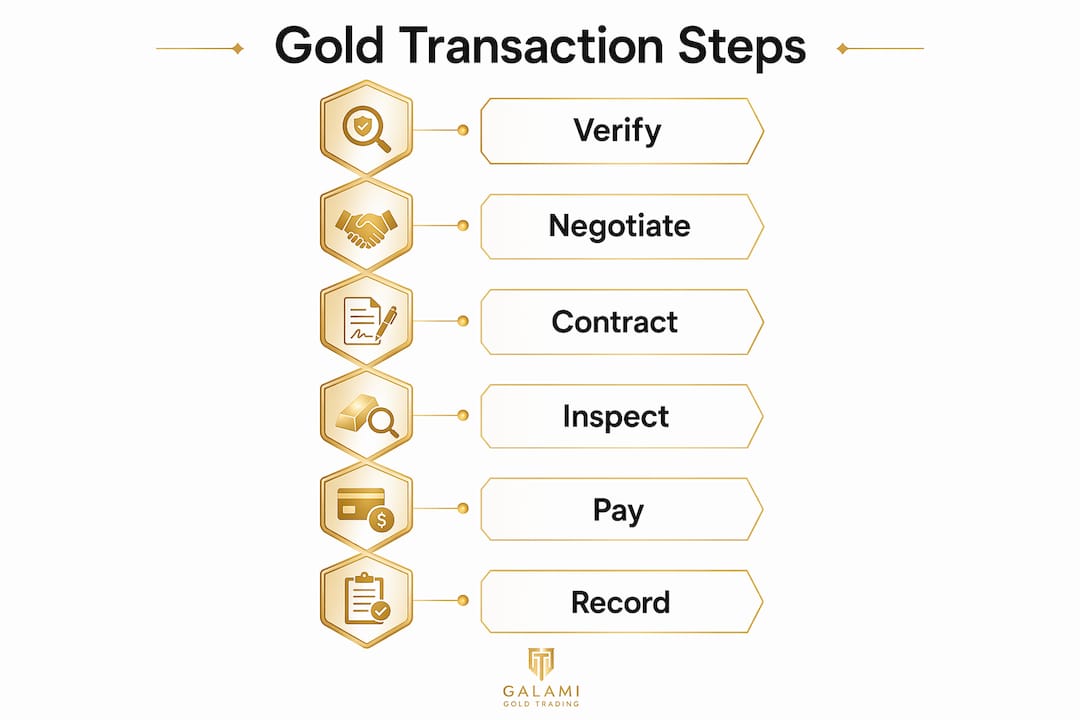
Individual buyers typically complete steps 1 through 6 within 3–5 business days. Business transactions involving larger volumes may require additional compliance review at steps 1 and 3, extending the timeline.
What are the legal and security considerations for a safe gold transaction?
Legal compliance and physical security are not separate concerns. They overlap at every stage of the gold selling process and must be treated as a single discipline.
AML and KYC requirements
AML regulations require dealers to identify their clients, verify the source of funds, and report suspicious transactions to financial intelligence units. As a buyer or seller, you will be asked to complete a KYC form before any transaction proceeds. This is standard practice, not an intrusion. Dealers who skip KYC are operating outside the law, which puts your transaction at legal risk.
Verifying dealer credentials
Trustworthy dealers publish their buy-back policies, display transparent pricing, and carry external accreditation such as a BBB A+ rating or membership in the Professional Numismatists Guild (PNG). Verify the dealer’s license with the relevant national authority before transferring any funds. A quick check takes five minutes and eliminates a large category of fraud risk.
Counterfeit gold and fraud prevention
Tungsten-filled bars and gold-plated coins are real threats in the secondary market. Always test gold you did not purchase directly from a licensed refiner or government mint. A Sigma Metalytics tester or XRF (X-ray fluorescence) analyzer provides non-destructive verification. Never accept gold at a price significantly below spot. That discount is the fraud’s profit margin.
“Physical gold involves storage and insurance costs but offers tangible ownership that counterparty-dependent instruments cannot replicate.” This distinction matters when evaluating the true cost of ownership.
Storage and insurance
Secure storage options include insured home safes, bank safety deposit boxes, and third-party vaults. Each option carries different cost and access trade-offs. Third-party vaults operated by specialist firms offer the highest security but add annual fees. Factor storage and insurance costs into your total cost of ownership before completing the transaction.
- Home safe: low cost, immediate access, limited insurance coverage
- Bank safety deposit box: moderate cost, restricted access hours, typically not insured by the bank
- Third-party vault: higher cost, full insurance, audited security, ideal for larger holdings
What best practices and common pitfalls should you know?
Most gold transaction errors are avoidable. They fall into two categories: pricing mistakes and process shortcuts.
Pricing and premium discipline
Shop multiple dealers before committing. Premium ranges are published and consistent across reputable sources. Historic fractional coins such as the 20 Franc Rooster trade at 2–5% over spot, compared to 5–10% for modern fractional government coins. That difference compounds across multiple purchases. Fractional historic coins are an underused entry point for buyers who want cost-effective exposure without committing to a full ounce.
Process discipline
- Never wire funds before receiving a signed purchase agreement.
- Confirm the dealer’s buy-back policy in writing before the sale closes.
- Avoid dealers who pressure you to decide within hours based on price movements.
- Use bank wire or check payments to avoid the 3–4% credit card surcharge.
- Keep a dedicated folder, physical and digital, for every transaction document.
Timing and market conditions
Gold is a long-term asset. Experts advise treating physical gold as a hedge rather than a short-term speculative trade. Reacting to daily price swings leads to overpaying on premiums and underselling during corrections. Buying in tranches over several months reduces timing risk and averages your entry premium.
Pro Tip: If a dealer’s offer sounds too good relative to spot, request a written breakdown of the premium. Legitimate dealers provide this without hesitation. Reluctance is a warning sign.
Balancing premium savings with convenience is the core discipline of gold buying. The cheapest premium is not always the best deal if it comes with a dealer who has no published buy-back policy or poor delivery track record.
Key takeaways
A secure gold transaction requires verified authenticity, a signed contract, compliant payment, and thorough recordkeeping at every stage.
| Point | Details |
|---|---|
| Verify before you pay | Confirm purity with an assay test or refiner database check before signing any agreement. |
| Know the premium range | Fair premiums run 4–7% for 1oz coins and 1–3% for large bars. Anything higher needs justification. |
| Use wire or check | Credit card payments add 3–4% in fees, erasing premium savings negotiated upfront. |
| Comply with AML/KYC | Complete all identity and source-of-funds checks. Dealers who skip them are a legal liability. |
| Document everything | File purchase agreements, receipts, and ID copies for tax, audit, and resale purposes. |
Gold transactions require patience, not speed
Physical gold is one of the few assets where slowing down consistently produces better outcomes. I have seen buyers rush through verification because the price looked right, only to discover the gold was plated or the dealer had no buy-back policy. The loss was not just financial. It was the time and legal exposure that followed.
The gold investment process rewards preparation. Dealers who are worth working with welcome your questions about premiums, assay certificates, and buy-back terms. Those who deflect or pressure you to decide quickly are telling you something important about how they operate.
Integrating physical gold into a broader portfolio requires the same discipline as any other asset class. The 5–10% physical gold allocation framework used by institutional investors exists for a reason: it provides a hedge without concentrating risk. Individual buyers benefit from the same logic. Buy in measured amounts, document every transaction, and treat each purchase as a long-term position, not a trade.
The gold market rewards informed, patient participants. It punishes those who treat it as a shortcut.
— Galami
Galamigold’s approach to physical gold trading
Galamigold operates as a physical gold trading platform built on transparent pricing, disciplined execution, and full AML/KYC compliance across established supply chains.

Every transaction through Galamigold follows the structured process outlined in this guide: verified authenticity and documented agreements. Program terms are stated upfront, and Galamigold does not provide insured delivery or storage. Individual buyers and corporate clients receive the same standard of documentation and compliance support. For those ready to move from research to execution, Galamigold’s trading platform provides a transparent starting point. Buyers who want to understand the full risk profile before committing can review the risk disclosure before placing any order.
FAQ
What is the gold transaction process?
The gold transaction process is a structured sequence covering authenticity verification, price negotiation, contract signing, payment, delivery, and recordkeeping. Each step protects both buyer and seller from fraud and legal exposure.
How do I verify gold authenticity before buying?
Use an assay kit, electronic gold tester, or XRF analyzer to confirm purity. For bars, cross-check the serial number against the refiner’s published database.
What payment method is best for buying gold?
Wire transfer or check is the most cost-effective option. Credit card payments add 3–4% in processing fees, which can eliminate any premium savings negotiated with the dealer.
What AML and KYC documents do I need for a gold transaction?
You need government-issued photo ID, proof of address, and proof of funds. Business buyers also need entity registration documents. These requirements apply to both buyers and sellers under FATF-aligned AML regulations.
How should I store physical gold after purchase?
Options include insured home safes, bank safety deposit boxes, and third-party vaults. Third-party vaults offer the highest security and full insurance coverage, making them the preferred choice for holdings above a few thousand dollars.
Recommended
- Gold Trade Settlement Explained for Investors and Traders
- What Is DVP in Gold Trades: A Trader's Guide
- Galami Gold — Physical Gold Supply & Bullion Trading | Dubai
- How to Ensure Transparency in Institutional Gold Trading
Ready to invest in physical gold trade finance?
Both the Zambia–Dubai and Sierra Leone–Dubai programs are open to qualified investors. Minimum investments from $115,000 USD or €125,000 EUR.
Zambia–Dubai Program Sierra Leone–Dubai Program