
To ensure transparency in physical gold trading, institutions must require five things in every custody and trading agreement: timestamped electronic execution records, bar-level allocated custody with serial numbers and refiner marks, daily reconciliations with documented remediation SLAs, independent third-party audit access, and a fully disclosed pricing methodology tied to a published reference such as the LBMA Gold Price (PM).
Paste this into your next RFP executive summary:
- Timestamped electronic trade records for every execution, accessible post-trade
- Allocated, bar-level custody: serial number, refiner, gross and fine weight per bar
- Daily reconciliation between execution tape, custody ledger, and bar list
- Annual independent audit with auditor access to seals, bar lists, and inspection confirmations
- Documented pricing methodology: reference source, snapshot time, VWAP parameters, and published trade history
- SWIFT or eBTS execution advices on value date, plus weekly inventory lists
- Formal inspection rights with defined notice periods written into the custody agreement
The FMSB Spotlight Review on Data and Transparency identifies the absence of standardized pre-trade pricing data in OTC forward markets as a concrete barrier to institutional adoption and HQLA recognition. The Federal Reserve Bank of New York treats customer gold as non-fungible, maintains bar-level records, and requires authenticated SWIFT instructions for every deposit or withdrawal. Those two benchmarks define the floor.
Key Takeaways
Allocated, bar-level custody combined with daily electronic reconciliations and independent audit access is the minimum standard for verifiable transparency in institutional physical gold trading.
| Point | Details |
|---|---|
| Allocated custody is the baseline | Require bar-level serial numbers, refiner marks, and segregation in every custody agreement. |
| Electronic execution records are non-negotiable | Timestamped trade tapes with venue and price data are the foundation of post-trade auditability. |
| Daily reconciliations close the gap | Match execution tape, custody ledger, and bar list every day; define a T+2 remediation SLA for discrepancies. |
| Independent audits prove the controls work | Request SOC/ISAE-type reports and auditor access to seals and bar lists, not just a clean opinion letter. |
| Galamigold provides the full stack | Galamigold offers allocated custody, electronic execution records, SWIFT advices, and annual audit access for U.S. institutional mandates. |
Table of Contents
- What contract clauses and operational controls must institutions insist on?
- How do you secure execution- and price-level transparency?
- What does credible custody and physical verification actually look like?
- What reconciliation, confirmation, and audit evidence should you require?
- What internal controls and governance evidence should providers supply?
- How do you score a provider in an RFP due-diligence process?
- How Galami Gold implemented these controls end-to-end
- Red flags institutional buyers should watch for
- How to build a provider evaluation scoring matrix for RFPs
- Operational risk management practices specific to physical gold trading
- What data security and encryption standards should you require?
- What dispute resolution mechanisms and contractual recourse should agreements include?
- Timeline for implementing transparency controls after contract award
- Why transparency in gold trading matters more now than most institutions realize
- Galamigold’s institutional transparency program
- Sources
What contract clauses and operational controls must institutions insist on?
Every custody and trading agreement should contain these elements, non-negotiable:
- Allocation language: explicit statement that bars are held in your name, not pooled with other clients
- Bar identification: serial number, refiner mark, gross weight, fine weight, and Good Delivery standard for each bar
- Substitution policy: written limits on when and how bars may be substituted, with prior written consent required
- Inspection and access rights: right to inspect on reasonable notice (typically 48–72 hours), with the right to be present when seals are broken
- Reporting cadence: SWIFT execution advices on value date, weekly bar lists, and annual custody summaries
- eBTS or API access: machine-readable data feeds for reconciliation, not PDF-only reports
- Audit cooperation clause: provider must cooperate with your appointed auditor and provide access to records, seals, and inspection confirmations
The LBMA Global Precious Metals Code translates directly into contract language here: its principles on last-look handling, mark-up disclosure, and post-trade conduct give you a ready-made checklist to map against a provider’s draft agreement. The SEC-filed custodial agreement exhibits confirm that itemized bar lists, daily activity notices, and inspection rights are standard market practice, not premium add-ons.
Pro Tip: Treat the substitution policy and inspection rights as non-negotiable. Allocation language and reporting cadence can be negotiated on format; the right to inspect and the prohibition on unrestricted substitution cannot.
How do you secure execution- and price-level transparency?
Require timestamped electronic execution records first. Then choose your venue accordingly.
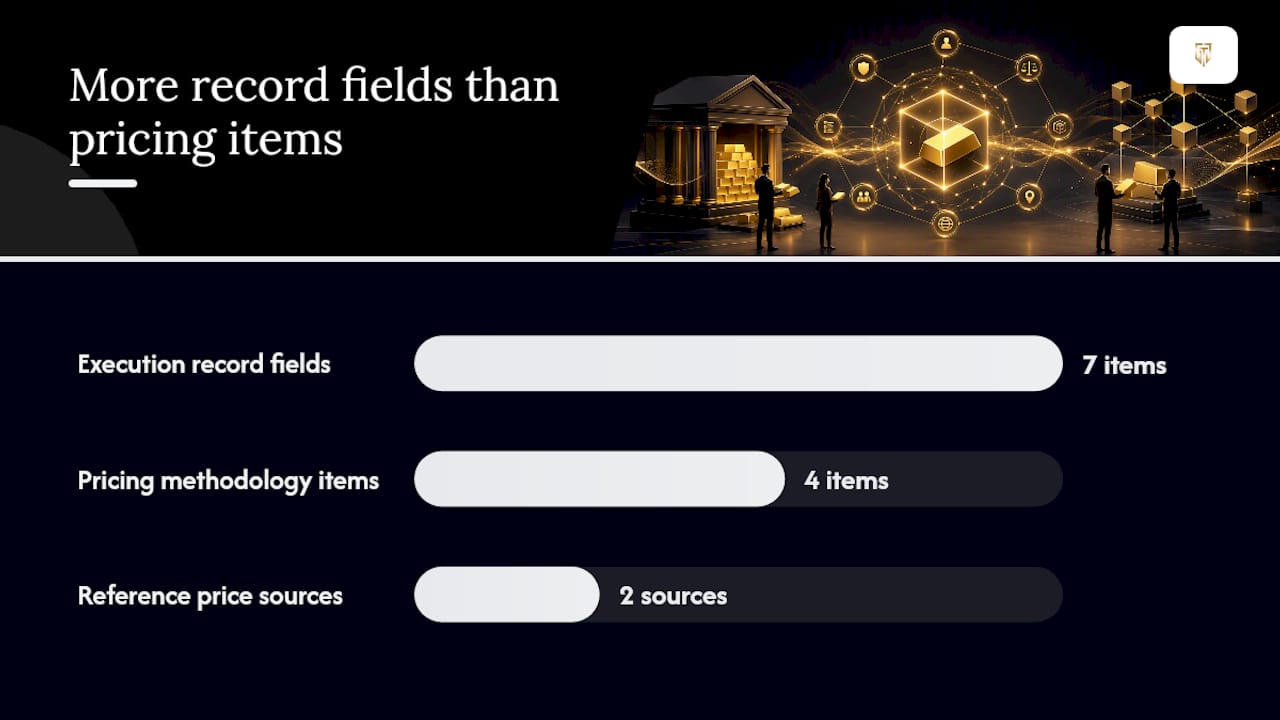
Multilateral electronic platforms publish live, timestamped bids and offers visible to all participants. Bilateral or voice trades produce pricing that is less consistently recorded and harder to audit. The FMSB recommends greater adoption of electronic trading and aggregated platform data precisely because voice markets leave pre-trade pricing largely undocumented. For real-time data interpretation across execution venues, guidance on reading live execution metrics helps compliance teams know which fields to validate.
Minimum data fields to require in every execution record:
- UTC timestamp (millisecond precision)
- Venue identifier
- Anonymized counterparty ID or hash
- Bid and offer at time of execution
- Size (troy ounces)
- Execution price
- Matching algorithm or VWAP parameters used
Pricing methodology disclosure must specify: the reference price source (LBMA Gold Price PM or COMEX front-month), the snapshot time, whether a VWAP or fixed-time benchmark was applied, and where historical trade data is published. A provider who cannot answer those four questions in writing has no documented pricing methodology.
FMSB finding: The lack of standardized pre-trade pricing data in OTC precious metals forward markets is a direct barrier to institutional adoption and HQLA recognition. Published, aggregated price histories are the structural fix.
What does credible custody and physical verification actually look like?
Insist on allocated, bar-level custody. That means your bars carry your name, their serial numbers are in your records, and no other client’s position can be netted against yours.

Unallocated custody is acceptable only when compensating controls are in place: daily mark-to-market reporting, explicit credit exposure disclosure, and a clear contractual path to physical allocation on demand. For most institutional mandates, unallocated is a credit position, not a gold position.
Bar-level records must include:
- Serial number and refiner mark
- Gross weight and fine weight (troy ounces)
- Good Delivery standard verification (LBMA-accredited refiner)
- Date of deposit and any subsequent substitution history
The New York Fed’s custody practice is the U.S. benchmark: customer holdings treated as non-fungible, segregated where practical, with SWIFT execution advices on value date and written procedures for inspections and withdrawals. Carrier handover rules should trigger a SWIFT confirmation or manifest update at each transfer point.
Pro Tip: Align your inspection rights SLA with your reconciliation cadence. If you reconcile weekly, your inspection notice period should be short enough that a discrepancy found on Monday can be physically verified by Friday.
Custody principle: Allocated, bar-level custody with documented inspection rights is the only arrangement that gives an institution verifiable, auditable ownership of specific physical gold. Everything else is a claim against a counterparty.
What reconciliation, confirmation, and audit evidence should you require?
Daily reconciliations between the execution tape, custody ledger, and bar list are the minimum. T+0 or T+1 SWIFT execution advices confirm each trade. Weekly bar lists confirm physical inventory. Annual independent audit access confirms the whole chain.
| Reconciliation item | Owner / source | Expected frequency |
|---|---|---|
| Execution tape | Trading platform or broker | Daily |
| Custody ledger | Custodian | Daily |
| Bar list (serial numbers) | Custodian | Weekly |
| Carrier manifest | Logistics provider | Per movement |
| Insurance certificate | Insurer / custodian | Annual (or on change) |
Treasury OIG audit language is explicit: management is responsible for designing and maintaining effective internal controls over financial reporting, and audit procedures provide reasonable but not absolute assurance. That framing belongs in your RFP: ask providers to supply auditor-consideration statements and evidence of internal control testing, not just a clean audit opinion.
The U.S. Mint’s deep storage audit disclosures illustrate why reconciled statutory and market valuation reporting matters: inventory records must support both book value and current market value simultaneously.
Audit evidence checklist for RFPs:
- SOC 1 Type II or ISAE 3402 report covering custody operations
- Auditor access confirmation (seals, bar lists, inspector sign-offs)
- Internal control testing summary from management
- Discrepancy remediation log with SLA compliance data
- Insurance coverage certificate with limits and exclusions
What internal controls and governance evidence should providers supply?
Require evidence of segregation of duties, tested internal controls, and documented management responsibilities before signing any agreement. The gold trading standards for institutional investors framework gives a practical baseline for what that evidence package should contain.
Controls evidence to request:
- Management responsibility statement signed by a named officer
- Segregation of duties matrix (who approves, who executes, who reconciles)
- KYC/AML policy documentation and last review date
- Insurance coverage: amount, carrier, covered perils, and exclusions
- Incident response plan with defined escalation timelines
- System access control policy and most recent penetration test summary
- Encryption standards for trade data in transit and at rest (AES-256 minimum)
Pro Tip: Build a vendor scorecard that re-runs this controls review annually, not just at onboarding. A provider who passes due diligence in year one but stops updating penetration tests or insurance certificates by year three is a different risk profile entirely.
How do you score a provider in an RFP due-diligence process?
Run a scored checklist across five categories. Weight execution and custody highest; they are hardest to remediate after contract award.
Scored checklist (suggested weights):
- Execution records: timestamped electronic tape, venue data, post-trade confirmations (20%)
- Custody model: allocated, bar-level, segregated, Good Delivery verified (25%)
- Reporting and reconciliation: SWIFT/eBTS, daily ledger, weekly bar list, SLA (20%)
- Audit and controls: SOC/ISAE report, internal control evidence, auditor access (20%)
- Pricing methodology: reference source, snapshot time, published history (15%)
Score each item 0–3 (0 = not provided, 1 = partial, 2 = documented, 3 = independently verified). For a full evaluation framework, the essential tips for evaluating gold traders guide covers RFP scoring in detail.
Red flags that should trigger immediate disqualification:
- Refusal to provide bar-level serial number lists
- Proprietary or undisclosed pricing methodology
- No SWIFT or eBTS reporting capability
- Absence of any third-party audit or attestation
- Insurance coverage that excludes physical loss in transit
Pro Tip: Ask providers to complete the checklist themselves and return it with supporting documents attached. A provider who scores themselves 3/3 on audit evidence but cannot attach the SOC report has answered your question.
How Galami Gold implemented these controls end-to-end
Galami Gold’s institutional workflow produces transparency artifacts at every stage, from RFQ to settled custody release.
Implementation workflow:
- RFQ to execution: electronic execution feed with UTC timestamps, venue ID, and anonymized counterparty hash generated at trade
- Post-trade: SWIFT execution advice issued on value date; execution tape archived for audit access
- Custody setup: bars allocated by serial number and refiner mark; Good Delivery verification confirmed at deposit
- Daily operations: custody ledger reconciled against execution tape; discrepancies flagged within T+1
- Weekly: bar list issued with serial numbers, weights, and refiner marks
- Annual: independent auditor access to seals, bar lists, and inspection confirmations; internal control testing summary provided to clients
Galami Gold’s operating principle: Every transparency artifact — execution tape, SWIFT advice, bar list, inspection note — is generated as a byproduct of normal operations, not assembled retrospectively for audit season. That distinction is what makes the audit trail credible.
For the full step-by-step institutional workflow, the gold trading step-by-step guide maps each stage to its corresponding transparency output.
Red flags institutional buyers should watch for
Beyond the disqualification thresholds in the scoring matrix, watch for these patterns during due diligence:
- Opaque fee structures: mark-ups embedded in execution prices with no disclosure of methodology
- Unallocated default: custody agreements that default to unallocated without explicit opt-in language
- PDF-only reporting: no machine-readable data feed or API; reconciliation requires manual re-keying
- Audit resistance: delays, redactions, or refusals when asked for SOC reports or auditor access letters
- Stale insurance certificates: coverage that has not been updated to reflect current inventory values
- No substitution policy: agreement silent on when bars may be substituted, leaving the institution exposed to undisclosed swaps
How to build a provider evaluation scoring matrix for RFPs
A scoring matrix works only if the criteria are weighted before you receive responses, not after. Lock the weights in your RFP document so providers cannot be scored retroactively on criteria you adjusted to favor a preferred outcome.
Structure the matrix around four tiers: pass/fail gates (items where any failure disqualifies), weighted scored criteria (the five categories above), qualitative assessment (management team depth, incident history, client references), and commercial terms (fee transparency, SLA penalties, exit provisions).
Pass/fail gates should include: allocated custody confirmation, SWIFT reporting capability, and third-party audit existence. A provider who fails any gate does not proceed to scoring. For context on how multi-asset electronic platforms handle aggregated data and institutional reporting, that framework translates directly to what you should expect from a gold-specific provider.
Operational risk management practices specific to physical gold trading
Physical gold introduces risks that financial instruments do not: theft, damage in transit, refiner default, and custodian insolvency. Each requires a specific control.
Transit risk: require all-risk insurance covering full replacement value, carrier liability confirmation at each handover point, and SWIFT manifest triggers on movement. A carrier who cannot produce a SWIFT-linked manifest update at handover is an uncontrolled custody gap.
Custodian insolvency: allocated custody is the primary protection. Verify that your bars are legally titled to you, not to the custodian’s balance sheet. Ask for a legal opinion on the insolvency treatment of allocated holdings under applicable U.S. law.
Refiner default: Good Delivery accreditation (LBMA-listed refiners) is the standard screen. Bars from non-accredited refiners require independent assay before acceptance.
Concentration risk: avoid single-custodian arrangements for large positions. Split custody across at least two independent facilities with separate audit trails.
What data security and encryption standards should you require?
Trade and custody data for physical gold carries the same sensitivity as any financial record, plus the added risk that it reveals the location and quantity of physical assets. Minimum standards:
- AES-256 encryption for data at rest; TLS 1.3 for data in transit
- Role-based access controls with multi-factor authentication for all custody system users
- Audit logs for every data access event, retained for a minimum of seven years
- Annual penetration testing by an independent third party, with findings and remediation timelines shared with clients
- Data residency confirmation: where trade and custody records are stored, and under which jurisdiction’s data protection law
Providers who cannot confirm these standards in writing are operating below the threshold that U.S. institutional compliance programs typically require.
What dispute resolution mechanisms and contractual recourse should agreements include?
Disputes in physical gold trading tend to cluster around three issues: pricing discrepancies, bar substitution without consent, and reconciliation failures. Each needs a specific contractual mechanism.
Pricing disputes: require a documented escalation path that starts with the provider’s compliance desk, moves to an independent price source (LBMA Gold Price PM or COMEX settlement), and resolves within five business days. The agreement should specify which reference price governs in the event of disagreement.
Substitution disputes: any substitution without prior written consent should trigger an automatic remediation obligation: return of the original bars or cash equivalent at the higher of the original execution price or current market value.
Reconciliation failures: define a remediation SLA (typically T+2 for execution discrepancies, T+5 for bar-list discrepancies) and specify that unresolved discrepancies beyond the SLA trigger a financial penalty or the right to appoint an independent inspector at the provider’s cost.
Governing law and arbitration venue should be specified explicitly. For U.S. institutional mandates, New York law and LCIA or AAA arbitration are standard.
Timeline for implementing transparency controls after contract award
Most institutions underestimate the lead time. A realistic implementation timeline runs 60–90 days from contract award to full operational transparency.
Days 1–15: finalize custody agreement language; confirm bar-level allocation and inspection rights in writing; establish SWIFT connectivity or eBTS API credentials.
Days 16–30: complete initial bar deposit and reconciliation; verify serial numbers against custody ledger; confirm insurance certificate covers current inventory value.
Days 31–60: run first full reconciliation cycle (execution tape vs. custody ledger vs. bar list); identify and remediate any discrepancies; confirm SWIFT execution advices are being received on value date.
Days 61–90: schedule first independent inspection; confirm auditor access rights are operational; deliver first internal control testing summary to governance committee.
After day 90, transparency controls shift to steady-state monitoring: daily reconciliations, weekly bar lists, annual audits, and quarterly vendor scorecard reviews.
Why transparency in gold trading matters more now than most institutions realize
The HQLA conversation is the real driver. The FMSB is direct: without sustained, publicly available pre-trade and post-trade price data, gold cannot make a credible case for high-quality liquid asset recognition under Basel III frameworks. That is not a distant regulatory concern. It is the structural reason why the transparency controls in this article matter beyond compliance hygiene.
Institutions that build audit-ready operations now, with allocated custody, electronic execution tapes, and independent audit trails, will be positioned to demonstrate gold’s liquidity and price transparency to regulators when the HQLA question is formally revisited. Those that rely on bilateral voice trades and PDF custody statements will not. The operational risk and transparency practices that distinguish credible providers from the rest are visible in the documentation they produce routinely, not the documentation they assemble under pressure.
Galamigold’s institutional transparency program
Galamigold delivers the full transparency stack for U.S. institutional mandates: electronic execution records with UTC timestamps, allocated bar-level custody with serial number documentation, daily reconciliations, SWIFT execution advices, and annual independent audit access. Sample custody reports, RFP language templates, and an onboarding checklist are available on request.

Institutions evaluating physical gold allocations can review Galamigold’s physical gold trading program and request sample reports or a pre-populated RFP template through the institutional onboarding inquiry form. The risk disclosure page covers the full scope of operational and market risks relevant to institutional mandates.
Sources
- Data and Transparency in Precious Metals Markets (FMSB Spotlight Review)
- Gold Custody — Federal Reserve Bank of New York (FOIA response)
- Custodial account agreement (SEC exhibit: bar lists, reporting, inspection rights)
- OIG-26-004 Financial Management Audit of the Department of the Treasury’s Schedules of United States Gold Reserves (Jan 2026)
This article is general information, not a substitute for advice from a qualified financial advisor. Consult a qualified financial professional about your own circumstances before acting on anything here.
Recommended
- Top institutional gold trading benefits for portfolio growth
- Gold Trade Settlement Explained for Investors and Traders
- How to Select Gold Partners: Institutional Guide 2026
- Step by Step Gold Transaction Process: 2026 Guide
Ready to invest in physical gold trade finance?
Both the Zambia–Dubai and Sierra Leone–Dubai programs are open to qualified investors. Minimum investments from $115,000 USD or €125,000 EUR.
Zambia–Dubai Program Sierra Leone–Dubai Program