
Global standards are not a compliance formality for institutional gold trading. They are the operational infrastructure that determines whether a bar is liquid, insurable, custodied, and acceptable to a U.S. fiduciary. Without them, physical gold is an opaque commodity with uncertain provenance and limited market access.
Standards deliver five concrete outcomes every allocator should understand before moving capital:
- Auditable provenance: documented chain-of-custody from mine to vault, enabling regulatory and counterparty verification
- Market eligibility: LBMA Good Delivery listing is the gateway to London’s institutional market and most major custodians
- Reduced counterparty risk: central clearing and delivery-versus-payment mechanics lower settlement exposure
- AML/CTF compliance: FinCEN-aligned programs satisfy U.S. regulatory obligations for dealers in precious metals
- Insurability and custody acceptance: audited vaults and third-party assay reports are prerequisites for most institutional insurance programs
The immediate verification step: before allocating capital, ask every counterparty for LBMA eligibility evidence, an independent audit report, and documented chain-of-custody records.
Table of Contents
- What global standards and regulators actually govern gold trade
- How standards are reshaping market structure and what that means for your execution
- What gold trade compliance standards mean for your risk and compliance programs
- How physical authenticity and custody eligibility are enforced
- How standards affect trading timelines, fees, and documentation workflows
- How do you evaluate trading platforms, custodians, and counterparties?
- Key Takeaways
- Why standards are the only honest foundation for institutional gold
- Galamigold’s standards-aligned trading program
- Authoritative sources for further reading
What global standards and regulators actually govern gold trade
The global gold trading regulations framework is built on a layered set of bodies, each with distinct authority and practical reach.
- LBMA (London Bullion Market Association): Sets the Good Delivery standard for 400 oz bars, runs the Responsible Sourcing Programme requiring annual third-party audits of refiners, and administers the Global Precious Metals Code for market conduct. LBMA accreditation includes refinery system checks and responsible-sourcing auditing, making it the primary trust anchor for institutional bar acceptance.
- OECD Due Diligence Guidance for Responsible Supply Chains: The international baseline for sourcing due diligence. Voluntary in most jurisdictions, it maps a five-step framework covering risk assessment, supplier audits, and remediation. Critically, voluntary standards create a baseline but lack full effectiveness without legal enforcement, which means independent due diligence must be layered on top.
- FATF (Financial Action Task Force): Classifies dealers in precious metals as Designated Non-Financial Businesses and Professions (DNFBPs), subject to customer due diligence, beneficial ownership verification, and suspicious-transaction reporting.
- World Gold Council (WGC): Drives market infrastructure through Gold247, which encompasses the Gold Bar Integrity (GBI) database, Wholesale Digital Gold, and the Standard Gold Unit. The GBI initiative, developed in partnership with LBMA, uses distributed ledger technology to create a secure global database of gold bars, digitizing provenance at scale.
- Responsible Jewellery Council (RJC): Provides third-party certification for responsible business practices across the gold supply chain, relevant for institutions with ESG mandates.
- FinCEN (U.S.): Requires AML program registration, suspicious activity reporting (SARs), and Bank Secrecy Act compliance for precious metals dealers operating in the U.S. market.
- OFAC: Administers sanctions lists that prohibit transactions with designated individuals, entities, and jurisdictions. Any gold trade touching a sanctioned counterparty or origin country triggers strict liability.
Trust signals to request from any counterparty: independent audit reports, Good Delivery listing or equivalent refinery certification, documented provenance records, and insured audited vault receipts.
How standards are reshaping market structure and what that means for your execution
Standards and transparency demands are pushing institutional gold trading away from purely bilateral OTC arrangements toward exchange-traded or centrally cleared execution. The WGC documents this structural shift explicitly: regulators are incentivizing central clearing to reduce counterparty and settlement risk, and non-bank liquidity providers have expanded their role as capital rules increased costs for bank participants since 2008.
The practical difference matters. OTC bilateral trading offers flexibility and confidentiality but concentrates settlement risk on the counterparty. Central clearing interposes a CCP, enabling netting, reducing gross exposure, and improving capital efficiency. For institutions subject to prudential frameworks, that netting benefit is real.
Key trade-offs to weigh:
- Liquidity: London’s OTC market remains the deepest pool for large-lot physical gold, but its curated ecosystem of trusted participants means access depends on counterparty relationships and Good Delivery bar eligibility
- Price discovery: Exchange-traded venues offer transparent pricing; OTC pricing requires independent benchmarking against LBMA AM/PM auctions
- Capital efficiency: Central clearing reduces gross exposure and collateral requirements under Basel III frameworks
- Operational complexity: Exchange-traded gold requires margin management and may limit lot flexibility compared to OTC
Institutions should evaluate whether any venue offers delivery-versus-payment mechanics, central clearing access, or a trusted custodial chain before committing capital. For a deeper look at OTC gold mechanics, the structural differences have direct implications for settlement timelines and counterparty exposure.
What gold trade compliance standards mean for your risk and compliance programs

Adherence to standards is a baseline, not a ceiling. Institutions must integrate those standards into KYC/AML workflows, provenance checks, and balance-sheet collateral policies.
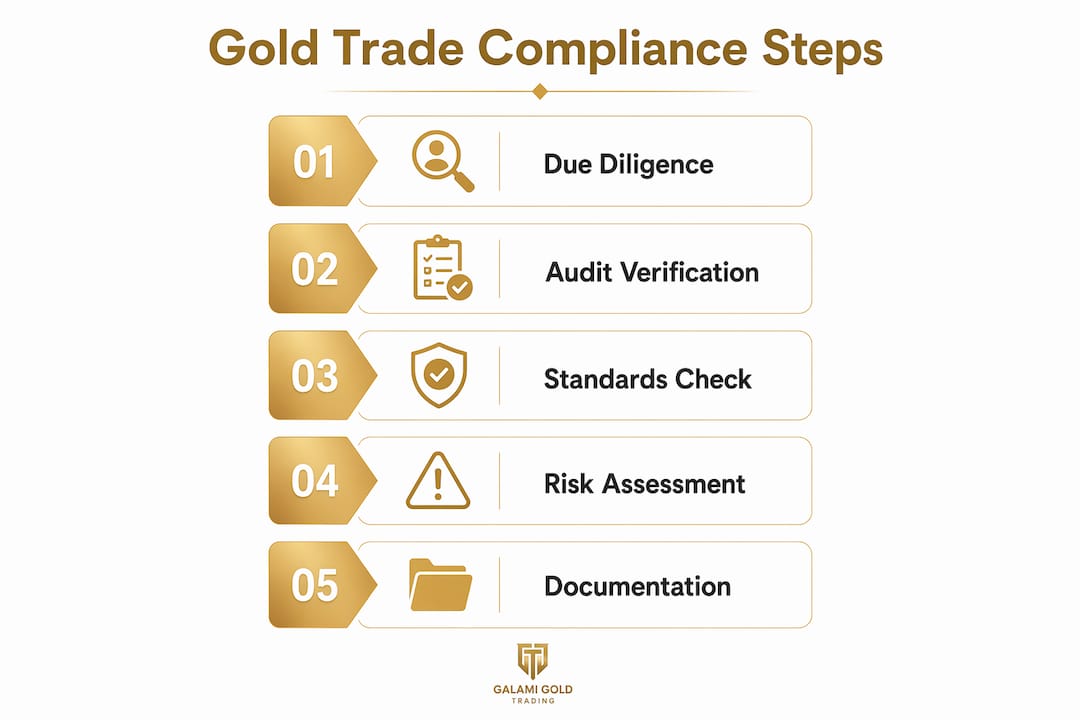
Compliance checklist for institutional programs:
- AML program verification: Confirm the counterparty maintains a FinCEN-registered AML program with documented policies, a designated compliance officer, independent testing, and ongoing training.
- Sanctions screening (OFAC): Screen all counterparties, beneficial owners, and origin countries against current OFAC SDN and consolidated sanctions lists before and during the trade lifecycle.
- Provenance documentation: Obtain refinery certificates, transport manifests, and chain-of-custody records tracing each bar from origin to current vault.
- Third-party assay verification: Require independent assay reports, not just refinery self-certification. Voluntary standards are best treated as baseline controls; independent assays manage residual risk that certifications alone cannot eliminate.
- Insurance and vault audits: Verify insurance limits, sub-limits, and the frequency of independent vault audits.
Red flags that warrant escalation: missing or incomplete audit reports, unverifiable chain-of-custody, cash-heavy provenance narratives, and assay certificates that do not match bar serial numbers or weights.
Pro Tip: Build sampling of independent assays and spot provenance audits into your periodic counterparty revalidation schedule, not just initial onboarding. Supply chains change; a clean onboarding file can become stale within 12 months.
How physical authenticity and custody eligibility are enforced
Assays, Good Delivery grading, and documented chain-of-custody are the gatekeepers of institutional liquidity. A bar that cannot prove its provenance faces a liquidity discount or outright rejection by custodians and clearing participants.
The typical documentation set institutions should require:
- Assay reports: Independent metallurgical analysis confirming purity (minimum 99.5% for Good Delivery) and weight
- Refinery certificates: Issued by an LBMA-accredited refiner confirming the bar meets Good Delivery specifications
- Good Delivery listing confirmation: Verification that the refinery of origin appears on the current LBMA Good Delivery List
- Transport manifests: Documented chain of physical custody from refinery through each transfer point to the receiving vault
- Vault receipts: Issued by an audited custodian confirming segregated or allocated storage
- Insurance certificates: Confirming coverage limits, perils insured, and the named insured party
Central banks and institutional investors regularly run gold upgrading programs to bring legacy holdings up to Good Delivery standards, because non-conforming bars face liquidity discounts and acceptance issues. The cost of upgrading should always be compared against the premium recovery and market-access benefits of full eligibility.
Audit frequency matters too. Institutions should accept nothing less than annual independent vault audits, with bar-level reconciliation reports available on request.
How standards affect trading timelines, fees, and documentation workflows
Standards increase up-front documentation requirements and add marginal cost, but they lower long-run liquidity discounts and counterparty costs. The trade-off is front-loaded friction for back-end market access.
A typical lifecycle from trade execution to physical delivery runs through several sequential steps:
- KYC/AML attestation: Completed before trade confirmation; can take 2–10 business days for new counterparties
- Assay verification: Independent assay review adds 1–3 business days if bars are not pre-certified
- Transfer of title: Documented via vault instruction and updated vault receipt; typically same-day to T+2 for allocated transfers
- Physical delivery or vaulting: Coordinated with insured transport and receiving vault; 3–7 business days for cross-border movements
Cost categories to budget for: compliance and AML program maintenance, assay and certification fees, transport and insurance, and annual vault audit costs. Set against those, the benefits are access to tighter bid-offer spreads in Good Delivery markets, eligibility for central clearing, and reduced liquidity discounts on exit.
For a structured view of how platform features affect settlement and custody costs, evaluating venues against these workflow stages is a practical starting point.
How do you evaluate trading platforms, custodians, and counterparties?
Prioritize verified provenance, LBMA or equivalent independent audits, FinCEN-compliant AML programs, and insured audited custody. Everything else is secondary.
Vendor due-diligence checklist:
- Evidence of Good Delivery eligibility or equivalent refinery certification for all bars offered
- Third-party audit reports (annual minimum) covering AML program, custody, and provenance
- Independent assay process with named assayer and methodology disclosed
- Insurance limits, sub-limits, and named-insured confirmation
- Segregation policy: allocated vs. pooled, and bar-level reconciliation availability
- Settlement mechanics: DvP capability and central clearing access where available
- Sanctions-screening protocols: frequency, list sources, and escalation procedures
- Reporting frequency: how often custody and pricing reports are issued, and in what format
Sample questions for counterparty diligence: What is your audit cadence and who conducts it? How do you handle a provenance dispute on a specific bar? What is your incident-response SLA if a bar fails assay post-delivery?
Galamigold provides institutional counterparties with a documentation package that includes chain-of-custody records, third-party audit attestations, and provenance verification, directly addressing items 1 through 4 on this checklist. Requesting that package at the start of onboarding is a practical way to benchmark any counterparty’s documentation standards.
Pro Tip: Ask for a sample audit report and a redacted provenance file before signing any mandate. A counterparty that hesitates to share those documents during diligence will not improve after capital is deployed.
For a portfolio transparency checklist that complements this gold-specific diligence, Marmot Finance’s five-point framework covers cost control and reporting standards relevant to institutional allocators.
Key Takeaways
Global standards in gold trade create the provenance, liquidity eligibility, and compliance infrastructure that U.S. institutional investors must verify before allocating capital to physical gold.
| Point | Details |
|---|---|
| LBMA Good Delivery is the liquidity gate | Bars without Good Delivery eligibility face liquidity discounts and custodian rejection. |
| Independent assays are non-negotiable | Certifications alone are insufficient; independent assays manage residual supply-chain risk. |
| FinCEN and OFAC alignment is mandatory | U.S. institutions must verify AML programs and run OFAC sanctions screening on every counterparty. |
| Central clearing reduces settlement risk | Exchange-traded or centrally cleared execution lowers counterparty exposure and improves capital efficiency. |
| Galamigold provides a documentation package | Galamigold supplies chain-of-custody records, third-party audit attestations, and provenance verification for institutional onboarding. |
Why standards are the only honest foundation for institutional gold
The conventional view treats compliance as a cost center. That framing misses the point entirely. Standards are what convert physical gold from a commodity with uncertain provenance into an asset that a fiduciary can actually defend to a board, an auditor, or a regulator.
What most allocators underestimate is the gap between certification and verification. An LBMA-accredited refinery has passed a process audit. That is meaningful. It is not, however, a guarantee that every bar in a given shipment is clean. The LBMA certification gives process-level assurance; independent assays and provenance audits give bar-level assurance. Institutions that conflate the two are carrying residual risk they have not priced.
The WGC’s Gold247 program and the GBI database are moving toward closing that gap by digitizing provenance at the bar level. That is the right direction. Until those systems achieve full market penetration, the practical answer is the same as it has always been: request the documents, verify independently, and revalidate periodically.
Galami treats standards as the operating premise, not an add-on. That is not a marketing position. It is the only way to serve institutional counterparties who cannot afford to discover a provenance problem after capital has been deployed.
Galamigold’s standards-aligned trading program
Physical gold trading that meets institutional documentation requirements is not the default in this market. Most platforms offer execution. Fewer offer the full documentation stack that a compliance team, auditor, or investment committee actually needs.

Galamigold aligns its trading, custody, and audit processes with LBMA, OECD, and FATF expectations, and provides institutional counterparties with the provenance and audit documentation to support internal compliance reviews. The offering covers physical gold supply and trading with chain-of-custody records, third-party attestations, and transparent pricing built into the engagement from day one.
To start a due-diligence conversation or request Galamigold’s audit and provenance package, contact the institutional desk directly through the Galamigold platform. Bring your compliance checklist. The documentation will be ready.
Authoritative sources for further reading
These sources support the diligence process and can be cited internally during procurement or compliance reviews. When onboarding any counterparty, request the specific documents named in each source.
- LBMA Market Standards: The primary reference for Good Delivery rules, Responsible Sourcing Programme requirements, and the Global Precious Metals Code. Request a counterparty’s current Good Delivery listing status and most recent Responsible Sourcing audit summary.
- LBMA — The Independent Precious Metals Authority: Overview of accreditation scope, including refinery system checks and participant eligibility for the Loco London market.
- World Gold Council — Market Structure Trends: Documents the regulatory-driven shift toward central clearing and the impact of capital rules on bank and non-bank liquidity provision.
- World Gold Council — Gold247 Program: Explains the GBI database, Wholesale Digital Gold, and Standard Gold Unit initiatives. Relevant for institutions evaluating digital provenance and tokenized gold structures.
- WGC — Expanding the Trusted Gold Ecosystem: Explains why London’s Good Delivery ecosystem functions as a curated network and what that means for liquidity planning.
- GI-TOC — Commodity Currency Crime: Analyzes how illicit gold markets exploit gaps in voluntary standards. Use this to justify independent assays and enhanced due diligence beyond certification.
- The Law Reporters — Global Rules and Gold Trade: Covers FATF DNFBP obligations, AML documentation expectations, and the role of fiscal policy in shaping official vs. informal gold flows.
- World Bank — Gold Upgrading Practices: Reference for institutional gold upgrading programs and the cost-benefit analysis of bringing legacy holdings to Good Delivery standards.
- Galamigold — AML Penalties and Gold Trading Regulations: Covers the compliance risks and AML penalty environment relevant to U.S. institutional gold traders.
This article is general information for institutional audiences, not legal, tax, or investment advice. Confirm current regulatory requirements with qualified legal counsel or your compliance team before executing transactions.
Recommended
- Understand ethical gold trading: standards, risks, and impact
- Step by Step Gold Transaction Process: 2026 Guide
- ISO 4217 XAU Explained: What the Gold Code Means
- Physical Gold Capital Management Guide for Institutions
Ready to invest in physical gold trade finance?
Both the Zambia–Dubai and Sierra Leone–Dubai programs are open to qualified investors. Minimum investments from $115,000 USD or €125,000 EUR.
Zambia–Dubai Program Sierra Leone–Dubai Program