
TL;DR:
- Ethical gold sourcing requires rigorous audits and transparency beyond superficial labels.
- Frameworks like LBMA and OECD set key standards but still have gaps risk actors may exploit.
- Combining certification, blockchain verification, and internal policies enhances risk management and trust.
Most institutional buyers assume that an ‘ethical gold’ label means the supply chain behind it is clean. In reality, sourcing gold ethically involves navigating a web of certifications, audit cycles, and disclosure requirements that vary widely in rigor. For high-net-worth individuals and institutional investors, the gap between a credible framework and a superficial label can translate directly into reputational, regulatory, and financial exposure. This guide cuts through the noise, examining the frameworks that actually matter, what audits and certifications look like in practice, and how to build a sourcing strategy that holds up under scrutiny.
Table of Contents
- Defining ethical gold trading: Standards and frameworks
- Audit, certification, and transparency requirements
- Sourcing models: Mined, recycled, and Fairmined gold
- Risk management and red flags in ethical gold trading
- Our perspective: Why transparency still falls short and what forward-looking investors do differently
- Invest ethically with Galami Gold
- Frequently asked questions
Key Takeaways
| Point | Details |
|---|---|
| Global standards matter | Adherence to LBMA and OECD frameworks is the foundation of ethical gold trading. |
| Transparency is critical | Third-party audits and supply chain disclosure ensure investor confidence in ethical sourcing. |
| Not all ethical sources are equal | Recycled and Fairmined gold offer different trade-offs in risk and societal impact. |
| Risk management is ongoing | Red flags and evolving regulations mean due diligence cannot be a one-time activity. |
| Premiums protect reputation | Paying more for verified ethical sourcing hedges against reputational and regulatory risks. |
Defining ethical gold trading: Standards and frameworks
Before we analyze the intricacies, let’s clarify what genuinely qualifies as ethical gold trading and which frameworks govern it.
Ethical gold trading is not simply about avoiding conflict zones. It means sourcing gold through supply chains that are audited for environmental harm, human rights compliance, and anti-money laundering controls. Two frameworks sit at the center of this: the LBMA Responsible Gold Guidance and the OECD Due Diligence framework. Both are recognized globally and form the baseline expectation for any serious institutional trading program.
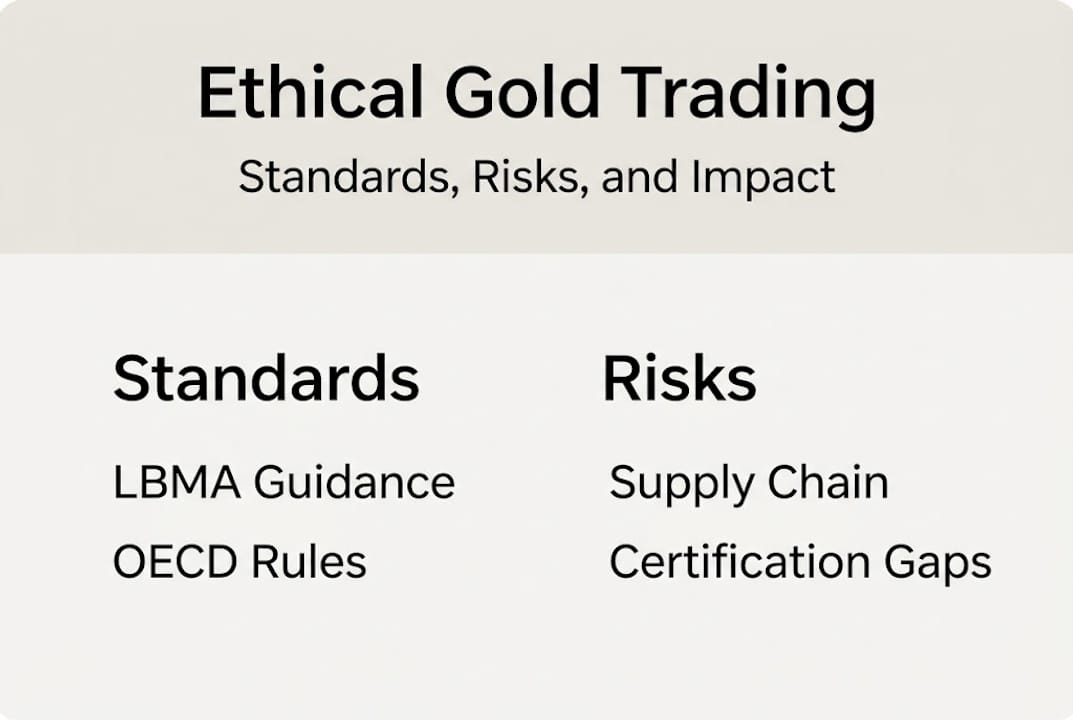
The LBMA Responsible Gold Guidance applies to refiners on the Good Delivery List and requires annual third-party audits. It covers five key areas: management systems, identifying and assessing risks, designing and implementing a strategy to respond to risks, third-party audit, and reporting. These map almost directly onto the 5-step OECD due diligence methodology, which was designed for companies sourcing minerals from conflict-affected and high-risk areas.
Here is how the major frameworks compare at a glance:
| Framework | Scope | Audit requirement | Public disclosure |
|---|---|---|---|
| LBMA Responsible Gold | Refiners on Good Delivery List | Annual third-party | Partial, expanding in 2026 |
| OECD Due Diligence | All supply chain actors | Ongoing self-assessment | Recommended |
| Fairmined | Artisanal and small-scale miners | Annual third-party | Yes |
| Certified recycled gold | Secondary processors | Chain-of-custody audit | Varies by certifier |
In 2026, the LBMA achieved an 89% alignment score with the EU Conflict Minerals Regulation, a meaningful benchmark that signals increased disclosure expectations for refiners. This is not a perfect score, and that 11% gap matters when you are deploying significant capital.
Key distinctions worth knowing:
- Fairmined gold supports artisanal and small-scale mining (ASM) communities with fair wages and environmental standards, verified by the Alliance for Responsible Mining
- Certified recycled gold reduces new mining demand but introduces its own laundering risks if chain-of-custody controls are weak
- LBMA-certified refiners operate at an industrial scale and are subject to the most rigorous annual audits in the sector
Understanding gold trading standards at this level is not optional for institutional investors. It is the foundation of a defensible ESG position. The framework you choose to prioritize should reflect both your risk tolerance and your stakeholder reporting obligations. Building trust in gold trading starts with knowing which standards carry real weight.
Audit, certification, and transparency requirements
Now that you know the gold-standard frameworks, let’s examine what actually happens behind the scenes and what transparency really looks like.
An annual third-party audit under LBMA Responsible Gold Guidance v9 is not a checkbox exercise. Auditors review management policies, trace specific gold shipments, interview staff, and assess whether the refiner has adequate controls for identifying high-risk supply sources. Starting in 2026, the LBMA’s transparency roadmap mandates disclosure of high-risk suppliers, a significant step toward public accountability that investors should actively track.
Here is a side-by-side comparison of what strong versus weak certification looks like in practice:
| Indicator | Strong certification | Weak certification |
|---|---|---|
| Audit frequency | Annual, independent third-party | Self-reported or infrequent |
| High-risk supplier disclosure | Publicly available | Withheld or vague |
| Chain-of-custody documentation | Full traceability to source | Partial or undocumented |
| Regulatory alignment | LBMA, OECD, EU CMR | Single-body or regional only |
| Corrective action process | Documented and time-bound | Ad hoc or absent |
“Transparency in gold trading is not just about what a refiner discloses today. It is about whether their systems can withstand scrutiny tomorrow when regulations tighten further.”
For investors evaluating gold traders, a practical due diligence checklist should include: confirmation of current LBMA Good Delivery status, access to the most recent third-party audit summary, evidence of corrective actions taken on prior findings, and disclosure of any suppliers flagged as high-risk.
Pro Tip: Do not accept a certification date older than 14 months. Audit cycles are annual, and a lapsed certificate is a meaningful red flag in a sector where supply chains shift quickly.
The mandatory disclosure trend is accelerating. Regulators in the EU and increasingly in the US are pushing for standardized public reporting on conflict mineral sourcing. Investors who demand this information now are positioning themselves ahead of requirements that will likely become compulsory within the next two to three years.
Sourcing models: Mined, recycled, and Fairmined gold
With audit and transparency standards in focus, let’s break down the main sourcing models and how their trade-offs might affect your investment decisions.
There are three primary sourcing models available to institutional buyers in 2026: newly mined gold, certified recycled gold, and Fairmined artisanal gold. Each carries a distinct risk and impact profile.
- Newly mined gold from LBMA-certified refiners offers the most established audit trail and regulatory coverage, but carries environmental impact from extraction
- Certified recycled gold reduces the demand for new mining, which has real environmental benefits, but recycled gold risks laundering illicit material into legitimate supply chains without rigorous chain-of-custody verification
- Fairmined gold directly supports ASM communities, improving livelihoods and local environmental practices, but typically carries a higher price premium and lower volume availability
Key statistic: Ethical gold premiums currently average 10 to 15% above standard spot prices, reflecting the real cost of certification, auditing, and supply chain management.
The recycled gold challenge deserves specific attention. Because secondary gold can originate from jewelry, electronics, or industrial sources, it is harder to trace back to a single origin point. Bad actors have exploited this ambiguity to blend illicit gold into recycled streams. This is not a theoretical risk. It is a documented pattern that regulators and compliance teams are actively working to close.

For institutions with both ESG reporting obligations and AML compliance requirements, a blended sourcing strategy often makes the most sense. You might prioritize LBMA-certified mined gold for volume and traceability, supplement with certified recycled gold from processors with strong chain-of-custody systems, and allocate a smaller portion to Fairmined gold to support social impact goals.
The 2026 gold trading regulations now place greater scrutiny on recycled gold processors, making it even more important to verify the specific certifier and audit history before committing capital.
Risk management and red flags in ethical gold trading
Understanding sources isn’t enough. Risk exposure in ethical gold trading is a moving target that every serious investor must actively manage.
A structured approach to risk management in ethical gold trading involves three ongoing steps: establishing clear internal policies that define acceptable sourcing standards, conducting geographic and supplier screening to identify elevated-risk counterparties, and maintaining a schedule of ongoing audit reviews rather than relying on point-in-time assessments.
Common red flags that should trigger enhanced due diligence:
- Sudden changes in a supplier’s declared country of origin without explanation
- Vague or inconsistent disclosures about refinery affiliations
- Suppliers operating in jurisdictions flagged by the FATF as high-risk for money laundering
- Certifications from bodies with no publicly accessible audit methodology
- Pricing significantly below market rates, which can indicate undisclosed sourcing
Edge cases are where the real complexity lives. ASM gold mixing with conflict material is a persistent problem in certain West African and Latin American corridors. Recycled gold laundering loopholes remain partially open even under current frameworks. The LBMA’s 89% EU CMR alignment means auditor oversight standards are still not fully harmonized, creating gaps that sophisticated bad actors can exploit.
Pro Tip: Blockchain-based traceability platforms now allow institutional buyers to verify gold provenance at the batch level. Requiring your trading counterparty to provide on-chain provenance data is no longer an unreasonable ask. It is becoming an industry expectation.
Certification premiums are not just a cost. They function as insurance. An institution holding gold from a fully audited, LBMA-certified source is far better positioned to absorb a future regulatory change or reputational event than one holding gold with a thinner paper trail. Explore risk management for gold trading and partner risk management techniques to build a more resilient framework. For portfolio-level thinking, optimizing gold trading risk and risk in gold investment strategies offer practical guidance on structuring positions.
Our perspective: Why transparency still falls short and what forward-looking investors do differently
Having dissected the rules and realities, here is what most guides won’t tell you.
LBMA and OECD standards are genuinely important. But treating them as a finish line rather than a starting point is where many institutions go wrong. An 89% alignment score with the EU CMR is progress. It is also a public admission that 11% of the framework remains unresolved. For recycled and ASM gold, the integrity challenges are not hypothetical edge cases. They are structural features of supply chains that were not designed with full traceability in mind.
The institutions that are actually winning on ethical gold in 2026 are not just checking certification boxes. They are layering certifications with on-chain verification, conducting direct site audits on key suppliers, and building internal expertise to evaluate audit quality rather than simply accepting audit existence. Institutional trust in gold trading is earned through systems, not labels.
Loopholes are closing, but slowly. Investors who stay ahead of the curve by demanding both transparency and verifiable traceability are not just managing risk. They are building a competitive advantage that will matter more as regulations tighten.
Invest ethically with Galami Gold
If you’re ready to implement robust ethical trading into your portfolio, here’s how Galami Gold can help.
Galami Gold sources exclusively from LBMA Good Delivery and certified Fairmined channels, giving institutional and high-net-worth clients a fully audited, transparent entry point into physical gold. Every position is backed by documented chain-of-custody records, current third-party audit reports, and clear risk disclosure for gold investment.

Our team works directly with sophisticated investors who need more than a certificate. They need a counterparty that understands the nuances of sourcing models, audit quality, and regulatory exposure. Explore our audited gold trading solutions and connect with our team to discuss how ethical gold fits your capital deployment strategy.
Frequently asked questions
What makes gold trading ‘ethical’ in 2026?
Ethical gold trading is defined by certified, transparent sourcing that upholds rigorous environmental, social, and governance standards, audited by LBMA and aligned with OECD due diligence frameworks. It goes well beyond a single label or certification.
Is recycled gold always ethical?
No. Recycled gold reduces mining demand but can be used to launder illicit gold unless the supply chain is fully verified with chain-of-custody checks. Always verify the certifier and audit methodology before accepting recycled gold as ethically sourced.
What are ethical gold premiums, and are they worth it?
Ethical gold premiums run 10 to 15% above standard spot prices, reflecting certification and audit costs. For institutional investors, that premium also buys meaningful protection against reputational damage and future regulatory penalties.
How can blockchain help ethical gold trading?
Blockchain provides end-to-end digital traceability for gold supply chains, allowing buyers to verify the origin and movement of specific gold batches in a way that paper-based audit trails cannot match. It is becoming a practical requirement for serious institutional sourcing programs.
Recommended
- Why trust matters in gold trading: Safeguarding institutional investments
- Institutional Gold Broker Checklist: 2026 Vetting Guide
- How to Select Gold Partners: Institutional Guide 2026
- How to Ensure Transparency in Institutional Gold Trading
Ready to invest in physical gold trade finance?
Both the Zambia–Dubai and Sierra Leone–Dubai programs are open to qualified investors. Minimum investments from $115,000 USD or €125,000 EUR.
Zambia–Dubai Program Sierra Leone–Dubai Program