
TL;DR:
- Gold’s reputation as a stable asset creates a dangerous blind spot amid rising transparency failures in global supply chains. Trust in gold trading now directly influences access to quality counterparties, costs, and long-term portfolio performance due to opaque supply lines and compliance risks. Building verifiable transparency through provenance tracking, audits, and digital ledger systems is essential for institutional resilience and regulatory adherence.
Gold trading’s reputation as a stable, time-tested asset class can create a dangerous blind spot. Declared gold import and export discrepancies increased 400% between 2020 and 2024, exposing the scale of transparency failures quietly accumulating across global supply chains. For institutional investors and wealth managers, this is not a background compliance issue. It directly determines your access to quality counterparties, your cost of capital, your regulatory exposure, and your portfolio’s long-term performance. Trust is now operational, quantifiable, and non-negotiable.
Table of Contents
- The hidden risks: Why trust is non-negotiable in gold trading
- How transparent supply chains build institutional confidence
- Regulatory compliance: The linchpin for sustainable gold portfolios
- Building a resilient gold portfolio: Practical steps for institutions
- Why trust is now the alpha in gold: What most institutions still get wrong
- Enhance your gold trading strategy with trusted partners
- Frequently asked questions
Key Takeaways
| Point | Details |
|---|---|
| Transparency drives trust | Open, auditable supply chains are essential for institutional gold trading confidence. |
| Compliance mitigates risk | Strict adherence to AML/KYC regulations protects portfolios from costly disruptions. |
| Trust enables higher returns | Institutions with trusted trading partners secure better terms and expanded diversification. |
| Platform diligence is crucial | Focusing due diligence on systems and controls—not just counterparties—yields lasting gold portfolio security. |
The hidden risks: Why trust is non-negotiable in gold trading
The assumption that established gold markets self-regulate is outdated. The real risk landscape facing institutions today is defined by opaque supply chains, documentation gaps, and counterparties who treat compliance as a checkbox rather than a system.
Supply chain documentation gaps allow illicit gold and laundering pathways, which means institutions that fail to enforce robust assurance controls become unwitting participants in financial crime. The consequences extend well beyond fines. Regulatory sanctions, forced asset liquidation, and reputational damage can unwind years of portfolio construction in months.
How trust shapes gold trading strategies is something most wealth managers understand in theory but underinvest in practice. The categories of risk institutions face are more varied than commonly acknowledged:
- Regulatory risk: Anti-money laundering (AML) failures and Know Your Customer (KYC) shortfalls can trigger enforcement actions from regulators in multiple jurisdictions simultaneously.
- Pricing manipulation risk: Opaque pricing mechanisms, particularly in over-the-counter physical gold trades, create opportunities for bid-ask manipulation that erode institutional returns invisibly.
- Supply chain origin risk: Gold sourced from conflict-affected or high-risk areas carries sanctions exposure and reputational liability, especially if downstream documentation cannot establish a clean chain of custody.
- Counterparty insolvency risk: Traders who lack transparent financials and verifiable reserves represent concentration risk that standard due diligence processes often miss.
Statistic callout: The OECD’s 2025 maritime gold report found that gold concentrates are particularly vulnerable to trade-based money laundering, with traceability gaps and mis-invoicing identified as the primary mechanisms. Institutional portfolios exposed to these supply chains face compounding risk across regulatory, pricing, and reputational dimensions simultaneously.
Market volatility and transparency are closely linked. When market conditions shift and gold prices move sharply, transparency gaps in your supply chain become acute liabilities rather than latent risks. Institutions that have not invested in traceability infrastructure tend to discover this at the worst possible moment.
Pro Tip: Map every counterparty in your gold supply chain against a standardized risk matrix at least annually. Focus specifically on documentation completeness, third-party audit frequency, and AML program maturity, not just credit ratings or relationship tenure.
Effective risk management in gold trading requires moving beyond relationship-based assurance toward process-based verification. The institutions that avoid regulatory and financial damage are those who treat trust as an infrastructure investment, not an assumption.
How transparent supply chains build institutional confidence
Addressing the risk landscape requires more than awareness. Institutions need practical frameworks that translate transparency principles into verifiable operational standards.
Weak due diligence allows beneficiary blending and processing to obscure gold origin, undermining trust at the most fundamental level. When refiners or traders blend concentrate batches from multiple sources, provenance tracking breaks down unless digital ledger systems capture each transaction in real time. Understanding transparency requirements in gold trading is the starting point for institutional due diligence that actually holds up.
The four practical transparency standards that institutional-grade gold trading platforms must demonstrate are:
- Provenance tracking: Every lot of physical gold should carry documented origin data traceable to the mine or refinery, verified by an independent party.
- Audit trails: Transaction records should be immutable, timestamped, and accessible to institutional clients and regulators on demand.
- Third-party verification: External auditors with recognized credentials should certify both financial claims and supply chain representations, separately.
- Digital ledger systems: Distributed ledger technology, when properly implemented, removes single points of failure in documentation and provides near real-time traceability.
The outcomes gap between transparent and opaque gold sourcing is measurable. Here is how institutional results differ across key dimensions:
| Dimension | Transparent sourcing | Opaque sourcing |
|---|---|---|
| Regulatory exposure | Low; documentation supports AML/KYC filings | High; gaps trigger enforcement reviews |
| Pricing terms | Competitive; trust premium attracts better counterparties | Discounted; risk markup inflates effective cost |
| Audit readiness | Immediate; records available on demand | Delayed; reconstructing records increases audit cost |
| Portfolio diversification | Easier; reputable platforms have broader market access | Restricted; compliance flags limit counterparty options |
| Reputational risk | Contained; provenance documentation provides defense | Elevated; association with illicit sources creates liability |
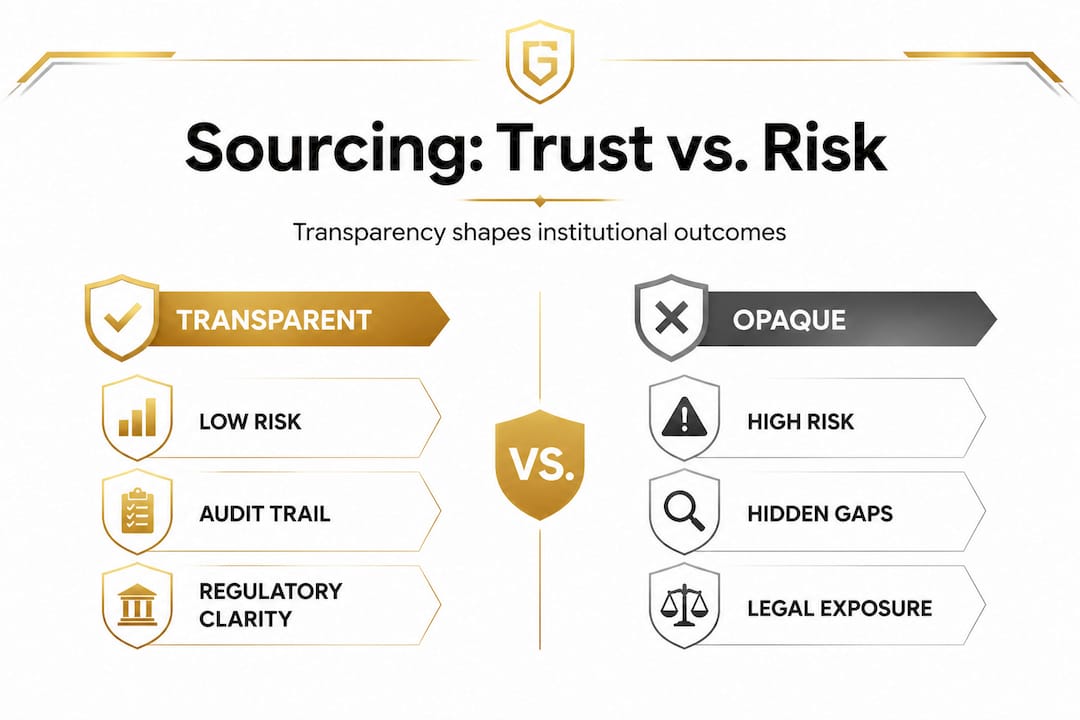
Trends in transparent gold trading show that platforms committed to provenance standards consistently attract more institutional capital, particularly from sovereign wealth funds and regulated pension vehicles that face their own fiduciary transparency obligations.
When evaluating a supplier’s transparency, use a structured sequential approach rather than relying on reputation alone:
- Request the full documentation package covering origin certificates, refinery certifications, and custody transfer records for a representative sample of recent transactions.
- Verify third-party audit credentials by contacting the auditing firm directly, confirming audit scope, frequency, and findings independently of what the supplier reports.
- Assess digital traceability systems by asking for a live demonstration of how the platform tracks a specific gold lot from origin to delivery.
- Cross-reference regulatory filings with the relevant jurisdiction’s public records to confirm AML program registration and any prior enforcement history.
- Interview operational staff, not just relationship managers. The people processing documentation daily will reveal whether transparency is a system or a sales message.
Pro Tip: Require that every prospective gold trading partner provide you with an unredacted copy of their most recent third-party supply chain audit. If they hesitate or offer only summaries, treat that as a significant negative signal regardless of their market standing.
Building trust on trading platforms is a discipline that must be actively reinforced at every stage of the relationship, not just at onboarding. Institutional confidence compounds over time when transparency standards are consistently applied and verified.

Regulatory compliance: The linchpin for sustainable gold portfolios
Transparency and compliance are related but distinct. An institution can have transparent internal processes while still failing to meet evolving external regulatory requirements. The two must operate together.
Declared import and export discrepancies equal to one-third of market value by 2024 illustrate the systemic scale of regulatory failure in global gold markets. For institutions, the practical implication is that trading partners operating in jurisdictions with weak enforcement may appear compliant on paper while routinely understating volumes or misclassifying shipments.
“Institutions that treat AML and KYC compliance as a static checklist rather than a dynamic risk management function are operating with a fundamental blind spot. The regulatory environment for gold trading is not stable. It is accelerating.”
Understanding AML penalties in gold trading is essential for any institution currently reviewing its counterparty roster. Penalties are no longer limited to fines. Regulators in the EU, UK, and US are increasingly pursuing individual accountability, asset freezes, and trading license revocations.
Here is how compliance maturity levels translate into operational practice:
| Compliance level | AML program structure | KYC depth | Monitoring frequency | Outcome |
|---|---|---|---|---|
| Basic | Written policy only; manual review | Identity verification at onboarding | Annual | Minimum threshold; high residual risk |
| Intermediate | Risk-based controls; periodic training | Enhanced due diligence for high-risk counterparties | Quarterly | Adequate for most regulated jurisdictions |
| Advanced | Real-time transaction monitoring; AI-assisted screening | Continuous beneficial ownership verification | Ongoing | Institutional best practice; minimal regulatory exposure |
Moving from basic to advanced compliance is not simply a cost center. The financial upsides of compliance-first investing are concrete and compounding:
- Lower cost of capital: Institutions with strong compliance records attract better financing terms because lenders and custodians assign lower risk premiums to well-governed gold portfolios.
- Expanded counterparty access: Tier-one banks, sovereign entities, and regulated exchanges increasingly restrict access to counterparties who cannot demonstrate advanced compliance programs.
- Faster transaction execution: When documentation is complete and compliance systems are integrated, trade settlement timelines compress significantly, freeing capital for redeployment.
- Reduced insurance costs: Custodians and underwriters price compliance maturity directly into physical gold insurance and custody fees.
Evaluating gold trading compliance is not a one-time exercise. Build compliance re-evaluation into your annual counterparty review cycle, and treat any regulatory change in a trading partner’s jurisdiction as an automatic trigger for an out-of-cycle assessment.
Building a resilient gold portfolio: Practical steps for institutions
Principle and framework are only useful when they translate into action. Portfolio managers and due diligence officers need a clear, sequenced process for turning trust-building into portfolio resilience.
Robust transparency and assurance controls are central to institutional confidence and risk management, according to the OECD. That finding should anchor how you prioritize resources across your gold portfolio operations.
Practical steps for institutions ready to act:
- Audit your current sources immediately. Map every active trading relationship against the transparency and compliance criteria outlined above. Identify gaps without waiting for a regulatory trigger or market event to force the review.
- Upgrade your due diligence documentation standards. Replace questionnaire-based onboarding with evidence-based verification. Require primary source documents, not summaries or representations from the counterparty themselves.
- Establish minimum transparency thresholds. Define non-negotiable standards for provenance tracking, audit frequency, and compliance program maturity, and apply them consistently across every counterparty regardless of relationship history.
- Partner only with platforms that can demonstrate real-time traceability. If a trading partner cannot show you live supply chain data for a specific transaction, they have not built the infrastructure necessary for institutional-grade trust.
- Create a trust performance scorecard. Review counterparties against your transparency and compliance criteria quarterly. Treat declining scores as early warning signals, not administrative observations.
Pro Tip: Invest in technology-enabled traceability systems now rather than waiting for regulatory mandates. Blockchain-based provenance tracking tools and automated AML screening platforms are already priced competitively for institutional use. The cost of adoption is a fraction of a single enforcement action or forced divestment.
The evidence from institutions that have already made this shift is consistent. Stronger trust translates directly into lower risk-adjusted costs, better trading terms, and access to diversification opportunities that opaque supply chains simply cannot offer. The guide for building trust in gold trading process is learnable and scalable, and the compounding benefits begin accumulating from the first rigorous audit.
Trust in gold investment is not a soft preference. It is the single most reliable predictor of long-term portfolio performance across regulatory, financial, and operational dimensions.
Why trust is now the alpha in gold: What most institutions still get wrong
Here is an uncomfortable observation: most institutional investors still equate trust with familiarity. They stay with established counterparties not because those counterparties have earned continued trust, but because switching costs feel high and the relationship is comfortable. That logic is increasingly expensive.
Recent data shows that counterparty reputation, by itself, is a lagging indicator. The institutions that suffered the most significant compliance failures over the past five years were almost universally partnered with well-known names in the market. The problem was not who they were trading with. It was the absence of process-level and platform-level transparency in those relationships. Name recognition is not an assurance control.
The shift that genuinely creates alpha in gold today is moving diligence away from paper credentials and toward operational and technological transparency. Ask yourself: can you trace a specific lot of gold in your portfolio from mine to vault in under 24 hours? If the answer is no, your trust is theoretical, not operational. That gap is precisely where regulatory risk, pricing manipulation, and supply chain origin exposure accumulate.
Sophisticated institutions are also recognizing that gold trust portfolio strategies must include an explicit willingness to exit legacy relationships when those relationships cannot meet modern transparency standards. That is a harder conversation than it sounds. Long-standing counterparties often push back on enhanced due diligence requirements, framing them as bureaucratic overreach or relationship friction. Institutions that hold firm consistently report better outcomes. Those that defer to relationship comfort tend to discover their exposure the hard way.
The true alpha in gold is not found in price timing or geographic arbitrage. It is found in refusing to compromise on trust at every stage of the supply chain, even when it creates short-term friction. The institutions that internalize this principle earliest will have the strongest, most defensible gold portfolios in the market.
Enhance your gold trading strategy with trusted partners
Acting on these frameworks requires more than internal discipline. It requires partners whose infrastructure, audit practices, and compliance programs can genuinely support institutional-grade trust.

Galami Gold operates as a physical gold trading platform built on disciplined execution, end-to-end transparency, and rigorous supply chain management. Every trading relationship is structured around verifiable provenance, independent audit trails, and compliance-first processes that meet the standards institutional investors need to protect their portfolios. If you are ready to move beyond paper credentials and build a gold trading program grounded in operational trust, explore the institutional gold trading benefits that a transparency-first platform delivers. To review audited, compliant solutions for your physical gold allocation, visit Galami Gold and connect with the team today.
Frequently asked questions
What are the main trust risks when trading gold internationally?
Major risks include supply chain opacity, documentation gaps, and exposure to illicit sources or trade-based money laundering. Gold concentrates are particularly vulnerable to mis-invoicing and traceability gaps that allow laundering pathways to go undetected.
How does regulatory compliance impact institutional gold trading?
Adhering to AML and KYC regulations enhances trust and reduces exposure to penalties or supply chain disruptions. Import and export discrepancies increased 400% between 2020 and 2024, illustrating how widespread compliance failures are across the market.
Which best practices can institutions use to verify gold trading partners?
Institutions should demand transparent provenance records, third-party audits, and robust digital traceability tools. Assurance controls and transparency are the OECD’s identified foundations for institutional confidence in gold supply chains.
Does trust impact pricing or access in gold trading?
Yes, higher trust and transparency generally yield better terms, pricing, and portfolio diversification opportunities. Counterparties and custodians price compliance maturity directly into fees, financing rates, and market access, making trust a measurable financial input rather than an intangible quality.
Recommended
- How to Ensure Transparency in Institutional Gold Trading
- The Role of Governance in Gold Trading: 2026 Guide
- Gold trading transparency checklist: Protect your portfolio
- Forex Trading Security Checklist: Protect Accounts & Copy Safely
Ready to invest in physical gold trade finance?
Both the Zambia–Dubai and Sierra Leone–Dubai programs are open to qualified investors. Minimum investments from $115,000 USD or €125,000 EUR.
Zambia–Dubai Program Sierra Leone–Dubai Program