
TL;DR:
- Governance in gold trading involves rules, oversight, and compliance controls that shape market operation. It prevents illicit activity, influences prices, and attracts institutional capital through independent oversight. Effective governance relies on licensing, transaction reporting, continuous monitoring, and institutional separation to ensure market integrity.
Governance in gold trading is defined as the system of rules, regulatory oversight, compliance obligations, and institutional controls that determine how gold markets operate and who participates in them. The role of governance in gold trading extends well beyond paperwork. It shapes price discovery, prevents illicit capital flows, and determines whether a market attracts institutional capital or repels it. Regulatory bodies such as the Financial Action Task Force (FATF), national financial intelligence units, and self-regulatory organizations (SROs) form the backbone of this system. Without enforceable governance, gold’s high liquidity makes it one of the most exploitable assets in global finance.
How does governance shape gold trading practices?
Governance frameworks translate abstract regulatory principles into concrete trading obligations. Licensing, transaction reporting, customer due diligence, and continuous monitoring are the four pillars that define how governance affects gold prices and market behavior.

Licensing is the entry point. Dealers and refiners must register with national authorities before operating. This requirement filters out unqualified participants and creates a traceable record of who is active in the market. Registration also subjects traders to periodic audits, which raises the cost of non-compliance and deters bad actors.
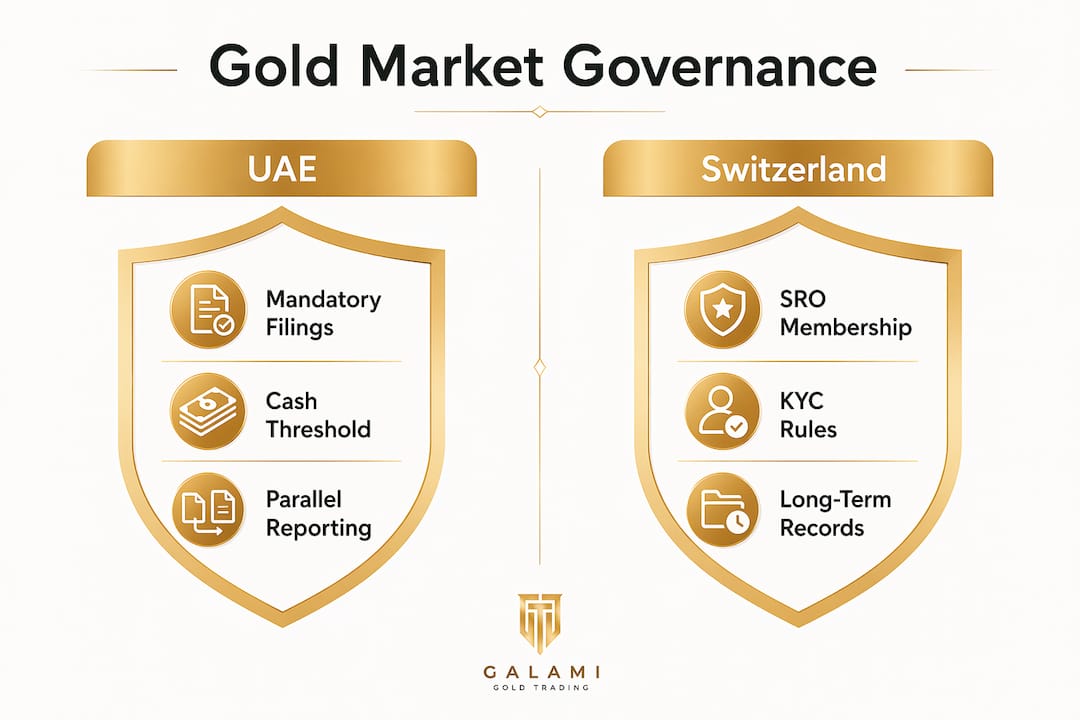
Transaction reporting is the most visible governance mechanism. The UAE requires Dealers in Precious Metals and Stones (DPMS) to file cash transaction reports for amounts at or above AED 55,000, with penalties reaching AED 5,000,000 for non-compliance. That penalty ceiling is not a theoretical maximum. Regulators in Dubai have imposed significant fines on firms that failed to distinguish between mandatory cash transaction filings and suspicious transaction reports (STRs), two parallel regimes that must both be satisfied.
Switzerland sets a different threshold. Gold spot traders must join a FINMA-approved SRO and conduct Know Your Customer (KYC) checks for transactions exceeding CHF 25,000, with transaction records kept for 10 years. The decade-long record-keeping requirement reflects a deliberate policy choice: regulators want enough historical data to reconstruct suspicious patterns years after they occur.
Pro Tip: Treat KYC and transaction reporting as two separate compliance tracks. Passing one does not satisfy the other. Many enforcement actions stem from firms that completed onboarding checks but skipped ongoing monitoring.
Continuous monitoring is where most firms fall short. Daily sanctions screening against global watchlists is mandatory in the UAE and Switzerland, not a one-time onboarding step. Investors and institutional traders evaluating counterparties should verify that their partners maintain live screening programs, not just static onboarding files.
- Register with the relevant national authority and obtain the required trading license.
- Implement a KYC program calibrated to your jurisdiction’s transaction thresholds.
- File cash transaction reports within the required window (14 days in the UAE).
- Submit STRs separately, without tipping off the subject.
- Run daily sanctions screening against OFAC, UN, and EU consolidated lists.
- Retain all transaction records for the minimum statutory period.
What are the key governance differences across major gold markets?
Gold governance is not uniform. Each major trading hub applies its own regulatory architecture, and those differences carry real compliance costs and market transparency implications.
UAE: Mandatory filings and parallel reporting regimes
The UAE’s DPMS framework is among the most detailed in the world. The AED 55,000 reporting threshold applies to cash transactions specifically, while STRs cover any transaction that raises suspicion regardless of amount. Firms that conflate the two regimes face enforcement actions even when their aggregate reporting volume looks adequate. The independence of compliance officers is also a formal requirement. Family-run trading firms in Dubai face particular scrutiny here, because regulators recognize that internal conflicts of interest undermine AML effectiveness.
Switzerland: Institutional membership and long-term records
Switzerland’s model centers on SRO membership as a precondition for operating. The FINMA-approved SRO acts as a first-line regulator, conducting its own audits before national authorities intervene. The CHF 25,000 KYC threshold and the 10-year record-keeping requirement reflect a philosophy that gold trading oversight must be durable, not just current.
Thailand: Volume-based reporting to the central bank
Thailand takes a different approach. Gold traders whose annual volumes exceed 10 billion baht must report transaction data directly to the central bank. This volume-based trigger means smaller dealers operate under lighter oversight, while high-volume traders face direct central bank scrutiny. The model improves transparency at the top of the market but leaves mid-tier traders in a regulatory gray zone.
Key implications for market participants across these three jurisdictions:
- Compliance costs scale with transaction volume and jurisdictional complexity.
- Firms operating across multiple markets must maintain parallel compliance programs.
- Reporting failures in one jurisdiction can trigger cross-border regulatory inquiries.
- Investors should request documented compliance histories from counterparties before executing large trades.
Why does institutional governance structure matter for market integrity?
The structure of the institution that governs gold trading matters as much as the rules it enforces. Ghana’s GoldBod offers the clearest recent example of why institutional design is not a secondary concern.
GoldBod was established to separate commercial gold trading from regulatory oversight previously held by the Minerals Commission. The core problem it addressed was a conflict of interest: when one agency both regulates the market and participates in it commercially, neither function works well. Merging regulatory and commercial roles within a single agency harms market trust, deters private investment, and limits transparency. That finding applies beyond Ghana. Any governance structure that allows a regulator to profit from the market it oversees creates an incentive to protect incumbents rather than enforce rules.
Institutional separation produces measurable benefits:
- Clearer accountability, because each entity has a defined and non-overlapping mandate.
- Greater competition, because the regulator cannot favor its own commercial arm.
- Stronger foreign exchange inflows, because international buyers trust markets with independent oversight.
- Reduced operational risk for central banks, since decoupling gold trading from central bank balance sheets protects monetary policy from commodity market volatility.
Pro Tip: When evaluating a gold market or counterparty, ask whether the entity that sets the rules also trades in the market. If the answer is yes, apply additional due diligence to every transaction.
The practical challenge for institutional governance is traceability. Separating regulatory and commercial functions is necessary but not sufficient. Markets also need technology that tracks physical custody in real time. Blockchain-based audit trails and digital chain-of-custody tools are moving from pilot programs to operational requirements in several jurisdictions. Investors who rely on gold trading standards built around physical verification will find these tools increasingly central to counterparty evaluation.
How does trade-based money laundering threaten gold governance?
Trade-based money laundering (TBML) is the most persistent governance challenge in gold markets. Gold’s portability, high value density, and global liquidity make it the preferred vehicle for criminal networks moving value across borders.
Gold’s high liquidity makes it attractive for money laundering schemes. Financial institutions must treat gold supply chain due diligence as a core compliance obligation, not a peripheral check. Criminal networks have demonstrated the capacity to control entire supply chains, from mining to refining to retail, making external certifications alone an insufficient defense.
The compliance response to TBML requires a shift in mindset. Gold sector governance is evolving toward mandatory internal audits and real-time supply chain monitoring, moving well past reliance on third-party certifications. A Fairtrade or Responsible Jewellery Council certification tells you something about a supplier’s practices at the time of audit. It tells you nothing about what happened in the supply chain last Tuesday.
Effective TBML mitigation follows a specific sequence:
- Map the full supply chain from origin to delivery, identifying every custody transfer point.
- Conduct real-time auditing of physical custody, not just document review.
- Screen all counterparties against sanctions lists before and during each transaction.
- File STRs promptly when transaction patterns deviate from established customer behavior.
- Engage independent AML auditors, particularly in firms where ownership and compliance functions overlap.
The AML penalties for TBML failures are severe across every major jurisdiction. Beyond fines, enforcement actions can result in license revocation, reputational damage, and criminal referrals. Policymakers designing governance frameworks should treat TBML not as an edge case but as the central threat model.
Key Takeaways
Effective governance in gold trading requires institutional separation, continuous compliance monitoring, and real-time supply chain auditing to maintain market integrity and prevent illicit activity.
| Point | Details |
|---|---|
| Transaction reporting is mandatory | UAE requires DPMS filings for cash above AED 55,000; Switzerland mandates KYC above CHF 25,000. |
| Institutional separation reduces risk | Separating regulatory and commercial roles, as Ghana’s GoldBod demonstrates, improves transparency and competition. |
| Continuous monitoring is non-negotiable | Daily sanctions screening and ongoing customer monitoring are required, not one-time onboarding checks. |
| TBML demands real-time auditing | External certifications alone do not satisfy due diligence; physical custody must be tracked continuously. |
| Governance structure affects investor confidence | Markets with independent oversight attract more institutional capital and generate stronger FX inflows. |
Governance in gold trading: What I’ve learned from watching markets get it wrong
The most common mistake I see is treating governance as a compliance checkbox rather than a market design problem. Firms invest heavily in onboarding documentation, pass their initial audits, and then let monitoring programs atrophy. Regulators in Dubai and Zurich have made clear that this approach ends in enforcement actions.
What strikes me about the Ghana GoldBod case is how universal the lesson is. Institutional capture, where a regulator begins protecting its own commercial interests, is not a developing-market problem. It appears wherever governance design allows it. The solution is structural, not cultural. You cannot fix a conflict of interest with a code of conduct.
Technology is changing the calculus faster than most policymakers realize. Blockchain-based chain-of-custody tools now make it possible to track physical gold from mine to vault in near real time. Markets that adopt these tools early will attract institutional investors who need that level of traceability. Markets that resist them will increasingly look like the jurisdictions that sophisticated capital avoids.
The governance gap between leading and lagging markets is widening. Investors and researchers who build trust in gold trading through rigorous counterparty evaluation will outperform those who rely on reputation alone. Governance is not a constraint on gold markets. It is the foundation that makes them worth participating in.
— Galami
Galamigold’s approach to compliant gold trading
Galamigold operates from Dubai as a physical gold supply and bullion trading platform built around disciplined execution and documented compliance.

Galamigold’s trading program is structured around the same governance principles this article covers: transparent transaction reporting, independent compliance oversight, and supply chain integrity across established gold corridors. Investors and institutional partners who need a counterparty with verifiable governance practices can review Galamigold’s physical gold supply operations and risk management disclosures directly. For those evaluating partners based on compliance track record and operational transparency, Galamigold’s approach to risk management and transparency reflects the standards that serious gold markets now require.
FAQ
What is the role of governance in gold trading?
Governance in gold trading is the system of regulatory rules, licensing requirements, reporting obligations, and compliance controls that determine how gold markets operate. It prevents illicit activity, ensures price transparency, and protects market participants.
What are the main gold trading regulations investors should know?
Key regulations include the UAE’s DPMS cash transaction reporting threshold of AED 55,000, Switzerland’s CHF 25,000 KYC requirement with 10-year record retention, and Thailand’s central bank reporting mandate for traders exceeding 10 billion baht in annual volume.
How does governance affect gold prices?
Governance affects gold prices by shaping market access, compliance costs, and investor confidence. Markets with strong, independent oversight attract more institutional capital, which supports price stability and tighter bid-ask spreads.
What is trade-based money laundering in gold markets?
Trade-based money laundering (TBML) uses gold transactions to move illicit value across borders, exploiting the metal’s high liquidity and portability. Effective mitigation requires real-time supply chain auditing and continuous sanctions screening, not just third-party certifications.
Why does institutional separation matter in gold governance?
Institutional separation prevents a single agency from both regulating and commercially participating in a gold market. Ghana’s GoldBod reform shows that separation improves transparency, reduces conflicts of interest, and attracts private investment.
Recommended
- ISO 4217 XAU Explained: What the Gold Code Means
- Step by Step Gold Transaction Process: 2026 Guide
- Gold trading risk management: strategies for institutions
- Capital Deployment Guide to Gold for Institutional Investors
Ready to invest in physical gold trade finance?
Both the Zambia–Dubai and Sierra Leone–Dubai programs are open to qualified investors. Minimum investments from $115,000 USD or €125,000 EUR.
Zambia–Dubai Program Sierra Leone–Dubai Program