
XAU is the ISO 4217 three-letter alphabetic code representing one troy ounce of gold. It sits alongside national currency codes like USD and EUR, but unlike those, XAU is not tied to any country. ISO 3166 reserves the letter “X” for exactly this purpose: non-sovereign assets. The IMF’s Special Drawing Right (XDR) follows the same logic. Both XAU and XDR exist because the standard needed a clean way to handle assets that don’t belong to any single nation’s monetary system.
Two things to know immediately:
- XAU/USD is the most common market pairing, expressing the price of one troy ounce of gold in U.S. dollars.
- One troy ounce equals approximately 31.1035 grams, and that is the precise unit XAU represents — not a standard avoirdupois ounce, not a kilogram.
Key Takeaways
XAU is the ISO 4217 alphabetic code for one troy ounce of gold, numeric code 959, with no minor unit — and every system that handles it correctly stores the unit field explicitly alongside the code.
| Point | Details |
|---|---|
| XAU code and numeric | Alphabetic code XAU, numeric code 959; both are canonical ISO 4217 identifiers for one troy ounce of gold. |
| Unit precision | One troy ounce equals 31.1035 g; never substitute avoirdupois ounces (28.35 g) or valuation errors follow. |
| No minor unit | XAU has no ISO-defined subdivision; systems must not apply a two-decimal minor-unit assumption to gold positions. |
| Market quoting | XAU/USD expresses the price of one troy ounce in U.S. dollars; the same pair appears in spot, futures, ETF, and CFD instruments. |
| Galamigold | Provides institutional-grade physical gold execution, custody, and reporting support for firms integrating XAU into portfolios. |
Table of Contents
- What are the key facts about the XAU currency code?
- How does ISO 4217 form its codes, and where does “X” come from?
- What are the technical specifics of XAU and the X-currencies group?
- How does XAU behave in markets and trading systems?
- How do you implement XAU correctly in systems and data feeds?
- What do institutions need to know about XAU custody and execution?
- Why precise XAU knowledge shapes portfolio decisions
- Galami Gold’s institutional execution and custody services
- Sources
What are the key facts about the XAU currency code?
| Field | Value |
|---|---|
| Alphabetic code | XAU |
| Numeric code | 959 |
| Unit | One troy ounce of gold |
| Minor unit | None (not subdivided) |
| ISO list | List 1 (current codes) |
The letter breakdown matters. “X” signals a non-country asset per ISO 3166 conventions. “AU” is the chemical symbol for gold, derived from the Latin Aurum. Put them together and you get a code that is both chemically precise and internationally unambiguous.
Related X-currency codes follow the same pattern:
- XAG (numeric 961): silver, one troy ounce
- XPT (numeric 962): platinum, one troy ounce
- XPD (numeric 964): palladium, one troy ounce
- XDR: IMF Special Drawing Rights (a basket of currencies, not a metal)
- XTS: reserved for testing purposes only
- XXX: denotes a transaction with no currency involved
Numeric code 959 identifies XAU in any system that cannot process Latin-script alphabetic codes — a critical detail for database engineers and cross-border settlement platforms.
How does ISO 4217 form its codes, and where does “X” come from?
ISO 4217 builds most alphabetic codes using a simple 2+1 rule: take the two-letter country code from ISO 3166 and append the first letter of the currency name. The U.S. dollar becomes USD (US + D), the euro area’s euro becomes EUR (EU + R), and the Japanese yen becomes JPY (JP + Y).

Numeric codes exist for a different reason entirely. Not every system can process Latin characters. Legacy banking infrastructure, SWIFT message formats, and non-Latin-script environments all benefit from a three-digit number that carries no character-encoding ambiguity. Numeric 840 means USD everywhere, regardless of the terminal’s character set.
The “X” prefix works because ISO 3166 has never assigned any country a two-letter code starting with X. That gap is intentional. ISO uses it as a reserved namespace for assets that are real and tradeable but not sovereign:
- Precious metals (XAU, XAG, XPT, XPD)
- Supranational instruments (XDR)
- Administrative codes (XTS, XXX)
ISO 4217 organizes its codes across three lists. List 1 covers currently active currencies and non-country codes including XAU. List 2 covers funds (like money-market units). List 3 covers historical currencies that have been withdrawn or replaced. XAU sits in List 1 and has remained there since precious metals were formally incorporated into the standard.
What are the technical specifics of XAU and the X-currencies group?
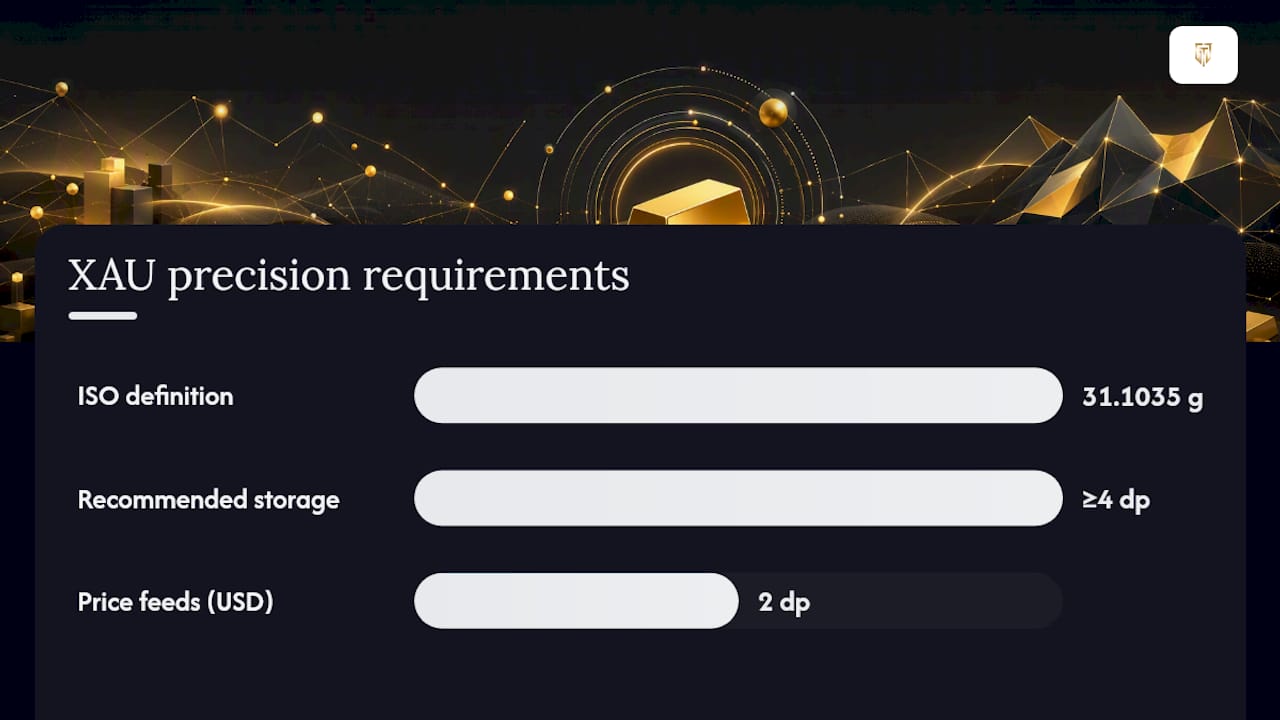
According to the ISO 4217 Wikipedia reference, XAU carries numeric code 959 and is defined as one troy ounce of gold. That definition is precise: 31.1035 grams, not rounded, not approximated. Finance systems that store gold positions should carry that figure to at least four decimal places to avoid compounding rounding errors across large positions.
Minor unit handling is where many implementations go wrong. National currencies have minor units: USD has cents (10^-2), JPY has none (10^0). XAU has no minor unit at all. There is no sub-ounce ISO subdivision. Price feeds that assume a two-decimal minor unit will misinterpret XAU prices, which are typically quoted to two decimal places in dollar terms but represent whole-ounce or fractional-ounce positions in the underlying asset.
Key technical facts for XAU:
- Alphabetic code: XAU (cite: ISO 4217 Wikipedia)
- Numeric code: 959
- Unit: one troy ounce = 31.1035 g
- Minor unit: none
- ISO list placement: List 1 (active)
- Amendment process: ISO 4217 is maintained by the ISO 4217 Maintenance Agency (currently SIX Group); updates are published as amendments and reflected in the online list
The standard is a living document. When a currency is withdrawn or a new one introduced, the Maintenance Agency issues a formal amendment. XAU itself has not changed since its inclusion, but the numeric code table and list structure are updated periodically. Systems should pull from the current ISO list rather than hardcoding values from a snapshot.
How does XAU behave in markets and trading systems?
XAU is quoted as XAU/USD in the same structural format as any FX pair: the base currency (XAU) priced in the quote currency (USD). If XAU/USD reads 3,300, that means one troy ounce of gold costs $3,300. The same logic applies to XAUEUR or XAUGBP, though XAU/USD dominates global volume.
FXCM’s product documentation confirms that gold spot is quoted as U.S. dollars per troy ounce, with trading available across extended hours on most platforms. The instruments that reference XAU span a wide range:
- Spot OTC: direct purchase or sale of gold at the current price, settled typically within two business days (T+2)
- Futures: standardized contracts on exchanges like COMEX, referencing 100 troy ounces per contract
- ETFs: funds like SPDR Gold Shares (GLD) track the XAU price; each share represents a fractional claim on physical gold
- CFDs: derivative contracts that track XAU/USD price movements without physical delivery
The classification question — is XAU a currency or a commodity? — has a practical answer: it depends on the reporting framework. Inside FX plumbing, XAU behaves like a currency pair because ISO coding and settlement infrastructure treat it that way. Under U.S. accounting standards (GAAP) and CFTC regulations, gold is a commodity. Firms that trade both spot and derivatives need to map XAU correctly in their chart of accounts and regulatory filings, because the same position can appear in two different buckets depending on the instrument.
Pro Tip: Three factors move XAU/USD more than most: the DXY (U.S. Dollar Index, since gold prices inversely with dollar strength), real interest rates (rising real yields compress gold’s appeal as a non-yielding asset), and liquidity windows (the London-New York overlap, roughly 8 AM–12 PM ET, typically carries the deepest order books). For short-term XAUUSD trading strategy, timing entries around these windows reduces slippage.
How do you implement XAU correctly in systems and data feeds?
Getting XAU right in a production system is less about understanding the standard and more about not making the assumptions that work for national currencies.
- Use alphabetic XAU for human-readable fields (API responses, UI labels, report headers) and numeric 959 for database keys and interchange formats where character encoding is a constraint.
- Store no minor-unit assumption. Set the minor-unit field to null or zero, not 2. A system that auto-applies two decimal places to XAU positions will misstate quantities.
- Record the unit explicitly. Every gold position record should carry both the ISO code (XAU) and the unit field (“troy ounce”). This prevents the most common valuation error in portfolio systems.
- Never mix troy and avoirdupois ounces. A troy ounce is 31.1035 g; an avoirdupois ounce is 28.35 g. Confusing the two produces a ~9% valuation error on every position — material at any institutional scale.
- Timestamp to the correct session. Spot OTC gold trades around the clock on weekdays; futures settle on exchange time. Mixing timestamps from different sessions without normalization distorts P&L calculations.
- Validate against the live ISO list. Do not hardcode numeric codes from a snapshot. Pull from the current ISO 4217 list on a scheduled basis and alert on any code-table change.
What do institutions need to know about XAU custody and execution?
Custody is where the ISO code meets physical reality. Institutions holding gold under XAU have two primary structures:
- Allocated holdings: specific bars assigned to the client, identified by serial number and weight. The client owns the metal outright; the custodian holds it on their behalf. Counterparty risk is minimal because the gold is segregated.
- Unallocated holdings: a claim on a pool of gold held by the custodian. More liquid and cheaper to administer, but the client is an unsecured creditor if the custodian fails.
The reporting implications differ sharply. Allocated gold appears on the balance sheet as a tangible asset. Unallocated positions carry credit exposure to the custodian and may require additional disclosure under IFRS 9 or U.S. GAAP depending on the entity’s reporting framework.
On the execution side, institutional gold trades typically clear through OTC matching rather than exchange order books. The LBMA (London Bullion Market Association) publishes twice-daily benchmark fixes — the LBMA Gold Price AM and PM — which serve as reference rates for contract settlement, fund valuations, and central bank transactions. Institutional desks often benchmark their fills against these fixes to demonstrate best execution.
Risk management for XAU positions requires measuring exposure in troy ounces first, then converting to currency value using the live XAU/USD rate. Hedging typically involves futures on COMEX or OTC forward contracts. Reconciliation should run daily: compare the troy-ounce position in the custody record against the trading system’s position, flag any discrepancy before converting to dollar value. Catching a unit mismatch at the ounce level is far simpler than unwinding a dollar-denominated error after month-end close.
Pro Tip: Automate unit normalization at the point of data ingestion. Flag any record where the unit field is missing, blank, or set to anything other than “troy ounce” before it reaches the ledger. A gold trading standards framework that enforces this at the API gateway level catches errors before they compound.
Why precise XAU knowledge shapes portfolio decisions
From Galami’s perspective, the gap between knowing that XAU means gold and knowing what XAU means operationally is where institutional incidents happen. A desk that treats XAU as just another ticker will eventually hit a unit mismatch, a minor-unit assumption error, or a custody classification problem that takes weeks to unwind.
Precision about the code, the unit, and the feed format is not pedantry. It directly affects auditability, regulatory reporting accuracy, and the quality of execution benchmarking. When a portfolio manager asks “what is our gold exposure?”, the answer is only as reliable as the data pipeline behind it. If that pipeline conflates troy and avoirdupois ounces, or applies a two-decimal minor-unit assumption to XAU positions, the exposure figure is wrong before anyone looks at the market price.
Galami’s approach to institutional gold execution starts from this foundation: disciplined handling of the unit, the code, and the custody structure, so that the numbers clients see reflect reality.
Galami Gold’s institutional execution and custody services
Institutional clients who need more than a data explainer — firms that are actively allocating to physical gold, integrating XAU into portfolio systems, or seeking transparent execution against LBMA benchmarks — can engage Galamigold directly.
Galamigold provides institutional-grade physical gold trading with transparent pricing, secure custody solutions, and expert support for allocation strategies. The platform is built for wealth managers, financial institutions, and sophisticated investors who need disciplined execution and clean reporting, not a retail wrapper around a commodity price feed. Suitability is assessed on a case-by-case basis; services are directed at institutional and qualified clients only. Review the risk disclosure before initiating any engagement. To explore a trading mandate or custody arrangement, visit Galamigold.
Sources
- ISO - ISO 4217 — Currency codes
- XAU/USD - Gold | FXCM Markets
- What unit is used for precious metals like gold (XAU) - Kubera Help
Recommended
- Bullion Explained: A Practical Guide for U.S. Investors
- Unallocated Gold Explained: Ownership, Risks, and When to Use It
- Step by Step Gold Transaction Process: 2026 Guide
- The Role of AML in Gold Trade for Institutional Investors
Ready to invest in physical gold trade finance?
Both the Zambia–Dubai and Sierra Leone–Dubai programs are open to qualified investors. Minimum investments from $115,000 USD or €125,000 EUR.
Zambia–Dubai Program Sierra Leone–Dubai Program