
For U.S. wealth managers, the practical best approach is a blended institutional solution that pairs insured, segregated physical custody with traded financial instruments and API-enabled execution. Four things are non-negotiable: segregated vaulting with independent third-party audits, regulated counterparty or broker-dealer relationships, transparent bid/ask spreads with time-stamped execution records, and API or batch reporting that reconciles cleanly with your portfolio accounting system. The World Gold Council frames gold as delivering long-term returns, diversification, and liquidity benefits that justify a permanent strategic allocation, not a tactical trade. Galami Gold is one institutional partner built around exactly this architecture.
- Segregated vaulting with third-party audit attestation
- Regulated counterparty or licensed broker-dealer relationship
- Transparent bid/ask pricing with time-stamped execution records
- API or FIX batch reporting compatible with your back-office systems
Pro Tip: During initial diligence, ask for a live proof-of-holdings package: a recent third-party audit report, the vault address, and a sample reconciliation statement. Any provider that hesitates on this request is telling you something important.
Table of Contents
- What do gold trading solutions actually cover for wealth managers?
- How does institutional gold execution actually work?
- What custody and insurance standards should you insist on?
- How do you integrate gold into client portfolios operationally?
- Which financial instruments help manage gold exposure, and what are the risks?
- What should you expect on pricing, fees, and settlement?
- What U.S. regulatory and compliance requirements apply?
- How do you select the right gold trading provider?
- How does Galami Gold’s program satisfy the institutional checklist?
- Key Takeaways
- What implementation pitfalls actually slow gold programs down
- Ready to request your institutional documentation package?
- Authoritative references for further diligence
What do gold trading solutions actually cover for wealth managers?
The term “gold trading solutions” spans a wider product set than most advisors realize. Understanding the full taxonomy of gold assets is the first step toward matching the right vehicle to each client’s objectives and your firm’s operational capacity.
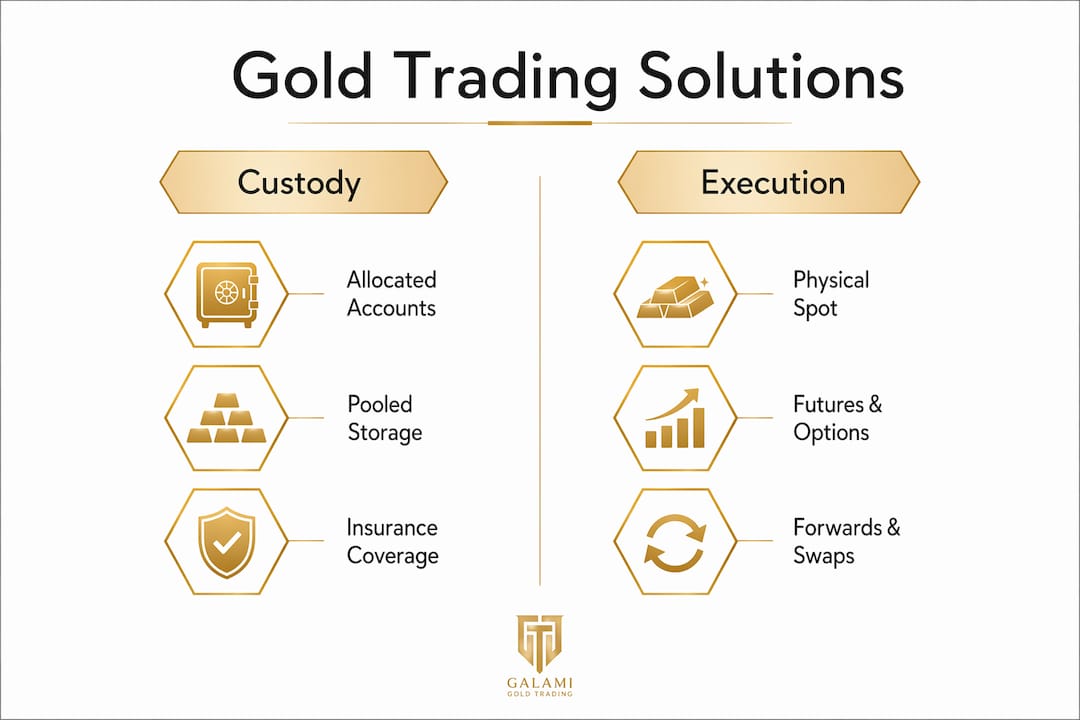
Physical bullion (allocated vs. pooled). Allocated accounts give clients legal title to specific bars or coins held in their name. Pooled accounts hold an undivided interest in a common stock of metal. Allocated is cleaner for fiduciary purposes; pooled is cheaper to administer.
Vaulted ownership certificates. A custodian holds physical metal and issues a certificate of ownership. Liquidity depends entirely on the custodian’s redemption terms.
ETFs and ETCs. These trade intraday on major exchanges, carry low tracking error, and require no custody setup on your end. Physical ETFs hold actual bullion; not all gold ETFs do, so verify holdings before recommending.
Forwards and swaps. OTC bilateral contracts that allow bespoke sizing and settlement dates. Require counterparty credit controls and daily monitoring.
Futures and options. Standardized, exchange-traded, centrally cleared. Futures on COMEX offer leverage and tactical flexibility but carry rollover and margin requirements.
Tokenized gold and savings plans. Emerging category. Gold-backed digital tokens can be fractionalized and traded on-chain, but issuer credibility risk is real and the market remains small.
| Vehicle | Custody complexity | Liquidity | Typical counterparty | Primary portfolio use |
|---|---|---|---|---|
| Allocated physical | High | Low–medium | Custodian bank / vault | Long-term store of value |
| Pooled physical | Medium | Medium | Custodian bank | Cost-efficient core holding |
| Gold ETF | Low | High (intraday) | Exchange / prime broker | Tactical and strategic allocation |
| OTC forward/swap | Medium | Medium–high | Bullion bank | Bespoke hedging, sizing |
| Futures/options | Low–medium | High | Clearing house (COMEX) | Hedging, leverage, tactical |
| Tokenized gold | High | Variable | Token issuer | Emerging / experimental |
Physical ETFs account for a significant portion of investment demand globally, according to the World Gold Council, which signals how mainstream the ETF channel has become. Still, for clients who want legal title to physical metal, an allocated account remains the only structure that delivers it.
How does institutional gold execution actually work?
Execution for institutional gold flows runs across two distinct venues, and choosing the wrong one for a given ticket size or timeline creates unnecessary cost and settlement risk.

Exchange-traded venues (COMEX futures, gold ETFs) offer intraday liquidity, central clearing, and standardized contract sizes. They suit tactical positioning, hedging overlays, and clients who need to enter or exit quickly. The tradeoff is that futures carry defined expiration dates, which means you manage rollover costs and basis drift over time. Futures contracts are standardized and represent large notional amounts, making them better suited to experienced institutional participants than to smaller advisory accounts.
OTC markets handle larger, customized trades between financial institutions, primarily through bilateral agreements. The London OTC market remains the global center for this activity, and recent data show OTC trading volumes have increased even as exchange-based futures activity softened. For physical delivery or bespoke settlement terms, OTC is typically the right venue.
Execution quality checklist: time-stamped fills, documented bid/ask at time of trade, transaction reference numbers, and a clear chain of custody from order to settlement.
Minimum ticket sizes matter for cash management planning. Physical spot delivery typically requires larger minimums than ETF purchases; OTC forwards can be sized to client needs but carry counterparty credit implications. Settlement timelines vary: ETFs settle T+1 or T+2, physical spot delivery can run T+2 to T+5 depending on logistics, and forward settlement windows are negotiated at trade inception.
Morgan Stanley’s 2026 gold forecast illustrates how institutional macro views can shift positioning and liquidity patterns quickly. When large institutional flows move in the same direction, OTC spreads can widen and physical delivery queues lengthen. Build that scenario into your liquidity planning.
What custody and insurance standards should you insist on?
Custody is where fiduciary exposure concentrates. A client who holds an allocated account has legal title to specific bars. A client in a pooled account holds a proportional claim on a common stock of metal. The distinction matters enormously in a custodian insolvency scenario.

Segregated vs. pooled storage. Segregated allocated accounts provide client-level legal title, cleaner audit trails, and unambiguous ownership in any dispute. Pooled accounts are operationally simpler and cheaper, but the client’s claim is unsecured against the custodian’s general estate if something goes wrong.
Insurance. Require full replacement value coverage from a third-party insurer, not a self-insured custodian. Confirm the policy covers the vault location, in-transit transportation, and any sub-custodian legs. Ask for the certificate of insurance, not just a summary.
Audits and attestation. Independent audits should occur at least annually, with existence reports and proof-of-reserve documentation available on request. The audit firm should be a recognized third party, not affiliated with the custodian.
Pro Tip: You can validate a custodian’s holdings without violating confidentiality by requesting a sample proof-of-holdings check: ask the provider to confirm a specific bar serial number against their vault records. A credible custodian accepts this request without hesitation.
Documents to request from any custody provider:
- Certificate of insurance (full replacement value, named insurer)
- Most recent independent audit report with auditor name and date
- Vault address and sub-custodian disclosure
- Chain-of-custody logs for recent deliveries
- Transportation insurance confirmation for any delivery legs
| Custody model | Legal title | Audit clarity | Insolvency protection | Cost |
|---|---|---|---|---|
| Segregated allocated | Client holds title | High | Strong | Higher |
| Pooled allocated | Pro-rata claim | Medium | Moderate | Lower |
| Certificate-based | Depends on issuer | Variable | Depends on structure | Variable |
Physical gold requires storage, insurance, and provenance tracking that financial vehicles do not. That operational overhead is the price of legal title, and for most institutional clients, it is worth paying.
How do you integrate gold into client portfolios operationally?
Moving from a decision to allocate gold to a fully reconciled client portfolio is where most implementation projects stall. The operational friction is real: custody setup, account mapping, reporting format alignment, and reconciliation workload all take longer than advisors expect.
Account structures. Client segregated accounts give the cleanest audit trail and the most straightforward reconciliation. Omnibus structures with client-level sub-ledgers work for larger programs but require your back-office team to maintain the sub-ledger mapping. Certificate-based ownership sits outside standard custody rails and often requires manual reconciliation.
Reporting requirements. At minimum, you need: trade confirmations on execution day, daily position reports with a valuation source reference, monthly client statements, and an audit trail that satisfies both internal compliance and external regulators. The valuation source matters. LBMA AM/PM fix, COMEX settlement, or a named OTC reference price should be documented in every position report.
| Reporting element | Who supplies it | Frequency | Format |
|---|---|---|---|
| Trade confirmation | Executing broker / custodian | Same day | PDF / FIX message |
| Position report | Custodian | Daily | CSV / API feed |
| Client statement | Custodian / your platform | Monthly | PDF / portal |
| Audit trail | Custodian | On request | Structured log |
| Valuation reference | Custodian / pricing vendor | Daily | LBMA fix or COMEX |
Technology integration. Requiring API or FIX-based reporting during the RFP stage dramatically shortens onboarding time for portfolio accounting teams and prevents later reconciliation surprises. Batch CSV or MT formats work as a fallback, but they require manual intervention that scales poorly. Confirm compatibility with your portfolio accounting system (Advent Geneva, SS&C Eze, or similar) before signing any agreement.
Operational onboarding checklist:
- KYC documents collected and approved by custodian
- Account mapping confirmed in your portfolio accounting system
- Settlement banking details tested with a small pilot transaction
- Cut-off times documented for same-day and next-day settlement
- Reporting format tested end-to-end before live client flows begin
Which financial instruments help manage gold exposure, and what are the risks?
Gold exposure can be expressed through several instruments, and each carries a distinct risk profile that wealth managers must understand before recommending it to clients.
Forwards are OTC bilateral contracts that lock in a price for future delivery. They allow bespoke sizing and settlement dates, which makes them useful for clients with specific cash flow needs. The risk is counterparty credit: if the counterparty defaults before settlement, the client’s position is unsecured. OTC bilateral forwards require robust counterparty credit controls and daily monitoring.
Location swaps allow a holder of gold in one vault location to exchange it for gold in another, typically to facilitate delivery logistics. They are operationally useful but introduce basis risk between locations.
Futures on COMEX are centrally cleared, which eliminates bilateral counterparty risk but introduces margin requirements and rollover costs. Track basis (spot minus futures) daily when using futures to hedge allocated physical exposure, and run a round-trip cost model monthly to avoid unintended tracking error over long-dated holdings.
Options give the right but not the obligation to buy or sell at a set price. They are useful for capping downside on a physical holding or for expressing a directional view with defined risk.
Leasing arrangements allow a gold holder to lend metal to a counterparty for a lease rate. They generate income on idle holdings but introduce credit and liquidity risk.
Risk controls to require from any provider:
- Defined counterparty credit limits with documented approval process
- Central clearing for futures and standardized derivatives where possible
- Daily P&L and margin monitoring with escalation thresholds
- Documented rollover policy for futures positions
- Basis risk tracking for any hedge overlays on physical holdings
For a practical framework on managing risk in gold investment strategies, the key discipline is separating the instrument risk from the underlying price risk and managing each with its own set of controls.
What should you expect on pricing, fees, and settlement?
Fee transparency is one of the clearest signals of a provider’s institutional credibility. A provider that cannot give you a clean, itemized fee schedule before you sign is not ready for institutional business.
Common fee lines:
- Spread or premium over spot (the primary execution cost for physical trades)
- Execution commission (for exchange-traded instruments)
- Custody fee (flat annual rate or basis points on AUM)
- Delivery and transportation fees
- Insurance pass-through (for physical delivery legs)
- Audit fee pass-through (annual, sometimes included in custody fee)
Settlement timelines by instrument:
- Physical spot delivery: T+2 to T+5, depending on logistics and vault location
- Gold ETFs: T+1 or T+2 on major U.S. exchanges
- COMEX futures: daily mark-to-market, final settlement on expiration date
- OTC forwards: negotiated at trade inception, typically T+2 to T+30
How to benchmark pricing. Request time-stamped quotes from at least two providers on the same day and compare all-in round-trip costs, not just the headline spread. Ask for a historical execution blotter covering at least 90 days. The blotter shows whether the provider’s actual fills track their quoted spreads or whether slippage is a pattern.
Pro Tip: For a small ticket (under $500,000 notional), the spread and custody fee combination often dominates total cost. For a large ticket (over $5 million), transportation and insurance pass-throughs become the meaningful variable. Model both scenarios before committing to a fee structure.
A sample round-trip cost for a physical gold purchase might include: a 0.5% spread over spot, a 0.15% annual custody fee, and a flat transportation and insurance charge. On a $1 million ticket held for one year, that totals roughly 0.65% plus the transport charge. On a $10 million ticket, the percentage cost of transport drops significantly, making the spread the dominant variable.
What U.S. regulatory and compliance requirements apply?
Gold trading for client accounts sits at the intersection of several U.S. regulatory frameworks, and the compliance burden falls on the wealth manager, not just the custodian; for detailed guidance, see How FinTech Innovations Achieved Global Compliance Success.
SEC and FINRA oversight. Broker-dealer activities in gold derivatives and ETFs fall under SEC and FINRA jurisdiction. Physical gold transactions are generally not securities, but any advice on gold allocation is subject to your firm’s fiduciary or suitability obligations under the Investment Advisers Act or Regulation Best Interest.
IRS tax reporting. Physical gold is classified as a collectible under U.S. tax law, which means long-term capital gains on physical gold held more than one year are taxed at a maximum rate of 28% rather than the standard long-term capital gains rate. Gold ETFs backed by physical bullion carry the same collectible treatment. Futures gains are taxed under the 60/40 rule (60% long-term, 40% short-term) regardless of holding period. Document every acquisition cost and disposition date carefully.
FinCEN AML expectations. Custodians and dealers in physical precious metals are subject to Bank Secrecy Act requirements, including AML program obligations and suspicious activity reporting. Your firm should confirm that any custodian or transport partner has a documented AML program and conducts sanctions screening on counterparties.
Client suitability and fiduciary duty. Before recommending physical gold or derivatives to a client, document the suitability analysis: investment objective, risk tolerance, liquidity needs, and tax situation. Physical gold’s collectible tax treatment and custody costs affect net returns in ways that differ materially from ETF exposure.
Compliance checklist for vendor diligence:
- Confirm custodian’s AML program documentation and FinCEN registration
- Verify broker-dealer or RIA registration status for any execution services
- Obtain sanctions screening policy for counterparties and transport partners
- Document IRS cost basis tracking methodology for physical holdings
- Confirm reporting format for Form 1099-B or equivalent tax documents
Pro Tip: Tax-advantaged wrappers such as a self-directed IRA can hold physical gold through an approved custodian, which defers the collectible tax treatment until distribution. Confirm IRS-approved custodian status before recommending this structure to clients.
For a deeper look at AML compliance in gold trading, the regulatory expectations for 2026 have tightened, with enforcement actions signaling that documentation gaps are a primary audit target.
How do you select the right gold trading provider?
Provider selection is a procurement decision, not a research exercise. The goal is to convert your evaluation criteria into a signed agreement with a provider that can actually deliver at institutional scale.
Top-line selection criteria:
- Custody model: segregated allocated, with documented legal title structure
- Insurance: third-party full replacement value, named insurer, policy available on request
- Audit attestation: independent annual audit, existence reports available
- Regulatory status: licensed custodian, registered broker-dealer or equivalent
- Execution connectivity: API, FIX, or documented batch reporting
- Client-level reporting: daily position reports, monthly statements, audit trail
- SLA and support: documented response times, named relationship manager
Step-by-step diligence process:
- Request initial documentation: insurance certificate, most recent audit report, regulatory registration, sample client statement
- Conduct an operational walk-through: settlement process, cut-off times, dispute resolution procedure
- Test execution: request a time-stamped quote and compare to spot; ask for a sample execution blotter
- Run a pilot: small notional transaction with full settlement cycle before committing client flows
- Confirm reporting integration: test API or batch feed with your portfolio accounting system
Red flags to watch for:
- No third-party audit, or audit performed by an affiliated firm
- Opaque pricing with no itemized fee schedule
- Missing or incomplete execution records
- Uninsured transportation legs
- Inability to provide a vault address or sub-custodian disclosure
Pro Tip: Assign internal ownership for each diligence item: legal reviews the custody agreement and insurance certificate, operations owns the settlement and reporting test, and the trading desk validates execution quality. A single owner for the whole process misses things.
Galamigold publishes step-by-step institutional onboarding guidance that covers the documentation and process expectations for wealth managers entering the physical gold market.
How does Galami Gold’s program satisfy the institutional checklist?
Galami Gold does not meet every requirement outlined at the top of this article, and it is important to be clear about which. Here is how its programs compare with the institutional checklist.
Custody and insurance. Galami Gold is not a custodian and does not provide insured vault storage. Investors hold a Loan Note with Galami UK Ltd rather than allocated bars, which carries counterparty risk. The programs are independently audited every 90 days.
Execution channels. The platform supports physical spot trading with transparent bid/ask pricing and time-stamped execution records. Execution blotters are available for review, giving wealth managers the provenance documentation they need for best-execution compliance.
Reporting and API capabilities. Galami Gold provides trade confirmations, daily position reports, and monthly client statements in formats compatible with standard portfolio accounting systems. The firm’s institutional risk management content reflects an operational discipline around transparency and audit trails.
Onboarding and client support. The KYC process follows standard institutional documentation requirements. Settlement banking details are confirmed during onboarding, and the firm provides a named point of contact for operational queries.
| Requirement | Galami Gold capability |
|---|---|
| Segregated allocated custody | Available with client-level documentation |
| Third-party audit attestation | Provided as part of institutional package |
| Insurance certificate | Available on request |
| Transparent execution blotter | Provided for all physical trades |
| API / batch reporting | Available; confirm format during onboarding |
| KYC / AML compliance | Standard institutional documentation process |
Pro Tip: Request a proof-of-holdings package during your initial call with Galami Gold. This should include the most recent independent audit information, the Loan Note terms and the risk disclosure. If the package arrives complete and promptly, that is your first operational signal.
To request a pilot or institutional documentation package, contact Galami Gold directly through galamigold.com. The firm will share independent audit information and the Loan Note terms with qualified investors as part of onboarding.
Key Takeaways
Wealth managers who integrate gold successfully treat it as an operational discipline first and an investment thesis second: custody quality, execution transparency, and reconcilable reporting determine whether the allocation actually works in practice.
| Point | Details |
|---|---|
| Custody model determines fiduciary exposure | Segregated allocated accounts give clients legal title; pooled accounts do not. |
| Physical gold carries collectible tax treatment | Long-term gains on physical gold are taxed according to collectible tax treatment under U.S. tax law. |
| API/FIX reporting shortens onboarding materially | Requiring machine-readable reporting at the RFP stage prevents reconciliation problems later. |
| Red flags are operational, not just financial | Missing audits, opaque pricing, and uninsured transport are go/no-go signals. |
| Galamigold maps to the institutional checklist | Audited holdings, insured segregated custody, and transparent execution blotters are available on request. |
What implementation pitfalls actually slow gold programs down
The most common onboarding delays have nothing to do with the gold market. They come from mismatched settlement cutoffs between the custodian and your prime broker, client account mapping errors that surface only at the first reconciliation, and reporting formats that your portfolio accounting system cannot ingest without manual intervention.
The fix is straightforward but requires discipline: run a parallel reconciliation for the first 30 days of any new gold program. Require a test settlement, including transport manifests, insurance confirmation, and vault acceptance paperwork, before approving live client flows. That single exercise surfaces 80% of the operational issues before they affect a real client account.
Cross-functional involvement during vendor selection is not optional. Compliance needs to review the custody agreement and AML documentation. Operations needs to own the settlement and reporting test. The trading desk needs to validate execution quality independently. When one person tries to cover all three, something gets missed, and it is usually the reporting integration.
Ready to request your institutional documentation package?
Galami Gold’s institutional program gives wealth managers a direct path from evaluation to live trading, with the documentation and operational infrastructure that serious due diligence requires.

The institutional onboarding packet includes audit reports, insurance certificates, execution blotters, and sample client statements. Settlement banking details, KYC requirements, and reporting format specifications are confirmed during the onboarding call. Response time for institutional inquiries is documented in the firm’s SLA terms.
To review program terms and risk disclosures before your first call, visit the risk disclosure page and the main trading program page. For wealth managers evaluating the Sierra Leone–Dubai supply chain program specifically, the program details page covers the trade structure and fee terms.
Contact Galami Gold through galamigold.com to request your institutional documentation package or schedule an operational walk-through.
Authoritative references for further diligence
The sources below are the primary references used in this article. Each is worth bookmarking for ongoing due diligence and regulatory monitoring.
- World Gold Council: How to Invest in Gold — the most comprehensive taxonomy of gold investment vehicles, with market share data and custody guidance.
- World Gold Council: The Case for a Strategic Allocation to Gold — the institutional rationale for gold as a portfolio diversifier, with long-run return and correlation data.
- State Street: Ways to Invest in Gold — a clear breakdown of ETF, OTC, futures, and physical options from an institutional asset manager’s perspective.
- Investopedia: A Beginner’s Guide to Investing in Gold — useful for explaining futures mechanics, margin requirements, and rollover costs to clients or junior staff.
- Fidelity: How to Buy Gold — practical overview of physical vs. financial gold, with custody and insurance implications.
- Reuters: Morgan Stanley Forecasts Gold at $4,800 by Q4 2026 — institutional macro context for gold demand and positioning.
- Galamigold: Partner Gold Traders — Risk Management & Transparency — Galami Gold’s operational framework for audited holdings and transparent execution.
- Galamigold: Gold Trading Step-by-Step Institutional Guide 2026 — step-by-step onboarding and reporting guidance for portfolio managers and custody ops teams.
Pro Tip: When requesting documents from any vendor during diligence, ask for three specific items in your first email: the most recent independent audit report, the certificate of insurance with named insurer and policy limits, and a 90-day execution blotter. How quickly and completely a provider responds tells you more than the documents themselves.
This article is general information for professional investors and does not constitute legal, tax, or investment advice. Confirm current regulatory requirements, tax treatment, and custody terms with qualified legal and tax counsel for your specific situation.
Recommended
- Gold Trade Settlement Explained for Investors and Traders
- Gold Market News & Analysis | Galami Gold Blog
- How to Select Gold Partners: Institutional Guide 2026
- Top Institutional Gold Trading Benefits | Galami Gold
Ready to invest in physical gold trade finance?
Both the Zambia–Dubai and Sierra Leone–Dubai programs are open to qualified investors. Minimum investments from $115,000 USD or €125,000 EUR.
Zambia–Dubai Program Sierra Leone–Dubai Program