
TL;DR:
- Gold offers low correlation and diversification benefits in elite portfolios, especially during market stress.
- It serves as a proven hedge against inflation and currency risk, with institutional demand rising.
- Physical gold provides direct ownership, essential for trusted capital protection and long-term wealth preservation.
Gold is not a relic. It is not a panic trade. And it is certainly not the speculative play that critics dismissed it as two decades ago. Today, high-net-worth investors are drawn to gold primarily because of its low correlation with stocks and bonds, making it one of the most powerful diversification tools available. Rising institutional demand, surging central bank purchases, and fifty years of portfolio data all point in the same direction. This guide covers why sophisticated investors allocate to gold, how it protects against inflation and currency risk, how it performs during crises, and how to participate in physical gold markets with confidence.
Table of Contents
- The diversification power of gold in elite portfolios
- Gold as a proven hedge: Inflation, currency risk, and beyond
- Resilience in volatility: Gold’s edge in modern uncertain markets
- Physical gold trading: Trusted routes for capital protection
- Expert perspective: What most investors get wrong about gold allocations
- Secure your legacy with trusted gold trading solutions
- Frequently asked questions
Key Takeaways
| Point | Details |
|---|---|
| Gold diversifies risk | Allocating gold to a portfolio lowers overall risk because it moves differently than stocks and bonds. |
| Trusted hedge for inflation | Gold stores value and preserves wealth during periods of rising prices and currency declines. |
| Resilient in crisis | Gold consistently performs well during volatility, stagflation, and global disruptions. |
| Physical gold preferred | High-net-worth investors often choose physical gold trading for transparency and direct ownership. |
| Expert strategy matters | Evidence shows most investors under-allocate gold despite proven advantages, so expert guidance optimizes results. |
The diversification power of gold in elite portfolios
When portfolio managers talk about diversification, they mean holding assets that do not move together. If everything in your portfolio falls at the same time, diversification has failed you. Gold solves this problem better than almost any other asset class.
Gold’s correlation with stocks and bonds is consistently low across market regimes, and historical backtests from 1973 to 2025 suggest an optimal gold allocation of around 18% for balanced risk-adjusted returns. That is not a guess. It is the output of rigorous modeling across five decades of market data, covering multiple recessions, bull markets, and geopolitical shocks.
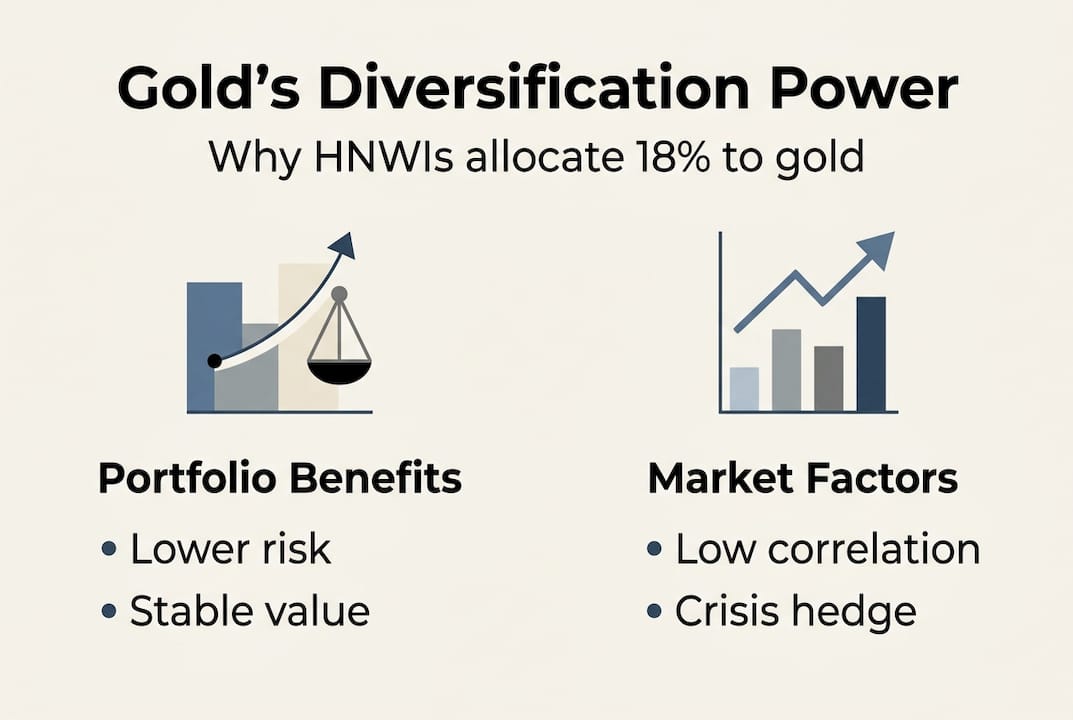
What does low correlation actually mean in practice? When equity markets drop sharply, gold tends to hold its value or rise. This is not a coincidence. Gold does not generate earnings, so it is not subject to the same earnings risk that drives stock prices. It is not a liability on anyone’s balance sheet. Its price is driven by entirely different forces: monetary policy expectations, real interest rates, and global demand for safety.
Portfolios that include a meaningful gold allocation have historically shown gold diversification and reduced risk across multiple asset combinations. The math is compelling: adding gold to a traditional 60/40 stock and bond portfolio has improved risk-adjusted returns without sacrificing meaningful upside.
Key reasons gold earns its place in elite portfolios:
- Low or negative correlation with equities during stress periods
- Acts as a currency hedge against dollar weakness
- Liquid global market with deep institutional participation
- No counterparty risk when held as physical metal
- Proven track record across inflation, deflation, and stagflation
Here is how gold compares to major asset classes on the metrics that matter most to sophisticated investors:
| Asset class | Correlation to S&P 500 | Inflation protection | Counterparty risk |
|---|---|---|---|
| Gold | Low (approx. 0.0 to 0.1) | Strong | None (physical) |
| US Treasuries | Moderate negative | Weak | Low |
| Commodities | Moderate positive | Moderate | Low |
| Real estate | Moderate positive | Moderate | Moderate |
| Cash | Near zero | None | Low |
For investors serious about portfolio diversification strategies, gold is not a satellite position. It is a structural allocation backed by data.
Gold as a proven hedge: Inflation, currency risk, and beyond
Inflation destroys purchasing power quietly. You do not feel it in a single quarter, but over five or ten years, a 4% annual inflation rate cuts the real value of cash holdings nearly in half. Gold has historically preserved purchasing power across generations, which is why central banks and private investors alike have increased their gold holdings significantly in recent years.
The 2025 data is striking. Central banks bought 863 tonnes of gold that year, gold averaged $3,431 per ounce representing a 44% year-over-year increase, and HNWI gold ownership rose from 20% to 38%. That kind of institutional behavior does not happen by accident. It reflects a deliberate strategic shift toward gold as a safe haven in an era of elevated debt levels and currency uncertainty.
Gold averaged $3,431/oz in 2025, a 44% year-over-year increase, while HNWI ownership nearly doubled from 20% to 38%.
Currency risk is the other side of this coin. When a government prints more money to cover deficits, the purchasing power of that currency falls. Gold, priced globally and not tied to any single government’s balance sheet, tends to rise in local currency terms during these episodes. This makes it especially valuable for investors with significant exposure to any single currency.
Steps to use gold as an inflation hedge:
- Establish a baseline allocation before inflationary signals appear, not after
- Monitor real interest rates (nominal rates minus inflation), as falling real rates historically support gold prices
- Increase allocation when central bank balance sheets expand rapidly
- Use physical gold for the core position and review it annually against inflation benchmarks
- Avoid overtrading based on short-term price moves; gold’s value is in its long-term role
Pro Tip: Do not wait for inflation headlines to act. By the time inflation is front-page news, gold has often already moved. Build your position during calm periods and treat it as portfolio risk management infrastructure, not a reactive trade.
For a deeper look at UHNWI gold trends and how the wealthiest investors are structuring their positions, the data from 2025 offers a clear signal about where sophisticated capital is moving.
Resilience in volatility: Gold’s edge in modern uncertain markets
Market volatility is not just about stock prices falling. It is about the entire framework of assumptions investors rely on being called into question at once. During these moments, the assets that hold value are the ones that were never dependent on those assumptions in the first place. Gold qualifies on every count.

Cross-asset portfolios combining the S&P 500, gold, oil, and bonds have yielded higher Sharpe ratios than US-only equity allocations since 2009. The Sharpe ratio measures return per unit of risk, so a higher number means you are being compensated better for the volatility you accept. Post-2009, blended portfolios that include gold have consistently outperformed on this metric, particularly during stagflation and de-dollarization scenarios.
This matters because the investment landscape going into 2026 looks more like those stress scenarios than the smooth bull markets of the 2010s. Geopolitical fragmentation, elevated government debt, and persistent inflation risk all create conditions where gold’s resilience in volatile markets becomes a genuine performance driver, not just a defensive footnote.
Scenarios where gold historically outperforms:
- Stagflation: when growth slows but inflation stays elevated
- Currency crises: when major currencies lose credibility rapidly
- Geopolitical shocks: wars, sanctions, and supply chain disruptions
- Banking system stress: when counterparty risk becomes systemic
- De-dollarization: when global trade shifts away from USD settlement
Pro Tip: To evaluate gold’s resilience factor in your own portfolio, run a simple stress test. Look at how your portfolio performed during 2008, 2020, and 2022. If gold was absent or underweighted during those periods, the gap in performance tells you exactly what you were missing.
For investors looking to invest in gold for diversification in 2026, the evidence from gold asset examples across multiple market cycles makes a strong case for a meaningful, sustained allocation rather than a token position.
Physical gold trading: Trusted routes for capital protection
Knowing why to own gold is one thing. Knowing how to own it properly is another. For high-net-worth and institutional investors, physical gold offers something that ETFs and derivatives cannot: direct ownership with no counterparty exposure. You own the metal. It is not a promise, a contract, or a fund unit.
Physical gold trading has empirical support from over 50 years of cross-regime data, and its appeal for trusted diversification is well-documented. The process of sourcing, authenticating, and settling physical gold requires discipline and the right partners, but the transparency it creates is unmatched.
Steps to initiate and secure a physical gold trade:
- Define your allocation target and the form of gold you require (bars, coins, allocated accounts)
- Select a reputable trading partner with verifiable credentials and established supply chains
- Confirm authentication and assay certification for all metal before settlement
- Arrange secure storage through an insured, audited vault provider
- Document chain of custody and review storage arrangements annually
Understanding the operational mechanics of gold trading is essential before committing capital. Mistakes at the sourcing or authentication stage are difficult and expensive to reverse.
Common pitfalls and how experienced investors avoid them:
- Skipping independent assay verification (always require third-party certification)
- Using unregulated intermediaries to save on fees (the cost of fraud far exceeds any savings)
- Storing gold in non-insured or unaudited facilities
- Failing to account for storage and insurance costs in return calculations
- Treating physical gold as a short-term trade rather than a long-term capital protection tool
Pro Tip: When selecting a trading partner, prioritize transparency of supply chain over price. A marginally better price from an unknown counterparty is not worth the authentication risk. Review the physical gold trading guide for institutional-grade best practices before executing any significant transaction.
Expert perspective: What most investors get wrong about gold allocations
Here is the uncomfortable truth: most high-net-worth portfolios are significantly underweight gold, not because the data is unclear, but because the data conflicts with how most wealth managers are trained to think. Conventional allocation models still treat gold as a 5% or less satellite position, even though decades of backtesting point to 18% as optimal.
The reason is psychological as much as analytical. Gold does not pay dividends. It does not generate quarterly earnings reports. In a bull market, it feels like dead weight. But wealth preservation is not a bull market game. It is a multi-decade discipline, and gold’s role is to protect what you have built when everything else is under pressure.
Many HNWIs chase headline returns and add gold only after a crisis has already started. That is backwards. The investors who benefit most from gold are the ones who treat it as a permanent structural allocation, not a trade. When you look at diversifying with physical gold through the lens of real portfolio construction, the question is not whether to include gold. It is whether your current allocation is large enough to actually move the needle when it matters most.
Going into 2026, with real rates uncertain and central banks continuing to accumulate, the case for a disciplined, evidence-based gold allocation has never been stronger.
Secure your legacy with trusted gold trading solutions
The evidence is clear, the mechanics are established, and the case for a meaningful gold allocation in 2026 is backed by five decades of data. What separates investors who benefit from gold from those who do not is execution quality and the partners they choose.

At Galami Gold, we operate at the intersection of disciplined execution and transparent physical gold supply and trading across well-established supply chains. Whether you are building a new allocation or refining an existing one, our team works with high-net-worth individuals and institutional investors who demand integrity at every step. Before committing capital, we encourage you to review our gold investment risk disclosure and explore how to invest in gold trading through a platform built for serious capital.
Frequently asked questions
What percentage of a portfolio should HNWIs allocate to gold?
Historical backtests from 1973 to 2025 suggest an optimal gold allocation of around 18%, balancing risk reduction with meaningful return contribution across multiple market cycles.
Is physical gold safer than gold ETFs or derivatives for HNWIs?
Physical gold provides direct ownership with no counterparty exposure, which is why many high-net-worth investors prefer it for trusted capital protection over paper-based alternatives.
How did gold perform during recent inflationary periods?
Gold averaged $3,431 per ounce in 2025, representing a 44% year-over-year increase, driven by surging central bank demand and rising private investor allocations.
What makes gold effective during market volatility and crises?
Gold’s low correlation with equities and bonds means it tends to hold or gain value when other assets fall, boosting Sharpe ratios and improving overall portfolio resilience during stress events.
Recommended
- Top benefits of physical gold for institutional investors
- Top Gold Asset Examples for Portfolio Diversification
- Gold as an asset class: Risk, diversification, and strategy
- Why Gold Secures Portfolio Diversification | Galami Gold
Ready to invest in physical gold trade finance?
Both the Zambia–Dubai and Sierra Leone–Dubai programs are open to qualified investors. Minimum investments from $115,000 USD or €125,000 EUR.
Zambia–Dubai Program Sierra Leone–Dubai Program