
TL;DR:
- Delivery versus payment is a settlement method that ensures the safe transfer of gold only upon confirmed payment, reducing risk for high-value trades.
- It employs an atomic process where both transfers occur simultaneously and reverses if either fails, preventing full loss.
- DVP differs from alternatives like Free of Payment, which decouples delivery from payment and increases exposure to default risk.
Delivery versus payment (DVP) is defined as a settlement mechanism that releases gold to the buyer only when confirmed payment reaches the seller, eliminating the risk that either party loses value in a failed trade. This principle sits at the core of professional bullion trading, where a single transaction can represent millions of dollars in physical metal. Understanding what is DVP in gold trades is not optional for serious investors. It is the contractual architecture that makes high-value gold transactions safe. Since the 1987 market crash, DVP procedures have been strengthened globally to reduce principal risk and improve systemic market safety. Galamigold builds every physical gold transaction around this principle, treating DVP not as a formality but as the foundation of trust between counterparties.
What is DVP in gold trades and how does it work?
DVP in gold trading is a risk-management mechanism used within gold escrow arrangements to link the release of funds to verifiable delivery events. The buyer’s money and the seller’s gold are held by a neutral escrow agent until both sides fulfill their contractual obligations. Neither party can access the other’s asset until the conditions are met. This structure removes the need for either side to trust the other personally.
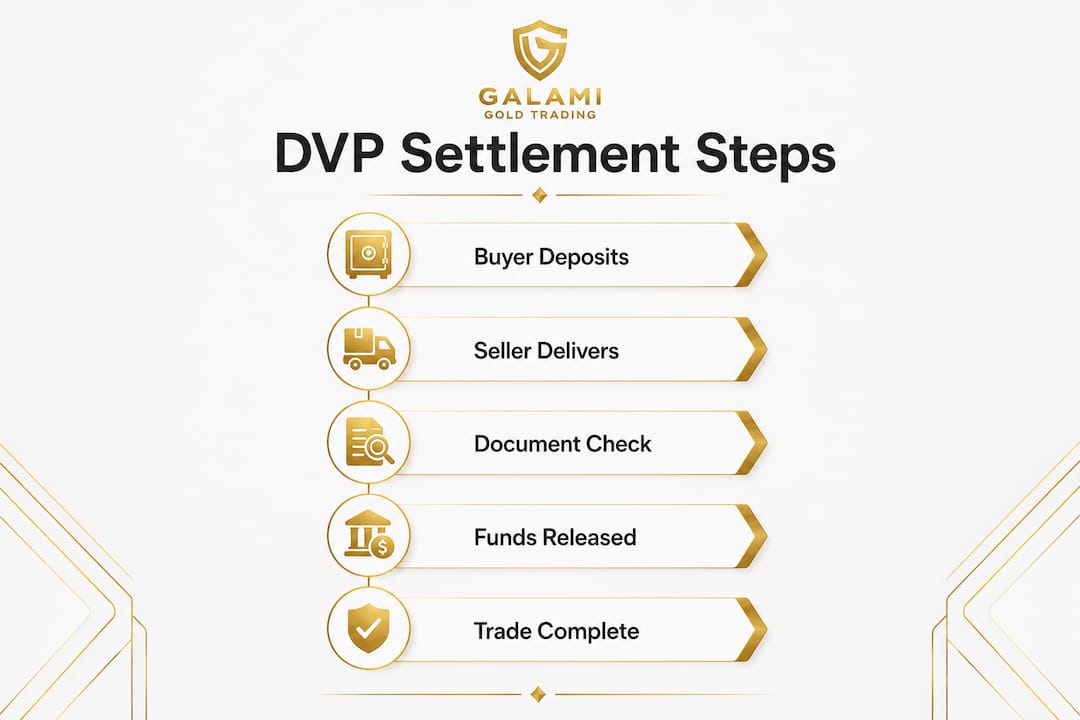
The process follows a clear sequence. First, the buyer deposits funds into escrow. Second, the seller initiates delivery of the physical gold and submits the required documentation. Third, the escrow agent confirms receipt of the agreed legal documents. Fourth, funds release to the seller and title transfers to the buyer simultaneously. That simultaneous exchange is the defining feature of DVP.
DVP employs an atomic settlement process where asset and cash transfer happen at the same moment. If one side fails, the entire settlement reverses. No partial outcomes exist. This eliminates principal risk entirely, which is the risk of losing the full value of a trade to a counterparty default.
One critical nuance: escrow agents do not verify gold quality. Escrow agents confirm receipt of the agreed legal documents relating to delivery, not the physical metal itself. That separation protects the escrow agent’s neutrality and limits liability while keeping the transaction moving. Buyers must conduct their own quality verification before the settlement process begins.
DVP also has a mirror term. DVP and RVP are two sides of the same coin: DVP from the buyer’s perspective and RVP (receive versus payment) from the seller’s perspective. Industry practice treats DVP as the catch-all term for the entire simultaneous settlement process.
Pro Tip: Confirm that your escrow agreement specifies exactly which documents trigger fund release. Vague documentary conditions are the most common source of settlement disputes in physical gold trades.
What are the different DVP settlement models?
DVP achieves settlement through three distinct models, each balancing risk reduction against operational speed differently. Understanding which model applies to your transaction determines how quickly you can access your gold or funds after a trade closes.
Model 1: Trade-by-trade gross settlement. Each transaction settles individually and in full as it occurs. Gold title and payment transfer simultaneously for every single trade. This model carries the lowest settlement risk because no trades are grouped or netted. The trade-off is higher operational cost and slower processing when transaction volumes are large.

Model 2: Gross asset settlement with netted funds. Gold transfers on a trade-by-trade basis, but cash payments are netted across multiple trades at the end of a settlement cycle. This reduces the volume of cash movements without increasing asset risk. Institutional traders who run multiple positions in a single session often prefer this model.
Model 3: Net settlement of both assets and funds. Both gold and cash are netted across all trades and settled at day-end. This model is the most operationally efficient but carries slightly higher intraday exposure because positions remain open until the settlement window closes.
The right model depends on your trading volume, counterparty relationships, and risk tolerance. Institutional gold traders running high-frequency positions favor Model 3 for efficiency. Traders executing large, one-off transactions favor Model 1 for maximum protection.
Key benefits shared across all three models:
- Settlement risk drops to near zero when both sides fulfill obligations.
- Counterparty exposure is contained within the escrow structure.
- Legal documentation creates an auditable record of every transaction.
- Disputes have a clear resolution framework because conditions are pre-agreed.
For a deeper look at how these mechanics fit into broader physical gold trading operations, the operational context matters as much as the settlement model itself.
How does DVP compare with Free of Payment settlement?
DVP is not the only settlement method in gold trading, but it is the most protective. The main alternative is Free of Payment (FOP), and the difference between the two is significant for anyone trading physical bullion.
FOP settlement decouples delivery from payment. Gold transfers to the buyer without a simultaneous payment guarantee. The seller delivers first and waits for payment separately. This arrangement works between parties with deep, established trust, such as affiliated entities within the same corporate group. For any other counterparty relationship, FOP creates serious exposure.
The risks of FOP in physical gold trades:
- Principal risk: The seller delivers gold and receives no payment if the buyer defaults.
- Counterparty exposure: The buyer has no guarantee of delivery after sending funds.
- No reversal mechanism: Unlike DVP’s atomic structure, FOP has no built-in fail-safe if one side fails to perform.
- Dispute complexity: Without simultaneous exchange, proving which party defaulted first becomes legally complicated.
Payment versus Delivery (PVD) is another variant, where payment moves first and delivery follows. This shifts the risk entirely to the buyer. DVP eliminates that asymmetry by making both transfers conditional on each other.
DVP is the foundational settlement protocol that makes modern financial markets safe by eliminating the risk of losing the full value of a trade to counterparty default. That principle applies with particular force in physical gold markets, where settlement involves real metal moving through real supply chains.
Pro Tip: Never agree to FOP terms with a new counterparty regardless of how credible they appear. Require DVP for every first transaction and revisit FOP only after a documented track record of completed trades.
Understanding counterparty risk in gold trading is the first step toward choosing the right settlement structure for every deal.
What are the practical challenges of implementing DVP for gold traders?
DVP is the safest settlement method, but it is not frictionless. Real-world implementation introduces operational and legal complexity that traders must plan for before entering a transaction.
Documentary precision matters above everything else. The escrow agent releases funds only when specific documents arrive. If those documents are incomplete, incorrectly formatted, or delayed, the settlement stalls. Common required documents include warehouse receipts, assay certificates, title transfer confirmations, and shipping or custody records. Every document must match the escrow agreement exactly.
Trade failures are a real risk under DVP. When one party fails to deliver by the settlement deadline, the entire DVP transaction stalls with escrow funds and gold remaining blocked until resolution. The atomic nature of DVP protects both parties from loss, but it does not prevent the operational disruption of a stalled trade. Renegotiation or cancellation may follow, and both outcomes consume time and legal resources.
Cross-border trades add regulatory layers. Physical gold moving across jurisdictions triggers customs documentation, export licensing, and in some cases, anti-money-laundering reporting requirements. Each regulatory checkpoint is a potential delay point. Traders must build these timelines into their settlement schedules or risk technical default through no fault of their own.
Infrastructure requirements are non-trivial. DVP at institutional scale requires automated messaging standards such as SWIFT MT 543 and dependable custodian infrastructure for conditional asset exchange. Without proper infrastructure, the advantages of DVP cannot be fully realized. Smaller traders working with undercapitalized custodians face higher operational risk even when the legal structure is sound.
Practical steps to reduce DVP implementation risk:
- Agree on every documentary trigger before signing the escrow agreement.
- Set realistic settlement deadlines that account for cross-border logistics.
- Use custodians with established SWIFT connectivity and institutional-grade infrastructure.
- Build a dispute resolution clause into every escrow agreement before trading begins.
- Conduct quality verification of gold before initiating the DVP process, not during it.
Payment fraud detection in cross-border transactions is an evolving area that directly affects settlement security. Traders operating across multiple jurisdictions should understand how payment infrastructure failures can disrupt even well-structured DVP arrangements.
For institutional traders looking to optimize gold transactions, DVP implementation quality is often the difference between a smooth settlement and a costly dispute.
Key Takeaways
DVP is the only settlement method in physical gold trading that eliminates principal risk by making gold delivery and payment contractually simultaneous and mutually conditional.
| Point | Details |
|---|---|
| DVP definition | DVP links gold delivery to payment confirmation, so neither party can lose value to counterparty default. |
| Atomic settlement | If either side fails, the entire transaction reverses, protecting both buyer and seller automatically. |
| Three settlement models | Gross, hybrid, and net settlement each balance risk and efficiency differently for different trade volumes. |
| Escrow agent role | Agents release funds on documentary proof only, not on gold quality verification. |
| FOP is riskier | Free of Payment decouples delivery from payment, creating principal risk that DVP eliminates entirely. |
DVP will define institutional gold trading in the years ahead
Professional gold escrow transforms subjective trust into contractual controls via DVP, relying on documentation rather than personal relationships. That shift is not just a legal technicality. It is a fundamental change in how gold markets operate at scale.
My view is that most traders underestimate how much of their settlement risk comes from infrastructure gaps rather than bad counterparties. I have seen well-intentioned trades stall because a custodian lacked SWIFT connectivity, or because a documentary trigger was written ambiguously. The legal structure was sound. The execution was not. DVP only works as well as the infrastructure behind it.
The next evolution is tokenized gold settlement, where DVP logic gets embedded directly into smart contracts. The atomic principle stays the same. The execution becomes automated and near-instant. Traders who understand DVP today will adapt to that environment far faster than those who do not.
My practical advice: treat DVP not as a compliance checkbox but as a design constraint. Build your escrow agreements, custodian relationships, and documentary workflows around DVP from the start. Retrofitting it after a failed trade is expensive and avoidable.
— Galami
Galamigold’s approach to secure physical gold trading
Galamigold operates physical gold supply and bullion trading programs built around disciplined settlement practices, including DVP-structured transactions for institutional counterparties.

Every transaction Galamigold facilitates prioritizes contractual certainty over informal trust. For investors and traders who want exposure to physical gold without accepting unnecessary settlement risk, Galamigold’s institutional gold trading program provides a structured framework backed by established supply chains and transparent documentation standards. Whether you are entering the gold market for the first time or scaling an existing position, working with a platform that treats DVP as standard practice protects your capital at every stage. Visit Galamigold to learn how the program works and what participation requires.
FAQ
What does DVP mean in gold trading?
DVP stands for delivery versus payment. It is a settlement mechanism that releases gold to the buyer only when confirmed payment simultaneously reaches the seller, eliminating counterparty default risk.
How is DVP different from Free of Payment in gold trades?
Free of Payment (FOP) decouples delivery from payment, meaning one party transfers their asset before the other performs. DVP requires both transfers to happen simultaneously, removing the principal risk that FOP creates.
What happens if a DVP gold trade fails?
If either party misses the settlement deadline, the entire transaction stalls and both escrow funds and gold remain blocked until the parties renegotiate or cancel. The atomic structure prevents loss but does not prevent disruption.
Does the escrow agent verify gold quality in a DVP transaction?
No. Escrow agents confirm receipt of the agreed legal documents only, not the physical quality of the gold. Buyers must conduct independent quality verification before the DVP process begins.
Why is DVP considered the safest settlement method for physical gold?
DVP eliminates principal risk by making delivery and payment mutually conditional. Neither party can lose the full value of a trade because the atomic settlement structure reverses automatically if either side fails to perform.
Recommended
- What is OTC Gold Trading: A Guide for Institutional Investors | Galami Gold
- Why gold attracts high-net-worth investors: 18% allocation
- Step by Step Gold Transaction Process: 2026 Guide
- What Is Bulk Gold Trading: Investor's 2026 Guide
Ready to invest in physical gold trade finance?
Both the Zambia–Dubai and Sierra Leone–Dubai programs are open to qualified investors. Minimum investments from $115,000 USD or €125,000 EUR.
Zambia–Dubai Program Sierra Leone–Dubai Program