
TL;DR:
- Most investors overlook operational risk in gold trading, which can silently deplete capital despite favorable market moves. Managing these risks entails implementing layered controls, real-time monitoring, and regular simulations to handle unique challenges like weekend gaps and settlement timelines. Building operational discipline into trading infrastructure is essential to prevent costly failures and protect capital across market cycles.
Most investors spend hours analyzing gold price charts and almost no time on the risks that can wipe out a position regardless of whether the market moves in their favor. Operational risk in gold trading is exactly that category. Operational failures cause nearly 60% of major corporate risk losses globally, and gold trading is not immune. Understanding what is operational risk in gold trading, where it hides, and how to control it is the difference between a disciplined trading operation and one that bleeds capital silently.
Table of Contents
- Key takeaways
- What is operational risk in gold trading
- Unique operational challenges in gold markets
- Managing operational risk in gold trading
- How operational risk compares to other gold trading risks
- My perspective on the risks most investors underestimate
- Trade gold with operational discipline built in
- FAQ
Key takeaways
| Point | Details |
|---|---|
| Operational risk is distinct | Losses come from failed processes, people, or systems, not from price movements or borrower defaults. |
| The 49-hour gap is real | Weekend market closures create a multi-day unhedged exposure window that is unique to gold trading. |
| T+1 pressure demands resilience | Compressed settlement timelines leave almost no room for manual error recovery in gold transactions. |
| Layered controls are non-negotiable | Kill switches, order limits, and real-time monitoring form the baseline of any sound gold trading operation. |
| Operational failure amplifies other risks | A system outage or human error during a price spike turns a market risk event into a compounded loss. |
What is operational risk in gold trading
Operational risk, at its core, is the possibility of loss resulting from inadequate or failed internal processes, people, systems, or external events. This definition comes directly from the Basel II regulatory framework and applies across all financial markets. In the gold trading context, it means anything from a trader entering the wrong lot size to a custodian’s system going offline during settlement.
Where it differs from market risk and credit risk is important to grasp. Market risk is the potential loss from price movements. Credit risk is the chance a counterparty defaults on a financial obligation. Operational risk sits in a third category entirely: it can strike even when gold prices move in your favor and even when your counterparties are perfectly solvent.
The core components of operational risk in gold trading break down into four categories:
- Human error: Fat finger trades, miscommunication between desks, incorrect data entry, or failure to follow established procedures. Physical gold trading adds a layer here since errors in refinery documentation or bar weight recording have direct financial consequences.
- Technology failures: Trading platform outages, data feed interruptions, order routing bugs, and connectivity failures. Neglecting operational safety is a leading cause of account-level blowups even for traders with correct market views.
- Cyber threats: Cyberattacks on trading infrastructure, custody platforms, or brokerage systems. Projections show cyber incidents could cause over $10 trillion in annual damage by 2030, a number that makes the risk category impossible to dismiss.
- Regulatory and compliance failures: Missed reporting deadlines, incorrect trade classification, or failure to comply with anti-money-laundering requirements in cross-border gold transactions.
Each of these factors is present in equity or forex trading too. What makes gold trading distinctive is the combination of physical settlement complexity, unique market hours, and a digital transformation that is accelerating faster than operational controls can keep pace.
Unique operational challenges in gold markets
Gold trading carries operational risk factors that have no direct equivalent in most other asset classes. The most significant is the so-called “49-hour gold problem.” When gold markets close on Friday afternoon, they do not reopen until Sunday evening. That is a 49-hour unhedged exposure gap that brokers and trading firms must manage carefully. Client positions remain open. Prices in adjacent markets continue to move. Geopolitical events can occur over a weekend with no ability to react or hedge until Monday morning.

This problem forces brokers into a difficult operational choice: restrict client trading ahead of the weekend close, which damages client relationships, or carry unhedged exposure through the gap, which exposes the firm to potentially large losses. Neither option is clean. Both reflect genuine gold market operational issues with no equivalent in 24-hour FX markets.
The scale of the gold market amplifies every operational risk. The global gold market’s daily trading volume reached $361 billion in 2025, while the tokenized gold segment grew from $1 billion to $6 billion over just two years. Tokenized gold introduces digital custody risks that physical gold never had. Smart contract vulnerabilities, key management failures, and blockchain settlement errors are now legitimate gold trading risk factors.
Settlement timelines add another layer of pressure. The move to T+1 settlement in major markets means trading firms now have less than 24 hours to resolve any operational error before it becomes a failed trade. T+1 settlement timelines require firms to build operational resilience through simulation exercises rather than static business continuity plans. Static plans sit in a binder. Simulation builds the reflexes that matter when things go wrong at 3:45 PM on a Friday.
| Operational risk factor | Description | Gold-specific impact |
|---|---|---|
| Weekend gap risk | 49-hour market closure creates unhedged exposure | Unique to gold; no equivalent in 24/5 FX |
| Settlement failures | T+1 compression reduces error recovery time | Physical delivery adds custody complexity |
| Digital custody risk | Tokenized gold introduces smart contract vulnerabilities | New risk vector absent in physical-only operations |
| Human error in physical handling | Weight, purity, and documentation errors in physical bars | Irreversible without costly dispute resolution |
| Cybersecurity breaches | Platform and custody system attacks | High-value commodity attracts targeted attacks |
Pro Tip: If you trade gold through a broker platform, ask directly how they manage the weekend gap. A firm that cannot articulate their Friday close procedure has not thought through this risk carefully.
Managing operational risk in gold trading
The firms that handle operational risk well treat it as a built-in product feature, not an afterthought managed by a compliance team. Most resilient trading firms embed risk management as a product capability with real-time alerts and behavioral analytics, moving it from back office to front line. That distinction matters enormously in practice.
Here are the key strategies that separate disciplined gold trading operations from vulnerable ones:
-
Implement layered operational safety controls. This means blocking oversized orders, daily loss limits, backup internet connections, and kill switches that halt all trading activity automatically when predefined thresholds are breached. Each layer addresses a different failure mode.
-
Build real-time monitoring into your infrastructure. Alerts that fire after end-of-day reconciliation are too slow. When a system anomaly or an unusually large position surfaces at 2 PM, you need to know at 2 PM. Behavioral analytics that flag deviation from normal trading patterns are increasingly standard in serious operations.
-
Run disruption simulations regularly. T+1 compression has made operational resilience through continuous simulation a practical necessity. Simulate what happens when your primary data feed goes down during a volatile gold price move. Simulate a failed settlement on a physical delivery. The goal is building muscle memory, not just documentation.
-
Control position sizing with discipline. 91% of individual equity derivatives traders lost money due to poor operational discipline rather than incorrect market views. Oversized positions amplify the impact of every operational error. A proper position sizing framework limits how much any single failure can cost you. You can explore specific approaches in Galamigold’s gold trading risk strategies guide.
-
Vet your broker’s operational infrastructure specifically for gold. Ask about weekend gap procedures, settlement failure protocols, physical delivery chains, and cyber incident response plans. A broker optimized for forex is not automatically equipped for gold trading risks.
Pro Tip: The greatest threat to modern traders increasingly comes from managing human and machine behavior under uncertainty, not just market volatility. Build systems that account for how people actually behave under pressure, not just how they behave under normal conditions.
How operational risk compares to other gold trading risks
Understanding what are trading risks in gold requires seeing how the major categories interact, not just how they are defined in isolation. Gold trading risk factors span four primary types, each with distinct sources and different management tools.
| Risk type | Source | Management approach | Can operational failure amplify it? |
|---|---|---|---|
| Market price risk | Gold price volatility | Hedging, position limits, diversification | Yes, a system outage during a spike leaves you exposed |
| Credit risk | Counterparty default | Creditworthiness checks, collateral requirements | Yes, settlement failures increase default probability |
| Counterparty risk | Broker or intermediary failure | Platform vetting, custody segregation | Yes, operational errors can trigger margin calls or forced liquidation |
| Operational risk | Process, people, system failures | Controls, automation, simulation, audits | It is the root cause that amplifies all others |
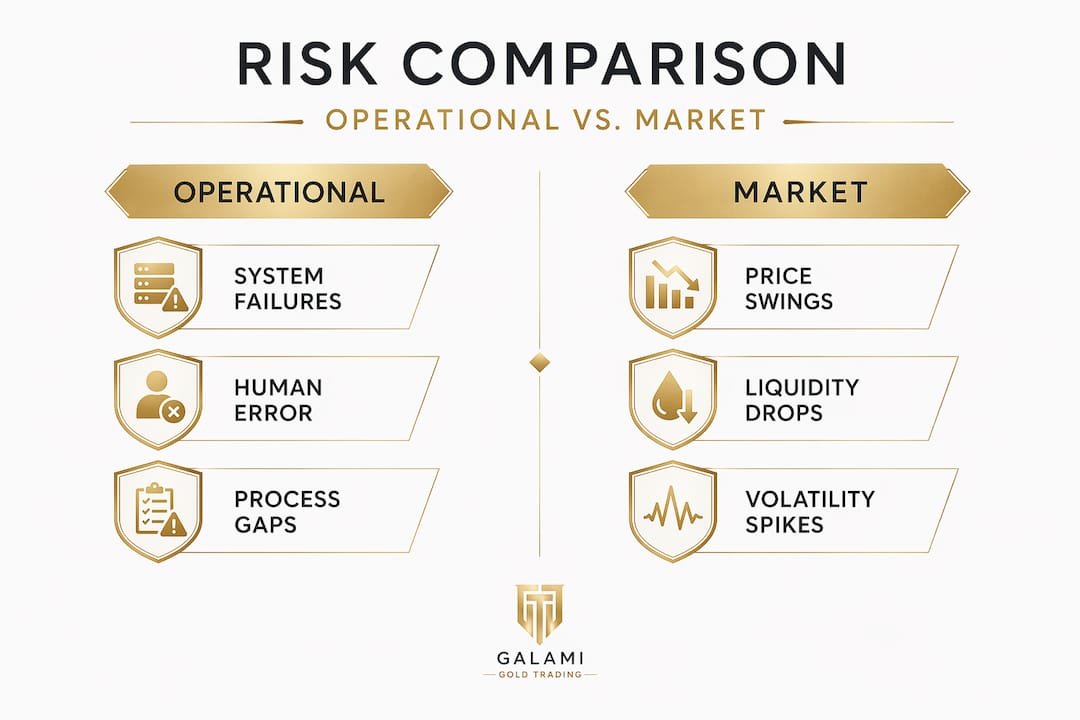
The interaction effects are where real damage occurs. A technology failure during a gold price spike does not just create an operational cost. It leaves your position unhedged precisely when price movement is most dangerous. That converts a contained operational issue into a compounded market loss. Similarly, a settlement failure caused by a documentation error can trigger a default scenario with a counterparty, combining operational and credit risk into a single event.
Galamigold covers the interplay of physical gold risks in depth, including how custody and settlement mechanics connect to broader portfolio exposure. Understanding these connections is what separates reactive risk management from genuinely proactive control.
My perspective on the risks most investors underestimate
I have watched sophisticated investors spend weeks stress-testing their gold market thesis and then deploy capital through platforms with no documented weekend gap procedure. The market analysis was excellent. The operational foundation was not. The losses that followed had nothing to do with where gold prices went.
In my experience, operational risk gets underweighted because it is harder to quantify than price volatility. You can pull up a gold price chart and see volatility. You cannot easily see the probability that your custodian’s system will fail during settlement. That invisibility creates a dangerous blind spot, particularly in a market where automation and behavioral monitoring need to be embedded in daily operations, not reviewed quarterly.
What I find most telling is the direction technology is pushing things. Tokenized gold, 24/7 trading infrastructure proposals, and AI-driven risk detection are all moving the market toward continuous operation. That raises the ceiling on efficiency. It also raises the floor on operational risk complexity. Firms and investors that treat operational controls as a checkbox will face an expanding gap between their risk exposure and their ability to manage it.
The right frame is not “how do I eliminate operational risk.” It is “how do I build a trading operation where operational failures are contained, detected fast, and resolved before they compound.” That mindset shift is what distinguishes the firms I have seen grow through multiple market cycles from the ones that do not.
— Galami
Trade gold with operational discipline built in

Galamigold is built around the principle that disciplined execution and transparent processes are not optional features. They are the foundation. Our audited physical gold trading operations are structured with documented risk controls, supply chain integrity checks, and settlement procedures that account for the operational realities covered in this article, including weekend exposure management and custody oversight. If you are a sophisticated investor or institutional partner looking for a gold trading program where operational risk is managed at the infrastructure level, explore what Galamigold offers and see how our processes align with your standards for capital protection.
FAQ
What is operational risk in gold trading?
Operational risk in gold trading refers to potential losses from failed internal processes, human errors, technology outages, or external disruptions rather than from gold price movements. It includes settlement failures, custody errors, cyber incidents, and weekend gap exposure unique to gold markets.
How does the 49-hour gold problem create operational risk?
When gold markets close Friday and reopen Sunday evening, brokers carry unhedged client positions for nearly 49 hours with no ability to react to price-moving events. This forces firms to either restrict client trading ahead of the weekend or absorb significant unhedged exposure.
Why is T+1 settlement a major operational risk factor?
T+1 settlement gives trading firms less than 24 hours to correct errors before a trade fails. Static contingency plans are not fast enough; firms need trained, simulation-tested procedures to handle documentation issues, system outages, or reconciliation failures under that time pressure.
How does operational risk differ from market risk in gold trading?
Market risk comes from gold price volatility. Operational risk comes from system and process failures. The critical distinction is that operational risk can cause losses even when your price position is correct, making it a separate and often overlooked category of financial risk in gold trading.
What controls reduce operational risk in gold trading?
Multi-layered controls including kill switches, oversized order blocks, daily loss limits, real-time monitoring systems, and regular disruption simulations form the practical baseline. Position sizing discipline and thorough broker vetting for gold-specific procedures add further protection.
Recommended
- Gold trading risk management: strategies for institutions
- Step by Step Gold Transaction Process: 2026 Guide
- Red Flags in Gold Trading: Investor Warning Guide
- Advantages of Wholesale Gold Trading for Investors
Ready to invest in physical gold trade finance?
Both the Zambia–Dubai and Sierra Leone–Dubai programs are open to qualified investors. Minimum investments from $115,000 USD or €125,000 EUR.
Zambia–Dubai Program Sierra Leone–Dubai Program