
Gold asset structuring is the deliberate process of selecting, sizing, and managing gold exposures within an institutional portfolio so that gold fulfills a defined role, whether that is hedging inflation, reducing drawdown risk, or preserving capital across market cycles. The term is not standard industry vocabulary as “asset allocation” or “duration management” are, but the practice it describes is well established and increasingly formalized in institutional mandates. The World Gold Council frames gold as a highly liquid, scarce asset with no credit risk, one that delivers diversification, long-term returns, and liquidity within a multi-asset portfolio. Getting that value requires more than buying gold. It requires structure.
For institutional investors, structure means four things working together:
- A formal policy document, typically an Investment Policy Statement (IPS), that defines gold’s role, target allocation, and rebalancing rules
- A chosen product form, physical bullion, physically backed ETFs, futures, or tokenized gold, matched to the portfolio’s liquidity and custody requirements
- Governance and compliance controls covering custody, audit, and regulatory obligations
- Ongoing monitoring using risk-adjusted return metrics and correlation analysis to verify gold is doing what the IPS says it should
The World Bank’s Gold Investing Handbook for Asset Managers treats gold structuring as a governance and strategic credential question, not just a return question. That framing is the right one for any institution managing reserves, pension assets, or endowment capital.
Why gold belongs in a structured institutional portfolio
The case for gold is not sentimental. Gold has delivered an average annual return of approximately 9.47% over the past 20 years, competitive with equities and well above investment-grade fixed income over the same period. More importantly, it tends to do that while moving differently from stocks and bonds, which is the diversification property that actually matters in a multi-asset context.
Research cited by the World Bank shows that a 10% gold allocation added to a 30/70 equity-bond portfolio reduces downside volatility by 0.3 percentage points, roughly a 10% reduction in negative volatility. For stock-heavy portfolios, the proportional reduction in downside volatility reaches approximately 15%. Those are not dramatic numbers in isolation, but for institutions managing liability-driven portfolios or sovereign reserves, reducing tail risk without sacrificing return is exactly the mandate.
| Asset characteristic | Gold | Investment-grade bonds | Equities |
|---|---|---|---|
| Credit risk | None | Present (sovereign or corporate) | Equity risk |
| Liquidity | Very high (OTC and exchange) | High | High |
| Inflation sensitivity | Positive | Negative (real yield erosion) | Mixed |
| Correlation to equities | Low to negative in stress | Low to moderate | — |
| Long-term return (20-yr avg) | ~9.47% annually | Below gold | Variable |
Gold also carries no counterparty liability when held in allocated form. Every other traditional reserve asset, government bonds included, is someone else’s obligation. The World Bank notes that gold held in specific form and place carries no credit, default, or political risk, a condition no other conventional safe haven asset can match. That property is why central banks have been net buyers of gold for years, and why institutional allocators are formalizing what was previously an informal or opportunistic exposure.
Statistic callout: According to World Bank research, a 10-year fixed-income model portfolio shows a median gold share supportive of minimizing portfolio volatility during tail-risk events, with smaller allocations also helping reduce variation in shorter-duration portfolios.
The inflation hedge argument is real but nuanced. Gold’s correlation with inflation is positive over long horizons, but it can diverge sharply over shorter periods. Institutions that treat gold purely as an inflation hedge and size it accordingly often end up disappointed in the short run. The stronger case is gold as a systemic stress hedge, a portfolio component that tends to attract safe-haven flows precisely when other assets are falling together.
What gold investment products are available to institutional investors?
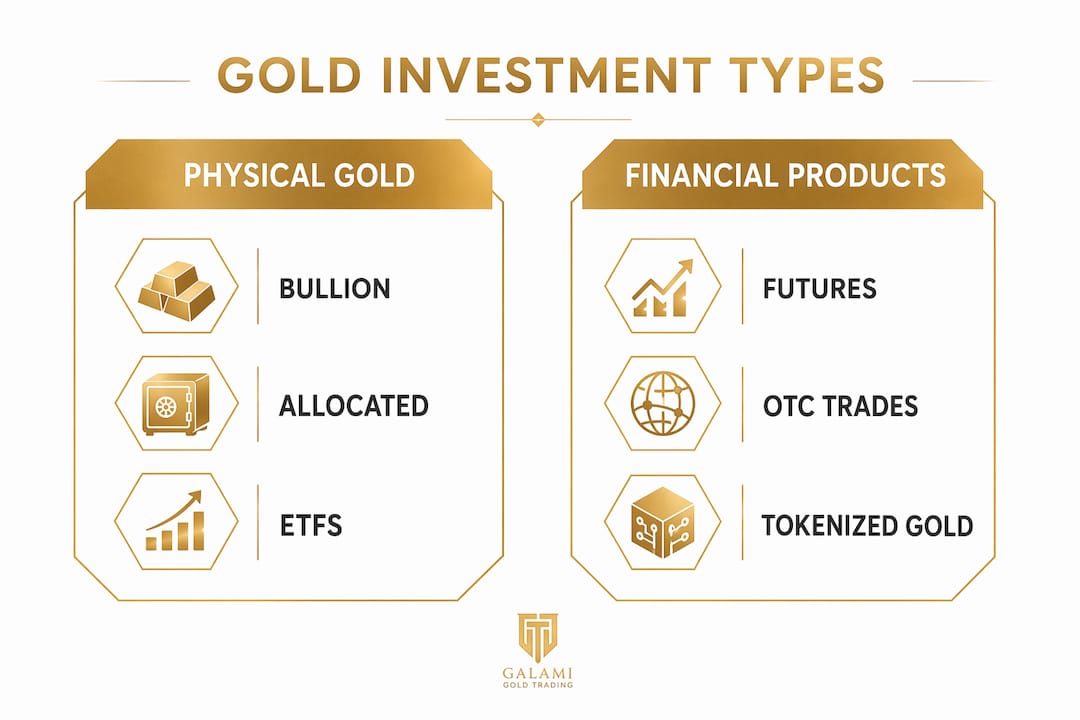
Institutional investors can access gold through six broad product categories, each with a different risk profile, cost structure, and operational footprint.

Physical bullion is the most direct form of ownership. Allocated bullion means the institution holds title to specific, serial-numbered bars segregated off the custodian’s balance sheet. Unallocated gold, by contrast, is a credit claim against a bullion bank for a specified weight, with no specific bar attribution. The distinction is critical: unallocated gold introduces counterparty risk and ranks as a liability on the bullion bank’s balance sheet. For institutions with fiduciary obligations, allocated is the standard.
Physically backed ETFs are the most widely used structured vehicle for institutional gold exposure. The SPDR Gold Trust (GLD) was the first US-listed ETF backed by a physical asset and remains the largest and most liquid gold-backed ETF in the world, with over $134 billion in assets. GLD shares trade like stocks, track the gold spot price minus expenses, and offer intraday liquidity without the storage and insurance costs of direct bullion. For many institutions, the total cost of ownership through GLD is lower than maintaining a traditional allocated bullion account.
Gold futures and options trade on regulated exchanges like COMEX in standardized contracts. Futures are efficient for tactical positioning, hedging, and leverage, but they carry roll costs and expiration dates that require active management. Options give the right without the obligation to buy or sell, useful for downside protection strategies, though the premium cost must be factored into the total exposure budget.
OTC gold trades primarily through the London market via bilateral agreements between financial institutions, usually involving unallocated accounts managed by major bullion banks. OTC is where large, customized trades happen, and it complements exchange-traded products for institutions needing size and flexibility.
Tokenized gold is the newest institutional-grade structure. A tokenized gold product issues digital tokens on a blockchain, each representing a defined weight of physical gold held in allocated, segregated vaulting. Institutional-grade tokenized gold requires a bankruptcy-remote Special Purpose Vehicle (SPV) holding the physical bullion, with independent monthly attestations verifying the physical backing against outstanding tokens.
Gold-backed securities and mining stocks round out the product universe, but State Street Global Advisors warns that not all gold ETFs invest exclusively in bullion. Mining ETFs and mutual funds that hold gold company equities carry equity-related risks, including management quality, free cash flow, and operational factors, that are distinct from bullion price exposure. Institutions should review holdings carefully before treating any gold-labeled fund as equivalent to physical exposure.
| Vehicle | Liquidity | Counterparty risk | Storage/custody cost | Leverage available | Regulatory complexity |
|---|---|---|---|---|---|
| Allocated bullion | Moderate (OTC) | None | High | No | Low |
| Physically backed ETF (e.g., GLD) | Very high (exchange) | Low (trust structure) | Low (embedded in fee) | No | Low |
| Gold futures (COMEX) | High (exchange) | Exchange-cleared | None | Yes | Moderate |
| OTC unallocated | High | Bullion bank credit | None | Yes | Moderate |
| Tokenized gold (SPV-backed) | Moderate to high | Low (SPV-isolated) | Low to moderate | No | High |
| Mining stocks/ETFs | High | Equity risk | None | No | Low |
Key considerations when selecting a product:
- Storage and insurance: Physical bullion requires vault arrangements, insurance, and audit access. ETFs embed these costs in the expense ratio.
- Regulatory compliance: Tokenized gold structures must satisfy AML/KYC requirements and, depending on jurisdiction, licensing with bodies like VARA or CIMA.
- Redemption terms: Understand whether redemption is physical delivery, cash settlement, or both, and what minimum thresholds apply.
- Fee transparency: Tokenized gold typically carries management and storage fees of 25–50 basis points per annum; futures carry roll and brokerage costs that compound over time.
- Tax treatment: Product form affects how gains are taxed; futures held as Section 1256 contracts in the US receive 60/40 long-term/short-term treatment, while ETF shares follow standard capital gains rules.
How to implement gold asset structuring within a diversified portfolio
Effective implementation starts with the IPS, not with product selection. The IPS is the governance document that defines why gold is in the portfolio, how much, and under what conditions it gets rebalanced or exited. Without that foundation, gold becomes a tactical bet rather than a structured allocation.
-
Define gold’s role in the IPS. Decide upfront whether gold serves a tactical function, short-term volatility control, or a strategic one, long-term capital preservation and diversification. The IPS framework should specify the target allocation, allowable range, rebalancing triggers, and the benchmark or reference price used to measure performance.
-
Set the allocation size. Institutional investors typically allocate 5%–10% of investable assets to gold, with some portfolios targeting up to 20% when home equity is excluded. The right number depends on the portfolio’s duration, liability profile, and existing correlation structure. A pension fund with long-duration liabilities may find a higher allocation justified; a short-duration reserve portfolio may stay closer to the lower end.
-
Select the product structure. Match the vehicle to the portfolio’s liquidity needs, custody infrastructure, and regulatory constraints. A fund with daily redemption obligations needs ETF-level liquidity. A sovereign wealth fund with a 10-year horizon can absorb the operational overhead of allocated bullion or a tokenized SPV structure.
-
Integrate with existing holdings. Map gold’s expected correlation to current portfolio positions, particularly equities and long-duration bonds. Use asset diversification analysis to confirm that adding gold actually reduces portfolio-level volatility rather than duplicating existing exposures.
-
Establish rebalancing rules. Specify whether rebalancing is calendar-based, threshold-based, or a combination. Gold’s price volatility means allocations can drift materially from target within a single quarter. A threshold of plus or minus 2–3 percentage points from target is a common institutional standard.
-
Address custody and documentation. For allocated bullion or tokenized gold, document the custody arrangement, audit rights, insurance coverage, and dispute resolution mechanism. Segregation of assets must be legally enforceable, not just contractually assumed.
-
Set up tax and regulatory reporting. Gold’s tax treatment varies by product form and holding entity. Futures contracts, ETF shares, and physical bullion each trigger different reporting obligations under US tax law. Coordinate with legal and tax counsel before the first trade.
-
Monitor using risk-adjusted metrics. Track gold’s contribution to portfolio Sharpe ratio, its realized correlation with equities and bonds over rolling 12-month and 36-month windows, and its drawdown behavior during stress periods. Correlation is not static; gold’s relationship with equities shifts during different macro regimes.
-
Conduct periodic IPS reviews. Gold’s portfolio role should be reassessed at least annually against the institution’s evolving liability profile, regulatory environment, and macroeconomic outlook. A gold allocation sized for a low-rate environment may need adjustment as rate regimes change.
Pro Tip: When monitoring gold’s portfolio contribution, calculate the marginal contribution to portfolio volatility (MCVOL) separately from the standalone volatility of the gold position. A gold allocation can reduce total portfolio volatility even when gold itself is volatile, because the correlation effect dominates the standalone risk.
For institutions exploring factor-based allocation frameworks, gold fits naturally as a defensive factor exposure, alongside low-volatility equities and inflation-linked bonds, rather than as a standalone commodity bet.
Risks and volatility characteristics you need to manage
Gold is not a risk-free asset. Its price can move sharply over short and medium time horizons, and its safe-haven properties are conditional, not guaranteed.
The World Bank cites research showing that gold and stocks decline together in approximately 17% of months, directly contradicting the assumption that gold is a reliable safe haven in all conditions. That figure matters for institutions that size their gold allocation based on a perfect negative correlation assumption. The actual correlation is low on average but variable, and it can turn positive during liquidity crises when investors sell gold to meet margin calls elsewhere.
Key risks institutions must manage within a gold allocation:
- Price volatility: Gold’s short-term price swings can be as large as equity drawdowns. Institutions with mark-to-market reporting obligations need to account for this in their risk budgets.
- Counterparty risk in unallocated structures: Unallocated gold is a credit claim, not ownership. If the bullion bank fails, the institution ranks as an unsecured creditor.
- Custody risk: Even allocated gold depends on the vault operator’s operational integrity, insurance coverage, and legal enforceability of the segregation arrangement.
- Regulatory uncertainty in tokenized gold: Tokenized gold structures operate under evolving regulatory frameworks. Compliance with AML/KYC requirements and licensing obligations varies by jurisdiction and is still being standardized.
- Currency risk: Gold is priced in US dollars globally. Non-US institutions holding gold in their domestic currency face an embedded FX exposure that must be managed separately or accepted as part of the allocation.
- Liquidity risk in stress: Physical bullion and some tokenized structures have lower liquidity than exchange-traded products. In a forced-liquidation scenario, the bid-ask spread on physical gold can widen materially.
Risk callout: Gold’s imperfect hedge properties mean that sizing the allocation based on a worst-case correlation assumption will overstate the diversification benefit in normal markets and understate it in genuine systemic crises. Disciplined allocation strategy, defined in the IPS and stress-tested against historical drawdown scenarios, is the only reliable way to calibrate this.
The inflation hedge case also requires nuance. Gold’s positive sensitivity to inflation is well documented over multi-decade horizons, but over periods of one to three years, the relationship can break down. Institutions that hold gold primarily as an inflation hedge should pair it with Treasury Inflation-Protected Securities (TIPS) or other direct inflation-linked instruments rather than relying on gold alone.
Advanced institutional practices in gold asset structuring
The most sophisticated institutional gold programs go well beyond a standard ETF allocation. Several structural and governance practices separate institutional-grade programs from basic commodity exposure.
Tokenized gold with SPV isolation is gaining traction as a practical way to combine physical backing with blockchain settlement efficiency. The structure requires a bankruptcy-remote SPV as the legal owner of the physical bullion, with the SPV segregated from the issuer’s operating risks. Tokenized gold structures operating under frameworks like Dubai’s VARA Category 1 use allocated, serialized LBMA good-delivery bars vaulted in audit-grade facilities, with Big-Four monthly attestations verifying the physical count and serial numbers against outstanding tokens. The DMCC processes around 25% of global gold trade, making it a natural hub for institutionally credible commodity tokenization.
Legal and compliance architecture for gold-backed tokens is more complex than for conventional ETFs. Custodial arrangements in jurisdictions like the Cayman Islands and BVI require full audit rights, insurance coverage, AML/KYC compliance aligned with FATF standards, and clear dispute resolution mechanisms. Asset segregation must be legally enforceable, not just contractually stated, and smart contract audits are necessary to verify token functionality before deployment.
Advanced considerations for institutional gold programs:
- ESG integration: Responsibly sourced gold from supply chains adhering to LBMA Responsible Gold Guidance is increasingly a requirement for institutions with ESG mandates. The World Gold Council notes that gold from established investment sources should be recognized as responsibly produced, and that gold can play a role in reducing investor exposure to climate-related risks.
- Third-party attestation cadence: Monthly physical-count attestations by independent auditors are the institutional standard for tokenized gold. Annual audits are insufficient for programs with active secondary trading.
- Redemption architecture: Institutional tokenized gold programs should specify minimum redemption thresholds for physical delivery, for example 1,000 tokens equaling 1 kilogram, with cash settlement available for smaller positions. This prevents operational bottlenecks while preserving the physical backing credibility.
- Refiner concentration risk: Programs sourcing gold from a single LBMA-accredited refiner carry concentration risk. Diversifying across two or three refiners reduces supply chain vulnerability.
- Secondary market infrastructure: Liquid secondary markets on regulated venues are increasingly available for tokenized gold, but institutions should verify trading volume and bid-ask spreads before committing to a tokenized structure for positions requiring frequent rebalancing.
The Galamigold approach to gold trading emphasizes disciplined execution, supply chain transparency, and risk management across established gold supply chains, principles that align directly with the governance standards institutional programs require. For institutions building or reviewing a gold allocation, the combination of physical backing credibility, clear custody documentation, and transparent pricing is the baseline expectation, not a premium feature.
Key Takeaways
Gold asset structuring delivers its full portfolio benefits only when allocation size, product form, custody governance, and IPS policy are defined together before the first position is taken.
| Point | Details |
|---|---|
| IPS defines the structure | Gold’s role, target allocation, and rebalancing rules must be documented in the IPS before selecting any product. |
| Allocated beats unallocated | Allocated gold eliminates counterparty risk; unallocated gold is a credit claim that ranks as a bullion bank liability. |
| 5%–10% is the institutional norm | Most institutional portfolios target 5%–10% gold, with some extending to 20% based on duration and liability profile. |
| Product form drives total cost | ETFs like GLD embed storage and insurance costs in the expense ratio; physical bullion and tokenized structures carry separate custody and attestation fees of 25–50 basis points per annum. |
| Gold’s hedge is conditional | Gold and equities decline together in approximately 17% of months, so allocation sizing must be stress-tested, not based on a perfect negative correlation assumption. |
Galamigold operates as a physical gold trading platform built on disciplined execution and supply chain transparency. For institutions evaluating a structured gold allocation, Galamigold’s trading programs offer direct access to physical gold supply with the governance standards institutional mandates require. Review the full risk disclosure before committing capital.

For a practical starting point on portfolio diversification with gold, Galamigold’s institutional resources cover allocation frameworks, product selection, and implementation guidance aligned with 2026 market conditions.
Recommended
- Bullion Explained: A Practical Guide for U.S. Investors
- Gold Trade Settlement Explained for Investors and Traders
- Step by Step Gold Transaction Process: 2026 Guide
- Top Institutional Gold Trading Benefits | Galami Gold
Ready to invest in physical gold trade finance?
Both the Zambia–Dubai and Sierra Leone–Dubai programs are open to qualified investors. Minimum investments from $115,000 USD or €125,000 EUR.
Zambia–Dubai Program Sierra Leone–Dubai Program