
Disciplined execution in physical gold trading means strict, documented adherence to pre-defined trade protocols, transparent pricing references, custody standards, settlement SLAs, and risk limits at every stage of a transaction. Galamigold, alongside institutional frameworks endorsed by the World Gold Council and J.P. Morgan, treats this discipline not as a preference but as the operational foundation that separates reliable physical allocation from improvised commodity exposure.
The core elements are:
- Pre-trade due diligence: counterparty checks, reference price governance, credit limits
- Execution rules: limit orders, slippage tolerances, staged fills, matching protocols
- Transport and logistics: insured transit, shipping manifests, chain-of-custody controls
- Custody and insurance: segregated holdings, vault operator standards, named insurers
- Settlement: delivery-versus-payment (DvP) mechanics, documented SLAs
- Reconciliation and proof-of-reserves: independent attestation, timestamped audit trails
Key Takeaways
Disciplined execution in physical gold trading requires documented protocols, segregated custody, independent reconciliation, and measurable SLAs at every stage of the transaction.
| Point | Details |
|---|---|
| Operational definition | Disciplined execution means strict adherence to trade protocols, transparent pricing, custody standards, settlement SLAs, and risk limits. |
| Core KPIs to track | Monitor slippage in basis points, fill rate above 90%, time-to-settlement vs. T+X SLA, and proof-of-reserves cadence. |
| Physical vs. proxy tradeoff | Physical allocation avoids roll costs from commodity index exposure but carries explicit storage, insurance, and audit fees. |
| Provider evaluation | Require audited holdings, segregated custody agreements, named insurance underwriters, and independent reconciliation reports before signing. |
| Galamigold next step | Request Galamigold’s operational due-diligence pack to verify audited holdings, custody terms, and settlement SLAs before mandate. |
This article provides general information only and is not legal, tax, or investment advice. Confirm all legal, tax, and custody arrangements with qualified advisors before executing any physical gold transaction.
Table of Contents
- What are the core components of disciplined execution?
- Why does disciplined execution matter for institutional gold allocations?
- What does the step-by-step execution process look like?
- How do you measure and govern execution quality?
- How should you evaluate a disciplined-execution provider?
- What do physical gold costs and liquidity actually look like?
- How Galamigold implements disciplined execution in practice
- Legal, tax, and custody considerations you must verify
- Why Galamigold puts disciplined execution at the center of everything
- Galamigold’s institutional execution program
- Sources
What are the core components of disciplined execution?
Each building block below is something you should expect, verify, and contractually enforce with any execution provider.
Pre-trade due diligence covers counterparty credit screening, KYC/AML checks, and reference price governance. Acceptable pricing sources include LBMA AM/PM fixes, CME spot references, and OTC dealer quotes benchmarked against a recognized index. No trade should begin without a documented price discovery record.
Execution rules define how a trade is filled. Limit orders cap slippage against the reference price. For large institutional blocks, staged fills spread market impact across time or multiple counterparties. Fill protocols must be written down, not improvised.
Transport and logistics require a signed shipping manifest, an insured transit policy with a named underwriter, and a documented chain-of-custody from seller vault to buyer vault. Any gap in the chain is a custody risk.

Custody and insurance are where allocated physical bullion separates from pooled or derivative exposure. Segregated accounts hold your specific bars, identified by serial number, in a recognized vault. Pooled accounts do not. Insurance policy limits and the insurer’s name must appear in the custody agreement.
Settlement and reconciliation close the loop. DvP mechanics confirm that title transfers only when payment clears. Independent reconciliation, ideally by a third party, compares the provider’s records against vault operator records. Proof-of-reserves statements, published on a defined cadence, verify that holdings match client ledgers.
Reporting and auditability require timestamped trade confirmations, itemized fee schedules, and third-party attestation reports. A Mercer/Xetra study warns that investors must review legal structure and collateralization carefully, since ETP and physical holding designs differ significantly in how settlement and tracking risks are managed.
Pro Tip: Ask any provider for a sample reconciliation report before signing. If they cannot produce one within 48 hours, that is a process gap, not a paperwork delay.
Why does disciplined execution matter for institutional gold allocations?
Disciplined execution preserves capital, reduces settlement risk, and protects allocation intent. Without it, slippage, custody ambiguity, and settlement delays erode the very resilience that physical gold is meant to provide.
That framing matters operationally. If gold’s primary role is resilience and tail-risk insurance, then execution quality during stress periods, when liquidity is tightest and counterparties are most stretched, determines whether the allocation actually delivers. Sloppy execution at exactly the wrong moment defeats the purpose.
The World Gold Council reports that global gold market daily trading averaged US$373bn in 2025, confirming that institutional-sized transactions can be absorbed without moving the market, provided execution is staged and disciplined. Physical allocation also avoids the roll costs embedded in broad commodity index exposure, a structural cost drag that compounds over multi-year holding periods.
Yet institutional ownership remains modest: roughly 15% of institutions hold specific gold positions, and among those that do, the average allocation is about 4%. Most plan to maintain or increase that position, which means execution reliability matters more than short-term trading gains. A single settlement failure or custody dispute can undo years of allocation intent. For more on why gold matters for institutional portfolios, the rationale extends well beyond inflation hedging.
What does the step-by-step execution process look like?
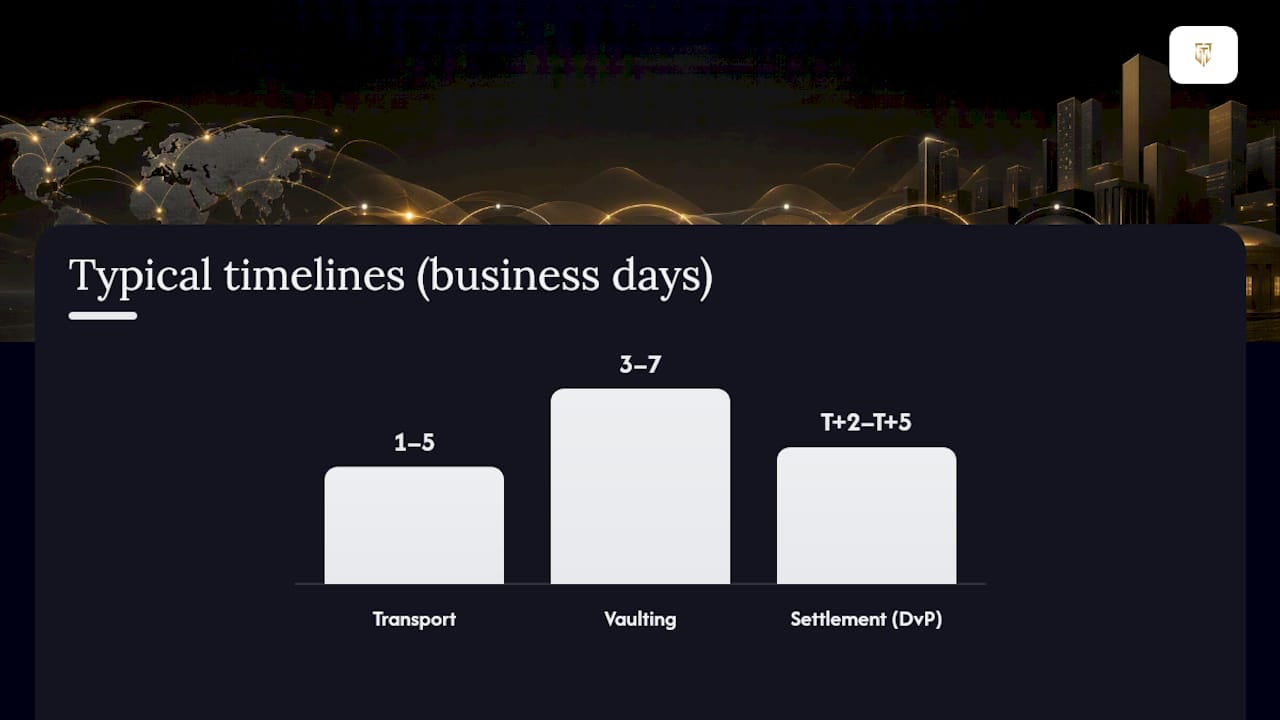
A complete physical gold transaction moves through six phases: pre-trade, execution, transport, vaulting, settlement, and reconciliation. Each has defined owners and measurable SLAs.
- Pre-trade (Day 0): Counterparty credit check, KYC/AML clearance, reference price lock, trade ticket generation. Target: complete within 2–4 hours of mandate.
- Execution (Day 0–1): Order placed with limit parameters, staged fills executed, trade confirmation issued. Target: confirmation within 30 minutes of fill.
- Transport (Day 1–5): Insured transit arranged, shipping manifest signed, chain-of-custody tracker activated. Timeline varies by origin and destination jurisdiction.
- Vaulting (Day 3–7): Physical receipt at recognized vault, bar serial numbers logged, segregated account updated. Vault operator issues receipt within 24 hours of delivery.
- Settlement (Day 2–5): DvP mechanics confirm title transfer on payment clearance. Standard OTC settlement is T+2; some jurisdictions allow T+5 for cross-border physical delivery.
- Reconciliation (Ongoing, monthly minimum): Independent reconciliation compares provider ledger against vault records. Proof-of-reserves statement issued on agreed cadence.
| Phase | Typical Timeline | Primary Owner |
|---|---|---|
| Pre-trade | 2–4 hours | Compliance + Trading Desk |
| Execution | Same day to T+1 | Trading Desk |
| Transport | 1–5 business days | Logistics Provider |
| Vaulting | 3–7 business days | Vault Operator |
| Settlement (DvP) | T+2 to T+5 | Settlement Agent |
| Reconciliation | Monthly minimum | Independent Auditor |
Pro Tip: Build contractual SLA breach notifications into your custody agreement. A missed settlement window that triggers an automatic alert is far more useful than one discovered during a quarterly review.
How do you measure and govern execution quality?
Measurement is what converts an SLA from a promise into an enforceable contract. The primary KPIs are:
- Slippage vs. reference price: actual fill price minus the agreed reference, expressed in basis points
- Fill rate: percentage of order filled within limit parameters on first attempt
- Time-to-settlement: actual settlement date versus contractual T+X
- Custody reconciliation drift: discrepancy between provider ledger and vault records
- Proof-of-reserves frequency: how often independent attestation is published
- Incident-response time: hours from identified breach to documented remediation
| KPI | Measurement Method | Acceptable Threshold | Remediation |
|---|---|---|---|
| Slippage | Fill price vs. LBMA fix | Within a few basis points | Escalate to trading desk; review limit order parameters |
| Fill rate | Order logs vs. confirmations | Above 90% | Review counterparty capacity; add backup liquidity sources |
| Time-to-settlement | Settlement date vs. SLA | Zero breaches | Trigger SLA penalty clause; notify compliance |
| Reconciliation drift | Third-party audit vs. ledger | Zero unresolved items | Freeze account; initiate independent investigation |
| Proof-of-reserves | Attestation report cadence | Monthly minimum | Escalate to board risk committee |
Governance artifacts that must exist in writing: signed SLAs with penalty clauses, independent attestation reports, proof-of-reserves statements, and a dated incident log. Without these documents, KPIs are unenforceable.
Pro Tip: Require that proof-of-reserves statements be signed by a named, independent auditor, not just the provider’s internal compliance team. The independence is the point.
How should you evaluate a disciplined-execution provider?
The evaluation principle is simple: insist on transparency, auditable controls, and segregated custody. Everything else follows from that.
Must-have disclosures:
- Audited holdings with named auditor and report date
- Proof-of-reserves statements on a defined cadence
- Segregated custody agreement with vault operator name and jurisdiction
- Insurance schedule with named underwriter and policy limits
- Itemized fee schedule covering spread, storage, insurance, and audit costs
- Settlement SLAs with documented breach consequences
- Independent reconciliation reports from a third party
Questions to ask in an RFP or discovery call:
- Which reference price governs your execution, and how is it documented?
- What are your settlement mechanics, and do you use DvP?
- Who is your vault operator, and is custody segregated by client?
- Who underwrites your transit and storage insurance, and what are the policy limits?
- How often is proof-of-reserves published, and who signs it?
- What is your dispute resolution process and timeline?
Red flags to walk away from:
- Opaque or bundled pricing with no itemized breakdown
- Pooled custody with no segregation and no bar-level identification
- Missing or self-issued attestation (provider signs its own proof-of-reserves)
- Vague insurance language with no named underwriter
- Settlement timelines described as “standard” with no contractual definition
Allocated physical accounts reduce counterparty exposure precisely because your bars are identified and segregated. Any provider that cannot demonstrate this in writing is offering something structurally different from what they may be describing. For gold trading strategies that address staging and market-impact reduction, the provider’s execution rulebook is the first document to request.
What do physical gold costs and liquidity actually look like?
Physical allocation avoids roll costs and counterparty tracking error, but it carries explicit, itemized costs that proxy instruments do not. The World Gold Council confirms that broad commodity index exposure creates roll costs that direct physical allocation avoids entirely.
Typical cost items for a physical institutional buy:
- Bid/ask spread (OTC physical, typically 0.1%–0.5% depending on bar size and counterparty)
- Trading commission or facilitation fee
- Insured transport and shipping
- Vaulting and storage fees (annual, charged on metal value)
- Insurance premiums (annual, on declared value)
- Audit and attestation fees
- Applicable taxes and import duties by jurisdiction
The Mercer/Xetra study specifically flags ETP tracking risk from fees and structural design as a material consideration investors often underweight.
For large blocks, OTC voice execution with staged fills reduces market impact. Electronic matching suits smaller, standardized lots. The choice of execution channel directly affects realized spread.
Pro Tip: Request an all-in cost illustration, not just a headline spread. Storage, insurance, and audit fees are predictable and should be quoted upfront. Any provider who cannot give you a written all-in figure is leaving cost risk with you.
How Galamigold implements disciplined execution in practice
Galamigold’s execution model integrates each component described above into a single, auditable workflow. A representative institutional transaction follows this sequence: mandate signed, counterparty and KYC checks cleared, reference price locked against the LBMA fix, limit order placed with documented slippage tolerance, transit arranged with a named logistics provider, physical delivery confirmed, DvP settlement completed, and an independent reconciliation report issued within the agreed window.
At Galamigold, execution rules, staged fills and independent reconciliation are applied together, because each one reduces a different kind of operational risk in physical gold transactions.
Key operational proof points Galamigold makes available during due diligence:
- Audited holdings with named third-party auditor
- Segregated custody agreements identifying vault operator and jurisdiction
- Proof-of-reserves statements on a defined cadence
- Itemized fee schedules covering all cost components
- Settlement SLAs with documented breach consequences
| Governance Artifact | Availability |
|---|---|
| Audited holdings report | On request during diligence |
| Proof-of-reserves statement | Periodic cadence, named auditor |
| Segregated custody agreement | Provided pre-mandate |
| Itemized fee schedule | Provided pre-mandate |
| Independent reconciliation report | Post-settlement, per transaction |
Pro Tip: When reviewing any provider’s case study, ask for the governance artifacts that verified the outcome, not just the outcome itself. Audited holdings and a signed reconciliation report are the difference between a claim and a proof point.
Legal, tax, and custody considerations you must verify
Legal and tax treatment for physical gold holdings vary by jurisdiction and must be confirmed with qualified legal and tax counsel before any transaction is executed. For US-based institutional investors, the minimum items to verify include:
- Custody jurisdiction: which country’s law governs the custody agreement and vault relationship
- Tax treatment: whether imported bullion is subject to sales tax, VAT, or import duties in the delivery jurisdiction
- AML/KYC and sanctions screening: compliance with FinCEN, OFAC, and applicable state-level requirements
- Insured custody terms: whether the insurance policy covers full replacement value and under what conditions claims are paid
- Contract law for settlement and delivery: governing law for DvP mechanics and title transfer
- Reporting and recordkeeping: IRS reporting obligations for physical commodity holdings and any FBAR or Form 8938 requirements for offshore custody
Physical gold held in allocated accounts outside the US may trigger foreign financial account reporting requirements. Confirm the custody jurisdiction and applicable reporting obligations with your legal and tax advisors before finalizing any cross-border custody arrangement.
Pro Tip: Request the custody agreement’s governing law clause on day one of diligence. A custody agreement governed by a jurisdiction with weak creditor protections is a structural risk, regardless of how strong the vault operator’s reputation appears.
Why Galamigold puts disciplined execution at the center of everything
Disciplined execution is not a feature Galamigold added to its offering. It is the premise the entire platform is built on. Institutional clients allocating to physical gold are not speculating on short-term price moves. They are making long-term, sticky allocations, averaging around 4% of portfolio per the World Gold Council’s institutional survey, that need to hold up under audit, regulatory scrutiny, and market stress. Transparent pricing, segregated custody, independent reconciliation, and audited holdings are not differentiators in that context. They are the baseline.
Galamigold’s institutional execution program
Galamigold provides institutional-grade physical gold trading with transparent, itemized pricing, segregated custody support, audited proof-of-reserves, and documented settlement SLAs. The offering is built for wealth managers, trading counterparties, and institutional allocators who need execution they can put in front of a compliance committee.

The practical next step is straightforward: request Galamigold’s operational due-diligence pack, which includes independent audit information, the Loan Note terms and the risk disclosure. You can also review the Sierra Leone–Dubai or Zambia–Dubai gold trading programs as concrete examples of how the execution model operates across established supply chains. To start the conversation, visit Galamigold’s trading platform and submit a mandate inquiry.
Sources
- Gold: The most effective commodity investment − 2026 edition | World Gold Council
- Gold in institutional portfolios: FAQs | First Eagle
This article is general information, not a substitute for advice from a qualified financial advisor. Consult a qualified financial professional about your own circumstances before acting on anything here.
Recommended
- Step by Step Gold Transaction Process: 2026 Guide
- Top institutional gold trading benefits for portfolio growth
- Gold Trade Settlement Explained for Investors and Traders
- What Is Bulk Gold Trading: Investor's 2026 Guide
Ready to invest in physical gold trade finance?
Both the Zambia–Dubai and Sierra Leone–Dubai programs are open to qualified investors. Minimum investments from $115,000 USD or €125,000 EUR.
Zambia–Dubai Program Sierra Leone–Dubai Program