
TL;DR:
- Successful gold negotiations depend on thorough preparation, market benchmarking, and strong relationships.
- Building credible alternatives (BATNA) and understanding market standards grant negotiators long-term leverage.
- Post-deal monitoring of costs, quality, and relationships ensures ongoing value and risk management.
Gold deal negotiation is one of the most technically demanding skills in the precious metals market, where a single misstep can cost you thousands in avoidable premiums or expose your capital to outright fraud. Whether you are structuring a bulk bullion purchase, evaluating an offtake agreement with a mining company, or simply trying to secure a better buy-back rate from your regular dealer, the same core principles apply: preparation, leverage, and relationship capital. This article walks you through every stage of that process, from benchmarking spot prices before you sit down at the table to monitoring deal outcomes months after the ink is dry, so you can consistently extract better value from every gold transaction.
Table of Contents
- Preparing for gold deal negotiations
- Negotiating prices and deal terms
- Avoiding common negotiation pitfalls
- Verifying deal outcomes and optimizing long-term value
- Why savvy gold negotiators focus on leverage and relationships
- Unlock gold trading advantages with Galami Gold
- Frequently asked questions
Key Takeaways
| Point | Details |
|---|---|
| Preparation matters most | Benchmark spot prices, dealer premiums, and build negotiation alternatives before entering any gold deal. |
| Structure deal terms smartly | Negotiate pricing, logistics, and contract details using market benchmarks for both physical and institutional transactions. |
| Avoid negotiation pitfalls | Stay alert for volatile markets, scams, and regulatory risks; always choose established, LBMA-approved dealers. |
| Verify and optimize value | After closing, check fulfillment, track sell-back rates, and sustain discounts through strong relationships. |
| Leverage expertise and relationships | Knowledge and trust trump chasing the lowest price—savvy negotiators maximize long-term returns with smart partnerships. |
Preparing for gold deal negotiations
Having set the stakes, the next step is careful preparation. Most negotiation failures happen before any conversation starts. Investors who walk into gold deals without proper benchmarks routinely overpay by 2% to 5% on premiums, which on a $500,000 position represents $10,000 to $25,000 left on the table. That is not a rounding error. It is a structural disadvantage caused by inadequate groundwork.
Start with price benchmarks you can defend. The London Bullion Market Association (LBMA) publishes the LBMA Gold Price twice daily, and COMEX futures data gives you real-time spot movement. These are your anchors. When a dealer quotes you a price, your first question should be: how far is this from spot, and why? If they cannot explain their premium in terms you can verify, that is already telling you something important.
Here are the core research tasks to complete before any negotiation:
- Pull the current LBMA morning and afternoon fix for the day of your intended transaction
- Check COMEX active month futures for intraday price direction
- Request quotes from at least three dealers, mixing local and online sources
- Review each dealer’s fee structure: storage fees, wire fees, delivery charges
- Note whether pricing is fixed-spread or spot-follow-through (meaning the final price adjusts with spot at time of settlement)
- Identify seasonal demand patterns, since premiums tend to spike during festival buying seasons in Asia and dip during slower Q1 periods
As a framework, negotiation tips from wholesale jewelry markets confirm that preparation is essential for gold deals: research spot prices, compare premiums from multiple dealers, and track market trends to time purchases during low demand periods.
| Dealer type | Typical premium range | Negotiability |
|---|---|---|
| Local coin dealer | 3% to 8% over spot | Low to moderate |
| Online bullion dealer | 1% to 4% over spot | Low |
| Wholesale distributor | 0.5% to 2% over spot | Moderate |
| Institutional broker | 0.1% to 0.8% over spot | High for large volume |
Understanding these gold trading standards gives you a clearer picture of what fair looks like at each level of the market.
Pro Tip: Build your BATNA (Best Alternative to a Negotiated Agreement) before you contact your primary dealer. If you have a confirmed alternative quote in hand, you negotiate from a position of genuine strength rather than implied flexibility. Dealers know when you are bluffing, and experienced ones will hold their spread if they sense you have no real options.
Negotiating prices and deal terms
Once armed with benchmarks and data, negotiating begins. The specific mechanics vary significantly depending on whether you are buying retail coins, accumulating bulk bullion, or structuring an institutional mining offtake agreement. Each scenario demands a different approach, but the underlying logic is the same: every element of the deal is negotiable until it is contractually fixed.
For physical coin and bar purchases, the primary leverage points are volume and payment terms. Dealers routinely offer lower premiums for orders above threshold quantities, typically starting at 20 to 50 ounces for bars and 100 ounces for coins. Paying by wire transfer rather than credit card often removes a 2% to 3% processing surcharge. Locking in a spot-follow-through price rather than a fixed spread protects you when spot prices drop between your order confirmation and settlement.
For bulk bullion and wholesale transactions, the negotiation expands to include:
- Agree on the pricing benchmark (LBMA PM fix, COMEX settle, or a specific time-stamped spot rate)
- Define the premium in writing, specifying whether it is a fixed dollar amount per ounce or a percentage
- Negotiate treatment charges if the metal is being refined or assayed before delivery
- Specify logistics terms clearly: who bears insurance, which Incoterms apply (CIF or FOB), and what the delivery window is
- Include a price review clause for any contract longer than 90 days, since gold spot can move 10% to 15% in that window
For institutional and mining agreements, the stakes and complexity scale dramatically. A useful data point: the Heath Goldfields and Trafigura deal valued at $2.3 to $2.8 billion covered 700,000 ounces at $3,300 to $4,000 per ounce and included $65 million in financing. In large-scale mining gold deals, pricing typically references LME or spot with adjustments for payable content, treatment and refining charges (TC/RC), and quality bonuses or penalties. Minimum and maximum volume provisions, price review triggers, and logistics terms are all embedded in the contract.
| Deal type | Key pricing variable | Main negotiating lever |
|---|---|---|
| Retail coins | Premium over spot | Volume and payment method |
| Bulk bullion | Fixed vs. floating spread | Volume discounts, Incoterms |
| Mining offtake | TC/RC and payable ratios | Project quality, financing package |
Understanding the difference between these contexts is critical. The strategies that work for physical vs trading operations are not interchangeable, and misapplying retail tactics to institutional deals signals inexperience fast.
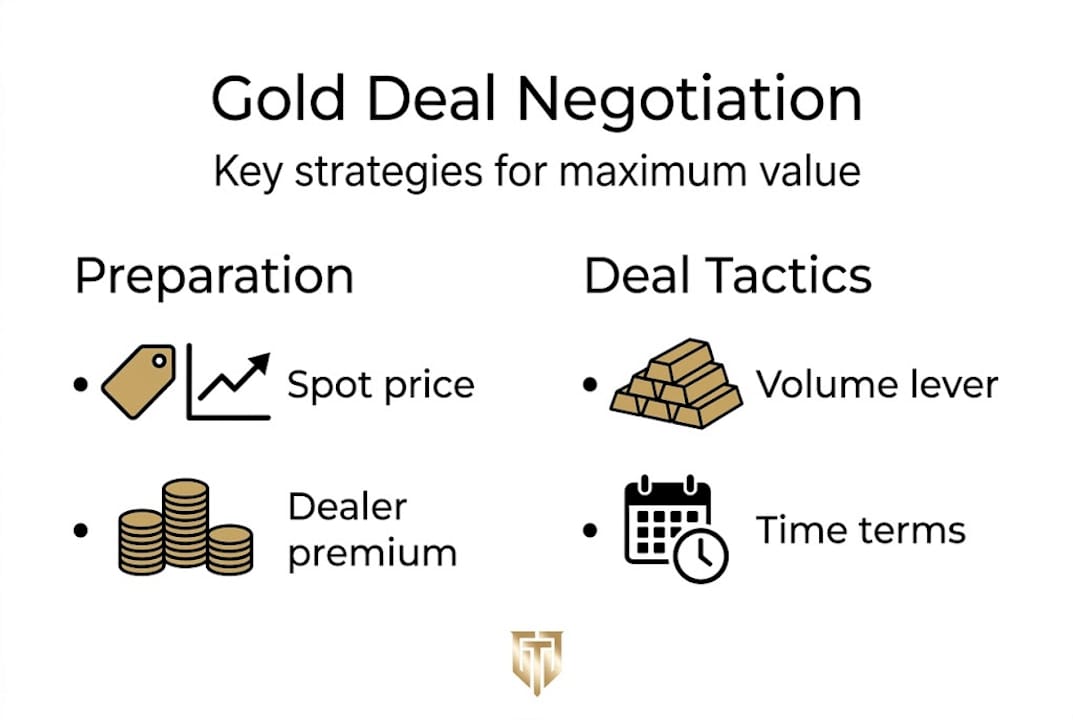
Pro Tip: In any written term sheet, define the pricing time explicitly. “Spot price” without a timestamp is legally ambiguous. Specify the exact fix, exchange, and time of day used to calculate your settlement price. This single clause has resolved countless post-trade disputes before they became arbitration cases.
Avoiding common negotiation pitfalls
Even experienced negotiators face pitfalls. Here is how to avoid the ones that appear most frequently in gold deal contexts.
Volatility-driven premium spikes are the most common ambush. When gold spot moves sharply, dealers widen their spreads to protect themselves from inventory loss. If you enter negotiation during a high-volatility period, you may be comparing quotes made at different spot levels, which makes apples-to-apples premium comparisons nearly impossible. Time your negotiations for calmer trading windows whenever possible.
Below-spot price offers are the single clearest fraud signal in the physical gold market. No legitimate dealer sells gold below spot. When you see it, you are either looking at adulterated metal, a short-weight product, or an outright scam. Coin premium risks analysis confirms this plainly: avoid below-spot prices, high volatility premium spikes, and rigid take-it-or-leave-it demands, and prefer LBMA-approved counterparties for liquidity.
Here is a practical checklist of pitfalls to screen for before finalizing any deal:
- Is the dealer on the LBMA Good Delivery List or an approved LBMA member? If not, your resale options narrow significantly.
- Has the dealer provided verifiable assay documentation and chain of custody records?
- Are there any clauses that restrict your ability to sell or transfer the metal within a defined period?
- Is the storage facility independently audited? Unverified storage claims are a recurring fraud vector.
- Does the contract specify what happens if delivery is delayed beyond the agreed window?
“In gold negotiations, the investor who controls the alternatives controls the conversation. BATNA is not a backup plan. It is your primary source of leverage.”
Solid risk management strategies in gold trading always start with counterparty vetting. Before you negotiate price, you need confidence in who you are negotiating with. Detailed guidance on evaluating gold traders covers the specific criteria worth applying, and understanding how to trust gold trading platforms adds another layer of protection for investors working with digital or hybrid trading environments.
Pro Tip: Build at least two pre-qualified alternatives before you approach your primary counterparty. Not theoretical alternatives. Actual quotes with terms you have reviewed. Walking into a deal with one real option and one fallback position changes the psychology of the entire negotiation.
Verifying deal outcomes and optimizing long-term value
After negotiation, successful deal monitoring is vital. Many investors treat deal signing as the finish line. In practice, it is the starting gun for a verification process that determines whether the negotiated terms actually deliver the value you expected.
Checking contract fulfillment begins at delivery. Verify metal weight and purity against the assay certificate before signing any confirmation of receipt. For larger transactions, independent third-party assaying is worth the cost. A deviation of 0.1% in purity on a 1,000-ounce order at current prices represents a meaningful dollar amount, and it is far easier to address before you have signed off on the shipment.

Payment accuracy tracking matters especially in spot-follow-through agreements. Cross-reference every invoice against the specific LBMA fix or COMEX settle that was contractually specified. Billing errors in gold transactions are rarely random. They consistently favor the dealer.
The following benchmarks give you a framework for evaluating ongoing deal performance:
- Compare your effective all-in cost per ounce (purchase price plus all fees) against the LBMA fix on the day of settlement
- Track your sell-back rate relative to spot: dealers offer up to 98% of spot on pure coin buy-backs for established clients
- Measure fee reductions over time: negotiation can yield 40% fee cuts in trading contexts, though physical deal premiums typically move only 1% to 2% through sustained relationship pressure
- Review each deal’s outcome against your original benchmark data to identify where you captured value and where you did not
Relationship capital is the most underestimated asset in long-term gold deal optimization. Dealers who trust you as a reliable, volume-consistent counterparty will offer preferential pricing before you even ask. They will notify you when favorable inventory positions exist, extend credit terms, and absorb small logistical costs that would otherwise appear as line items on your invoice.
For institutional investors and corporate buyers, gold M&A benchmarks reveal that acquirers pay $34 to over $1,000 per resource ounce, depending on gold price, project grade, and development stage. This variance makes relationship intelligence at the deal-sourcing level as valuable as any technical negotiation skill.
Key metrics to track after every deal:
- Effective premium paid vs. your pre-deal benchmark
- Delivery accuracy: weight, purity, and timing
- Sell-back rate offered vs. prevailing spot on the same day
- Total fees as a percentage of transaction value
Compliance and documentation hygiene also matter here. Staying current with gold trading regulations in 2026 protects you from the growing wave of AML enforcement actions that have impacted investors who treated paperwork as an afterthought.
Why savvy gold negotiators focus on leverage and relationships
Here is the perspective most deal guides skip: the investors who consistently extract the best terms in gold markets are not the ones who spend the most time chasing the lowest premium. They are the ones who have built the most credible alternatives and the strongest dealer relationships simultaneously.
Price-focused negotiators hit a ceiling fast. At some point, a dealer’s spread covers real costs: inventory risk, storage, logistics, and compliance. Pushing past that floor creates friction that damages the relationship and eventually causes the dealer to quietly deprioritize you as a client.
What actually generates sustained long-term value is being seen as a serious, reliable counterparty with options. That combination, knowledge of market benchmarks plus credible BATNA plus consistent volume, gives you negotiating power that no single-deal tactic can replicate.
The mistake most investors make is treating each deal as a standalone transaction. The best gold negotiators we have observed treat every deal as a deposit into a long-term relationship account. They concede small points strategically, knowing those concessions will be returned in the form of better pricing, faster execution, and preferential access over time. Connecting that approach to risk management transparency with your trading partners creates a foundation that outperforms pure price negotiation in almost every market environment.
Unlock gold trading advantages with Galami Gold
With strategy in hand, partnering with experts can maximize value.
At Galami Gold, disciplined execution and transparent deal structures are built into every trading relationship, from physical gold supply chains to institutional capital deployment. If you are ready to apply the negotiation frameworks covered here, working with a partner who understands market benchmarks, counterparty risk, and long-term deal optimization changes your outcomes meaningfully.

Explore gold trading programs built around integrity and efficient capital deployment in the precious metals market. Before committing to any position, review the platform’s risk disclosure to ensure your strategy aligns with your investment parameters. Galami Gold is designed for serious investors who want transparent counterparties, not just competitive quotes.
Frequently asked questions
What are the key factors to consider before negotiating a gold deal?
Research current spot prices using LBMA or COMEX, compare premiums from at least three dealers, build a concrete BATNA, and confirm LBMA approval before entering any negotiation. Dealer credibility and liquidity matter as much as the price itself.
How do gold dealers set premiums, and can they be negotiated?
Premiums are set based on spot price, dealer inventory costs, and market demand conditions. Fee reductions up to 40% are achievable in trading contexts, while physical deal premiums typically move only 1% to 2% through sustained relationship pressure.
What mistakes should investors avoid when negotiating gold deals?
Avoid entering negotiations during high volatility periods, reject any offer priced below spot as a fraud signal, and never finalize a deal without verifying the counterparty’s LBMA credentials and assay documentation.
How can I check if my gold deal delivers long-term value?
Track your effective all-in cost against the LBMA fix at settlement, monitor sell-back rates at 98% of spot as a benchmark for pure coins, and measure fee trends over time to verify that relationship value is actually accruing to your positions.
Recommended
- Gold Trade Settlement Explained for Investors and Traders
- Gold Broker Roles: Institutional Trading Edge in 2026 | Galami Gold
- Institutional Gold Broker Checklist: 2026 Vetting Guide
- How to Select Gold Partners: Institutional Guide 2026
Ready to invest in physical gold trade finance?
Both the Zambia–Dubai and Sierra Leone–Dubai programs are open to qualified investors. Minimum investments from $115,000 USD or €125,000 EUR.
Zambia–Dubai Program Sierra Leone–Dubai Program