
TL;DR:
- Physical gold offers limited information about its origin due to blending and variable documentation standards.
- Institutional investors must rely on verified frameworks and comprehensive supply chain evidence to assess responsible sourcing effectively.
Physical gold is one of the few asset classes where the product you hold tells you almost nothing about where it came from. For institutional investors, knowing how to evaluate gold supply chains is not a compliance checkbox — it is a direct input into ESG risk scoring, regulatory exposure, and long-term portfolio integrity. The problem is structural: gold blends at the refinery, documentation standards vary by jurisdiction, and terms like “responsible” and “ethical” carry no legal weight on their own. This guide walks you through the exact frameworks, documents, and verification logic you need to assess gold sourcing with confidence.
Table of Contents
- Understanding the problem: the challenges of evaluating gold supply chains
- Preparation: key standards and documentation frameworks for gold supply chain evaluation
- Execution: how to assess gold supply chain evidence and verify responsible sourcing
- Verification: common pitfalls and how to avoid risks in gold supply chain evaluation
- A practical perspective: why traceability evidence matters more than labels in gold investment risk
- Connecting with trusted gold trading partners for investment confidence
- Frequently asked questions
Key Takeaways
| Point | Details |
|---|---|
| Complexity of gold supply chains | Gold supply chains often blend materials, making traceability and provenance verification challenging. |
| Importance of documented evidence | Institutional investors must seek comprehensive documentation like invoices, assay reports, and chain-of-custody certificates to verify sourcing. |
| Standard frameworks guide evaluation | Frameworks such as WGC RGMPs and LBMA Responsible Gold Guidance provide structured methods for responsible sourcing assessment. |
| Beware generic ethical claims | Marketing terms like ‘ethical’ require backing by specific, auditable frameworks and verifiable traceability to reduce risk effectively. |
| Segregation vs mass-balance impacts trust | Physical segregation of gold by source strengthens origin assurance more than mass-balance handling that blends lots. |
Understanding the problem: the challenges of evaluating gold supply chains
The first thing most institutional investors discover when assessing gold supply chains is that the product itself offers no answers. Unlike equities or real estate, gold loses its identity at the refinery. Multiple source streams — artisanal, large-scale, recycled — are physically combined into a single bar. Blended streams mean precise country-of-origin attribution becomes unprovable once that mixing occurs, which is not a minor footnote. It fundamentally changes how you evaluate any origin or sourcing claim a counterparty makes.
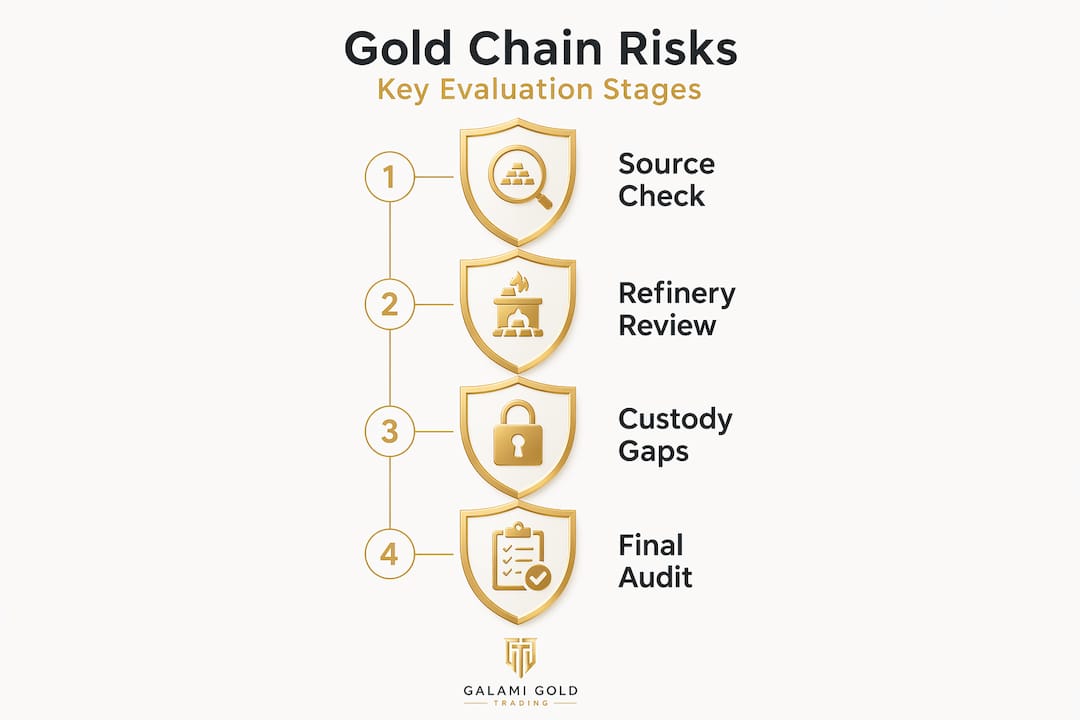
This challenge is compounded by language. The precious metals industry has not converged on precise definitions for “responsible,” “ethical,” or “conflict-free” gold. A supplier can use all three terms and mean entirely different things by them, or mean nothing auditable at all. Without mapping those claims to a recognized framework with third-party verification, they are marketing language, not evidence.
What this means in practice for investors:
- Origin claims without segregation cannot be validated after refining and should be treated as aspirational at best.
- Responsible sourcing labels are only meaningful when attached to a named, auditable standard with documented compliance cycles.
- Broker-level representations about supply chain integrity are not a substitute for refinery-level disclosures and independent audits.
- Jurisdiction risk is layered, not binary. Even gold refined in a low-risk country may incorporate feedstock from high-risk geographies.
Understanding these structural limitations is the foundation for trust in gold investment at an institutional level. Without it, even a well-intentioned due diligence process can miss the material risks entirely.
Preparation: key standards and documentation frameworks for gold supply chain evaluation
Before you can evaluate any specific gold product or counterparty, you need a working map of the standards landscape. Three frameworks dominate institutional due diligence in 2026.
The World Gold Council’s Responsible Gold Mining Principles (RGMPs) are the most comprehensive mine-level standard. They directly align with OECD due diligence and address key risks including conflict financing, human rights abuses, and mercury use in artisanal mining. The RGMPs require independent third-party assurance and produce publicly available reports — which makes them one of the few frameworks that gives investors concrete, checkable outputs.
The LBMA Responsible Gold Guidance operates at the refinery level. LBMA Good Delivery refiners must implement responsible sourcing expectations, including chain-of-custody documentation and risk-based due diligence on their feedstock. If a bar carries a Good Delivery stamp, that stamp signals the refiner met LBMA standards at the time of assay — it does not guarantee the feedstock was conflict-free, but it does mean the refiner accepted accountability for a structured due diligence process.
The OECD Due Diligence Guidance for Responsible Supply Chains is the upstream anchor for both frameworks above. It defines a five-step risk management model that begins with establishing strong company management systems and runs through to reporting. Many investors use it as the backbone for their own internal gold supply chain analysis.
Framework comparison
| Framework | Focus level | Third-party audit required | Public reporting |
|---|---|---|---|
| WGC Responsible Gold Mining Principles | Mine site | Yes, independent | Yes |
| LBMA Responsible Gold Guidance | Refinery | Yes, periodic | Limited |
| OECD Due Diligence Guidance | Full chain | No (guidance only) | No |
| Fairmined Standard | Artisanal / small-scale mines | Yes | Yes |
Documentation you should require before making sourcing assessments:
- Chain-of-custody records linking mine output to refinery to end product
- Assay certificates with batch or lot numbers tying purity results to specific material
- Segregation certificates or mass-balance disclosure statements
- Refinery compliance reports referencing specific LBMA or equivalent audits
- Invoice trails connecting physical transfers across supply chain nodes
These documents form the evidentiary floor for institutional gold investing considerations. Without them, you are evaluating reputation, not evidence.
Execution: how to assess gold supply chain evidence and verify responsible sourcing
With the frameworks mapped and documentation types identified, the actual assessment process becomes methodical. Here is a step-by-step approach that holds up under regulatory scrutiny.
-
Request refinery-level disclosure first. Ask which specific standard the refinery operates under, which audit cycle they are currently in, and when the last third-party assessment was completed. Generic statements about “industry standards” are not acceptable responses at this stage.
-
Verify the chain-of-custody document set. A credible “mine to market” evidence set includes invoice trails, refiner identification, lot numbers, purity test results, and segregation handling details. Review each element independently. Missing lot numbers or absent purity documentation are immediate red flags.
-
Distinguish segregation from mass-balance. This distinction is more important than most investors realize. Segregated handling means the physical gold from a specific source was kept separate throughout processing — giving you genuine origin certainty. Mass-balance handling means the volume of responsibly sourced feedstock is tracked numerically, but the physical metal may have been mixed by source during processing. Both can be disclosed responsibly, but they carry different levels of origin assurance.
-
Cross-reference marketing claims against documentation. If a counterparty represents their gold as “ethically sourced” or “conflict-free,” ask them to name the specific standard, the certifying body, and the date of the last audit. Any reluctance to answer those three questions precisely is itself data.
-
Map geographic exposure across the feedstock chain. Even if the refinery is low-risk, trace where the feedstock originated. Small-volume contributions from high-risk jurisdictions can create disproportionate reputational exposure for your institution.
-
Review ongoing compliance mechanisms. One-time certifications are not the same as continuous compliance programs. Ask how the counterparty monitors and updates their supply chain assessments between formal audit cycles.
Pro Tip: When reviewing chain-of-custody documents, pay specific attention to gaps between transfer points. A complete document set with a missing link between a trading intermediary and the refinery is often where undisclosed sourcing risk lives. For more guidance on identifying these vulnerabilities, see essential tips for evaluating gold traders and how risk management transparency factors into selecting supply chain partners.

Verification: common pitfalls and how to avoid risks in gold supply chain evaluation
Even rigorous investors get this wrong. The most common failure mode is what practitioners call delegated due diligence: accepting that someone else in the chain has already done the verification work, so your institution does not need to repeat it. That approach is a liability.
Accepting valid certificates without independent verification, particularly for gold with any high-risk geography in its feedstock chain, creates direct accountability gaps for your institution. A valid LBMA stamp from a compliant refinery does not transfer responsibility for what happened upstream of that refinery.
Key pitfalls to guard against when evaluating gold sourcing:
- Dominant-source labeling. A supplier may disclose that 80% of their feedstock came from a certified responsible mine and treat that as full disclosure. The remaining 20% is the risk. Require explicit disclosure of all material sources, not just the dominant one.
- Outdated audit reliance. Responsible sourcing audits have defined validity periods. An LBMA audit from 18 months ago does not cover today’s feedstock decisions. Confirm currency.
- Superficial conflict-mineral screening. Checking a country-level risk list is not the same as supply chain due diligence. Artisanal small-scale mining (ASM) operations within otherwise low-risk countries can still carry significant conflict exposure.
- Sole reliance on self-reported questionnaires. Supplier questionnaires are a starting point, not an endpoint. They need to be validated against documentary evidence and, where exposure is material, independent site assessments.
“The most expensive due diligence failure is the one you don’t discover until after the investment is made. In gold, that discovery often arrives via regulatory inquiry or investigative journalism — not internal audit.”
Pro Tip: For any gold product with measurable exposure to artisanal or small-scale mining, consider commissioning independent digital asset evaluations or third-party supply chain verification services as a complement to standard refiner documentation. It is a modest cost relative to the reputational exposure it protects against.
Continuous reassessment matters here. Supply chains shift as geopolitical conditions change, as refiners update their feedstock sources, and as new ASM operations come into or out of compliance. Build review cycles into your risk management framework rather than treating initial evaluation as permanent clearance.
A practical perspective: why traceability evidence matters more than labels in gold investment risk
After years of working across physical gold markets, the clearest thing we can say about gold supply chain evaluation is this: the label on the product tells you almost nothing. The documentation behind it tells you almost everything.
Traceability is an evidence standard, not a marketing promise. Establishing gold’s legal and responsible origin is the mechanism that prevents illicit metal from entering legitimate supply chains. When an institution skips traceability rigor in favor of a supplier’s assurances, they are not saving time — they are accepting undisclosed risk onto their balance sheet.
The industry has made real progress on vocabulary. “Responsible,” “ethical,” and “conflict-free” now each have specific meaning within particular frameworks. The problem is that none of these terms are legally protected, so they can appear in marketing materials without any corresponding framework alignment. The institutional investor’s job is not to take the label at face value but to ask: Which standard defines this claim? Who verified it? When?
There is also a governance angle that gets underweighted. Regulatory environments around ESG and responsible sourcing are tightening across the EU, UK, and increasingly the US. What constitutes adequate due diligence for a pension fund or sovereign wealth fund in 2026 is not what it was in 2018. Institutions that built their gold sourcing processes around the looser standards of that era are now holding documentation gaps they may not realize are gaps. Demanding traceability evidence today is also future-proofing your compliance posture.
The institutions that get this right tend to share one characteristic: they treat gold supply chain evaluation not as a procurement task but as a risk discipline, with the same analytical rigor they apply to credit or counterparty risk. That posture, reflected in how you build trust in gold trading institutions, is what separates durable gold programs from those that become regulatory case studies.
Connecting with trusted gold trading partners for investment confidence
Knowing the framework is one thing. Finding counterparties who can actually meet the standard is another challenge entirely.

At Galami Gold, our trading program is built around the documentation discipline and supply chain transparency that institutional investors need to deploy capital with confidence. We align our sourcing standards with LBMA and OECD responsible sourcing frameworks, maintain chain-of-custody documentation across our supply network, and structure our trading relationships around the kind of traceability evidence this guide describes. If you manage institutional capital in gold and need a counterparty whose compliance posture matches your own risk standards, we welcome the conversation. Reach out through galamigold.com to discuss your program requirements directly.
Frequently asked questions
What documentation is essential for evaluating a gold supply chain?
A credible evidence set includes invoice trails, refiner identification, batch and lot numbers, metal purity test results, and chain-of-custody records that connect each transfer point from mine to market.
How does the LBMA Responsible Gold Guidance affect supply chain evaluation?
It requires Good Delivery refiners to implement responsible sourcing expectations including chain-of-custody documentation, which establishes a verifiable baseline that institutional investors can reference when assessing refinery-level compliance.
Why is the blended stream problem significant in gold supply chains?
Because blended streams mean physical separation by source becomes impossible after refining, precise origin assurance depends entirely on process-level documentation and segregation controls rather than the physical metal itself.
Can ethical gold claims be trusted without evidence?
No. Ethical claims only reduce risk when they are backed by specific, framework-aligned, and independently verifiable traceability evidence. Generic marketing language with no named standard attached carries no evidentiary value for institutional due diligence.
Recommended
- Institutional Gold Broker Checklist: 2026 Vetting Guide
- How to Select Gold Partners: Institutional Guide 2026
- Gold trading risk management: strategies for institutions
- Operational Risk in Gold Trading: What You Must Know
Ready to invest in physical gold trade finance?
Both the Zambia–Dubai and Sierra Leone–Dubai programs are open to qualified investors. Minimum investments from $115,000 USD or €125,000 EUR.
Zambia–Dubai Program Sierra Leone–Dubai Program