
TL;DR:
- Gold trade finance involves using structured financial instruments backed by physical gold to fund the gold supply chain. It offers capital-efficient solutions that eliminate currency risk, with key instruments like Gold Metal Loans, Production Finance, and Asset-Based Lending. The sector is rapidly modernizing through tokenization and digital platforms, enabling near-instant settlement and improved transparency for institutional and mid-market participants.
Gold trade finance is defined as the use of structured financial instruments, secured by or denominated in physical gold, to fund the purchase, production, and movement of gold across supply chains. Unlike general commodity finance, gold trade finance aligns credit directly with a hard asset whose value is recognized globally. The core instruments include Gold Metal Loans (GML), Production Finance, and Asset-Based Lending (ABL). Institutions like Commercial Bank of Dubai have formalized these structures for institutional clients, while digital platforms are now extending access to a broader market. For financial professionals and investors, understanding what is gold trade finance means understanding one of the most capital-efficient tools in precious metals markets.
How does gold trade finance work?
Gold trade finance operates through three primary instruments, each suited to a different stage of the gold supply chain. Production Finance, Gold Metal Loans, and ABL each carry distinct credit structures, with loan-to-value ratios ranging from 50% to 90% of gold’s market value and repayment terms from one month to three years. That range reflects the flexibility of the asset class and the diversity of borrower needs.

Gold metal loans (GML)
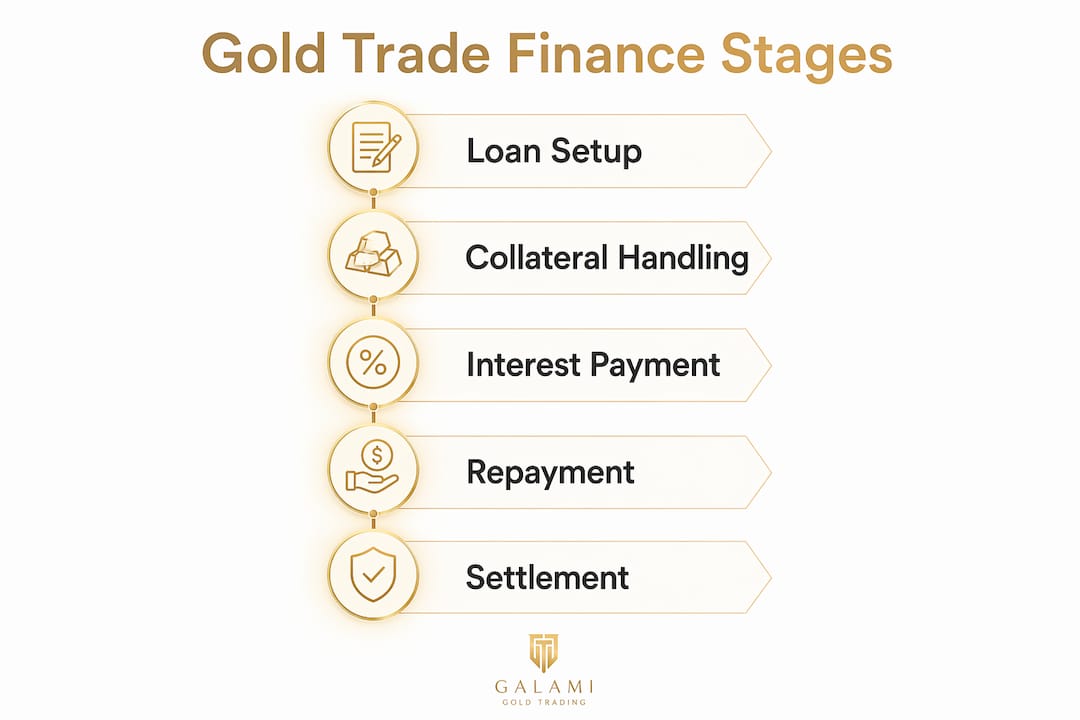
A Gold Metal Loan is a facility where the borrower receives physical gold, or its cash equivalent, and repays in troy ounces at a later date. Commercial Bank of Dubai structures GMLs electronically through approved bullion partners, allowing clients to borrow and repay in XAU (the ISO code for gold). Denominating loans in XAU eliminates the need for costly currency hedging because the liability and the asset are measured in the same unit.
Production finance and asset-based lending
Production Finance funds mining operations before gold is extracted, using projected output as collateral. ABL, by contrast, uses existing gold inventory as security. Both structures are common in West Africa and the Gulf, where gold supply chains are active and well-documented. Short-term facilities of 1–3 months typically support inventory replenishment, while long-term facilities of 1–3 years fund capital projects or refinery expansions.
- GML: Borrow and repay in troy ounces; ideal for refiners and dealers managing inventory cycles
- Production Finance: Secured against future output; used by miners and junior producers
- ABL: Secured against physical gold stock; suits traders and wholesalers needing working capital
- LTV ratios: 50%–80% is standard for most lenders, with up to 90% available for high-grade collateral
- Term lengths: Short-term (1–3 months) for trade cycles; long-term (1–3 years) for capital investment
The Gold Forward Offer Rate (GOFO) serves as the institutional benchmark for leasing physical gold to refiners and dealers. GOFO is a specialized wholesale credit market, not a retail loan benchmark, so it is not directly accessible to individual investors. Central banks and bullion banks use GOFO rates to bridge inventory cycles between production and sale.
Pro Tip: When evaluating a gold trade finance facility, compare the loan’s interest rate against the prevailing GOFO rate. A facility priced significantly above GOFO signals either elevated credit risk or an inefficient lender structure.
Gold trade finance vs. traditional trade finance
The core difference between gold trade finance and traditional fiat-based trade finance is the unit of account. Traditional trade finance denominates credit in U.S. dollars, euros, or other fiat currencies, which exposes both lender and borrower to exchange rate risk during the transaction period. Gold trade finance removes that variable by anchoring the transaction to a commodity with a globally accepted price.
| Feature | Traditional Trade Finance | Gold Trade Finance |
|---|---|---|
| Unit of account | Fiat currency (USD, EUR) | Troy ounces (XAU) or gold-linked value |
| Currency risk | High, especially in emerging markets | Reduced; gold price risk replaces FX risk |
| Hedging requirement | Often required for cross-border deals | Eliminated when loan is XAU-denominated |
| Collateral type | Receivables, inventory, or guarantees | Physical gold or gold-backed instruments |
| Settlement speed | 2–5 business days standard | Near-instant with digital/tokenized platforms |
| Regulatory complexity | Moderate; standard banking frameworks | Higher; commodity-specific compliance required |
Gold-backed trade settlements reduce exposure to currency risk by anchoring transactions to gold rather than fiat currency. This matters most in regions where local currencies are volatile, such as sub-Saharan Africa or parts of Southeast Asia. A gold-denominated facility in Ghana, for example, insulates both the lender and the exporter from cedis depreciation during a 90-day trade cycle.
The tradeoff is operational complexity. Gold trade finance requires assay certification, secure storage, insurance, and in some cases, physical delivery logistics. These costs add up, particularly for smaller loan sizes, and must be factored into the total cost of financing.
How is tokenization changing gold trade finance?
Gold tokenization is the process of representing physical gold as a digital token on a blockchain, where each token corresponds to a specific quantity of audited, vaulted gold. Tokenized gold assets exceeded $2 billion as of 2024, a figure that reflects growing institutional confidence in digital gold instruments. That scale signals a structural shift, not a speculative trend.
The operational benefits are significant. Tokenization enables near-instant cross-border settlements, replacing the 2–5 day standard of traditional banking with near-real-time finality. For intra-African trade under the AfCFTA framework, this is particularly valuable because it removes correspondent banking delays and reduces counterparty risk. Afreximbank, which processes more than $180 billion in annual trade finance volume, has identified tokenized gold as a priority instrument for regional trade development.
Digital freight and compliance tools compound these gains. Ghana’s 2025 requirement for electronic filings for refined gold exports is one example of how regulatory frameworks are pushing the industry toward digital infrastructure. Digital freight forwarding tools like ICUMS enable real-time shipment tracking and can save up to $15,000 per shipment in demurrage costs by reducing manual processing delays. That is a material cost reduction for any trader moving gold at scale.
- Near-instant settlement: Tokenized gold clears in minutes versus days for wire-based transactions
- Improved traceability: Blockchain records provide an auditable chain of custody from mine to vault
- Lower demurrage costs: Digital documentation reduces port delays and associated fees
- Financial inclusion: Smaller producers in Africa and Asia can access institutional-grade financing without correspondent banking relationships
- Regulatory alignment: Electronic filing mandates in Ghana and other jurisdictions are accelerating digital adoption
Pro Tip: When evaluating a digital gold finance platform, verify that the underlying gold is independently audited and that the token issuer holds a recognized custodial license. Platforms without third-party audits carry unquantified collateral risk.
You can explore how technology optimizes gold trading strategies in more detail, including the operational tools that institutional traders use to manage digital gold positions.
What are the strategic benefits of gold trade finance?
Gold trade finance delivers three core strategic benefits: currency risk reduction, improved financial predictability, and portfolio-level liquidity. Each benefit compounds when the financing structure is properly aligned with the underlying gold asset.
- Currency risk reduction. Gold-backed loans insulate borrowers from fiat currency depreciation. A refiner in Dubai borrowing in XAU and selling gold at international spot prices carries no net currency exposure on that transaction.
- Financial predictability. XAU-denominated loans reduce hedging costs by aligning liabilities and assets in the same unit. This simplifies cash flow forecasting and reduces the need for derivative overlays.
- Liquidity without liquidation. ABL structures allow gold holders to unlock working capital without selling their position. A trader holding 500 troy ounces can borrow against that inventory, fund a new purchase cycle, and repay when the next sale closes.
- Portfolio diversification. For institutional investors, gold asset examples within a broader portfolio provide a non-correlated return stream that performs differently from equities and fixed income.
- Scalability. Gold trade finance structures are available to both SMEs and large institutions. Small-balance commercial lending programs, including those modeled on asset-based lending frameworks, can be adapted for gold collateral at ticket sizes below $5 million.
Risk management is the other side of this equation. Gold-collateral loans include maintenance covenants with margin calls triggered when gold value falls below defined thresholds. Storage, insurance, and assay costs affect the economic viability of smaller loans. Borrowers who structure short-term facilities and renew them preserve capital gains exposure while maintaining liquidity. That is a more tax-efficient approach than outright liquidation in most jurisdictions.
Reviewing gold investment terminology before entering a structured facility helps you avoid misreading covenant language or collateral definitions in term sheets.
Key takeaways
Gold trade finance is the most capital-efficient tool for precious metals businesses because it aligns credit directly with the underlying asset, eliminates currency hedging costs, and scales from SME working capital to institutional production finance.
| Point | Details |
|---|---|
| Core instruments | GML, Production Finance, and ABL each serve different supply chain stages with LTV ratios of 50%–90%. |
| XAU denomination | Borrowing in troy ounces eliminates FX risk and reduces the need for derivative hedging overlays. |
| Tokenization impact | Over $2 billion in tokenized gold assets enables near-instant settlement and lower demurrage costs. |
| Risk management | Margin call covenants and storage costs must be modeled into total financing cost before committing. |
| Digital compliance | Ghana’s 2025 electronic filing mandate and tools like ICUMS show that regulatory digitization is accelerating. |
Gold trade finance is maturing faster than most investors realize
I have watched gold trade finance shift from a niche instrument used by bullion banks and central banks into a structured product that mid-market traders and institutional investors are actively deploying. The change is real, and it is moving faster than most market participants recognize.
The part that concerns me is the gap between sophistication and due diligence. High-volume gold deals with steep discounts are almost always fraudulent. Multi-layer broker chains add cost and risk without adding value. The legitimate market is smaller and more direct than most newcomers expect. If you cannot reach the principal directly, you are not close enough to the deal to finance it safely.
The digital transformation is genuinely lowering barriers. Tokenization, electronic filing mandates, and real-time tracking tools are compressing the operational friction that once made gold trade finance inaccessible below a certain deal size. That is a structural improvement, not a marketing claim.
My advice: select counterparties based on audited supply chains and verifiable custody. Assess credit risk at the asset level, not just the borrower level. And watch the regulatory environment closely. AML compliance in gold trading is tightening globally, and the firms that build compliance infrastructure now will have a durable competitive advantage over those that treat it as an afterthought.
— Galami
Why Galamigold belongs in your gold trade finance strategy
Galamigold operates at the intersection of physical gold supply and disciplined capital deployment, serving institutional clients and sophisticated investors who need audited, traceable gold with efficient execution. The platform’s physical gold trading program is built on verified supply chains, transparent pricing, and direct counterparty access, which eliminates the broker-chain risk that undermines so many gold finance transactions.

Galamigold’s institutional gold trading benefits include audited supply and structured programs across active corridors in Sierra Leone and Zambia. Program details are shared with certified investors, and capital is at risk. Explore the full gold trading program to assess fit for your portfolio or business.
FAQ
What is gold trade finance, exactly?
Gold trade finance is a form of commodity finance where physical gold serves as collateral or the unit of account for structured credit instruments, including Gold Metal Loans, Production Finance, and Asset-Based Lending. It is used by miners, refiners, traders, and institutional investors to fund gold supply chain operations.
How does a gold metal loan differ from a standard secured loan?
A Gold Metal Loan is denominated in troy ounces (XAU) rather than fiat currency, meaning the borrower repays in gold rather than dollars or euros. This structure eliminates currency risk and removes the need for hedging instruments that add cost to standard secured loans.
What are the risks of using gold as collateral?
The primary risks include margin calls triggered by gold price declines, plus ongoing costs for storage, insurance, and assay that reduce net loan economics. Borrowers should model these costs into the total cost of financing before committing to a gold-collateral facility.
Is gold tokenization regulated?
Regulation varies by jurisdiction, but the trend is toward stricter oversight. Ghana’s 2025 electronic filing mandate for refined gold exports is one example of how governments are formalizing digital gold trade infrastructure. Institutional investors should verify that any tokenized gold platform holds a recognized custodial license and complies with local AML requirements.
Who uses gold trade finance?
Gold trade finance is used by gold miners, refiners, bullion dealers, commodity traders, and institutional investors. Central banks and bullion banks access the wholesale market through GOFO-benchmarked leasing facilities, while mid-market participants typically work through structured ABL or GML programs offered by specialized lenders and trading platforms like Galamigold.
Recommended
- ISO 4217 XAU Explained: What the Gold Code Means
- Step by Step Gold Transaction Process: 2026 Guide
- Capital Deployment Guide to Gold for Institutional Investors
- Top Gold Asset Examples for Portfolio Diversification
Ready to invest in physical gold trade finance?
Both the Zambia–Dubai and Sierra Leone–Dubai programs are open to qualified investors. Minimum investments from $115,000 USD or €125,000 EUR.
Zambia–Dubai Program Sierra Leone–Dubai Program