
TL;DR:
- Not all gold is created equal, with responsible sourcing standards playing a vital role in mitigating supply chain risks. Understanding the full supply chain from extraction to delivery ensures investors can verify ethical provenance and meet compliance requirements. Incorporating transparent, audited sourcing practices reduces regulatory, reputational, and price premium risks while supporting sustainable development.
Not all gold is created equal. Understanding what is gold sourcing is the difference between building a portfolio on verifiable, conflict-free bullion and holding assets with hidden supply chain risk that can surface during regulatory scrutiny or institutional due diligence. Gold sourcing covers the full journey from extraction or recovery through refining to final delivery, and every step carries legal, ethical, and financial weight. This article breaks down how the gold sourcing process works, what responsible sourcing actually requires, and why it matters for your investment decisions right now.
Table of Contents
- Key takeaways
- What is gold sourcing and how it works
- Responsible gold sourcing standards and frameworks
- Why gold sourcing matters for investors
- Challenges in gold sourcing and traceability
- Practical guidance on assessing gold sourcing quality
- My perspective on sourcing and investor responsibility
- Why Galamigold takes gold sourcing seriously
- FAQ
Key takeaways
| Point | Details |
|---|---|
| Gold sourcing spans the full supply chain | Understanding origin, refining, and delivery separates credible investment assets from unverified bullion. |
| LBMA and OECD set the compliance baseline | Responsible gold sourcing is governed by auditable, globally recognized frameworks, not just self-declaration. |
| Good Delivery has real limits | Certification confirms quality standards but does not guarantee the ethical provenance of every refined ounce. |
| ESG demand is reshaping supply | 68% of institutional investors now prioritize responsible sourcing when purchasing gold. |
| Traceability gaps create portfolio risk | The Blended Stream Problem makes full origin verification nearly impossible post-refining without deep due diligence. |
What is gold sourcing and how it works
Gold sourcing refers to the identification, procurement, and verification of gold through its entire supply chain, starting from raw extraction or recovery and ending with refined, deliverable bullion. For investors, understanding this process is not academic. It shapes the risk profile, liquidity, and regulatory standing of every physical gold position you hold.
At the broadest level, gold is categorized into two types: mined gold and recycled gold. Mined gold comes from three distinct scales of operation.
- Large-scale mining (LSM): Industrial operations run by publicly listed companies with environmental and social governance reporting requirements.
- Medium-scale mining (MSM): Formally registered but smaller operations, often in emerging markets, with variable compliance standards.
- Artisanal and small-scale mining (ASM): Informal or semi-formal operations, often in high-risk jurisdictions, accounting for roughly 20% of global gold production and carrying the highest sourcing risk.
Recycled gold adds a separate layer of complexity. It includes post-consumer jewelry, industrial scrap, and electronic waste. Risk profiles vary across recycled gold types; electronic scrap generally carries lower conflict risk compared to scrap bullion jewelry due to more traceable origin chains. That said, the gold sourcing process for recycled material still requires formal due diligence before a refiner can accept it as compliant.
The scale of the market underlines why sourcing oversight matters. The London market dominates global physical gold transactions, with the LBMA Good Delivery List governing over 90% of the world’s physical gold business. Getting gold onto that list, and keeping it there, requires adherence to sourcing standards that go far beyond basic purity testing.
Pro Tip: When evaluating any gold product for purchase, ask specifically whether the refiner is on the LBMA Good Delivery List and whether their most recent responsible sourcing audit is publicly available. Refiners that do not disclose audit status should trigger additional scrutiny.
Responsible gold sourcing standards and frameworks
Asking what is responsible gold sourcing leads you directly to three interlocking frameworks that define compliance across the global market. Each serves a different function, but together they form the backbone of credible, auditable gold sourcing.
-
LBMA Good Delivery List and Responsible Sourcing Programme: Refiners on the Good Delivery List must meet strict operational, purity, and supply chain standards. The Responsible Sourcing Programme requires annual third-party audits. However, Good Delivery accreditation confirms quality and supply chain responsibility audits, not direct proof of ethical origin for every batch refined.
-
World Gold Council Responsible Gold Mining Principles (RGMPs): The RGMPs cover 51 principles across environmental, social, and governance categories. Compliance requires third-party assurance, meaning a mining company cannot simply self-certify. These principles are increasingly referenced by institutional investors when setting procurement criteria.
-
OECD Five-Step Due Diligence Framework: This is the operational playbook refiners and traders must follow when handling gold from conflict-affected or high-risk areas. Responsible gold sourcing requires refiners to apply all five steps, which include establishing strong company management systems, identifying and assessing risk, designing and implementing responses, conducting third-party audits, and reporting annually on supply chain due diligence.
-
Third-party audits: These are the enforcement mechanism. Without independent verification, frameworks are just documents. Annual audits by accredited firms create a paper trail that investors and regulators can review.
-
Terminology distinctions: The terms responsible, ethical, and best-practice mining have distinct meanings that affect strategy and supply chain integrity. “Responsible” typically refers to compliance with established frameworks. “Ethical” carries broader social values. “Best practice” denotes leading standards beyond minimum compliance.
“Responsible sourcing is about active engagement to support sustainable development in difficult areas, rather than outright avoidance of risk.” — LBMA Responsible Sourcing Report 2020
This framing matters for investors. It means a responsible sourcing certification does not indicate that a company avoids all difficult geographies. It indicates that the company has processes in place to manage risk in those areas. The distinction is significant for portfolio-level due diligence.
The Royal Canadian Mint offers a working example. Canada’s gold supply chain adheres to both LBMA and OECD frameworks with annual independent audits, providing conflict-free assurance that investors can reference and verify. That level of transparency is the benchmark serious investors should apply broadly.
Why gold sourcing matters for investors
The advantages of gold sourcing extend well beyond ethical preference. Sourcing provenance directly affects risk exposure, compliance standing, and ESG portfolio eligibility.
Here is where the financial logic gets concrete:
- Regulatory risk: Holding gold from unverified or conflict-affected sources exposes institutional portfolios to potential sanctions violations, AML scrutiny, and regulatory reporting obligations that can freeze positions or trigger penalties.
- Reputational risk: Institutional asset managers and family offices face growing pressure from limited partners and boards to demonstrate ESG compliance. A gold holding flagged for sourcing issues can create outsized reputational damage relative to its portfolio weight.
- Price premiums: Responsibly sourced, certified gold commands a market premium. That premium is not just a cost; it reflects a verifiable quality signal that supports liquidity in institutional markets.
- ESG integration: Investors increasingly view ethically sourced gold as a component of financial security, enhancing portfolio confidence beyond pure market value. That perspective is now embedded in ESG portfolio construction frameworks used by leading asset managers.
The numbers support the shift. 68% of institutional investors now identify responsible sourcing as a key factor when purchasing gold. That is not a niche concern. It reflects a market-wide recalibration of what constitutes a quality gold asset.
Pro Tip: Before adding physical gold to an institutional portfolio, cross-reference the refiner’s LBMA audit status against your fund’s ESG screening criteria. Responsible sourcing documentation should be part of standard pre-trade due diligence, not an afterthought.
The sustainable investment market has grown substantially, and gold is not exempt from that scrutiny. Investors who treat sourcing as a compliance checkbox rather than a risk variable will find themselves increasingly out of step with institutional standards.

Challenges in gold sourcing and traceability
Understanding how to source gold responsibly is one thing. Executing it with full confidence is another. The industry has structural challenges that no certificate fully resolves.
| Challenge | Description | Investor Impact |
|---|---|---|
| Blended Stream Problem | Refined gold from multiple origins is chemically indistinguishable | Origin cannot be verified post-refining |
| ASM documentation gaps | Artisanal miners often lack formal records | High fraud risk in informal supply chains |
| Audit limitations | Third-party audits are point-in-time reviews | Non-compliance between audits goes undetected |
| Geographic risk | High-risk jurisdictions create smuggling routes | Gold enters compliant chains with false documentation |
| Self-reporting bias | Some sourcing claims rely on supplier declarations | Unverified data weakens due diligence quality |
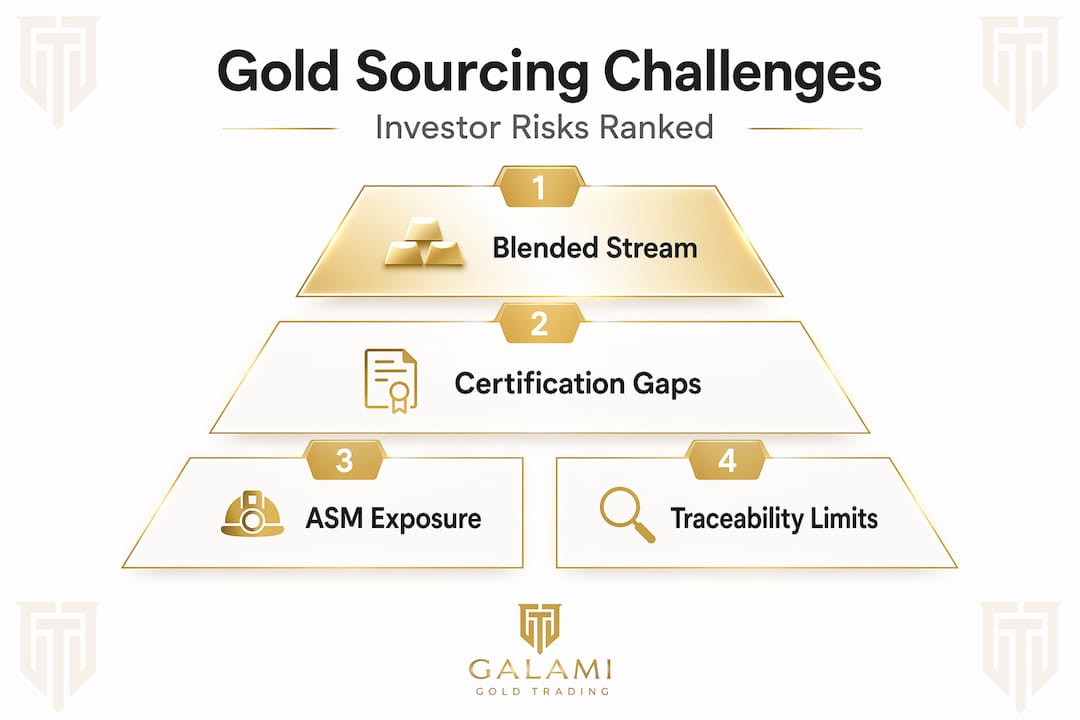
The Blended Stream Problem is the single most significant structural limitation in gold sourcing transparency today. Once gold from multiple sources is melted and refined into a single bar, the physical metal carries no traceable origin marker. A bar stamped with a compliant refiner’s hallmark may contain material that entered the supply chain before responsible sourcing controls were applied.
This does not make responsible sourcing pointless. It means that certification applies to processes and systems, not to individual ounces. Investors need to understand that distinction clearly before interpreting any sourcing documentation they receive.
Artisanal and small-scale mining creates additional exposure. ASM operations often lack the administrative infrastructure to generate reliable provenance records, and the gold they produce frequently passes through multiple informal intermediaries before reaching a formal refiner. Each handoff is a potential point of documentation failure.
Practical guidance on assessing gold sourcing quality
Integrating responsible sourcing into your gold investment strategy requires moving beyond surface-level verification. Here is a structured approach for financial professionals:
- Verify LBMA Good Delivery status directly on the LBMA’s published list. Do not rely on verbal assurances or third-party summaries. The list is publicly accessible and updated regularly.
- Request the most recent responsible sourcing audit report. Compliant refiners provide these. An inability or unwillingness to share audit documentation is a significant red flag.
- Assess the refiner’s due diligence policy against the OECD Five-Step Framework. Look for specific language about conflict-affected and high-risk area sourcing, not generic compliance language.
- Evaluate geographic concentration in the supply chain. Refiners sourcing predominantly from high-risk jurisdictions require proportionally deeper due diligence. Check the gold trading standards that apply to your institutional context.
- Distinguish between process certification and provenance certification. A Good Delivery stamp confirms that a refiner met operational and supply chain management standards. It does not certify the origin of every ounce. Frame your expectations accordingly.
- Use sourcing data in portfolio risk assessments. Incorporate gold sourcing risk into portfolio risk management reviews, particularly for holdings in physical gold ETFs or allocated accounts where the underlying metal’s origin may be less visible.
Selecting vendors with transparent supply chains is the single most practical step investors can take. A refiner that publishes annual supply chain reports, names its upstream suppliers, and undergoes third-party audits consistently is a substantially lower-risk counterparty than one that relies on proprietary compliance claims.
My perspective on sourcing and investor responsibility
I have spent years watching investors treat gold sourcing as back-office paperwork. That view is changing fast, and in my experience, the investors who understood it earliest are now positioned better in regulated and institutional markets.
Here is what I have actually learned: the gap between certification and true traceability is wider than most fund managers realize. A refiner can be fully LBMA-compliant and still have no reliable mechanism to tell you where 40% of its feedstock originated. I do not say that to dismiss the frameworks. They matter. But treating a Good Delivery stamp as the end of your due diligence is a mistake I have seen create problems during regulatory reviews.
The most underrated aspect of responsible gold sourcing is the engagement model described in the LBMA Responsible Sourcing Report 2020. The goal is not to avoid difficult geographies. It is to create conditions that enable sustainable, verifiable production in those areas. Investors who understand this frame sourcing risk differently. They ask not just “is this gold certified?” but “what systems support ongoing compliance?”
On technology: blockchain-based tracking and isotopic fingerprinting are genuinely advancing what is possible in supply chain transparency. I am optimistic about where these tools will be in five years. Today, they are pilots, not standards. Do not let a vendor’s mention of blockchain in their marketing substitute for an actual audit trail.
— Galami
Why Galamigold takes gold sourcing seriously
At Galamigold, gold sourcing transparency is not a marketing position. It is the operational foundation of every trade we facilitate. Our programs are built on supply chains that align with LBMA responsible sourcing standards and are subject to third-party verification, because our clients are sophisticated investors who require that level of accountability.
When you invest through Galamigold, you gain access to physical gold trading supported by documented sourcing practices, audit-ready compliance records, and a team that treats provenance verification as a core part of risk management, not a compliance afterthought. If you are building or reviewing a gold position and want to understand how responsible sourcing integrates into your portfolio strategy, explore our gold trading program and connect with our team directly.
FAQ
What does gold sourcing mean?
Gold sourcing refers to the process of identifying, procuring, and verifying gold through its supply chain from mine or recovery point to refined deliverable bar. It covers origin tracing, refiner selection, and compliance with international sourcing standards.
What is responsible gold sourcing?
Responsible gold sourcing means applying documented due diligence frameworks, such as the OECD Five-Step process and LBMA Responsible Gold Guidance, to verify that gold is procured without funding conflict, environmental harm, or human rights violations.
Does the LBMA Good Delivery stamp guarantee ethical gold?
No. Good Delivery accreditation confirms that a refiner meets quality and supply chain management standards, but it does not certify the ethical origin of every ounce refined. Investors need additional sourcing documentation for full confidence.
What is the Blended Stream Problem in gold sourcing?
The Blended Stream Problem occurs when gold from multiple origins is refined into a single bar, making downstream origin verification chemically impossible. This is a core limitation of current gold traceability systems that investors should factor into their due diligence.
How do investors use gold sourcing data in portfolio decisions?
Investors use sourcing data to assess regulatory exposure, ESG eligibility, and counterparty risk. Verified, conflict-free gold qualifies for ESG-screened portfolios and meets the responsible sourcing criteria increasingly required by institutional investment mandates.
Recommended
- Gold trading risk management: strategies for institutions
- Gold as an asset class: Risk, diversification, and strategy
- Top benefits of physical gold for institutional investors
- Why gold secures portfolio diversification and reduces risk
Ready to invest in physical gold trade finance?
Both the Zambia–Dubai and Sierra Leone–Dubai programs are open to qualified investors. Minimum investments from $115,000 USD or €125,000 EUR.
Zambia–Dubai Program Sierra Leone–Dubai Program