
TL;DR:
- Gold arbitrage exploits temporary price differences across markets, instruments, or regions to generate risk-adjusted profits. Success depends on infrastructure, speed, and discipline, not on predicting gold’s future prices.
Gold arbitrage is defined as the practice of exploiting temporary price differences for gold across markets, instruments, or geographic regions to generate risk-adjusted profits. Investors who understand what is gold arbitrage gain access to one of the most technically demanding, yet potentially rewarding, strategies in the precious metals market. The standard basis — futures price minus spot price — ranges from $5 to $15 per ounce under normal conditions. That narrow window defines the entire playing field. Success depends on speed, infrastructure, and disciplined risk controls, not on predicting where gold prices will go next.
What is gold arbitrage and how does it work?
Gold arbitrage, known in institutional circles as basis trading, captures price inefficiencies between two or more gold markets simultaneously. A trader buys gold where it is priced lower and sells it where it is priced higher, closing both positions at nearly the same moment. The profit is the spread between the two prices, minus transaction costs. When executed correctly, the trade carries minimal directional risk because the trader holds no net exposure to gold’s price movement.

The three main arenas where these price differences appear are spot markets, futures markets, and geographic markets. The London OTC spot market and the CME COMEX futures contract are the two most liquid reference points for global gold pricing. Temporary dislocations between them create the basis trades that institutional desks monitor around the clock. True arbitrage opportunities often arise from dislocations between physical fundamentals and futures pricing caused by monetary policy expectations.
Understanding the mechanics also means understanding what commodity arbitrage is at its core. Any commodity with multiple trading venues will develop price gaps when information travels unevenly or when supply and demand conditions differ by location. Gold, as a globally traded asset with deep futures and physical markets, produces these gaps more reliably than most commodities.
How does modern latency arbitrage capture gold price differences?
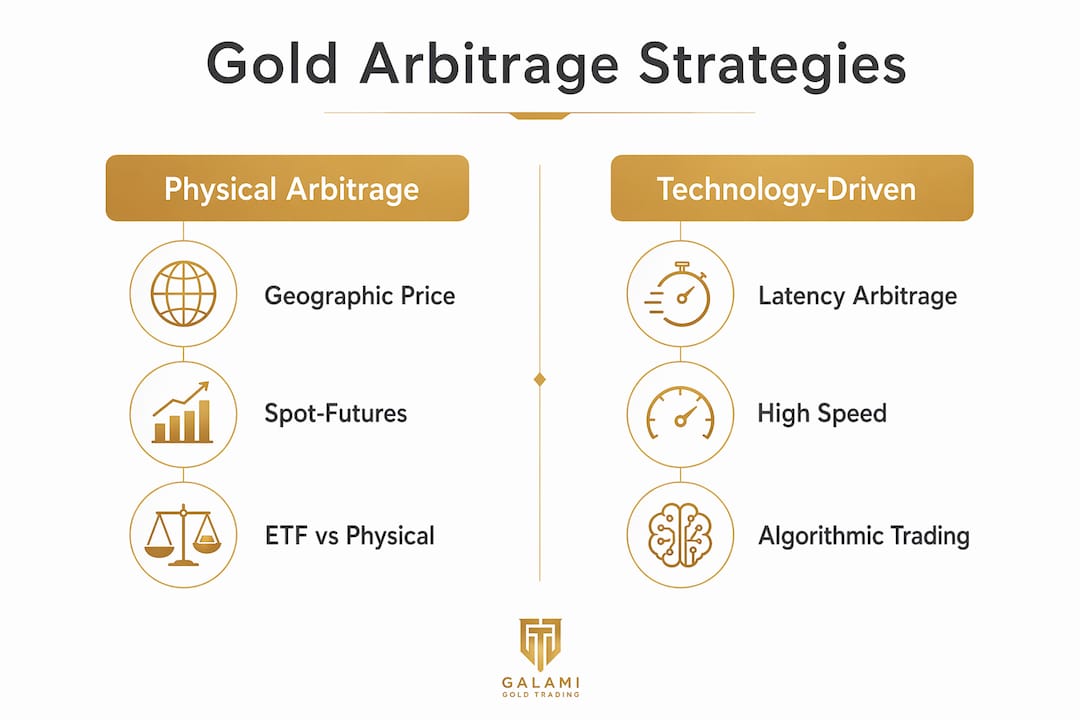
Modern latency arbitrage is the dominant form of gold arbitrage practiced by institutional traders today. It works by comparing a fast institutional price feed against a slower broker quote, then executing a trade before the broker’s price updates. Monthly returns for high-frequency arbitrage range from 5–25%, and returns above that range signal unrealistic risk assumptions. Each individual trade yields 30–150 cents profit per ounce, which adds up significantly at scale.
The technology requirements are non-negotiable. Colocated servers in data centers such as LD4 in London and NY4 in New York are standard for achieving execution speeds under 25 milliseconds. Without sub-25ms infrastructure, price discrepancies vanish before an order reaches the market. Sophisticated operations use multiple fast institutional feeds, including the CME COMEX GC contract via CQG or Rithmic for futures, and spot feeds like LMAX or Integral OCX, to cross-reference prices reliably.
The key risks in latency arbitrage are not gold price movements. They are operational: latency spikes, partial fills, and technical failures. Leg risk occurs when one side of the trade fills and the other does not, leaving the trader with an unhedged position. That exposure can turn a small expected profit into a real loss within seconds.
Pro Tip: Require your arbitrage software to include news blackout filters and feed-staleness kill-switches that halt all order execution during data disruptions or high-volatility news events. These features prevent the system from acting on misleading price data.
What are the primary gold arbitrage strategies investors use?
Investors and institutions apply several distinct approaches to gold arbitrage, each with different capital requirements and operational complexity.
Spot-futures arbitrage and the cash-and-carry trade
Spot-futures arbitrage exploits the price gap between the London spot price and the COMEX front-month futures contract. The cash-and-carry trade is the classic execution: buy physical gold at spot, simultaneously sell a futures contract at a higher price, and deliver the gold at expiry to collect the spread. Institutional traders use the Exchange for Physical mechanism, known as EFP, to link spot and futures positions efficiently. EFP transactions require allocated physical gold, making this a capital-intensive strategy suited to well-funded desks.
Geographic arbitrage across global gold markets
Geographic arbitrage buys gold in one country and sells it in another where prices are higher. Price differences across regions arise from local regulation, market demand, and logistical costs. Import duties, export restrictions, transport insurance, and currency conversion all erode the apparent spread. What looks like a $20 per ounce opportunity in a market with high import tariffs can collapse to a loss once all costs are counted.
ETF vs. physical gold arbitrage
A third approach targets the gap between gold ETF share prices and the net asset value of the underlying physical gold. When an ETF trades at a premium to its gold holdings, authorized participants can create new shares by delivering physical gold, then sell those shares at the higher market price. This mechanism keeps ETF prices anchored to spot, but temporary dislocations offer short windows for profit.
The table below compares the three primary strategies across key dimensions.
| Strategy | Capital intensity | Execution speed required | Primary risk |
|---|---|---|---|
| Latency arbitrage | Moderate | Sub-25 milliseconds | Leg risk, technical failure |
| Spot-futures (EFP) | High | Minutes to hours | Basis widening, delivery cost |
| Geographic arbitrage | High | Days to weeks | Regulatory, transport, currency |
| ETF vs. physical | Moderate to high | Hours | Redemption delays, premium collapse |
What risks and challenges affect gold arbitrage profitability?
Gold arbitrage is not risk-free. The phrase “riskless profit” describes the theoretical ideal, not the operational reality. Professionals who treat it as guaranteed income consistently underestimate execution complexity.
The core operational risks break down into three categories:
- Latency risk. A price feed delay of even a few milliseconds can turn a profitable signal into a losing trade. Brokers update prices continuously, and a slow connection means the opportunity has already closed.
- Leg risk. One side of the trade fills at the expected price while the other side fails or fills at a worse price. The trader is left with a directional position they did not intend to hold.
- Technical failure. Server outages, API disconnections, or software bugs can freeze execution mid-trade. Without automated circuit breakers, losses accumulate quickly.
Market risks add another layer. Sudden volatility spikes, triggered by central bank announcements or geopolitical events, can widen spreads unpredictably and trigger stop-outs before positions close. Gold is better understood as a derivative on monetary policy expectations rather than a simple safe-haven asset. That framing matters because monetary policy surprises create the largest and most dangerous dislocations between physical and futures markets.
Regulatory risk is particularly acute in geographic arbitrage. Import and export taxes, transport costs, and currency volatility all compress profit margins in ways that are difficult to model in advance. Regulatory changes can eliminate a geographic spread overnight. Galamigold’s approach to gold trading regulations emphasizes staying current with compliance requirements across jurisdictions, which is the correct posture for any institution active in cross-border gold flows.
Pro Tip: Build a risk management framework that treats each arbitrage leg as an independent position until both sides confirm. Never assume a fill on one leg guarantees a fill on the other.
How can investors apply gold arbitrage strategies effectively?
Applying gold arbitrage effectively requires meeting a clear set of prerequisites before committing capital. Skipping any one of them increases the probability of operational loss rather than arbitrage profit.
- Secure institutional-grade price feeds. Retail data sources are too slow for latency arbitrage. Access to feeds from CME COMEX via CQG or Rithmic, and spot feeds from venues like LMAX, is the minimum standard for competitive execution.
- Build or lease colocated infrastructure. Execution speed is the primary competitive advantage. Servers must sit in the same data centers as the exchanges and brokers you trade against.
- Define your capital allocation per strategy. Spot-futures and geographic arbitrage require significantly more capital than latency strategies. Allocate based on the specific approach, not a generic “gold trading” budget.
- Implement automated risk controls before going live. News blackout filters, feed-staleness kill-switches, and maximum position size limits must be active from day one. Manual oversight alone is insufficient at execution speeds under 25 milliseconds.
- Set realistic return expectations. Monthly returns in the 5–25% range are consistent with well-run latency arbitrage operations. Promises above that range warrant serious scrutiny of the underlying risk model.
- Monitor continuously and adapt. Market microstructure changes. Brokers update their pricing engines, regulators adjust rules, and new competitors enter the space. A strategy that works today may require recalibration within months.
Integrating arbitrage into broader gold trading strategies works best when it complements, rather than replaces, fundamental position-taking. Arbitrage captures short-term inefficiencies. Fundamental gold investing captures long-term monetary and macroeconomic trends. The two approaches serve different portfolio functions and carry different risk profiles. Understanding physical gold trading mechanics is also essential for anyone moving between spot, futures, and physical delivery markets.
Key Takeaways
Gold arbitrage profits depend on execution speed, infrastructure quality, and disciplined risk controls, not on predicting gold price direction.
| Point | Details |
|---|---|
| Definition of gold arbitrage | Exploiting temporary price differences across markets, instruments, or regions to earn risk-adjusted profits. |
| Basis range | The standard futures-minus-spot basis runs $5–$15 per ounce under normal market conditions. |
| Latency arbitrage returns | Monthly returns of 5–25% are realistic; anything higher signals unaccounted risk. |
| Primary risks | Leg risk, latency spikes, and technical failures are the main threats, not gold price moves. |
| Geographic arbitrage complexity | Import taxes, transport costs, and currency volatility routinely eliminate apparent price spreads. |
Gold arbitrage is not what most investors think it is
The biggest misconception I encounter is that gold arbitrage is a passive income machine. Investors hear “buy low, sell high simultaneously” and assume the hard part is finding the opportunity. The hard part is everything that comes after: the infrastructure, the risk controls, the regulatory compliance, and the continuous adaptation to a market that never stops evolving.
What I find most clarifying is the framing of gold as a derivative on monetary policy rather than a standalone commodity. When you accept that framing, arbitrage opportunities make more sense. Dislocations between physical and futures markets are not random. They reflect real disagreements between market participants about what central bank policy means for gold’s value. Arbitrageurs who understand that dynamic can position themselves more intelligently than those who treat every spread as a purely mechanical opportunity.
The technology race in latency arbitrage is also more intense than most outsiders realize. The edge is measured in microseconds, and it narrows every year as more capital chases the same inefficiencies. That compression is why I believe the most durable arbitrage opportunities for most investors lie in spot-futures basis trading and geographic arbitrage, where human judgment, supply chain relationships, and regulatory knowledge create advantages that pure speed cannot replicate. The technology infrastructure matters, but it is not the only moat.
Balancing arbitrage with fundamental gold investing is the approach I respect most. Arbitrage captures what the market misprices today. Fundamental investing captures what the market will eventually recognize. Both belong in a serious precious metals portfolio.
— Galami
Galamigold’s approach to physical gold trading
Galamigold operates at the intersection of physical gold supply and disciplined capital deployment, which makes it a natural fit for investors who want to move beyond theoretical arbitrage and into real market execution.

Galamigold’s physical gold trading platform is built on audited processes, transparent supply chains, and a clear-eyed approach to risk. For investors exploring how arbitrage integrates with physical gold positions, Galamigold provides the operational foundation that institutional strategies require. Before committing capital to any gold trading program, reviewing the full risk disclosure is the right first step. Galamigold publishes this information openly because informed investors make better long-term partners.
FAQ
What is gold arbitrage in simple terms?
Gold arbitrage is buying gold at a lower price in one market and simultaneously selling it at a higher price in another market to capture the spread as profit. The trade works because temporary price differences exist across exchanges, regions, or instruments.
Is gold arbitrage legal?
Gold arbitrage is legal in most jurisdictions, though geographic arbitrage involving cross-border gold transfers is subject to import and export regulations, taxes, and anti-money-laundering compliance requirements that vary by country.
What is the basis in gold arbitrage?
The basis is the difference between the gold futures price and the spot price. Under normal market conditions, the standard basis ranges from $5 to $15 per ounce, and deviations from that range signal potential arbitrage opportunities.
How much capital do you need for gold arbitrage?
Capital requirements vary significantly by strategy. Latency arbitrage requires moderate capital plus significant technology investment, while spot-futures and geographic arbitrage require substantial allocated capital to cover physical gold purchases and logistical costs.
What is the biggest risk in gold arbitrage?
Leg risk is the most acute operational risk. It occurs when one side of the trade fills and the other does not, leaving the trader with an unintended directional position in gold.
Recommended
- What is OTC Gold Trading: A Guide for Institutional Investors | Galami Gold
- Why gold attracts high-net-worth investors: 18% allocation
- Step by Step Gold Transaction Process: 2026 Guide
- Bullion Explained: A Practical Guide for U.S. Investors
Ready to invest in physical gold trade finance?
Both the Zambia–Dubai and Sierra Leone–Dubai programs are open to qualified investors. Minimum investments from $115,000 USD or €125,000 EUR.
Zambia–Dubai Program Sierra Leone–Dubai Program