
TL;DR:
- Gold trading compliance involves verifying counterparties, sourcing, reporting, and record-keeping amid complex international regulations. Many firms mistakenly rely solely on Good Delivery standards and overlook upstream provenance, increasing audit risk. Implementing real-time, automated monitoring and embedding compliance in deal approval processes are essential for industry progress by 2026.
The gold trading compliance process sits at the intersection of financial crime prevention, supply chain accountability, and multi-jurisdictional regulatory demands. For compliance officers and legal professionals, this creates a genuinely complex environment where a single gap in due diligence can trigger enforcement action, reputational damage, or criminal liability. This guide covers the foundational requirements, step-by-step workflow, common failure points, and audit best practices you need to operate a defensible compliance program in 2026, whether you are at a bullion dealer, a financial institution, or a commodity trading firm.
Table of Contents
- Key takeaways
- Understanding the gold trading compliance process
- The step-by-step compliance workflow
- Common pitfalls and how to avoid them
- Auditing and verification best practices
- My perspective on where gold compliance is really headed
- How Galamigold supports your compliance requirements
- FAQ
Key takeaways
| Point | Details |
|---|---|
| Regulatory thresholds vary by jurisdiction | Know your reporting triggers: $10,000 in the US, AED 55,000 in the UAE, and separate EU conflict minerals rules. |
| KYC is the foundation | Customer onboarding with risk-tiered due diligence prevents the majority of AML exposure before a transaction begins. |
| Good Delivery does not mean ethical sourcing | Refinement standards and provenance accountability are separate; relying on one for the other creates compliance gaps. |
| Automation is no longer optional | Real-time transaction gating and automated monitoring have replaced periodic manual review as the industry standard. |
| Audits must go beyond documentation | Independent verification, data analytics, and upstream checks are required to build a genuinely defensible compliance record. |
Understanding the gold trading compliance process
Gold trade compliance explained at its simplest is this: verify who you are dealing with, verify where the gold came from, report what the law requires, and keep records long enough to prove it. The complexity comes from the fact that all four of those tasks operate under overlapping, and sometimes conflicting, regulatory frameworks across different countries.
In the US, the FinCEN Dealers in Precious Metals and Stones (DPMS) Rule mandates that AML programs include a designated compliance officer, a written risk assessment, OFAC screening, transaction monitoring, and documented staff training. These are not suggestions. They are enforceable requirements, and regulators have been increasing examination frequency since 2024.
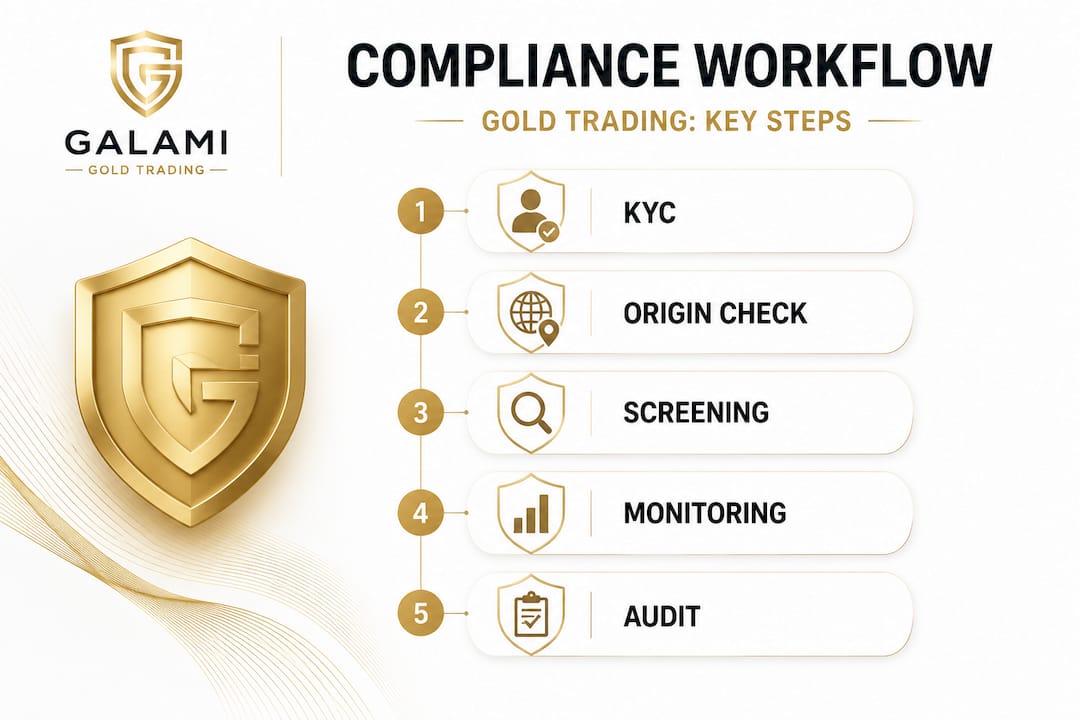
Core regulatory layers every compliance officer must map
The following requirements apply across most major gold trading jurisdictions and form the backbone of any defensible compliance program:
- AML/CFT program: A written policy covering customer risk categories, prohibited transaction types, and internal escalation procedures
- Customer Due Diligence (CDD): Verification of identity, beneficial ownership, and purpose of transaction for all customers
- Transaction monitoring: Automated or manual review of patterns that indicate structuring, layering, or unusual volume
- Suspicious Activity Reports (SARs): Filed with the relevant financial intelligence unit when red flags are identified and cannot be resolved
- Supply chain due diligence: Required for EU importers since January 1, 2021, covering mine origin and tax documentation
- Record retention: US dealers must retain records for five years and file IRS Form 8300 for cash transactions exceeding $10,000
In the UAE, the stakes are high from a financial perspective. Dealers in precious metals and stones must report transactions at or above AED 55,000, and fines per violation range from AED 50,000 to AED 1,000,000 under 2025 regulations. That exposure makes documentation accuracy a financial priority, not just a legal one.
| Jurisdiction | Reporting threshold | Retention period | Key framework |
|---|---|---|---|
| United States | $10,000 (cash) | 5 years | FinCEN DPMS Rule |
| UAE | AED 55,000 | 5 years | CBUAE AML regulations |
| European Union | Transaction-based | 5 years | EU Conflict Minerals Regulation |
| UK | Equivalent of €10,000 | 5 years | HMRC HMWT registration |
The step-by-step compliance workflow
The role of compliance in gold trading is most visible in the operational workflow. Every transaction touches multiple compliance checkpoints, and missing one creates a gap that auditors will find. The following sequence reflects current best practice for a physical gold trading firm.
-
Customer onboarding and KYC. Collect government-issued ID, proof of address, and beneficial ownership documentation for all entities. Assign a risk tier based on customer type, jurisdiction, and transaction history. High-risk customers require enhanced due diligence, including source of funds verification and periodic review.
-
OFAC and sanctions screening. Screen the customer and any associated parties against OFAC’s SDN list, UN sanctions lists, and relevant national lists before any trading relationship begins. This screening should be repeated at each transaction for high-risk counterparties.
-
Transaction pre-approval review. Before execution, review the transaction against your firm’s risk appetite, check for structuring patterns, and confirm that the gold’s proposed provenance is documented and credible. For institutional investors optimizing gold transactions, this checkpoint often includes counterparty credit review alongside compliance screening.
-
Large transaction reporting. File the required reports before or at the time of transaction execution. In the US, that means IRS Form 8300 for cash over $10,000. In the UAE, it means a Designated Non-Financial Business and Profession (DNFBP) report to the Financial Intelligence Unit.
-
SAR filing. When a transaction presents unresolved red flags, file a SAR with your jurisdiction’s financial intelligence unit. Do not tip off the customer. Maintain the SAR and all supporting documentation separately from the customer’s general file.
-
Record management. Store transaction records, due diligence files, and screening results in a format that is searchable and retrievable within 24 hours of a regulatory request. Segregate records by transaction type and customer tier.
-
Post-transaction monitoring. Use automated tools to flag outliers in volume, frequency, geography, and counterparty patterns. Effective gold trading compliance now requires real-time automated risk-gating rather than weekly or monthly batch reviews.
Pro Tip: Set your transaction monitoring system’s alert thresholds below the legal reporting floor, not at it. Sophisticated structuring activity deliberately stays just under the threshold. Catching patterns at 70 to 80 percent of the threshold is where most violations are detected early.
Common pitfalls and how to avoid them

Gold trading compliance essentials include knowing where the frameworks fail in practice, not just what they require in theory. These are the failure points that auditors and regulators consistently find.
The Good Delivery misconception
This is the most widespread compliance gap in the industry. Many firms treat LBMA Good Delivery status as evidence of ethical sourcing. It is not. Good Delivery focuses on refinery standards including bar weight, fineness, and hallmarks. It says nothing about where the gold came from geographically or whether it funded conflict. Relying on Good Delivery certification to satisfy conflict minerals due diligence is a compliance failure waiting to be discovered.
The blended stream problem
Once gold from multiple sources is smelted together, the resulting material is chemically indistinguishable. This means traditional provenance audits fail once the gold enters a blended stream. Paper-based documentation can no longer reliably verify origin at that point. Forward-thinking compliance programs are beginning to integrate digital twin tracking or molecular marker verification at the upstream processing stage to address this gap.
“Certificate acceptance alone is insufficient for supply chain due diligence. Programs must independently verify upstream provenance or accept accountability gaps that regulators will hold against them.” Adapted from current industry audit standards.
Intermediary and transporter due diligence gaps
Compliance officers frequently apply rigorous KYC to the end buyer but apply lighter scrutiny to the brokers, freight forwarders, and storage operators in between. Each of those parties represents a potential insertion point for illicit proceeds. Accepting certificates without supplemental verification delegates accountability without eliminating it.
Gold concentrates deserve special attention. Unlike refined bullion, gold concentrates present significantly higher money laundering risk at upstream processing points, which means due diligence at concentrate stage must be more intensive than at the refined bullion stage.
Other common pitfalls compliance officers encounter in trading gold compliance strategies include:
- Allowing record retention periods to lapse without a documented review and archiving protocol
- Filing SARs after extended internal deliberation instead of within the required timeframe
- Failing to update customer risk ratings when their transaction profile changes materially
- Applying outdated screening lists because OFAC update notifications are routed to the wrong inbox
- Misunderstanding regulatory transparency requirements around hallmarking, which must be scientifically justified, not just commercially convenient
Auditing and verification best practices
The gold trading audit process is where compliance programs prove themselves. A well-designed audit cycle catches gaps before regulators do, and a documented audit trail is the single most effective defense in an enforcement inquiry.
Internal audit design
A gold investment compliance program needs at least two internal compliance reviews per year. The first should be a transaction sample review covering a randomly selected subset of completed trades, checking documentation completeness, screening evidence, and reporting accuracy. The second should be a program-level review examining policy currency, staff training records, and technology system performance.
| Audit type | Frequency | Key outputs |
|---|---|---|
| Transaction sample review | Semi-annual | Documentation gaps, missed reporting |
| Program-level review | Annual | Policy updates, training gaps |
| Independent external audit | Annual or biennial | Regulator-facing certification |
| Ongoing automated monitoring | Continuous | Real-time anomaly flags |
Working with independent auditors
External auditors should be engaged with a clearly defined scope that includes testing your firm’s screening procedures, reviewing a sample of high-risk customer files, and evaluating the effectiveness of your transaction monitoring logic. Do not hand auditors only your best files. A valid audit needs access to the full population.
Pro Tip: Before a regulatory examination, run a mock exam with your internal team using the same document request list that your primary regulator publishes. Most regulators post their examination procedures online. Walk through the exercise as if you had 24 hours to respond, because you might.
Leveraging data analytics for the gold trading audit process has moved from advanced practice to baseline expectation. Auditors now routinely analyze full transaction datasets for velocity anomalies, geographic clustering, and counterparty network patterns. If your compliance team cannot perform those analyses internally, your external auditor should be contracted to do so annually. Reviewing the 2026 AML penalty trends affecting gold dealers makes clear why this level of scrutiny has become non-negotiable.
Continuous training rounds out the audit cycle. Every change in regulation, every enforcement action against a peer firm, and every internal SAR filing is a training opportunity. Staff who understand why a control exists are significantly more likely to apply it correctly than those who only know the procedural steps.
My perspective on where gold compliance is really headed
I’ve spent considerable time working through the realities of physical gold trading across multiple jurisdictions, and my honest view is that the industry is about five years behind where financial services compliance already sits. Most firms are still running compliance as a documentation exercise rather than a real-time risk function.
What I’ve seen is this: the firms that get into trouble are almost never the ones who ignored the rules entirely. They are the ones who followed the rules on paper but never stress-tested whether the controls actually worked. They accepted certificates, filed reports on schedule, and retained records dutifully. Then they discovered that a counterparty three steps upstream was the source of the problem, and their paper trail did not go back far enough.
The regulated liquidity routing approach, where transactions are gated in real time before execution rather than reviewed after the fact, is where the industry needs to go. Manual periodic reviews made sense when transaction volumes were lower. They no longer do.
My take on building institutional trust in gold trading is that compliance culture has to be set at the top and enforced in the middle. A compliance officer who writes excellent policies but has no authority to block a transaction is decorative, not functional. The firms I respect most have compliance embedded in the deal approval process, not appended to it after the fact.
— Galami
How Galamigold supports your compliance requirements

Galamigold operates physical gold trading programs with transparency and supply chain discipline built into every transaction. For compliance officers who need to know exactly what they are buying and where it came from, Galamigold’s approach to documentation, provenance verification, and audited delivery provides the kind of paper trail that holds up to regulatory scrutiny. Every trade through Galamigold is structured around the gold trading essentials that institutional compliance programs require, from KYC-ready counterparty documentation to clear sourcing records. If you are evaluating physical gold trading partners against your firm’s 2026 compliance standards, Galamigold is worth a direct conversation.
FAQ
What triggers mandatory reporting in the gold trading compliance process?
In the US, cash transactions over $10,000 require IRS Form 8300 filing. In the UAE, any transaction at or above AED 55,000 triggers AML reporting obligations under current DNFBP regulations.
How long must gold trading records be retained?
Most jurisdictions, including the US and UAE, require a minimum of five years of record retention covering transaction documents, customer due diligence files, and screening evidence.
Is Good Delivery status sufficient for supply chain compliance?
No. Good Delivery certification covers refinery technical standards and does not address geographic origin, conflict minerals, or ethical sourcing requirements. These require separate provenance documentation and due diligence.
What is the blended stream problem in gold compliance audits?
Once gold from multiple sources is smelted together, it becomes chemically indistinguishable. Paper-based audits cannot reliably verify origin after blending, which is why emerging compliance programs are turning to molecular marker or digital twin verification methods.
How often should a gold trading compliance program be audited?
Best practice calls for semi-annual internal transaction reviews, an annual program-level review, and an independent external audit at least every two years. High-risk operations should conduct external audits annually.
Recommended
- The Role of AML in Gold Trade for Institutional Investors
- Institutional Gold Broker Checklist: 2026 Vetting Guide
- Step by Step Gold Transaction Process: 2026 Guide
- Global Standards in Gold Trade: A Guide for Institutional Investors
Ready to invest in physical gold trade finance?
Both the Zambia–Dubai and Sierra Leone–Dubai programs are open to qualified investors. Minimum investments from $115,000 USD or €125,000 EUR.
Zambia–Dubai Program Sierra Leone–Dubai Program