
TL;DR:
- The gold import-export process involves obtaining licenses, shipment-specific permits, and government-approved assay certificates to trade legally across borders. Compliance requires continuous documentation, accurate customs declarations, and adherence to jurisdictional rules to avoid seizures and penalties. Traders must implement ongoing AML and KYC measures to maintain legal and operational integrity in gold trading.
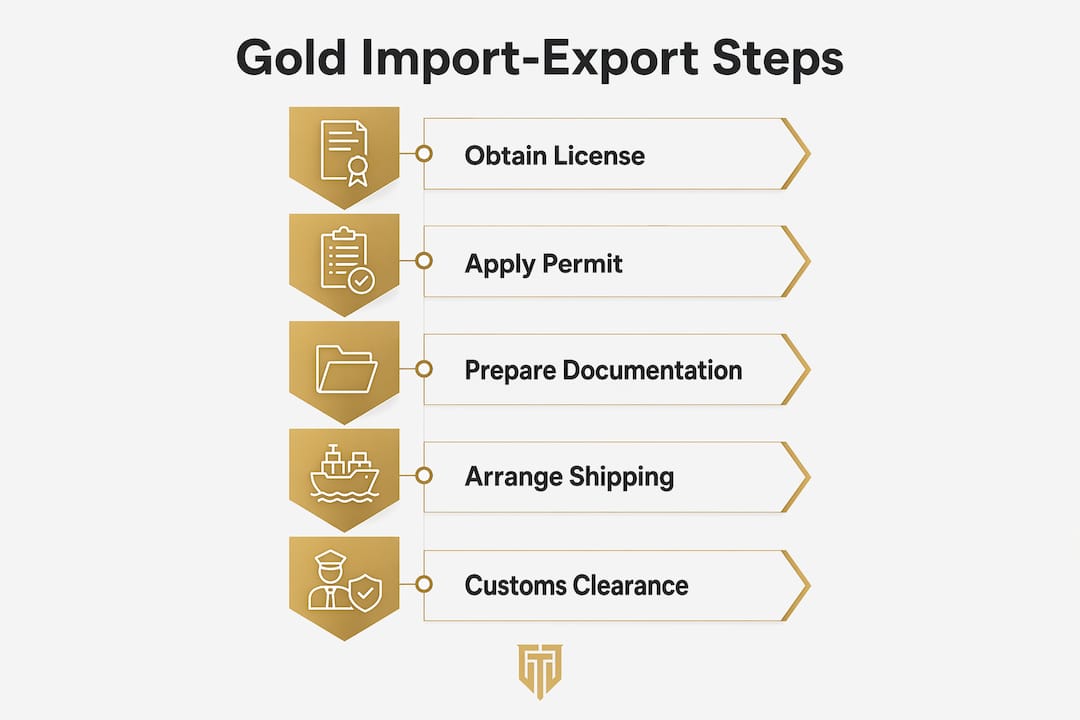
The gold import-export process is the regulated, multi-step procedure businesses and individuals must follow to legally trade gold across international borders. It covers licensing, shipment-specific permits, government-accredited assaying, mandatory documentation, customs duties, and anti-money laundering (AML) compliance. Regulatory bodies such as India’s Directorate General of Foreign Trade (DGFT) and Reserve Bank of India (RBI), Uganda’s Directorate of Geological Survey and Mines (DGSM), and Tanzania’s Mining Commission each enforce distinct rules. Understanding the gold trade process is not optional. A single missing document or wrong permit can trigger seizure, fines, or criminal liability.
What is the gold import-export process, and what licenses does it require?
The gold import-export process begins with obtaining the right licenses before any shipment moves. Two separate legal instruments govern this: a trading license and a shipment-specific export or import permit. Confusing the two is one of the most common and costly mistakes traders make.

A trading license authorizes a business to buy and sell gold domestically. It does not authorize a single international shipment. Every cross-border consignment requires its own export or import permit, issued by the relevant mineral or trade authority. Exporting gold legally requires obtaining a dealer or trading license, a shipment-specific export permit, an official assay certificate, and a full documentation package including a commercial invoice and certificate of origin.
Key license and permit requirements across major jurisdictions include:
- India: An Importer Exporter Code (IEC) issued by DGFT, plus RBI-nominated agency authorization for gold imports. Private traders cannot import gold directly without going through an approved channel.
- Uganda: A DGSM dealer license, followed by a separate export permit application for each shipment, supported by an assay certificate from a government-recognized lab.
- Tanzania: A Dealer Licence from the Mining Commission, with a mandatory rule that Tanzanian nationals hold at least 25% ownership in any foreign-involved gold trading entity.
- General rule: Annual trading licenses do not replace per-shipment permits. Both must be active and valid at the time of export or import.
The consequences of operating without the correct permits are severe. Customs authorities seize shipments, revoke licenses, and refer cases for criminal prosecution. In regulated economies, gold imports are restricted to authorized banks or nominated agencies, and bypassing these channels triggers immediate customs scrutiny.
Pro Tip: Verify that both your trading license and your shipment permit are valid before booking logistics. A lapsed permit discovered at the port of export means a delayed or seized shipment, not a quick fix.
What documentation is mandatory for gold import-export shipments?
Documentation is the backbone of every legal gold shipment. Customs authorities, mineral boards, and financial regulators all review these records to verify legality, value, and origin. Missing or inconsistent documents are the leading cause of shipment delays and seizures.
The standard mandatory document set for most jurisdictions includes:
- Commercial invoice — specifies the quantity, purity, declared value, buyer, and seller details.
- Packing list — details the physical contents, weight, and packaging of the shipment.
- Certificate of origin — confirms the country where the gold was mined or processed.
- Assay certificate — issued by a government-accredited laboratory, verifying purity and weight. Discrepancies between invoice values and assay certificates result in shipment seizures and audits. This document is the final gatekeeper.
- Export or import license — the shipment-specific permit from the relevant authority.
- Customs declaration form — filed with the national customs authority, declaring all shipment details.
- Sales and purchase agreement — specifies payment terms and confirms that transactions flow through verifiable banking channels.
- Insurance documents — cover the shipment against loss or damage in transit.
- AML declaration and KYC records — confirm the identity of all parties and the legal origin of the gold.
For a quick reference on how documentation requirements compare across key markets, the table below outlines the core differences:
| Document | India | Uganda | Tanzania |
|---|---|---|---|
| Assay certificate | Required (accredited lab) | Required (DGSM-approved lab) | Required (Mining Commission lab) |
| Export permit | Per shipment via DGFT | Per shipment via DGSM | Per shipment via Mining Commission |
| Certificate of origin | Mandatory | Mandatory | Mandatory |
| Local ownership proof | Not applicable | Not applicable | Required (25% Tanzanian ownership) |
| AML/KYC records | Mandatory | Mandatory | Mandatory |
For a detailed breakdown of documentation standards in European markets, the gold selling documentation guide from Gior provides a useful comparative reference.
Pro Tip: Prepare your AML declaration and KYC package before applying for your export permit. Regulators increasingly cross-check these records against financial transaction data, and gaps cause application rejections, not just delays.
How do customs duties and taxes affect the gold import-export process?
Customs duties and taxes directly affect the cost and viability of every gold shipment. Getting these calculations wrong leads to underpayment penalties, shipment holds, and in serious cases, misdeclaration charges.
India’s current tax structure illustrates how significant the burden can be. As of may 2026, India’s total tax on imported gold stands at 18.45%, combining a 15% customs duty with 3% GST. That figure rose from 9.18%, effectively doubling the cost of importing gold through standard channels. This kind of sudden shift shows why traders must monitor duty rates continuously, not just at the start of a trade relationship.
India also operates an Advance Authorization scheme that allows duty-free imports for re-export purposes. However, this scheme now caps imports at 100 kg per license. Firms that exceed this cap or fail to meet reporting requirements risk losing their zero-duty status entirely.
Key customs compliance points for gold traders include:
- File customs declarations accurately. Declared value must match the commercial invoice and assay certificate. Any discrepancy triggers a physical inspection and potential seizure.
- Pay duties before clearance. Customs authorities do not release shipments until all applicable duties and taxes are settled.
- Track advance authorization reporting cycles. Advance authorization holders face frequent reporting cycles in 2026, with fortnightly or monthly submissions required. Missing a cycle risks license revocation.
- Understand export taxes in source countries. Many African nations levy mineral royalties and export taxes on gold before it leaves the country. These are separate from import duties at the destination.
For traders operating across European markets, the French precious metals tax guide from Gior provides a useful reference on how duties and capital gains taxes interact in cross-border gold transactions.
What compliance and operational best practices ensure smooth gold trade?
Compliance in gold trading is not a one-time checklist. It is a continuous operational discipline. The traders who avoid seizures, penalties, and license revocations treat AML and KYC as ongoing processes, not paperwork filed once at setup.
The most effective compliance practices for gold import-export operations include:
- Source only from licensed entities. Legitimate gold export requires sourcing from licensed miners or verified cooperatives, with full KYC and transaction records maintained for every purchase. Buying from unlicensed sources invalidates your entire compliance chain.
- Use independent assay labs. Government-accredited assay certificates are the final quality gatekeepers. An independent assay before shipment catches purity discrepancies before customs does.
- Maintain continuous AML monitoring. AML compliance in gold trading requires ongoing transaction monitoring, not just initial KYC verification. Regulators now expect firms to flag and report suspicious patterns in real time.
- Use insured, secure logistics providers. Gold shipments require carriers with specific precious metals experience and full insurance coverage. A standard freight forwarder without precious metals authorization creates both legal and financial exposure.
- Specify payment channels in contracts. Sales and purchase agreements must confirm that all payments flow through verifiable banking channels. Cash transactions or informal payment methods are red flags under AML frameworks and can void export permits.
The gold export permit itself is designed primarily as an AML enforcement and mineral royalty collection tool, not just administrative paperwork. Misunderstanding this purpose leads traders to treat permits as a formality, which is exactly when seizures and legal risks occur. Treat every permit application as a compliance audit, because regulators do.
Pro Tip: Build a compliance calendar with all reporting deadlines for your advance authorization, AML submissions, and permit renewals. Missing a single deadline in 2026 can cascade into shipment holds and license suspension.
How do jurisdictional differences impact gold import-export procedures?
No two countries run identical gold trade procedures. The core framework is consistent, but the specific agencies, ownership rules, and reporting requirements vary enough to require jurisdiction-specific operational planning.
India restricts gold imports to RBI-nominated agencies and authorized banks. Private traders cannot import gold directly. The DGFT manages export licensing, and the RBI sets the rules for who qualifies as a nominated agency. This channel restriction means that most businesses must work through an approved intermediary rather than importing directly.
Uganda follows a step-by-step permit and assay workflow managed by the DGSM. A trader first obtains a dealer license, then applies for a shipment-specific export permit, then submits the gold for assay at a DGSM-approved laboratory. Only after the assay certificate is issued does the export permit get finalized. The Uganda legal export process is sequential, and skipping any step invalidates the entire application.
Tanzania adds a foreign ownership layer. Any gold Dealer Licence involving foreign participation must include at least 25% Tanzanian ownership. This rule directly affects how multinational businesses structure their local entities before applying for a license.
For businesses operating across multiple African markets, the layered mineral trading laws create a compliance matrix that requires local legal counsel in each jurisdiction. A permit valid in Uganda does not transfer to Tanzania or any other country. Each shipment, in each country, follows that country’s specific rules.
Understanding physical gold trading mechanics across these jurisdictions is the foundation for building a compliant, repeatable export workflow.
Key Takeaways
The gold import-export process requires a trading license, a shipment-specific permit, a government-accredited assay certificate, and continuous AML compliance to move gold legally across any border.
| Point | Details |
|---|---|
| Licenses vs. permits | A trading license covers domestic activity; every international shipment needs its own export or import permit. |
| Assay certificates are mandatory | Government-accredited assay labs verify purity and weight; discrepancies trigger seizures and audits. |
| India’s 18.45% tax burden | India’s total import tax on gold rose to 18.45% in 2026, with duty-free imports capped at 100 kg per license. |
| AML compliance is continuous | Ongoing transaction monitoring and KYC updates are required, not just initial setup documentation. |
| Jurisdictions differ significantly | Tanzania requires 25% local ownership; India restricts imports to nominated agencies; Uganda uses a sequential permit-and-assay workflow. |
Why compliance in gold trade is harder than most traders expect
After working closely with gold supply chains across multiple jurisdictions, the pattern I see most often is this: traders who struggle are not ignorant of the rules. They underestimate how continuous compliance actually is.
Most traders prepare their documentation carefully for the first shipment. Then, six months in, reporting deadlines slip, assay certificates get reused instead of refreshed, and AML records fall behind. That is when regulators act. The 2026 shift toward hyper-compliance, with fortnightly reporting cycles and tighter advance authorization caps, has made this problem worse. The margin for administrative drift is now essentially zero.
The other underestimated factor is assay quality. I have seen shipments seized not because the gold was illegal, but because the declared purity on the invoice did not match the assay result by a fraction of a percentage point. Customs authorities treat that as misdeclaration. Using a government-accredited lab and getting an independent pre-shipment assay is not overcaution. It is the minimum standard.
My advice to any business entering gold trade in 2026 is to treat every permit application as a compliance audit and every reporting deadline as non-negotiable. The risk management frameworks that work are the ones built around continuous monitoring, not periodic reviews.
— Galami
How Galamigold supports physical gold supply and trading
Galamigold operates as a physical gold trading platform built around disciplined execution, transparency, and supply chain integrity. For businesses and individuals navigating the gold trade process, working with a partner who understands the full compliance picture makes a measurable difference.
Galamigold’s physical gold supply and bullion trading operations are structured around verified sourcing, documented supply chains, and full AML and KYC compliance at every stage. Whether you are sourcing gold for investment, institutional trading, or cross-border supply, Galamigold brings the operational discipline and regulatory awareness that complex gold transactions require. Explore Galamigold’s trading program and risk framework at galamigold.com/risk to understand how the platform manages compliance and capital deployment across established gold supply chains.
FAQ
What is the gold import-export process in simple terms?
The gold import-export process is the regulated set of legal, logistical, and compliance steps required to move gold across international borders. It includes obtaining a trading license, securing a shipment-specific permit, completing an independent assay, and filing all mandatory customs and AML documentation.
Do I need a separate permit for every gold shipment?
Yes. A trading license authorizes domestic buying and selling, but every international gold shipment requires its own export or import permit issued by the relevant mineral or trade authority. The two instruments are legally distinct and not interchangeable.
What happens if my assay certificate does not match my invoice?
Customs authorities treat any discrepancy between the declared invoice value and the assay certificate as misdeclaration. The standard outcome is shipment seizure, a formal audit, and potential criminal referral.
How does India’s 18.45% gold import tax affect traders?
India’s total tax burden on imported gold rose to 18.45% as of may 2026, combining a 15% customs duty and 3% GST. Duty-free imports under the Advance Authorization scheme are now capped at 100 kg per license, with strict reporting requirements to maintain that status.
What AML obligations apply to gold exporters?
Gold exporters must source only from licensed miners or verified cooperatives, maintain full KYC records for all counterparties, monitor transactions continuously for suspicious activity, and ensure all payments flow through verifiable banking channels. These obligations apply throughout the trading relationship, not just at initial setup.
Recommended
- Step by Step Gold Transaction Process: 2026 Guide
- Institutional Gold Broker Checklist: 2026 Vetting Guide
- ISO 4217 XAU Explained: What the Gold Code Means
- Global Standards in Gold Trade: A Guide for Institutional Investors
Ready to invest in physical gold trade finance?
Both the Zambia–Dubai and Sierra Leone–Dubai programs are open to qualified investors. Minimum investments from $115,000 USD or €125,000 EUR.
Zambia–Dubai Program Sierra Leone–Dubai Program