
TL;DR:
- Non-bank gold trading enables investors to gain gold exposure or ownership outside traditional banks through OTC markets, apps, or blockchain protocols. The primary distinction lies in whether investors hold allocated, specific bars or unallocated claims, affecting ownership and risk. Verification of custody and regulatory status is essential to ensure a sound and transparent gold investment approach.
Non-bank gold trading is the practice of gaining gold price exposure or physical gold ownership outside traditional bank intermediaries, using channels such as over-the-counter (OTC) markets, gold investment apps, or blockchain-based protocols. The industry term for the broader category is alternative gold trading, and it covers everything from bilateral dealer contracts to self-custody wallets holding tokenized gold on Solana. Investors are drawn to these channels for lower fees, direct ownership, and access that bypasses the strict requirements of institutional bank accounts. Understanding custody structure and counterparty risk from the start is not optional. It is the single factor that separates a sound gold position from an unsecured creditor claim.
What is non-bank gold trading and how does it differ from bank-based trading?
Non-bank gold trading removes the commercial bank from the transaction chain. In traditional bank bullion trading, the bank acts as custodian, counterparty, and settlement agent simultaneously. You hold an account with the bank, and your gold exposure is an obligation of that institution. Non-bank alternatives replace one or more of those roles with OTC dealers, regulated apps, or decentralized protocols.

The most consequential difference is the allocated vs. unallocated distinction. Allocated gold means you hold legal title to specific, numbered bars stored in a vault. Unallocated gold means you hold a creditor balance against a pool of metal. Most bank gold accounts are unallocated, which makes your position analogous to a bank deposit rather than direct ownership. That distinction matters enormously if the institution faces insolvency.
The London OTC gold market operates almost entirely on an unallocated basis, with clearing banks including HSBC, ICBC Standard Bank, JP Morgan, and UBS settling claims daily through the AURUM system. Thousands of transactions clear without a single bar moving. This is operationally efficient but means most participants hold claims, not gold. Non-bank platforms that offer allocated storage break from this model and give investors a stronger legal footing.
Regulatory oversight also differs. The UK Financial Conduct Authority now treats OTC positions as economically equivalent to exchange-traded contracts, enforcing position limits and surveillance. That regulatory parity is relatively recent, and many non-bank platforms outside the UK operate in lighter-touch jurisdictions. Investors must check the regulatory status of any platform before committing capital.
Pro Tip: Before opening any gold account, ask the provider one direct question: “Is my gold allocated to specific bars with serial numbers, or is it held in a pooled unallocated account?” The answer tells you whether you own gold or are owed gold.
Common types of non-bank gold trading: OTC, apps, and on-chain protocols
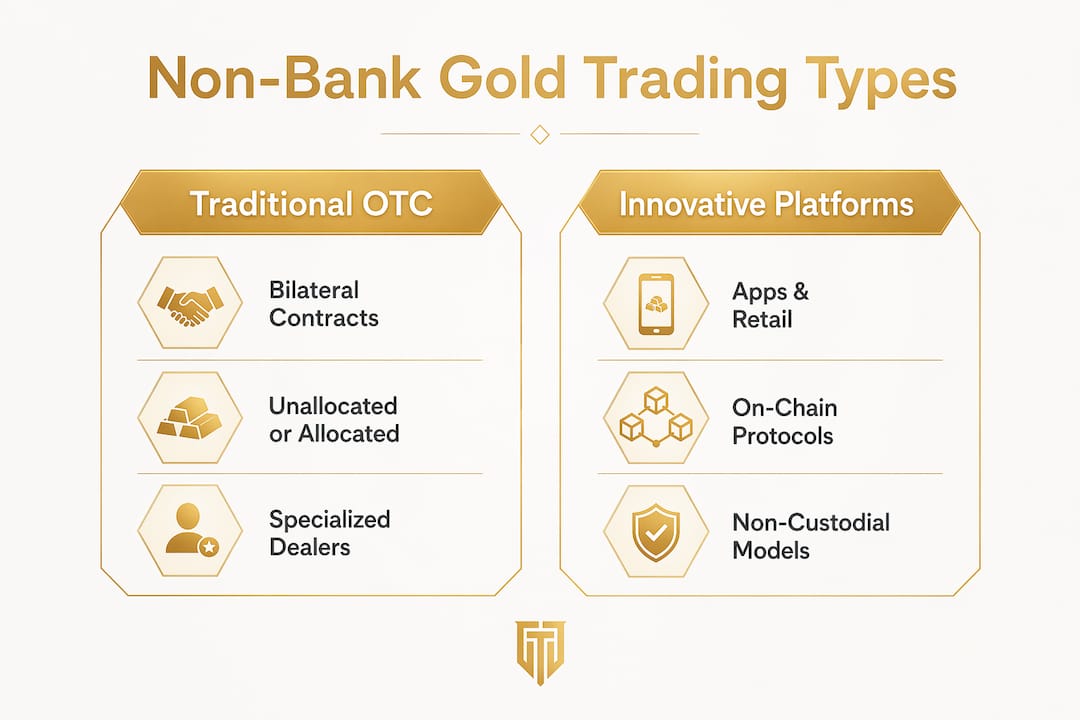
Three distinct models define how investors trade gold without banks today. Each carries a different custody structure, fee model, and risk profile.
OTC dealer markets
OTC gold trading uses bilateral contracts between two parties, typically an investor and a specialized dealer or trading firm. Contracts are customized, prices are negotiated, and settlement terms vary by relationship. OTC liquidity and price execution depend heavily on dealer relationships and contract terms, which contrasts sharply with the transparent order books of centralized exchanges. Credit risk concentrates on the counterparty. If the dealer defaults, recovery depends on contract terms and jurisdiction, not an exchange guarantee fund.
Gold investment apps
Apps like Vaulted represent a more accessible entry point for retail investors. Vaulted stores gold at the Royal Canadian Mint, tracks ownership by serial number, and provides fully insured, independently audited storage. Users pay transparent fees and can take physical delivery. This model gives investors allocated ownership claims without requiring a bank account or institutional minimum. The trade-off is that you are trusting a private company’s operational integrity and the vault’s security rather than a regulated bank.
On-chain gold trading protocols
The newest category involves non-custodial gold exposure on blockchain infrastructure. Platforms like Manic Trade offer XAU/USD trading with zero spread, no KYC requirements, and instant settlement on the Solana blockchain. Trades settle in seconds, and the investor controls their own wallet. No broker holds custody. This removes counterparty risk from the platform itself but transfers full security responsibility to the investor. A lost private key means a lost position.
| Method | Custody model | Typical access | Key risk |
|---|---|---|---|
| OTC dealer market | Unallocated or allocated by contract | Institutional or high-net-worth | Counterparty and credit risk |
| Gold investment app (e.g., Vaulted) | Allocated, serial-numbered bars | Retail, low minimums | Platform operational risk |
| On-chain protocol (e.g., Manic Trade) | Self-custody wallet | Anyone with a crypto wallet | Wallet security, no KYC safety net |
For investors exploring non-bank platforms and apps in 2026, the comparison above is the starting framework. The right method depends on your investment size, technical comfort, and how much custody responsibility you want to carry yourself.
Benefits and risks of non-bank gold trading for investors
Non-bank gold investing offers real advantages over traditional bank channels, but those advantages come with trade-offs that demand honest evaluation.
The benefits are concrete. Cost efficiency is the most immediate. Bank bullion accounts often carry custody fees, transaction spreads, and account maintenance charges that erode returns on smaller positions. OTC dealers and apps typically offer tighter spreads and lower storage costs for comparable allocated positions. Accessibility is the second advantage. On-chain platforms require no bank account, no geographic restriction, and in some cases no identity verification. That opens gold exposure to investors in markets where traditional banking infrastructure is weak or expensive.
The risks are equally concrete. Unallocated gold represents a creditor balance, not ownership of specific bars. Investors who do not verify their custody arrangement may believe they own gold when they actually hold an unsecured claim. If the platform or dealer fails, they join the queue of creditors rather than reclaiming their metal. This is not a theoretical risk. It has materialized in past precious metals dealer insolvencies.
Regulatory risk is the second major concern. Regulators monitor OTC trading venues and expect firms to aggregate OTC risk exposures alongside exchange-traded positions. Platforms operating outside regulated jurisdictions may not meet these standards, leaving investors with limited recourse. Effective risk management in gold trading requires verifying a platform’s regulatory status before the first trade.
Transparency is the third issue. OTC markets lack the price transparency of exchanges. Investors relying on dealer quotes without independent price benchmarks may pay wider spreads than necessary. Using a real-time benchmark like the LBMA Gold Price as a reference point before any OTC transaction is standard practice among experienced participants.
Pro Tip: Always request a copy of the vault’s most recent independent audit report before committing to any app-based or OTC gold storage arrangement. Reputable providers publish these. Providers that refuse or delay the request are telling you something important.
How to get started with non-bank gold trading
Entering the gold market without banks requires more preparation than opening a standard brokerage account. The steps below apply whether you are evaluating an OTC dealer, a gold app, or an on-chain protocol.
-
Define your custody requirement. Decide upfront whether you need allocated, serial-numbered gold or whether a creditor claim against pooled metal is acceptable for your risk tolerance. This single decision narrows your platform options significantly.
-
Verify regulatory status. Check whether the platform is registered with a financial regulator such as the FCA in the UK, the CFTC in the US, or an equivalent body. Unregulated platforms are not automatically unsafe, but they offer no formal recourse if something goes wrong.
-
Audit the fee structure. Compare storage fees, transaction spreads, and withdrawal costs across at least three providers. A 0.5% annual storage fee on a $100,000 position costs $500 per year. Over a decade, fee differences compound meaningfully.
-
Set up the right infrastructure. For app-based trading, this means a verified account and a linked funding method. For on-chain trading, this means a self-custody wallet such as Phantom (for Solana-based platforms), funded with the required base currency. Test with a small amount before committing a full position.
-
Conduct counterparty due diligence. For OTC markets specifically, research the dealer’s track record, capitalization, and references. The physical gold vs. trading operations distinction matters here. A dealer who sources and stores physical metal operates differently from one who only trades paper claims.
-
Document your position. Keep records of every transaction, custody confirmation, and vault receipt. In the event of a dispute or insolvency, documentation is your primary tool for recovery.
Key takeaways
Non-bank gold trading gives investors direct access to gold markets outside bank intermediaries, but the custody model determines whether you own gold or are merely owed it.
| Point | Details |
|---|---|
| Custody determines ownership | Allocated gold gives legal title to specific bars; unallocated gold is a creditor claim against pooled metal. |
| Three main channels exist | OTC dealer markets, gold investment apps, and on-chain blockchain protocols each carry distinct risk and access profiles. |
| Regulatory status matters | Platforms outside regulated jurisdictions offer limited recourse; always verify registration before trading. |
| Fee efficiency is real | Non-bank platforms typically offer lower spreads and storage costs than traditional bank bullion accounts. |
| Self-custody shifts responsibility | On-chain trading removes broker risk but places full wallet security responsibility on the investor. |
What I have learned from watching non-bank gold trading evolve
The conversation around non-bank gold investing has shifted noticeably over the past few years. Investors who once accepted unallocated bank accounts without question are now asking sharper questions about custody, audit trails, and what happens to their position if a counterparty fails. That shift is healthy, and it reflects a broader maturation in how sophisticated investors think about gold as an asset class.
What concerns me is the gap between marketing language and legal reality. Providers routinely describe their products as “owning gold” when the underlying structure is an unallocated claim. That language is not technically false, but it obscures a meaningful legal distinction. I have seen investors discover this distinction only after a platform ran into trouble, at which point the difference between allocated title and creditor status becomes very real very fast.
The blockchain-based options are genuinely interesting. Removing the custodian from the equation solves one category of risk while creating another. Self-custody wallets are powerful tools, but they require discipline and technical competence that many investors underestimate. A platform like Manic Trade offering zero-spread, no-KYC gold trading on Solana is a legitimate innovation. It is not a shortcut past the need for investor education.
My recommendation is straightforward. Treat custody verification as a non-negotiable step, not an optional one. Ask for audit reports. Read the terms of service before you fund an account. The gold market without banks is accessible, often cheaper, and increasingly well-regulated. But it rewards investors who do their homework and penalizes those who assume “gold” on a screen means gold in a vault.
— Galami
How Galamigold supports investors in non-bank gold trading
Galamigold operates as a physical gold trading platform built on disciplined execution, supply chain transparency, and clear risk disclosure. For investors moving beyond bank-based gold accounts, Galamigold provides direct access to physical gold supply chains with the documentation and custody clarity that alternative trading demands.

Whether you are evaluating OTC structures, comparing custody models, or looking for a counterparty with a verifiable track record in physical bullion, Galamigold’s gold trading program is designed for investors who prioritize transparency over convenience. The platform targets sophisticated investors and corporate entities who understand that gold’s value as a portfolio asset depends entirely on the integrity of the structure holding it. Explore Galamigold’s approach to see how physical gold trading operates when trust and documentation are built into every step.
FAQ
What is non-bank gold trading in simple terms?
Non-bank gold trading is buying, selling, or holding gold exposure through channels that bypass commercial banks, including OTC dealer markets, gold investment apps, and blockchain-based protocols. The key variable is who holds custody of the metal and under what legal terms.
Is gold trading safe without banks?
Safety depends on the custody model and platform regulation. Allocated gold held in an audited, insured vault is generally secure regardless of whether a bank is involved. Unallocated positions with unregulated counterparties carry meaningful credit and recovery risk.
What is the difference between allocated and unallocated gold?
Allocated gold gives you legal title to specific, identified bars. Unallocated gold is a creditor claim against a pool of metal, meaning you are owed gold rather than owning it outright.
Can I trade gold online without a broker?
Yes. On-chain platforms like Manic Trade allow XAU/USD trading on Solana with no broker, no KYC, and instant settlement using a self-custody wallet. The trade-off is that you bear full responsibility for wallet security.
How do I verify that a gold platform is legitimate?
Check for registration with a recognized financial regulator, request the vault’s most recent independent audit report, and confirm whether your account is allocated or unallocated before funding. Platforms that cannot provide clear answers to these three questions warrant caution.
Recommended
- Step by Step Gold Transaction Process: 2026 Guide
- ISO 4217 XAU Explained: What the Gold Code Means
- What is OTC Gold Trading: A Guide for Institutional Investors | Galami Gold
- Top Gold Asset Examples for Portfolio Diversification
Ready to invest in physical gold trade finance?
Both the Zambia–Dubai and Sierra Leone–Dubai programs are open to qualified investors. Minimum investments from $115,000 USD or €125,000 EUR.
Zambia–Dubai Program Sierra Leone–Dubai Program