
TL;DR:
- Gold custody arrangements determine whether investors own specific bullion or hold a pooled, unsecured claim, significantly affecting risk. Reputable custodians use best practices, regular audits, and clear documentation to ensure security and enforce ownership rights. Choosing allocated custody in regulated vaults like London’s ensures long-term ownership protection and reduces counterparty risk.
Physical gold sitting in a vault sounds simple. You own it, someone stores it, done. But for institutional investors and high-net-worth individuals, the question of what is gold custody is far more consequential than that. The type of custody arrangement you choose determines whether you truly own your gold or whether you are simply an unsecured creditor hoping a financial institution stays solvent. Get this wrong at scale and the consequences can be permanent.
Table of Contents
- What is gold custody and how does it protect your investment?
- Allocated vs unallocated custody: understanding the critical ownership difference
- Security practices and industry standards for custodians and vaults
- How to apply gold custody knowledge when choosing a custodian
- London vaulting market: key players and scale of gold custody
- Why allocated custody is the gold standard for institutional investors
- How Galami Gold fits in
- Frequently asked questions
Key Takeaways
| Point | Details |
|---|---|
| Gold custody defined | Professional custodians store and document physical gold bullion securely on your behalf. |
| Allocated versus unallocated | Allocated custody means owning specific bars; unallocated means claiming a share of pooled metal with more risk. |
| Security standards | Vaults follow strict industry guidelines with audits and specialized staff to safeguard gold holdings. |
| Due diligence steps | Verify barlists, audit frequency, legal protections, and insurer credentials when choosing a custodian. |
| London market role | London vaults manage vast amounts of gold, serving as a global trading and clearing hub. |
What is gold custody and how does it protect your investment?
Gold custody is the outsourced safekeeping arrangement where a professional custodian holds physical bullion on behalf of an investor, with custody records used to document ownership. That definition sounds clean, but the infrastructure behind it is anything but simple.
Custodians operate purpose-built secure vaults with multiple access layers, environmental controls, and armed security. They maintain barlists, which are detailed records identifying each gold bar by serial number, weight, fineness, and the name of the legal owner. For institutional investors, that barlist is not a formality. It is evidence of ownership in a way that a brokerage statement simply cannot replicate for a hard asset.
Custodians serve three core functions in the gold market:
- Safeguarding physical bullion against theft, damage, and unauthorized access
- Maintaining ownership records that can be independently verified and audited
- Acting as gatekeepers to the wholesale gold market by validating Good Delivery standards for bars held in recognized vaults
London is the epicenter of this infrastructure. A small number of major vault custodians there manage gold holdings measured in thousands of tonnes on behalf of central banks, commercial institutions, and private investors. Building trust in gold trading starts with understanding who controls your metal and what documentation proves it.
Allocated vs unallocated custody: understanding the critical ownership difference
This is where most investors either protect themselves or unknowingly expose themselves to serious risk. Allocated gold is tied to specific bars with defined ownership rights, while unallocated gold is a contractual claim on pooled metal that carries substantially higher risk.
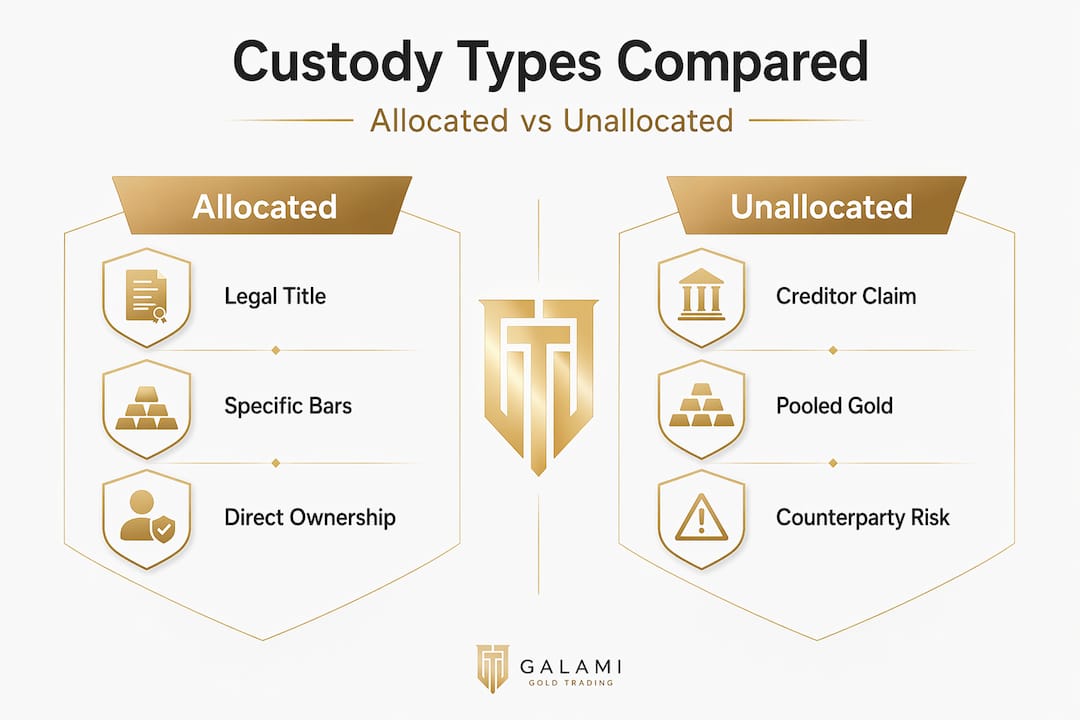
Here is how the two structures differ in practice:
| Feature | Allocated custody | Unallocated custody |
|---|---|---|
| Ownership type | Legal title to specific bars | Creditor claim on pooled gold |
| Barlist provided | Yes, with serial numbers | No |
| Appears on custodian balance sheet | No | Yes |
| Insolvency protection | Gold returned to you | You join unsecured creditor queue |
| Storage fee | Higher | Lower or zero |
| Typical users | Institutional, HNW | Trading, short-term positions |
The balance sheet distinction matters more than most investors realize. Because allocated gold sits off the custodian’s balance sheet, it cannot be lent out, rehypothecated, or used as collateral. Unallocated gold, by contrast, sits on the custodian’s balance sheet and can be deployed in ways you have no visibility into.
Key risks to understand at a glance:
- Unallocated accounts can be used to fund custodian operations or lending programs
- Allocated accounts are ring-fenced from custodian insolvency proceedings
- Unallocated gold offers liquidity and lower costs but at the expense of ownership certainty
- Switching from unallocated to allocated requires explicit instruction and may carry fees
Understanding gold investment terminology in your custody agreements is not optional. Phrases like “title passes upon delivery” or “held commingled” signal unallocated arrangements even when the word itself does not appear.
Pro Tip: Always request the custody agreement in writing before committing capital. If the agreement does not name specific bar serial numbers or reference a barlist provision, assume the arrangement is unallocated until proven otherwise.
Security practices and industry standards for custodians and vaults
Once you know what type of custody you hold, the next question is how well that gold is actually protected. LBMA vaulting best practices include ongoing security protocols, regular audits, validation of holdings, and specialized staff to ensure physical gold standards are met.
Best-in-class vault operators apply security at multiple levels simultaneously:
- Physical architecture: Reinforced walls, blast resistance, flood-proofed lower levels, restricted entry zones
- Technology systems: CCTV coverage across all zones, biometric access control, alarm systems linked to external monitoring
- Operational procedures: Dual-control protocols for vault access, movement logs for every bar, background-checked staff
- Insurance: Full coverage of stored volumes against physical loss, not just liability coverage
Audits are the mechanism that turns these controls into verifiable facts. A vault that claims security without independent audit confirmation is asking you to take their word for it. Reputable custodians undergo scheduled and surprise inventory reconciliations where every bar on the barlist is physically verified against what sits in the vault.
Vault managers with specialized credentials, often trained to verify Good Delivery standards for bar quality and compliance, play a central role in maintaining integrity. They are also responsible for supervising staff handling, preventing substitution of bars, and flagging discrepancies immediately.

Pro Tip: When evaluating a custodian, ask for their last audit report and the name of the auditing firm. If they cannot provide both within 48 hours, that tells you something important about how they operate. You can also review tips for evaluating gold traders to sharpen your due diligence process.
How to apply gold custody knowledge when choosing a custodian
Knowing the theory is one thing. Applying it when you are committing eight or nine figures in physical gold to someone else’s vault is another. Here is a practical sequence for assessing any gold custody provider:
- Clarify custody type in writing. Request the full custody agreement and confirm whether your gold will be allocated to specific bar serial numbers. Do not accept verbal assurances.
- Request barlist confirmations. Ask for sample or current barlists and verify that they include serial numbers, weights, fineness, and your name or entity as owner.
- Review audit schedules and reports. Due diligence should verify audit schedules, Good Delivery compliance, and insurer credentials to make ownership enforceable in practice.
- Assess legal jurisdiction. Confirm where the vault operates and whether your ownership rights are enforceable under that jurisdiction’s property law. Some offshore custody arrangements create jurisdictional ambiguity that becomes expensive in a dispute.
- Verify insurance coverage. Confirm coverage is in place for the full replacement value of stored gold, not a capped liability amount.
- Consider a site visit. For significant holdings, a visit or independently arranged audit of the physical vault is a legitimate ask. Reputable custodians accommodate this.
- Diversify custody locations. Holding all physical gold with a single custodian in one location creates concentration risk. Spreading custody across two or more vaults in different jurisdictions is a standard practice in gold safeguarding diversification.
Trust in gold investment is built through documentation, not reputation alone. The best custodians actively encourage this level of scrutiny.
Pro Tip: Include a clause in your custody agreement requiring notification within 24 hours of any audit discrepancy or security incident. Custodians who resist this clause should be treated with caution.
London vaulting market: key players and scale of gold custody
London is not just the world’s largest gold trading hub. It is home to the most significant physical gold custody infrastructure on earth. London vault custodian firms hold over 8,000 tonnes of gold, with six major custodians servicing the Loco London Market with secure vaulting.
The major vault operators in London include clearing members of the LBMA and specialist security carriers. Together they form the backbone of gold trading standards for institutional market participants worldwide.
| Custodian category | Role in the market |
|---|---|
| LBMA clearing members | Store, clear, and settle bullion between market participants |
| Security carriers | Provide specialized vault and transport services |
| Central banks | Hold sovereign reserves and offer custodian services |
Key facts about the London vault market:
- The Bank of England operates the second-largest gold vault in the world, storing gold for central banks and select institutions
- London vaults hold gold and silver measured in thousands of tonnes, with gold holdings alone exceeding most national reserves
- The Loco London designation is a quality and location standard that determines whether gold can be traded at spot market pricing
- Custodians in London act as critical infrastructure for pricing discovery, clearing, and settlement across the global gold market
For institutional investors operating outside the UK, understanding London’s role matters because much of what drives gold pricing and settlement globally flows through these vaults. Whether you store gold in London or elsewhere, the standards set here serve as the reference point for what is precious metal custody at the highest level.
Why allocated custody is the gold standard for institutional investors
After years of working closely with physical gold markets, one thing becomes clear: the cost difference between allocated and unallocated custody is not a savings, it is a risk premium you are paying someone else to carry your exposure.
In a custodian insolvency, allocated gold remains owners’ property, whereas unallocated gold holders risk losing their assets as unsecured creditors. That is not a theoretical risk. Financial institutions fail. Custodians face operational crises. When they do, the legal structure of your custody arrangement determines whether you walk away with your gold or stand in a bankruptcy queue with a claim that may settle for cents on the dollar.
Unallocated accounts exist for a reason. They are efficient for short-term trading, arbitrage, and positions that change frequently. But using unallocated custody for long-term wealth preservation or institutional reserve management is a category error. You are accepting counterparty risk in an asset class specifically chosen for its absence of counterparty risk.
The uncomfortable reality is that many investors do not know what they hold. They see gold on a statement and assume ownership. Asking for a barlist is the fastest way to find out the truth. Custodians holding allocated gold provide it immediately. Those holding unallocated accounts cannot, because there are no specific bars to list.
Non-negotiable due diligence items for any serious gold custody arrangement include audit frequency, the independence and credentials of the auditor, barlist access rights written into the custody agreement, and the enforceability of ownership in the operating jurisdiction. Trust in gold is not given because a firm has a prestigious address. It is earned through documentation you can verify independently.
The investors who lose money in custody failures are rarely the ones who asked too many questions.
How Galami Gold fits in
Understanding gold custody is the foundation. Working with a counterpart who applies it with discipline is what protects capital at scale.

Galami Gold works upstream of custody: it sources, assays and refines physical gold from Africa through Dubai, with independent verification along the chain. It is not a custodian, so the questions in this guide are the ones to put to whichever vault or custodian you use. To understand how Galami's supply chain and programs work, see the Galami Gold programs or contact our investor relations team.
Frequently asked questions
What does ‘allocated gold custody’ mean?
Allocated gold custody means you own specific, identified bars of gold held separately in a vault on your behalf, ensuring direct legal ownership and protection from custodian insolvency. Allocated gold is tied to specific bars with ownership rights that protect investors even if the custodian fails.
How is unallocated gold custody different from allocated custody?
Unallocated custody represents a creditor claim on pooled gold without ownership of specific bars, increasing counterparty risk if the custodian becomes insolvent. Unallocated gold holders are unsecured creditors with elevated risk if the institution fails.
Why are audits important in gold custody?
Regular audits and inventory checks validate that the custodian holds and accounts for the exact gold you own, ensuring security, transparency, and enforceable ownership. LBMA best practices require regular audits and validations to confirm stock held on behalf of customers.
Can I hold physical gold myself without a custodian?
While possible, holding gold personally entails risks like theft, loss, and no audit trail. Institutional investors typically prefer professional custody for security, regulatory compliance, and the documentation needed to verify holdings independently.
What role do London vault custodians play in the global gold market?
London vault custodians securely store thousands of tonnes of gold, acting as trusted gatekeepers that underpin global pricing, clearing, and trade settlement in precious metals. London vaults hold over 8,000 tonnes of gold and act as custodians for the Loco London Precious Metals Market.
Recommended
- Physical Gold Capital Management Guide for Institutions
- Top institutional gold trading benefits for portfolio growth
- Bullion Explained: A Practical Guide for U.S. Investors
- Step by Step Gold Transaction Process: 2026 Guide
Ready to invest in physical gold trade finance?
Both the Zambia–Dubai and Sierra Leone–Dubai programs are open to qualified investors. Minimum investments from $115,000 USD or €125,000 EUR.
Zambia–Dubai Program Sierra Leone–Dubai Program