
The premium over spot is the extra amount you pay to turn a quoted market price into an actual coin or bar you can hold. Spot price plus premium equals the price you pay. That gap is the single most important number for any physical-gold buyer to understand before placing an order.
Here is the practical bottom line before anything else:
- 1 oz gold bars typically carry a premium of 2–4% over spot in normal U.S. market conditions; sovereign coins run 4–8%.
- Smaller units cost more, percentage-wise. A 1/10 oz coin can carry a 12–20% premium because fixed production costs spread over less metal.
- Always check dealer buyback behavior before you buy. A low purchase premium means little if the dealer buys back significantly below spot.
Key Takeaways
The percentage premium over spot is the single number that determines whether a physical gold price is competitive, and comparing it across at least two dealers before buying is the most effective step any new buyer can take.
| Point | Details |
|---|---|
| Premium = spot + markup | The price you pay always equals spot plus a premium covering minting, shipping, and dealer margin. |
| Typical ranges (1 oz) | Bars run 2–4% over spot; sovereign coins 4–8%; fractional 1/10 oz coins commonly 12–20%. |
| Round-trip cost matters | Buy premium plus buyback spread defines your true break-even; sovereign coins typically offer tighter spreads. |
| Percentage beats dollar | Use percentage premium to compare dealers and products; dollar premiums mislead when spot moves. |
| Galamigold’s approach | Galamigold provides transparent premium disclosure, verified assay, and secure custody for physical gold allocations. |
Table of Contents
- What the gold premium over spot actually means
- How to calculate the gold bullion markup you’re actually paying
- What drives the gold price premium higher or lower
- Typical premium ranges by product type in the U.S. market
- How premiums affect your returns and break-even math
- How to minimize the premium you pay
- Questions to ask dealers and red flags to watch for
- Why premiums move: the institutional supply-chain view
- Galamigold’s perspective on premium, custody, and long-term cost
- Galamigold: physical gold trading with transparent pricing
- Sources
What the gold premium over spot actually means
The spot price is the live benchmark for one troy ounce of pure gold traded on institutional markets, primarily quoted through COMEX in New York and the LBMA in London. It is a wholesale price, set by futures contracts and large institutional transactions. You, as a retail buyer, will never transact at spot.
Why? Because spot reflects unallocated, undelivered metal. It does not include the cost of refining raw metal into a bar, stamping a coin at a government mint, packaging it securely, insuring it during shipment, or the dealer’s overhead and margin. Every one of those costs sits between the spot quote and the price on a dealer’s website.
Common U.S. sources for live spot quotes include Kitco, APMEX’s live feed, and the CME Group’s COMEX settlement. Keep in mind that dealer ask prices update in near-real time and often lag or lead the spot feed by a few seconds, so always pull both numbers at the same moment when you calculate a premium.
How to calculate the gold bullion markup you’re actually paying
The math is straightforward. Two numbers matter: the dollar premium and the percentage premium.
- Dollar premium = Dealer ask price − (spot price × troy ounces of pure gold in the product)
- Percentage premium = Dollar premium ÷ (spot price × troy ounces) × 100
Worked example: Spot is $3,200 per troy ounce. A dealer lists a 1 oz American Gold Eagle at $3,392.
- Dollar premium: $3,392 − $3,200 = $192
- Percentage premium: $192 ÷ $3,200 × 100 = 6.0%
The dollar figure tells you the raw cost in cash. The percentage figure is what you use to compare across dealers and product types because it normalizes for spot level. When spot rises sharply, a fixed dollar premium becomes a smaller percentage, which is why percentage premium is the preferred metric for tracking costs over time.
Pro Tip: Always compute percentage premium, not just the dollar difference. A $150 premium sounds cheap on a $3,000 spot day but expensive on a $1,500 spot day. The percentage cuts through the noise.
What drives the gold price premium higher or lower
Several distinct cost layers stack up between the mine and your mailbox:
- Refining and assaying: Converting raw gold into .999 or .9999 fine metal costs money. Certified assay adds more.
- Fabrication and minting: Stamping a coin or casting a bar requires tooling, labor, and quality control. Government mints like the U.S. Mint charge a seigniorage fee on top of production cost.
- Security features and certification: Anti-counterfeiting technology on coins like the American Gold Buffalo and Canadian Gold Maple Leaf adds per-unit cost.
- Packaging and insured shipping: Tamper-evident packaging and fully insured delivery are not free. Dealers build both into the ask.
- Dealer operating costs and margin: Rent, staff, compliance, and profit margin are real costs that every legitimate dealer recovers through the premium.
- Inventory holding costs: A dealer who stocks physical metal ties up capital. That carry cost flows into the price.
- Order size and liquidity: Buying a single coin costs more per ounce than buying a monster box. Volume discounts are real.
- Supply and demand stress: During crisis-driven surges in physical demand, premiums can spike well above typical ranges as refinery throughput and delivery channels tighten.
Minting jurisdiction also matters. Costs differ by country based on labor, regulatory requirements, and distribution infrastructure. For context on how jurisdictional cost structures vary globally, resources covering company setup costs across major financial hubs illustrate why the same product can carry different premiums depending on where it originates.
Pro Tip: When a major economic event breaks, check a live premium tracker before buying. Premiums on sovereign coins can jump 3–5 percentage points within hours of a shock, then normalize over days or weeks as supply catches up.
Typical premium ranges by product type in the U.S. market
The table below shows normal-market premium ranges for common products. These figures apply to calm conditions; stress events widen every range.
| Product | Typical Premium Over Spot | Liquidity / Recognition |
|---|---|---|
| 1 oz gold bar (branded) | 2–4% | High; widely accepted by dealers |
| 1 kg gold bar | 1–2% | High in volume; less liquid for small buyers |
| American Gold Eagle (1 oz) | 5–8% | Very high; U.S. legal tender, universal recognition |
| American Gold Buffalo (1 oz) | 4–8% | Very high; .999 fine, strong institutional demand |
| Canadian Gold Maple Leaf (1 oz) | 4–8% | Very high; globally recognized, tight spreads |
| Generic 1 oz gold round | 2–4% | Moderate; lower buyback prices from many dealers |
| Fractional coins (1/4 oz) | 8–12% | Moderate; higher premium, accessible entry price |
| Fractional coins (1/10 oz) | 12–20% | Lower; fixed costs spread over less metal |
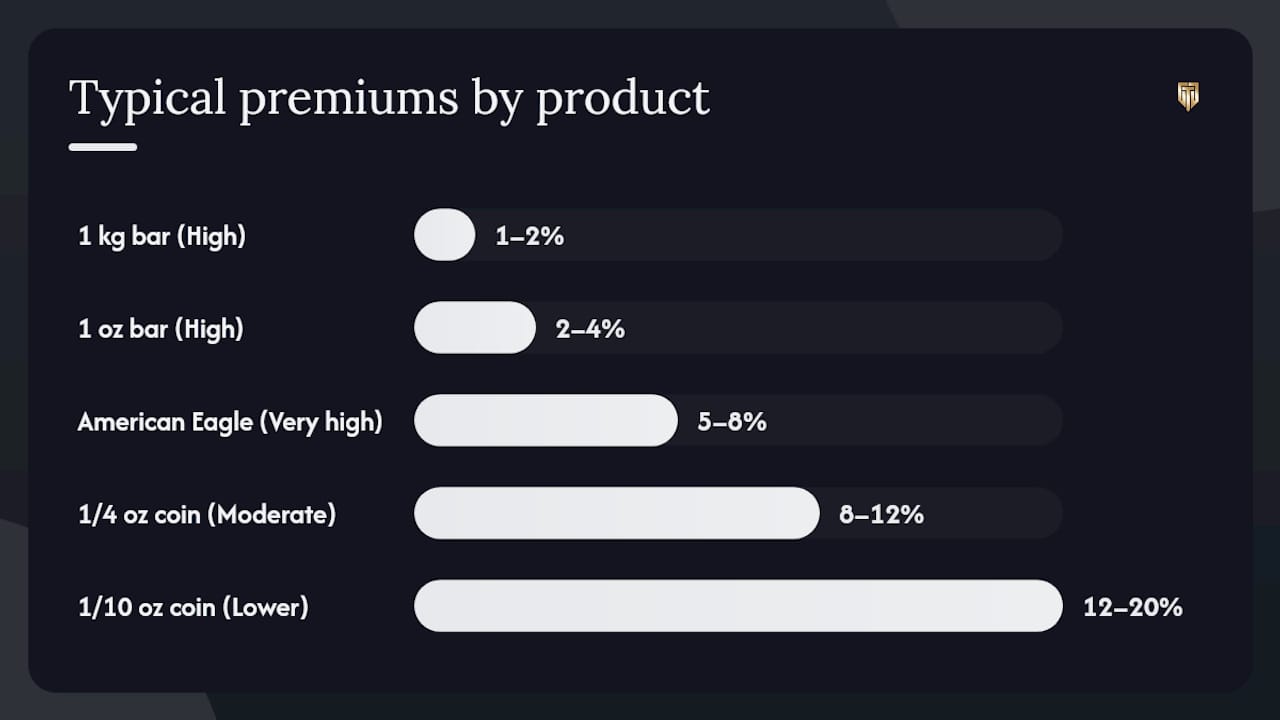
Worked example for a 1 oz gold bar: Spot at $3,200, dealer ask at $3,264. Dollar premium = $64. That sits at the low end of the normal bar range, which is competitive.
Generic rounds carry bar-level premiums at purchase but often face wider buyback spreads because they lack the universal recognition of sovereign coins.
How premiums affect your returns and break-even math
Buying physical gold is a round-trip transaction. You pay spot plus a purchase premium; you sell at spot minus a buyback discount. Both sides cost you.
- Buy: 1 oz American Gold Eagle at 6% premium over $3,200 spot = $3,392 paid.
- Sell: Dealer buyback at 2% below spot = $3,200 × 0.98 = $3,136 received.
- Round-trip cost: $3,392 − $3,136 = $256 per ounce, or roughly 8% of spot.
Typical buyback spreads run 1–3% below spot, so the exact break-even depends on the product and the dealer.
Sovereign coins like the Eagle, Buffalo, and Maple Leaf tend to have tighter buyback spreads than generic rounds because any dealer recognizes them instantly. That tighter spread reduces your effective round-trip cost even if the purchase premium is slightly higher.
Pro Tip: For long-term holders, a higher purchase premium on a sovereign coin often costs less over time than a low-premium generic round with a wide buyback spread. Run the full round-trip math, not just the buy side.
Physical bullion makes most sense for investors with a multi-year horizon who want direct ownership. Short-term traders face a steep premium-and-spread hurdle that gold ETFs, with their lower friction costs, do not carry. Matching your product to your portfolio allocation strategy matters as much as picking the right dealer.
How to minimize the premium you pay
- Compare percentage premium, not headline price. Pull the spot price at the same moment you check dealer quotes, compute the percentage for each, and rank dealers by that number.
- Buy larger units. A 1 oz bar beats a 1/4 oz coin on premium percentage every time. A kilo bar beats a 1 oz bar. The tradeoff is liquidity: larger bars are harder to sell in partial amounts.
- Avoid panic buying. Premiums spike during news events. If you can wait 48–72 hours after a market shock, premiums often compress back toward normal ranges.
- Minimize repeated shipping costs. If you plan to accumulate over time, ask dealers about allocated storage programs. Paying one shipping and insurance fee beats paying it on every small purchase.
- Prioritize sovereign coins for liquidity. The American Gold Eagle, Gold Buffalo, and Canadian Gold Maple Leaf all carry strong dealer recognition, which translates directly to tighter buyback spreads.
- Use a live premium tracker. Tools like GoldMarketDaily’s premium tracker flag when a dealer’s ask is running more than 2–3 percentage points above the typical upper bound for that product type.
Pro Tip: Ask dealers for their current buyback price before you commit to a purchase. A dealer who quotes a competitive buy price but a punishing sell price is not a competitive dealer, regardless of how the purchase premium looks.
Questions to ask dealers and red flags to watch for
Before wiring money or entering a credit card number, run through this checklist with any dealer:
- What live spot source do you use, and when does your price update? A reputable dealer ties ask prices to a real-time feed, not a price set hours ago.
- What is your exact formula for the premium? They should be able to say: spot + $X fabrication + $Y shipping + $Z margin = ask price.
- What is your current buyback price for this product? Get a number, not a vague “competitive.”
- What are your shipping and insurance terms? Fully insured, trackable delivery is standard. Anything less is a risk you bear.
- Do you provide assay certificates or refinery documentation for branded bars? For purchases above a few ounces, this is non-negotiable.
- What is your return window? Reputable dealers offer at least a short inspection period.
For a full dealer evaluation framework, Galamigold’s guide to evaluating gold traders covers the credibility signals worth checking.
Why premiums move: the institutional supply-chain view
Retail premiums are not arbitrary. They are the visible price of converting a traded contract into a physical, deliverable object. Institutional trading desks watch three operational signals: LBMA and COMEX delivery notices (which reveal how much metal is actually available for physical settlement), refinery throughput capacity, and insured-shipping availability.

When those channels tighten, as they did during the March 2020 COVID shock and again during mid-2022 supply disruptions, retail premiums on sovereign coins and small bars widened sharply because the physical supply chain could not keep pace with demand. The spot price itself may barely move while premiums double. That divergence is what catches unprepared buyers off guard.
A live premium-over-spot tracker gives retail buyers a window into this dynamic. When the tracker shows premiums running well above historical norms, it is a signal that physical supply is stressed, not that dealers are being greedy.
Galamigold’s perspective on premium, custody, and long-term cost
The instinct to chase the lowest possible premium is understandable, but it can be the wrong optimization. Here is the tradeoff that often gets missed: a slightly higher premium from a dealer with verified chain-of-custody, documented assay, and institutional-grade secure settlement can cost less over the full holding period than a rock-bottom premium from a source with opaque provenance and a wide buyback spread.
Physical precious metals have no central title registry. Secure custody and clear documentation matter enormously for long-term ownership, estate planning, and any eventual gold title transfer. When metal changes hands through an allocated transfer rather than a physical delivery, the documentation trail is what protects the buyer. Paying a modest premium for that infrastructure is not a cost; it is risk management.
For institutional allocations, Galamigold generally favors 1 oz and kilo bars for efficiency, and sovereign coins like the American Gold Eagle or Canadian Gold Maple Leaf where liquidity and universal recognition are priorities. The choice depends on the allocation’s purpose. For deeper analysis of how premiums fit within a broader gold portfolio risk management framework, Galamigold’s market insights cover the institutional perspective in detail.
Galamigold: physical gold trading with transparent pricing

Most new gold buyers spend hours comparing dealer websites without a clear framework for what they are actually comparing. Galamigold offers institutional-grade physical gold trading built around the one thing that matters most: transparent, documented pricing from verified supply chains. Every transaction comes with clear premium disclosure, assay documentation, and secure custody options, so you know exactly what you are paying and why.
That combination of price transparency and verified chain-of-custody is what separates a sound physical gold allocation from an expensive mistake. Whether you are making a first purchase or integrating gold into a larger portfolio, Galamigold’s team provides the execution and advisory support to do it efficiently. Review Galamigold’s risk disclosure and contact the team at Galamigold to discuss your allocation.
Sources
These resources let you track live premiums, verify typical ranges, and go deeper on the mechanics:
- Understanding Premiums and Pricing - GoldSilver
- Premium Over Spot Tracker | GoldMarketDaily
- Findbullionprices
- Understanding Premiums Over Spot Price | MetalWealthNow
- Transfer gold & silver into trust - Keyt Law
This article is general information, not a substitute for advice from a qualified financial advisor. Consult a qualified financial professional about your own circumstances before acting on anything here.
Recommended
- Gold Market Dynamics Explained: What Investors Need to Know
- Institutional Gold Broker Checklist: 2026 Vetting Guide
- Advantages of Wholesale Gold Trading for Investors
- ISO 4217 XAU Explained: What the Gold Code Means
Ready to invest in physical gold trade finance?
Both the Zambia–Dubai and Sierra Leone–Dubai programs are open to qualified investors. Minimum investments from $115,000 USD or €125,000 EUR.
Zambia–Dubai Program Sierra Leone–Dubai Program