
Custody fees for physical gold are the ongoing charges a custodian and depository collect to hold, insure, and administer your metal. For most U.S. retail and IRA investors, the total annual bill typically falls within a moderate range combining custodian administration and depository storage fees, though the exact amount depends heavily on account size and whether you choose flat or percentage-based pricing.
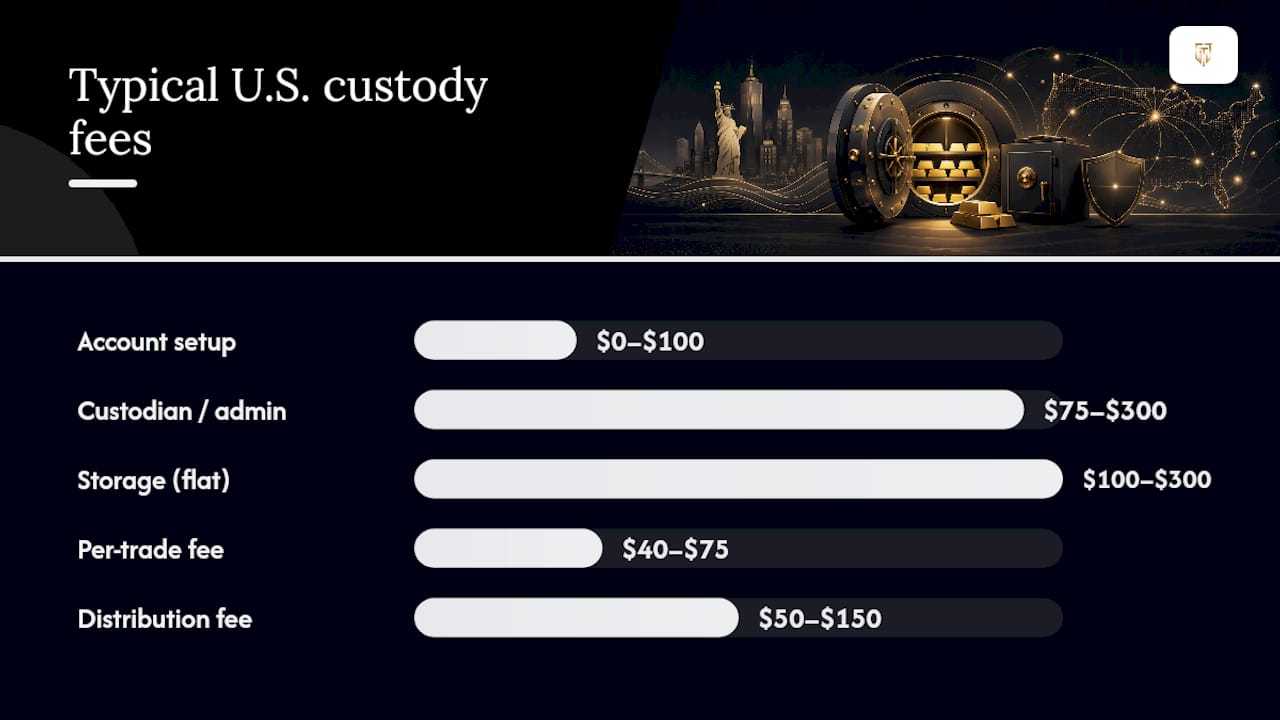
The three lines that dominate total cost are storage, custodian administration, and transaction or handling fees. Gold IRA fees explained from USA Today puts the typical IRA stack at setup $0–$100, annual custodian/admin $75–$300, and annual storage $100–$300, with dealer markups of roughly 3%–10% layered on top when metal changes hands.
Two red flags worth flagging immediately:
- Percentage-based storage on a rising gold price. A 0.50% annual rate on $50,000 of gold costs $250 today. If gold doubles, that same rate costs $500 with no change in service. Flat-fee plans protect you from that drift.
- Segregated storage premiums that are materially higher without explanation. Segregated storage is worth paying for in some cases, but if a custodian charges 2–3x the commingled rate without specifying what the extra buys (individual serial-number tracking, named-bar audits), ask for the breakdown in writing.
Key Takeaways
Flat-fee custody models consistently outperform percentage-based models for holdings above roughly $70,000–$100,000, and the gap widens as gold appreciates.
| Point | Details |
|---|---|
| Top cost drivers | Storage and custodian admin fees dominate; together they typically run $175–$600 per year for U.S. IRA accounts. |
| Flat vs. percentage model | Flat fees win above ~$70,000–$100,000 in holdings; percentage models can be cheaper for smaller accounts. |
| IRA-specific constraints | IRS rules require a qualified custodian, making storage and admin fees mandatory, not optional. |
| Hidden-fee watch list | Minimum annual charges, forced-sale clauses, and unspecified handling fees are the most common contract traps. |
| Galamigold | Provides transparent, dated fee schedules and sample invoices before account opening, with support for IRA custody transitions. |
Table of Contents
- What custody fees actually cover on your invoice
- How custody fees are calculated — pricing models and worked examples
- Allocated vs. unallocated storage — what the difference costs you
- Custody fees in Precious Metals IRAs — the rules you cannot negotiate around
- Typical U.S. fee ranges — sourced numbers for budgeting
- Where hidden costs appear in custodian contracts
- How to reduce unnecessary custody costs
- Questions to ask a custodian before you open an account
- Why custody fees deserve a place in your portfolio math
- Galamigold’s approach to custody and transparent fee structures
- Sources
What custody fees actually cover on your invoice
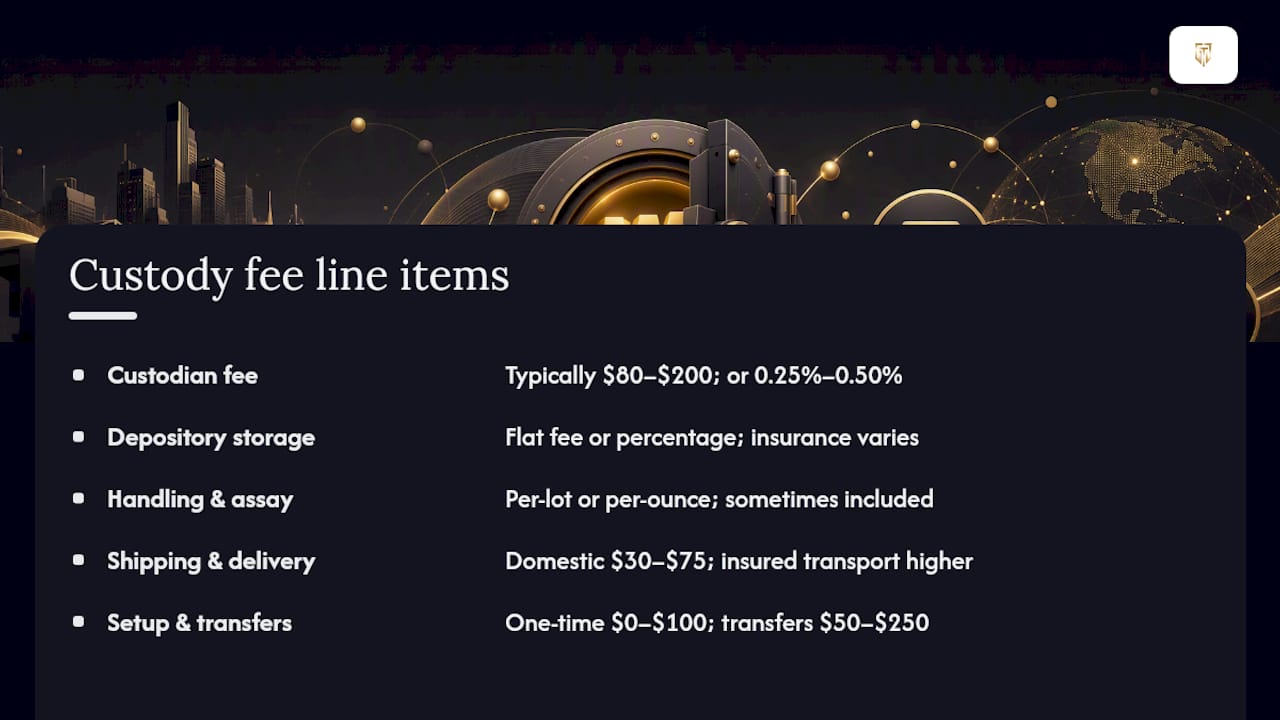
Every custodian fee schedule breaks down into a handful of distinct line items. Knowing what each one pays for lets you spot when you are being charged twice for the same service.
1. Custodian or annual administration fee. This is the fee the IRS-qualified trustee charges for maintaining your account: filing IRS Form 5498 and 1099-R, generating statements, handling recordkeeping, and processing any required minimum distributions. Gold IRA Fees Explained — Every Line Item puts the typical range at $80–$200 annually for flat-fee custodians, with a minority using percentage-of-assets models at 0.25%–0.50%.
2. Depository storage fee. This is what the vault charges to physically hold the metal. It may be quoted as a flat dollar amount or as a percentage of market value. Insurance is sometimes bundled in, sometimes billed separately. Always ask whether the quoted storage rate includes vault insurance or whether gold storage insurance appears as a separate line.
3. Handling, acceptance, and assay fees. When metal arrives at the vault, it may be weighed, assayed for purity, and logged. Some depositories charge a per-lot or per-ounce acceptance fee. Others roll this into the annual storage rate. The distinction matters when you are making multiple deposits in a year.
4. Packaging, shipping, and delivery fees. Taking physical possession of your metal, or moving it between vaults, triggers a delivery fee. These can range from a flat $30–$75 for domestic shipping to several hundred dollars for insured, armored transport of larger lots.
5. Account setup, transfer, and termination fees. Opening an account often carries a one-time setup charge of $0–$100. Transferring metal in from another custodian or closing the account can add another $50–$250. These are one-time costs, but they affect the break-even math if you switch custodians frequently.
6. Dealer markups and buyback spreads. These are not custody fees in the strict sense, but they interact directly with custody costs. When you sell, the buyback spread reduces what you receive. For institutional gold investing best practices, minimizing round-trip spread is as important as minimizing the annual storage rate.
How custody fees are calculated — pricing models and worked examples
Two billing models dominate the market, and the right one for you depends almost entirely on account size.
Flat annual fee. A fixed dollar amount regardless of how much metal you hold. Common flat storage rates run $100–$300 per year. The custodian administration fee adds another $75–$300. Total flat-fee cost is predictable and does not grow with gold’s price.
Percentage-of-assets model. An annual rate expressed in basis points, applied to the current market value of your holdings. Gold IRA Storage Fees: What You’ll Actually Pay cites the common band as 0.15%–0.50%. Some providers publish rates as low as 0.12% per year with a small quarterly minimum. At the high end, depository-published rates reach 0.3%–0.65% depending on vault location and account class.
Hybrid and tiered structures. Some custodians charge a flat administration fee plus a percentage storage fee. Others use tiered rates that drop as account value rises.
Worked examples
The flat-fee model becomes the clear winner above roughly $70,000–$100,000 in holdings, depending on the specific rates quoted. Below that threshold, a low percentage model can cost less.
Allocated vs. unallocated storage — what the difference costs you
The terms “allocated” and “unallocated” describe who legally owns the specific bars in the vault, and that distinction has direct fee and risk consequences.
Allocated (segregated) storage means your specific bars, identified by serial number and weight, are set aside and titled to you. You own those exact bars. The custodian cannot lend them or commingle them with other clients’ metal. Audits can confirm your specific holdings by serial number.
Unallocated (commingled) storage means you own a fractional interest in a pool of metal. The vault holds bars on behalf of multiple clients, and your claim is a share of the pool rather than specific bars. You are a creditor of the pool, not the owner of identified bars.
| Feature | Allocated (Segregated) | Unallocated (Commingled) |
|---|---|---|
| Legal ownership | Specific identified bars | Fractional pool interest |
| Serial-number tracking | Yes | No |
| Annual cost | Higher (typically 20%–40% premium) | Lower |
| Counterparty risk | Lower | Higher (pool-level) |
| Audit complexity | Lower | Higher |
| Insurance labeling | Per-bar | Pool-level |
Segregated storage typically costs more because the vault must maintain individual records, handle each client’s bars separately, and produce bar-specific audit reports. Segregated storage is often defensible for institutional clients when auditability and individual serial-number control matter. For gold safeguarding and diversification, the choice between models is a genuine risk decision, not just a cost one.
Pro Tip: Run the break-even math before defaulting to segregated storage. That may be worth it for holdings above $200,000 or for institutional accounts where serial-number control is a compliance requirement. For smaller retail IRA accounts, commingled storage with a reputable, insured depository is often the more rational choice.
Custody fees in Precious Metals IRAs — the rules you cannot negotiate around
Gold IRAs operate under a constraint that standard brokerage accounts do not: IRS Publication 590-A requires that IRA-held precious metals be held by a qualified trustee or custodian. You cannot store IRA gold at home or in a personal safe-deposit box. That requirement makes custodial and storage fees mandatory, not optional.
The typical IRA fee stack looks like this:
- Setup or account-opening fee: $0–$100, charged once when the account is established.
- Annual custodian or administration fee: $75–$300, covering IRS reporting, statements, and account maintenance.
- Annual depository storage fee: $100–$300 flat, or 0.15%–0.50% of account value.
- Transaction fees: Charged per buy or sell order, sometimes a flat $40–$75 per transaction.
- Distribution or liquidation fees: Triggered when you take a required minimum distribution or close the account. Can be $50–$150 or a percentage of the distributed amount.
- Transfer-out or termination fees: $50–$250 when moving the account to a new custodian or closing it entirely.
One operational detail that catches investors off guard: custodians and depositories typically bill storage fees to the custodian, who then debits the IRA’s cash balance. If your IRA holds only metal and no cash, the custodian may be forced to liquidate a portion of your gold to cover the fee. Keeping a small cash reserve inside the IRA specifically for fee payments is a practical safeguard.
Coins or bars that do not meet the standard cannot be held in the IRA, and attempting to do so creates a prohibited-transaction issue. For a broader look at the regulatory framework, the IRS retirement account rules cover contribution limits and transfer procedures that affect how you fund the account and manage fee payments over time.
Typical U.S. fee ranges — sourced numbers for budgeting
The table below consolidates sourced ranges across the main fee categories. Use it as a starting budget, then verify against the specific custodian’s dated fee schedule.
| Fee Type | Typical U.S. Range | Notes |
|---|---|---|
| Account setup | $0–$100 | One-time; waived by some custodians |
| Annual custodian/admin | $75–$300 | Flat-fee majority; 0.25%–0.50% for percentage models |
| Annual storage (flat) | $100–$300 | Often includes insurance; confirm in writing |
| Annual storage (percentage) | 0.12%–0.65% | Low end: some providers; high end: premium vaults |
| Dealer markup on purchase | 3%–10% above spot | Not a custody fee, but a real acquisition cost |
| Transaction fee (per trade) | $40–$75 | Per buy or sell order |
| Distribution/liquidation fee | $50–$150 | Or a percentage of distributed amount |
| Transfer-out/termination | $50–$250 | One-time; varies widely |
Sources: USA Today, LegalClarity, BullionLens, International Depository Services.
Depository location and minimum fee policies can double the effective rate on small accounts versus larger ones. If your holding is under $50,000, the minimum-fee clause deserves as much attention as the headline rate.
Those rates are defensible for large institutional holdings where auditability is a compliance requirement. For a $25,000 retail IRA, they represent a meaningful drag on returns.
Where hidden costs appear in custodian contracts
Most custody surprises are not fraud. They are ambiguous language that the investor did not catch before signing.
1. “Insurance included” without specifics. A fee schedule that says storage includes insurance but does not name the carrier, the coverage limit, or whether it covers full replacement value at spot price is incomplete. Ask for the insurance certificate and confirm the per-ounce or per-account coverage cap.
2. Unspecified handling or assay fees. Language like “additional fees may apply for non-standard items” can cover assay charges, repackaging fees, or lot-splitting costs that add $50–$200 per transaction. Ask for a complete list of per-transaction charges before depositing.
**3. If your account value drops, the minimum kicks in and your effective rate rises. This clause is common and not inherently unfair, but it needs to be included in your cost model.
4. Forced-sale clauses. If the IRA cash balance falls below a threshold and fees are due, the custodian may sell metal without prior notice. The clause is usually buried in the custody agreement under “fee collection” or “account maintenance.” Ask specifically whether the custodian will notify you before liquidating metal.
5. Wire and payment fees. Some custodians charge $15–$35 per wire transfer for fee payments or distributions. If you are taking monthly distributions, that adds up to $180–$420 per year in wire fees alone.
**6.
7. Per-shipment rounding. Delivery fees are sometimes rounded up to the next weight increment (e.g., any shipment under 10 oz billed as 10 oz). Ask for the exact rounding methodology in writing.
How to reduce unnecessary custody costs
The single most effective lever is choosing the right pricing model for your account size. Beyond that, several tactics consistently lower the total bill.
- Negotiate a multi-year fee guarantee. Some custodians will lock in the current flat fee for two or three years in exchange for a commitment not to transfer out. That protects you from rate increases during a period of rising gold prices.
- Consolidate multiple small accounts. Two $30,000 accounts each paying a $200 minimum storage fee cost $400 per year. One $60,000 account at the same minimum costs $200. Consolidation cuts the fixed-cost burden in half.
- Choose commingled storage when auditability is not required. For most retail IRA investors, commingled storage at a reputable, insured depository is functionally equivalent to segregated storage for day-to-day purposes. The premium for segregated storage is only justified when serial-number control is a genuine compliance or estate-planning requirement.
- Keep a cash reserve inside the IRA. A $500–$1,000 cash buffer prevents forced liquidation and gives you control over when and how fees are paid.
- Confirm billing cadence and dates. Some custodians bill quarterly, others annually. Knowing the billing date lets you time contributions or distributions to avoid being caught with insufficient cash.
- Schedule distributions to minimize handling fees. If you plan to take several distributions in a year, consolidating them into one or two transactions reduces per-transaction handling and shipping fees.
- Request a sample invoice before signing. A custodian that provides a real, dated sample invoice with all line items populated is showing you exactly what the bill will look like. That transparency is a meaningful signal about how they operate.
Pro Tip: A custodian offering a slightly lower headline storage rate but charging $75 per transaction and $150 to terminate the account can easily cost more over three years than one with a higher storage rate and no transaction fees. Model the total cost over your expected holding period, not just the annual storage line.
For a deeper look at how to evaluate custodians and trading platforms, evaluating gold traders covers the due diligence steps that separate credible providers from those that rely on opaque pricing.
Questions to ask a custodian before you open an account
Use this list on a call or in an email. Request written answers for anything that affects your cost model.
Pricing and billing:
- Is your storage fee flat or percentage-based, and what is the exact rate or dollar amount?
- Is there a minimum annual storage or administration charge, and how is it calculated?
- Do you offer both segregated and commingled storage, and what is the price difference?
- What is the billing date, and is the fee calculated on a single-day snapshot or an average?
- Are transaction fees charged per buy, per sell, or per round trip?
Insurance and coverage:
- Is vault insurance included in the storage fee, or billed separately?
- Who is the insurance carrier, and what is the per-account or per-ounce coverage limit?
- Does the policy cover full replacement at current spot price, or is there a cap?
Account mechanics:
- What happens if my IRA cash balance is insufficient to cover fees? Will you notify me before selling metal?
- What is the transfer-out or termination fee, and how much notice is required?
- Are there wire or payment processing fees for distributions or fee payments?
Documentation to request in writing:
- A dated, signed fee schedule (not a marketing summary).
- A sample invoice with all line items populated.
- The custody agreement with the fee-collection and forced-sale clauses highlighted.
- The insurance certificate naming the carrier and coverage limit.
If a custodian resists providing any of these documents before account opening, that resistance is itself a signal. Requesting a sample dated invoice and a written fee schedule up front is the fastest way to avoid surprises. A provider that declines is telling you something about how they handle disputes later.
For due diligence frameworks that go beyond custody fees into broader alternative-asset verification, gemstone investment due diligence covers investigative approaches that transfer well to evaluating any custodial arrangement.
Why custody fees deserve a place in your portfolio math
Most investors spend significant time analyzing gold’s price trajectory and almost no time modeling what custody fees will cost over a 10 or 20-year holding period. That asymmetry is a mistake.
In year one, the total custody cost is $500. Over 20 years, the cumulative custody cost under that percentage model can exceed $15,000 on a holding that started at $100,000. A flat-fee model at $350 per year totals $7,000 over the same period. The difference is not trivial when compounded against the opportunity cost of capital.
Galamigold’s orientation toward transparent custody pricing reflects a straightforward belief: investors who understand their full cost structure make better allocation decisions. Opaque fee schedules benefit the custodian, not the client. Before committing to any custodian, run the worked examples from the section above using your actual account size and the custodian’s actual rates. The arithmetic takes ten minutes and can save thousands over a decade.
The other underappreciated point is that custody fees interact with tax treatment. In a traditional IRA, fees paid from inside the account reduce the tax-deferred balance. Fees paid from outside the account with after-tax dollars are not deductible under current IRS rules for most investors. That distinction affects which fee-payment method is more efficient for your specific tax situation, and it is worth confirming with a tax advisor before the first billing cycle.
Galamigold’s approach to custody and transparent fee structures
Custody fees are not a detail to sort out after you commit to a provider. They are a core part of the investment’s total cost, and Galamigold treats them that way from the first conversation.

Galamigold works with institutional and qualified investors who want physical gold custody handled with the same discipline applied to the trading side: clear, dated fee schedules provided before account opening, sample invoices available on request, and explicit documentation of whether storage is segregated or commingled. For investors moving retirement assets into a physical gold structure, Galamigold’s onboarding support covers the custodian-selection process, fee negotiation, and the IRS compliance requirements that govern IRA-held metals.
The practical difference is that you are not left to decode a fee schedule alone. If you are evaluating a custody arrangement for a significant gold allocation, review Galamigold’s institutional trading benefits or contact the team directly through galamigold.com to request a fee comparison and custody overview for your specific holding size.
Sources
The sources below are the primary references used for fee ranges, IRS rules, and depository pricing in this article. Each covers a distinct layer of the custody cost picture.
- Gold IRA fees explained
- Gold IRA Storage Fees: What You’ll Actually Pay - LegalClarity
- Gold IRA Fees Explained — Every Line Item
- OneGold™ | Storage Fees
- Publication 590-A
This article is general information, not a substitute for advice from a qualified financial advisor. Consult a qualified financial professional about your own circumstances before acting on anything here.
Recommended
- The Role of AML in Gold Trade for Institutional Investors
- What Is Non-Bank Gold Trading? A 2026 Investor Guide
- Why gold secures portfolio diversification and reduces risk
- Gold Trade Settlement Explained for Investors and Traders
Ready to invest in physical gold trade finance?
Both the Zambia–Dubai and Sierra Leone–Dubai programs are open to qualified investors. Minimum investments from $115,000 USD or €125,000 EUR.
Zambia–Dubai Program Sierra Leone–Dubai Program