
TL;DR:
- Intermediaries in gold trading include brokers, dealers, refineries, and platforms essential for liquidity, price discovery, and logistics. They significantly influence market prices, carry compliance risks, and are evolving through vertical integration and transparency efforts. Active due diligence and choosing accredited, transparent counterparts are crucial for managing risks and optimizing trading outcomes.
Intermediaries in gold trading are defined as the brokers, bullion dealers, refineries, and trading platforms that connect buyers and sellers across every stage of the gold market. The role of intermediaries in gold trading extends well beyond simple transaction facilitation. They provide liquidity, enable price discovery, and manage the logistics of moving physical metal through a supply chain that spans mines, refineries, and institutional vaults. The global physical gold market is valued at approximately US$14 trillion, with daily trading volumes of US$114 billion on COMEX and US$51 billion on the Shanghai Futures Exchange in 2025. That scale makes the intermediary layer not just useful but structurally necessary.
How do intermediaries function in the gold supply chain?
The gold supply chain runs from mine extraction through refining, wholesale distribution, and final sale to investors or manufacturers. Intermediaries operate at every link in that chain, and their functions differ significantly by tier.
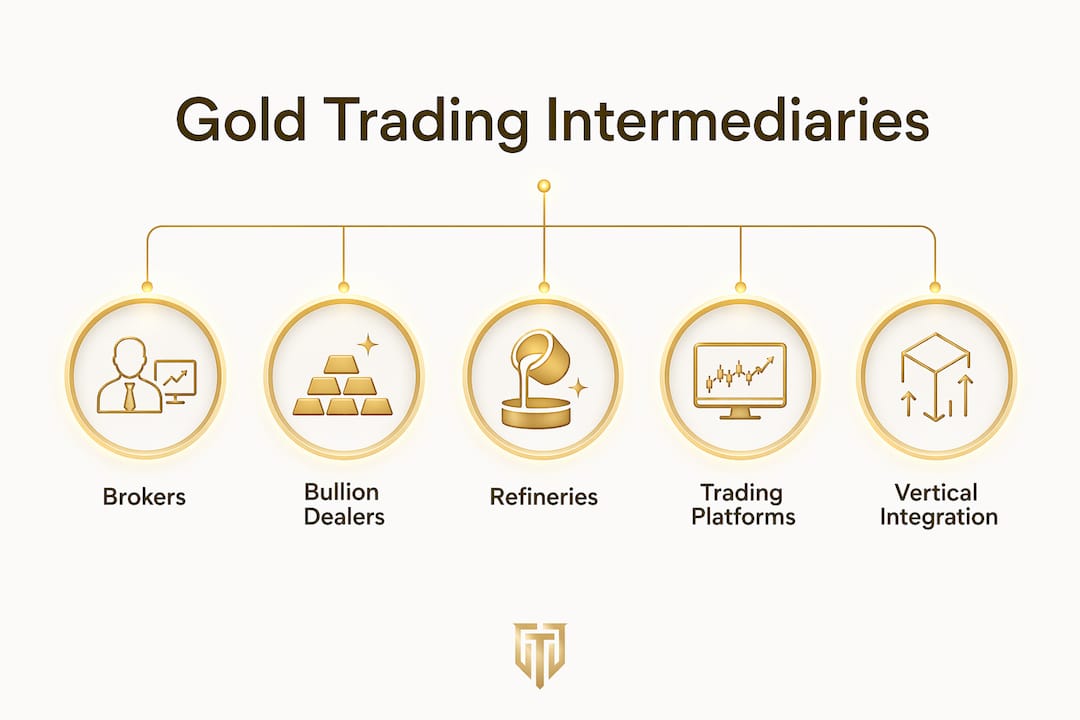
The four main types of intermediaries are:
- Brokers: Execute buy and sell orders on behalf of clients, typically earning a commission. They rarely hold physical inventory.
- Bullion dealers: Buy and sell physical gold directly, holding inventory and profiting from the spread between bid and ask prices.
- Refineries: Transform raw or recycled gold into standardized bars and coins, acting as critical processing intermediaries between miners and the wholesale market.
- Trading platforms: Provide electronic or OTC venues where institutional participants transact, including exchanges like COMEX and the London Bullion Market Association (LBMA) system.
Each type performs distinct functions. Brokers aggregate demand from smaller buyers and present it to large dealers. Dealers provide price quotes and absorb inventory risk. Refineries standardize metal quality to LBMA Good Delivery or equivalent specifications. Platforms provide the infrastructure for settlement, clearing, and price transparency.
A notable structural shift is reshaping these roles. Large bullion dealers in India have built their own refineries, cutting banks out of the import chain. Bank market share of Indian gold imports dropped from 40% in 2017 to just 19% in 2020. That vertical integration concentrates pricing power in fewer hands and reduces the number of independent intermediary layers.
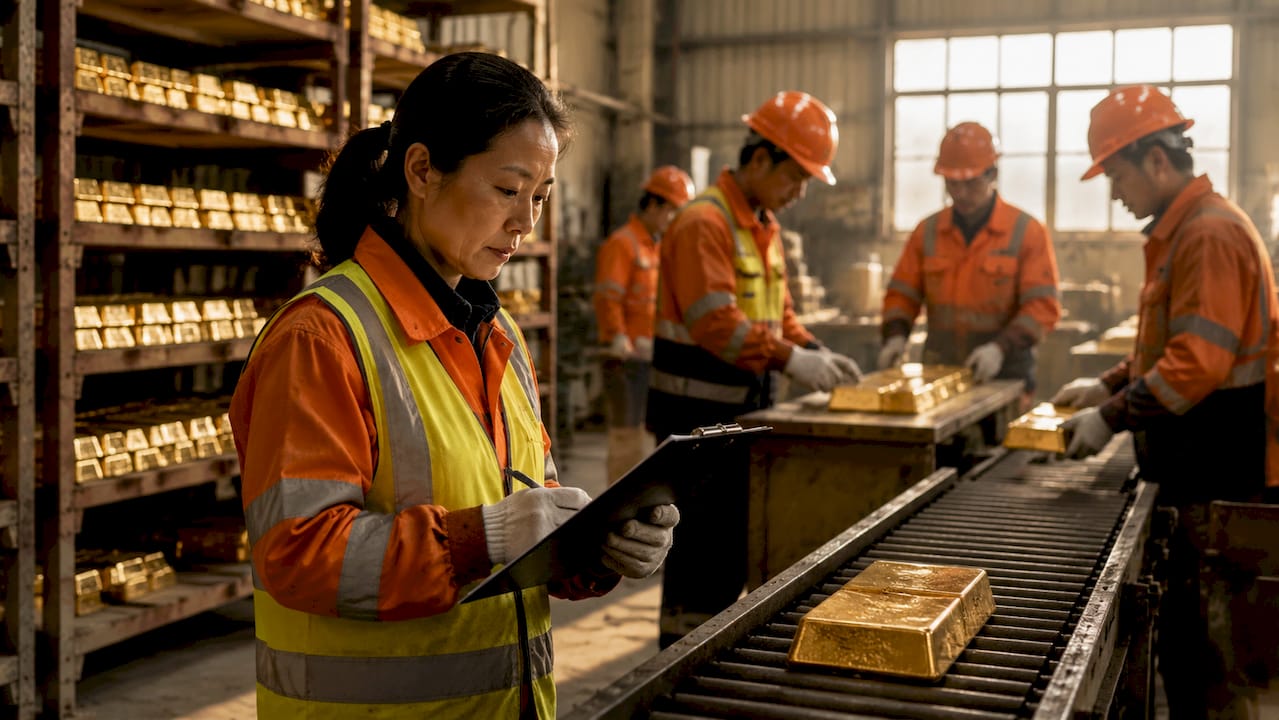
Dubai and the UAE represent a different model. Resource-rich nations increasingly route gold through Dubai as a distribution hub, with the DRC-UAE supply deal being a recent example of how trading hubs like Dubai anchor regional intermediary networks.
Pro Tip: When evaluating a gold intermediary, ask specifically which tier they occupy in the supply chain. A broker who also holds inventory is functioning as a dealer, which changes their incentive structure and the pricing you receive.
What are the financial and market impacts of intermediaries?
Intermediaries shape gold market pricing, liquidity, and information flow in ways that directly affect your execution quality as an investor or financial professional.
The most significant financial function is price discovery. Gold derivatives markets, particularly futures and options on COMEX and the Shanghai Futures Exchange, carry derivatives open interest of approximately US$1.5 trillion as of end-2025. Intermediaries, especially large bullion banks and dealers, are the primary participants in these markets. Their trading activity sets the reference prices that flow downstream to retail and institutional buyers alike.
Information asymmetry is the less-discussed financial impact. India’s bullion market illustrates this clearly: upstream large importers have real-time price feeds and hedging tools, while small downstream dealers rely on secondhand, often delayed information. Small participants frequently execute at unfavorable prices because they are working with stale data. This tiered information structure is not accidental. It is a feature of how OTC markets reward scale and relationships.
Key financial impacts of intermediaries include:
- Liquidity provision: Large dealers commit capital to maintain two-way markets, allowing institutional buyers to transact in size without moving prices sharply.
- Hedging facilitation: Intermediaries connect producers and consumers to derivatives markets, enabling forward sales and options strategies.
- Spread capture: Dealers earn the bid-ask spread, which narrows in liquid markets and widens during volatility, directly affecting investor transaction costs.
- Financing: Some dealers provide gold leasing and consignment arrangements, effectively acting as lenders within the supply chain.
The OTC and relationship-based nature of most gold trading creates opacity that benefits established intermediaries. Cash transactions dominate in markets like India, which hampers price discovery and gives well-connected dealers a structural advantage over newer entrants.
What risks and challenges do intermediaries introduce?
The same opacity that benefits established intermediaries creates serious compliance and financial crime risks. These risks are not theoretical. They are documented, active, and increasingly targeted by regulators.
The four primary risk categories are:
-
Money laundering through complex supply chains: Launderers exploit intermediaries using shell companies, circular trade flows, and layered transactions to obscure the origin of funds. Gold’s high value-to-weight ratio makes it particularly attractive for this purpose.
-
Provenance destruction at refineries: The refining process melts gold to 995+ purity, erasing its physical origin. Once refined, the metal is indistinguishable regardless of source. Supply chain integrity depends entirely on documentation and audits, not the metal itself.
-
Beneficial ownership opacity: Intermediaries structured as shell companies or nominee-held entities can obscure the true owner of gold, making sanctions screening and anti-money laundering (AML) compliance extremely difficult.
-
Conflict gold transit: EU sanctions in 2025 targeted Gasabo Gold Refinery and its CEO for facilitating conflict gold flows through secondary refineries and reprocessing hubs. This case shows how intermediary refineries can become conduits for sanctioned material even within nominally compliant systems.
The paper trail is the only defense against these risks. Physical gold cannot self-certify its origin after refining. Every responsible participant in the chain, from miner to final buyer, must maintain and verify documentation.
Pro Tip: Request a full chain-of-custody document set from any intermediary before settlement. This includes mine-of-origin declarations, refinery certificates, and LBMA or equivalent accreditation records. If any link in that chain is missing, treat it as a red flag.
For a broader view of how AML penalties are reshaping compliance obligations across gold trading in 2026, the regulatory environment is tightening faster than most market participants expect.
How can investors navigate intermediaries effectively?
Working with intermediaries well requires a structured approach to due diligence, counterparty selection, and ongoing monitoring. The functions of brokers in gold trading and the broader intermediary ecosystem offer real advantages, but only to participants who engage with them deliberately.
Practical steps for navigating intermediaries:
- Verify source-of-goods documentation before any transaction. Confirm mine-of-origin, refinery accreditation, and chain-of-custody records. Do not accept verbal assurances.
- Select intermediaries with recognized accreditation. LBMA membership, Responsible Gold Guidance compliance, or equivalent third-party audits signal a baseline of operational standards.
- Monitor AML and sanctions developments actively. Regulatory changes in the EU, US, and UAE directly affect which intermediaries you can legally transact with. Designations can happen quickly, as the 2025 Gasabo case demonstrated.
- Use transparent platforms where possible. Exchange-traded products and regulated venues reduce counterparty risk compared to purely bilateral OTC arrangements.
- Understand the information tier you occupy. If you are not a large institutional buyer with direct access to real-time price feeds, factor that information disadvantage into your pricing expectations and negotiate accordingly.
For institutional investors specifically, the choice of intermediary tier determines execution quality, financing costs, and compliance exposure simultaneously. Treating intermediary selection as a strategic decision rather than an operational one changes the outcomes significantly.
The gold market is also shifting toward vertically integrated models. Miners, refineries, and distributors are consolidating functions that were previously handled by separate intermediaries. Investors who understand this shift can identify which intermediary relationships still add genuine value and which are simply adding cost and opacity.
Pro Tip: Build relationships with at least two intermediaries at different tiers of the supply chain. A direct relationship with a refinery or large dealer gives you better pricing and information access than relying solely on a broker.
Key takeaways
Intermediaries in gold trading are structurally necessary, but their opacity, information advantages, and compliance risks require active management from every serious market participant.
| Point | Details |
|---|---|
| Intermediaries define market access | Brokers, dealers, refineries, and platforms each serve distinct functions that determine your pricing and execution quality. |
| Information asymmetry is structural | Upstream dealers hold real-time data; downstream participants work with secondhand information, leading to worse execution outcomes. |
| Provenance risk is a documentation problem | Refining destroys physical origin, so chain-of-custody records and audits are the only reliable compliance tools. |
| Vertical integration is reshaping the chain | Large dealers building their own refineries concentrate pricing power and reduce independent intermediary layers. |
| Due diligence is non-negotiable | Verifying accreditation, beneficial ownership, and source-of-goods documentation protects against AML and sanctions exposure. |
Why the intermediary layer deserves more scrutiny than it gets
Most investors treat intermediaries as a necessary cost of doing business in gold markets. My experience working across physical gold supply chains tells a different story. The intermediary layer is where the most consequential decisions about pricing, compliance, and counterparty risk actually get made, and most participants engage with it passively.
The information asymmetry problem is more severe than published research suggests. When a small dealer in a downstream market quotes you a price based on secondhand data that is 15 minutes old, and the upstream dealer they sourced from is hedging in real time on COMEX, the spread you pay reflects that gap. You are not just paying a commission. You are paying for the information disadvantage built into the structure.
The vertical integration trend is the most important structural shift I have observed in recent years. When a large bullion dealer controls its own refinery, it controls provenance documentation, pricing, and distribution simultaneously. That concentration creates efficiency, but it also concentrates compliance risk. If that entity has a problem, the entire chain has a problem.
My view is that the future of gold intermediaries runs through transparency technology and regulatory pressure, not through further consolidation. Platforms that provide real-time pricing, auditable documentation, and direct market access will gradually displace relationship-based OTC arrangements for institutional flows. The intermediaries who survive will be those who add genuine value through expertise and compliance infrastructure, not those who profit from opacity.
— Galami
How Galamigold supports transparent gold trading
Galamigold operates as a physical gold trading platform built around the principles that the intermediary layer too often ignores: verified sourcing, documented chain-of-custody, and disciplined execution across established supply chains.
For investors and financial professionals who want direct access to physical gold supply and bullion trading without the opacity that characterizes much of the OTC market, Galamigold provides a structured alternative. Every transaction is supported by compliance-grade documentation, counterparty verification, and transparent pricing. The platform targets sophisticated investors who understand that the quality of your intermediary relationships determines your actual risk exposure, not just your stated returns. Explore Galamigold’s trading program and risk disclosure framework to understand how disciplined intermediary management translates into better capital deployment.
FAQ
What is the role of intermediaries in gold trading?
Intermediaries in gold trading connect buyers and sellers, provide liquidity, enable price discovery, and manage logistics across the supply chain. They include brokers, bullion dealers, refineries, and trading platforms, each serving a distinct function.
How do intermediaries influence gold prices?
Large bullion dealers and brokers set reference prices through their activity on COMEX and OTC markets, with derivatives open interest reaching approximately US$1.5 trillion in 2025. Their bid-ask spreads and hedging activity directly determine the prices smaller participants receive.
What compliance risks do gold intermediaries create?
Intermediaries can facilitate money laundering through shell companies and circular trade flows, and refineries destroy physical provenance by melting gold, making documentation the only reliable compliance tool. Regulatory bodies including the EU have sanctioned intermediary refineries for conflict gold facilitation as recently as 2025.
How should investors select a gold intermediary?
Investors should prioritize intermediaries with LBMA membership or equivalent third-party accreditation, verified chain-of-custody documentation, and transparent AML compliance programs. Counterparty tier within the supply chain also determines pricing quality and information access.
What is vertical integration in gold supply chains?
Vertical integration occurs when a single entity controls multiple supply chain functions, such as a bullion dealer that also owns a refinery. This model concentrates pricing power and compliance responsibility, reducing independent intermediary layers but increasing single-entity risk.
Recommended
- Gold Broker Roles: Institutional Trading Edge in 2026 | Galami Gold
- Gold Market News & Analysis | Galami Gold Blog
- 2026 Gold Trading Trends: Key Insights for Institutions
- Step by Step Gold Transaction Process: 2026 Guide
Ready to invest in physical gold trade finance?
Both the Zambia–Dubai and Sierra Leone–Dubai programs are open to qualified investors. Minimum investments from $115,000 USD or €125,000 EUR.
Zambia–Dubai Program Sierra Leone–Dubai Program