
TL;DR:
- Gold recertification involves re-testing and re-documenting physical gold assets after their original certification becomes invalid. This process ensures the gold’s purity and authenticity, maintaining its liquidity and institutional acceptance in markets. Professional credential renewal for appraisers and gemologists is separate but also essential for market credibility and compliance.
Gold recertification is defined as the formal process of re-assaying and re-verifying a previously certified gold asset to restore its authenticated status after certification has been compromised, expired, or transferred. Investors, traders, and financial professionals rely on this process to maintain the liquidity, collateral value, and institutional acceptance of physical gold holdings. Standards set by bodies like the London Bullion Market Association (LBMA) and credentials maintained by organizations such as the U.S. Gemological Institute (USGI) and the American Gem Society (AGS) govern both physical asset recertification and the professional credential renewal that supports it. Understanding what is gold recertification, and why it matters, is the first step toward protecting the full market value of any gold position.
What is gold recertification and when does it apply?
Gold recertification is the re-validation of a gold asset’s purity, authenticity, and documentation after its original certified status has lapsed or been voided. The process applies to physical gold bars, coins, and bullion products that have lost their certified standing due to seal compromise, document loss, or ownership transfer.

Two distinct domains use the term. Physical asset recertification restores the certified status of a gold bar or coin. Professional credential recertification renews the qualifications of appraisers, gemologists, and financial advisors who evaluate gold. Mixing the two creates confusion in financial reporting and compliance audits, so keeping them separate is critical for accurate portfolio management.
Certified gold carries a certificate that functions as an identity card. It confirms purity (often 999.9‰), origin, serial number, and weight, which simplifies valuation and legal transactions, including inheritance settlements and collateral agreements. Without that certificate, a gold asset loses its paper trail and its institutional standing.
What triggers the need for physical gold recertification?
Several specific events void a gold asset’s certified status and require recertification before the asset can re-enter institutional markets.
- Broken or tampered seals. Breaking the manufacturer’s seal voids certified status on most bullion products, even if the gold itself is untouched. Re-assay becomes mandatory to restore liquidity.
- Damaged or expired documentation. A certificate that is physically destroyed, water damaged, or simply missing removes the traceability chain. Labs need documentation to confirm origin and prior testing results.
- Change of ownership. Transfers through inheritance, estate settlement, or secondary market purchase often require fresh verification to satisfy the receiving institution’s due diligence requirements.
- Regulatory compliance updates. Market standards evolve. Gold that met certification thresholds five years ago may need re-testing to satisfy current LBMA or national regulatory requirements.
- Counterfeiting risk management. Uncertified gold risks counterfeit exposure and limited resale options. Recertification removes that risk by establishing a fresh, documented chain of authenticity.
The economic cost of skipping recertification is significant. Banks and financial institutions typically reject non-certified gold for collateral or storage. That rejection removes the asset from institutional liquidity channels entirely, which is a direct hit to portfolio flexibility.
Pro Tip: Keep original packaging and seals intact at all times. Once a seal is broken, even for inspection, the recertification process becomes both mandatory and expensive. Store certified gold in its original, sealed condition inside a regulated vault.
How to recertify gold: steps, requirements, and costs
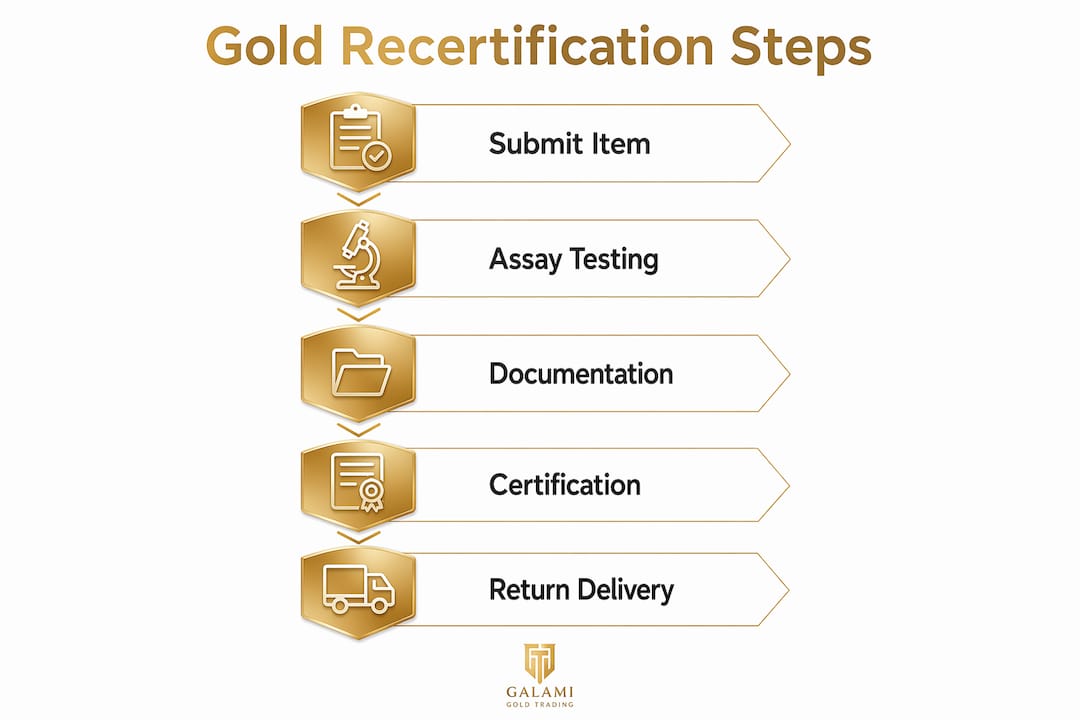
The gold recertification process follows a defined sequence. Each step builds on the last, and skipping any one of them delays or invalidates the outcome.
- Locate an accredited assay laboratory or numismatic expert. Choose a lab recognized by the LBMA, a national mint, or a relevant regulatory body. Accreditation confirms the lab’s testing methods meet market standards.
- Gather all existing documentation. Submit the original certificate, purchase records, and any prior assay reports alongside the gold item. Original or expired documentation expedites recertification by giving labs a reference point, which reduces both time and cost.
- Present valid identification. Labs require government-issued ID to confirm ownership and satisfy anti-money laundering (AML) requirements. This step is non-negotiable under most national regulatory frameworks.
- Submit the gold for physical testing. The lab checks weight, purity, and hallmark integrity. Certified gold bars commonly contain 99.5% or higher pure gold. Any deviation from the original specification triggers additional analysis.
- Receive the recertification report and new certificate. The lab issues a new certificate with a unique serial number traceable to the re-assay event. This document replaces the voided original and restores the asset’s institutional standing.
Pro Tip: Request a split assay report if you hold multiple bars from the same lot. Testing each bar individually costs more upfront but prevents a single failed bar from casting doubt on the entire holding.
The table below summarizes typical recertification variables investors should plan for.
| Variable | Typical Range | Notes |
|---|---|---|
| Turnaround time | 5–15 business days | Expedited services available at higher cost |
| Cost per bar | Varies by lab and bar size | Original documentation reduces cost |
| Purity threshold | 99.5% minimum (LBMA standard) | Lower purity triggers rejection or remelting |
| Documentation required | Certificate, ID, purchase record | Missing docs extend timeline significantly |
Legal compliance runs through every step. AML regulations, Know Your Customer (KYC) requirements, and national customs rules all intersect with the recertification process. Investors working across borders should confirm which jurisdiction’s rules govern the specific transaction before submitting gold for re-assay. Galamigold’s approach to gold trading standards addresses these compliance layers directly for institutional clients.
Professional gold credential recertification in finance and appraisal
Professional recertification is a separate process from physical asset recertification, though both affect the integrity of gold markets. Appraisers, gemologists, and financial advisors who evaluate gold must renew their credentials on a defined schedule to maintain market credibility.
The USGI Registered Gemologist Appraiser (RGA) credential requires biennial recertification. That two-year cycle keeps practitioners current on market shifts, including the growing presence of lab-grown materials and changes in commodity trade flows. The American Gem Society (AGS) applies similar periodic requirements, typically combining online coursework, examinations, and continuing education credits.
Key features of professional recertification programs include:
- Credit-based renewal. Programs like Lean Gold Certification require 60 credits over a three-year period, accumulated through approved courses and industry events.
- Online and flexible formats. Digital recertification pathways are expanding, allowing professionals to maintain credentials online without repeated in-person testing, provided renewal is completed on schedule.
- Ethics and market integrity components. AGS and USGI recertification programs include modules on ethical standards and consumer protection, not just technical knowledge.
- Compliance separation. Gold asset recertification and professional credential recertification serve fundamentally different purposes. Conflating them in financial reports creates audit delays and compliance gaps.
Professional recertification matters to investors because the quality of an appraisal depends directly on the appraiser’s current credentials. An expired credential signals that the practitioner has not kept pace with market developments, which undermines the reliability of any valuation they produce.
How does gold recertification affect investors and asset management?
Recertification directly determines whether a gold asset can function as a liquid, bankable instrument or sits as an illiquid store of value with limited institutional utility.
Reinstated certified status improves gold’s position in secondary markets. Buyers pay a premium for certified gold because the documentation removes uncertainty about purity and origin. Without certification, sellers face discounted bids or outright rejection from institutional buyers. For portfolio managers, that discount represents a real, measurable drag on returns.
Collateral acceptance is the most immediate financial implication. Banks and financial institutions require certified gold for collateral agreements. Non-certified gold is excluded from these arrangements, which limits a portfolio’s ability to generate liquidity without selling the asset outright. Maintaining certified status keeps that option open. Galamigold’s guidance on building trust in gold trading covers how institutional counterparties evaluate certification as part of their due diligence.
The fraud and counterfeiting risk reduction is equally concrete. Recertification re-establishes a documented chain of custody. That chain is the primary defense against counterfeit gold entering a portfolio, a risk that grows as gold prices rise and the incentive to fake bars increases.
The table below compares certified and non-certified gold across the dimensions that matter most to institutional investors.
| Dimension | Certified gold | Non-certified gold |
|---|---|---|
| Institutional collateral | Accepted | Typically rejected |
| Secondary market liquidity | High, premium pricing | Low, discounted bids |
| Counterfeiting risk | Low (documented chain) | Elevated |
| Audit and compliance readiness | Straightforward | Complex, requires additional verification |
| Recertification cost if needed | Lower with original docs | Higher without documentation |
Best practice for investors is to schedule a certification review whenever a gold asset changes hands, enters a new storage facility, or approaches a regulatory reporting cycle. Proactive review costs far less than emergency recertification after a compliance audit flags an uncertified holding. Investors managing diversified precious metals positions can also reference gold safeguarding strategies to understand how certification fits within a broader risk management framework.
Key Takeaways
Gold recertification is the mandatory re-assay and documentation process that restores a physical gold asset’s certified status, institutional liquidity, and collateral eligibility after its original certification has been voided or compromised.
| Point | Details |
|---|---|
| Certification triggers | Broken seals, missing documents, or ownership transfers all void certified status and require re-assay. |
| Process sequence | Submit gold with original documentation and ID to an accredited lab for weight, purity, and hallmark testing. |
| Institutional impact | Banks reject non-certified gold for collateral; recertification restores full liquidity and premium pricing. |
| Professional vs. asset recertification | USGI and AGS credential renewal is separate from physical gold re-assay; confusing the two causes compliance errors. |
| Proactive renewal | Scheduling recertification before audits or transfers costs less and avoids forced discounts on uncertified holdings. |
Why I think most investors underestimate recertification risk
The most common mistake I see is treating certification as a one-time event rather than an ongoing asset management responsibility. Investors spend considerable effort sourcing certified gold, then store it for years without checking whether the seals remain intact or the documentation is still accessible. By the time they need to sell or pledge the asset, the certified status has lapsed, and they face an expensive, time-consuming re-assay under deadline pressure.
The confusion between physical asset recertification and professional credential recertification compounds the problem. I have seen portfolio reviews where an appraiser’s expired USGI credential was flagged as a certification issue for the gold itself. These are entirely separate domains, and mixing them wastes time and creates unnecessary compliance friction.
The shift toward digital recertification pathways for professional credentials is genuinely useful, but it has also created a false sense of ease around the physical asset side. Re-assaying a gold bar still requires a physical submission to an accredited lab. No digital shortcut exists for that step, and investors who assume otherwise get caught out.
My practical advice: treat the certification seal on every bar as a live asset. Check it at every storage audit. Keep the original certificate in a separate, fireproof location from the gold itself. And when a transfer is imminent, initiate recertification before the transaction closes, not after.
— Galami
How Galamigold supports certified gold trading and asset integrity
Galamigold operates within established gold supply chains where certification is a baseline requirement, not an optional feature. Every position Galamigold facilitates carries documented purity and provenance, which means clients avoid the most common recertification triggers from the start.

For investors who need to verify, recertify, or source certified physical gold, Galamigold provides direct access to institutional-grade bullion trading with full transparency on certification standards. The platform’s focus on disciplined execution means certification documentation is maintained throughout every transaction, reducing the compliance burden on the investor’s side. Clients seeking a reliable entry point into certified physical gold can start at Galamigold’s trading platform to review current supply and program terms.
FAQ
What is gold recertification in simple terms?
Gold recertification is the process of re-testing and re-documenting a gold asset to restore its certified status after the original certification has been voided, damaged, or expired. It confirms the gold’s purity, weight, and authenticity through an accredited laboratory.
What voids a gold bar’s certified status?
Breaking the manufacturer’s seal voids certified status on most bullion products, even if the gold itself is untouched. Missing or damaged certificates and changes in ownership also trigger the need for recertification.
How long does the gold recertification process take?
Turnaround at an accredited assay laboratory typically runs 5–15 business days, depending on the lab’s workload and whether original documentation is available. Submitting complete records shortens the timeline and reduces cost.
Is professional gold credential recertification the same as asset recertification?
No. Professional recertification, such as the USGI RGA biennial renewal, updates an appraiser’s credentials and market knowledge. Physical asset recertification re-assays the gold bar or coin itself. Confusing the two creates compliance errors in financial reporting.
Why do banks reject non-certified gold as collateral?
Banks require certified gold because the documentation confirms purity, origin, and chain of custody, which are the minimum standards for risk management and regulatory compliance. Non-certified gold lacks that verified paper trail, making it unacceptable for collateral or institutional storage arrangements.
Recommended
- Institutional Gold Broker Checklist: 2026 Vetting Guide
- Why trust matters in gold trading: Safeguarding institutional investments
- Why gold secures portfolio diversification and reduces risk
- Gold trading risk management: strategies for institutions
Ready to invest in physical gold trade finance?
Both the Zambia–Dubai and Sierra Leone–Dubai programs are open to qualified investors. Minimum investments from $115,000 USD or €125,000 EUR.
Zambia–Dubai Program Sierra Leone–Dubai Program