
TL;DR:
- Institutional gold trading involves multiple pricing mechanisms including LBMA benchmarks and real-time quotes.
- LBMA Gold Price is a twice-daily, auditable benchmark used for large settlement referencing unallocated gold.
- Real-time quotes fluctuate continuously based on microstructure, macroeconomic news, and market liquidity conditions.
Most financial media reports a single gold price, but institutional investors know the reality is far more layered. The “price of gold” you see on a Bloomberg terminal or financial news feed is not the same rate your counterparty will quote when you move $50 million in physical metal. Institutional gold trading operates across multiple pricing mechanisms, each serving a distinct function in settlement, risk management, and portfolio reporting. Understanding how these mechanisms interact, and when to use each one, is essential for optimizing execution and managing exposure across large, complex gold positions.
Table of Contents
- Key gold pricing benchmarks and how they work
- Real-time market quotes: microstructure and influences
- Comparing pricing methods: benchmarks vs. live markets
- Optimizing gold pricing for institutional strategies
- The misunderstood nuances of gold pricing in institutional markets
- Explore gold investment solutions with Galami Gold
- Frequently asked questions
Key Takeaways
| Point | Details |
|---|---|
| Benchmark pricing clarity | Benchmarks like LBMA Gold Price anchor large institutional trades and set global price references. |
| Live quotes’ volatility | Real-time prices shift quickly and reflect current market microstructure and liquidity. |
| Strategic mechanism choice | Institutional investors can optimize gold trades by strategically choosing between benchmark and live market pricing. |
| Risk management essentials | Understanding pricing nuances helps reduce transaction risks and ensures more transparent deals. |
Key gold pricing benchmarks and how they work
Gold benchmarks exist to solve a fundamental problem: how do you establish a fair, auditable reference price for a commodity traded in fragmented markets across dozens of time zones? The answer, refined over decades, is a structured auction or fixing process that produces a single published price at a defined point in time.
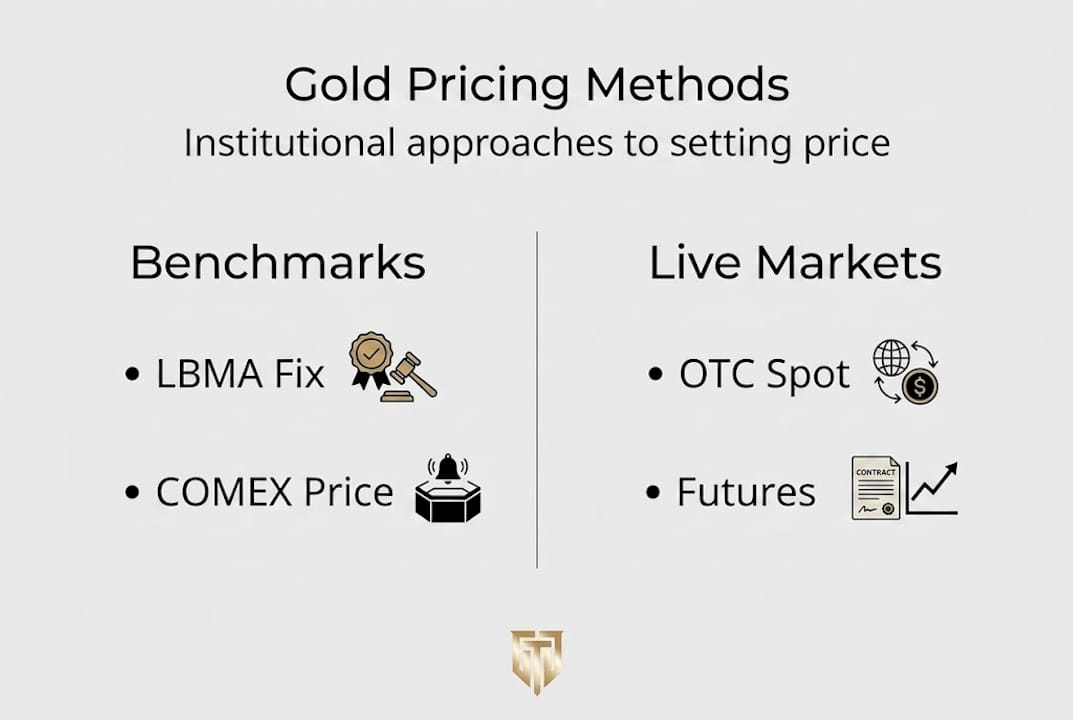
The most important of these is the LBMA Gold Price, administered twice daily in London. Institutional gold pricing for large trades typically references the LBMA Gold Price benchmark as a global settlement anchor. The morning fix occurs at 10:30 AM London time, and the afternoon fix at 3:00 PM. Both are administered by ICE Benchmark Administration (IBA), which replaced the older telephone-based fixing system in 2015 with an electronic, auditable auction process.
The IBA process works through a round-based auction involving accredited direct participants, mostly major bullion banks. Each round, participants submit buy and sell volumes. The auction continues until volumes balance within a defined tolerance. The resulting price is published and used globally for contracts, ETF valuations, central bank reserves reporting, and physical delivery pricing.
“The LBMA Gold Price is the de facto global reference for institutional gold transactions, particularly for unallocated gold delivered in London. Its twice-daily fixing creates a transparent, auditable anchor that most large trades reference directly.”
Beyond the LBMA, the CME Group’s COMEX futures exchange in New York also plays a critical role. While COMEX prices reflect forward expectations and are highly liquid, they are denominated in troy ounces and USD and serve primarily as hedging and derivatives pricing instruments rather than physical settlement benchmarks.

Here is how the two main institutional gold pricing benchmarks compare in structure:
| Feature | LBMA Gold Price | COMEX Futures |
|---|---|---|
| Frequency | Twice daily (AM/PM) | Continuous |
| Administration | ICE Benchmark Administration | CME Group |
| Primary use | Physical settlement, reporting | Hedging, derivatives |
| Currency | USD per troy ounce | USD per troy ounce |
| Delivery basis | Unallocated gold, London | Futures contracts, NY |
| Participant access | Direct participants, banks | Broad exchange access |
Key characteristics that distinguish benchmark pricing from real-time market quotes include:
- Auditability: Benchmarks produce a documented, time-stamped reference that satisfies regulatory and reporting requirements.
- Finality: Once published, a benchmark rate is fixed. It cannot be renegotiated, making it ideal for large trade settlement.
- Global recognition: Counterparties in Asia, Europe, and the Americas all accept LBMA as a neutral pricing authority.
- Lagged reflection: Because benchmarks are set at specific times, they may not reflect price movements that occur in the hours between fixings.
For institutions managing large trades, aligning execution to institutional trading standards around benchmark pricing is not just best practice. It is increasingly a compliance expectation.
Real-time market quotes: microstructure and influences
While benchmarks offer structured, time-stamped reference points, real-time gold market quotes operate on a completely different logic. Real-time market quotes are continuous and influenced by broader market microstructure across OTC and derivatives venues, meaning they shift second by second in response to live trading activity.
The over-the-counter (OTC) market in London is the dominant venue for spot gold trading globally. Trades here are bilateral, negotiated directly between counterparties, and settled through the LBMA’s clearing system. Spot prices quoted in the OTC market reflect current supply and demand in real time, and spreads, the gap between bid and ask, vary significantly based on trade size, counterparty credit, and current liquidity conditions.
For institutional investors, this microstructure matters enormously. A $5 million gold trade might execute at a spread of $0.20 per ounce. A $200 million trade, depending on current liquidity, could see spreads widen considerably, particularly during periods of market stress. Experienced institutional desks monitor depth of market data, not just the quoted spot price, to assess true execution cost.
| Price Type | Update Frequency | Driven By | Best For |
|---|---|---|---|
| OTC Spot Quote | Continuous | Active market participants | Spot deals, immediate settlement |
| COMEX Futures | Continuous | Exchange order flow | Hedging, exposure management |
| LBMA AM Fix | Once daily (10:30 AM London) | IBA auction | Morning settlement reference |
| LBMA PM Fix | Once daily (3:00 PM London) | IBA auction | Afternoon settlement reference |
Macroeconomic drivers that move real-time gold prices include:
- Central bank activity: When major central banks announce rate decisions or reserve shifts, gold reacts immediately. Central bank net purchases hit 1,136 tonnes in 2022, a record that sent a strong signal to institutional buyers.
- Currency dynamics: Gold is priced in USD, so dollar strength or weakness creates inverse price movements that are particularly sharp in real-time quotes.
- Geopolitical events: Armed conflicts, sanctions regimes, and trade disruptions create sudden demand spikes that hit OTC quotes before they reach any benchmark.
- Derivatives positioning: Large shifts in COMEX open interest or ETF flows can lead or follow spot price movements, creating feedback loops that institutional desks must track.
For those wanting to track these shifts, live gold price insights provide the kind of real-time visibility needed to manage intraday exposure. Understanding OTC gold trading mechanics is equally important for institutions operating outside exchange-traded structures.
Statistic callout: Gold’s average daily trading volume in the London OTC market regularly exceeds $50 billion, making it one of the deepest commodity markets in the world, yet liquidity is not uniformly distributed across the trading day.
Comparing pricing methods: benchmarks vs. live markets
Now that both pricing mechanisms are clear, the practical question is: which one should institutional investors use, and when? The answer depends on trade purpose, size, counterparty requirements, and risk tolerance.
Benchmark pricing is used as a global reference for unallocated gold delivered in London, which makes it the default for large physical trades requiring a clear, auditable settlement reference. Live market pricing, by contrast, offers immediacy but introduces execution risk, particularly for large positions that can move the market during the trade.
| Factor | Benchmark Pricing | Live Market Pricing |
|---|---|---|
| Price certainty | High (published at fixed time) | Low (changes second by second) |
| Execution risk | Low | Higher for large trades |
| Auditability | Excellent | Varies by venue |
| Flexibility | Limited to fix times | Continuous |
| Best for | Large settlements, reporting | Spot deals, hedging |
| Market impact | None (single published rate) | Possible for large orders |
Choosing between the two involves understanding several key trade-offs:
- Settlement clarity: Benchmark pricing eliminates ambiguity. Both parties reference the same published rate, reducing post-trade disputes and simplifying reconciliation for large institutions.
- Timing risk: Committing to the LBMA PM fix price means accepting whatever rate the auction produces at 3:00 PM London time. If gold rallies sharply beforehand, buyers may pay more than anticipated.
- Market impact for large trades: Executing a 10-tonne physical purchase in the live OTC market carries real market impact risk. Benchmark pricing sidesteps this because the fix rate absorbs the trade in an auction context.
- Hedging alignment: For institutions using COMEX futures to hedge physical positions, live market pricing aligns better with derivatives mark-to-market processes.
- Regulatory reporting: Many jurisdictions require fund administrators to use recognized benchmark rates for NAV calculations, making LBMA the only compliant option in certain structures.
Pro Tip: Always specify in your trade confirmation whether settlement references the LBMA AM or PM fix, or a live market quote at a defined timestamp. Ambiguity in pricing terms is one of the most common sources of institutional gold trade disputes.
For a deeper understanding of execution structures, the institutional gold trading guide covers settlement mechanics in detail. Separately, reviewing key institutional trading factors will help teams build a complete decision framework around pricing method selection.
Optimizing gold pricing for institutional strategies
Institutional investors reference gold pricing models and benchmarks to optimize transaction efficiency and risk exposure, but optimization goes well beyond simply choosing a benchmark or a live quote. The most sophisticated desks integrate pricing mechanism selection into their broader trade strategy from the outset.
Here is how institutions approach gold pricing optimization in practice:
- Venue selection based on order size: Trades under 500 ounces can typically execute at tight OTC spreads without material market impact. For orders above 2,000 ounces, referencing the LBMA fix or splitting execution across multiple sessions reduces impact cost significantly.
- Timing trades around liquidity windows: The hour before and after the London AM and PM fixes sees the highest liquidity in OTC gold markets. Institutions that time large block trades to coincide with these windows tend to achieve better execution quality.
- Hedging with a layered approach: Rather than hedging an entire gold position at once, sophisticated investors use a combination of benchmark-referenced forwards and live-market COMEX futures to balance price certainty with flexibility.
- Counterparty credit management: In the OTC market, pricing is also a function of counterparty creditworthiness. Institutions with strong credit profiles often negotiate tighter spreads, effectively lowering their all-in acquisition cost.
- Documentation and audit trails: Using benchmark rates creates clean audit trails for compliance and investor reporting. This is particularly relevant for regulated funds and sovereign wealth vehicles.
Pro Tip: When structuring a large physical gold purchase for settlement, consider referencing both the LBMA PM fix for the bulk and a live OTC rate for a smaller tranche. This hybrid approach gives you a blended price that reduces timing risk while preserving auditability for the major portion of the trade.
Statistic callout: Institutions that align at least 70% of their gold settlement to benchmark pricing report significantly fewer post-trade reconciliation issues compared to those relying solely on live market quotes, based on typical operational patterns in large bullion bank clearing operations.
A practical case: consider a family office acquiring 500 kilograms of physical gold for custody transfer. Referencing the LBMA PM fix on a defined settlement date gives both buyer and seller a neutral, undisputed price. The buyer locks in a known rate, the seller can hedge forward, and the trade closes without negotiation over intraday price movements. This structure is also easier to explain in investor reports and satisfies most regulatory disclosure requirements.
For those building out their approach, optimizing gold transactions covers practical execution frameworks in detail. You can also explore the gold trading benefits that come from disciplined pricing strategy, particularly in volatile market environments.
The misunderstood nuances of gold pricing in institutional markets
After years of working with institutional gold trades, what strikes us most is how often even experienced investors conflate the spot price they see on a screen with the effective price they will actually pay or receive on a large transaction. These are genuinely different numbers, and the gap between them, when unmanaged, can erode returns that took months to build.
The deeper issue is that gold pricing is not just a market mechanics question. It shapes deal structure, risk disclosure, and financial reporting in ways that are often overlooked until a trade settles at an unexpected rate. We have seen sophisticated investors express surprise at post-fix settlement prices simply because they did not ask, upfront, which pricing mechanism their counterparty was referencing.
Our advice, drawn from consistent execution in physical gold markets: treat pricing term clarification as a non-negotiable part of trade initiation. Before any significant position is taken, confirm whether settlement references the LBMA AM fix, PM fix, or a live OTC quote at a specific time. This single discipline, outlined in detail through step-by-step gold trading resources, eliminates the most common source of institutional pricing friction.
Explore gold investment solutions with Galami Gold
Applying these pricing insights to real trades requires more than theoretical knowledge. It requires partners with the operational infrastructure and market access to execute with precision.

Galami Gold provides institutional gold trading and physical supply solutions built on transparent pricing practices, disciplined execution, and deep supply chain integrity. Whether you are structuring a benchmark-referenced settlement or managing live-market exposure across a complex position, our team brings the operational rigor that sophisticated investors expect. Explore our approach to bullion trading in Dubai or review our full gold investment risk disclosure to understand how we manage exposure across all transaction types. Reach out to begin the conversation.
Frequently asked questions
What is the LBMA Gold Price benchmark and why is it important?
The LBMA Gold Price benchmark is a globally recognized reference rate for unallocated gold delivered in London, administered twice daily by ICE Benchmark Administration and used widely for trade settlement, ETF valuation, and reserve reporting.
How are real-time gold market quotes determined?
Real-time gold prices are driven by continuous bilateral trades in OTC and derivatives markets, where supply, demand, currency movements, and macroeconomic events all interact to move quotes second by second.
Is benchmark or live market pricing better for institutional trading?
Large physical trades and regulated settlement typically favor LBMA benchmark pricing for its auditability and price certainty, while spot deals and hedging strategies often benefit from the flexibility of live market quotes.
Which factors most affect gold prices for institutional investors?
Gold pricing is shaped by supply and demand fundamentals, central bank reserve activity, macroeconomic conditions including inflation and interest rates, geopolitical risk, and the liquidity characteristics of the venue where a trade executes.
Recommended
- Bullion Explained: A Practical Guide for U.S. Investors
- Top Institutional Gold Trading Benefits | Galami Gold
- What is OTC gold trading: A guide for institutional investors
- Gold Trade Settlement Explained for Investors and Traders
Ready to invest in physical gold trade finance?
Both the Zambia–Dubai and Sierra Leone–Dubai programs are open to qualified investors. Minimum investments from $115,000 USD or €125,000 EUR.
Zambia–Dubai Program Sierra Leone–Dubai Program