
TL;DR:
- Gold’s average daily trading volume of $163 billion rivals major liquid assets like US Treasury bills.
- Liquidity depends on format and is built through auctions, OTC trades, and futures markets.
- Physical gold offers high long-term liquidity with low counterparty risk, but slower to execute.
Gold sees more daily trading volume than most major currencies, yet institutional investors still treat it like a slow, cumbersome physical asset. That gap between perception and reality is expensive. Daily gold trading volume averages around $163 billion, placing it firmly alongside the most liquid instruments in global finance. For institutional investors and wealth managers, understanding what drives that liquidity, how to access it, and where the traps are hidden is not optional. It is foundational to executing trades efficiently, managing portfolio risk, and deploying capital with confidence in the precious metals space.
Table of Contents
- Defining gold liquidity: What it means and why it matters
- Core mechanisms: How gold is traded and liquidity is built
- Liquidity benchmarks: Daily volumes, market depth, and stress periods
- Nuances: Physical vs paper gold, redemption risk, and liquidity traps
- A practical institutional take: What actually works for portfolio execution
- Connect with reliable gold liquidity solutions
- Frequently asked questions
Key Takeaways
| Point | Details |
|---|---|
| Gold liquidity defined | Gold liquidity means trading large volumes with minimal price movement. |
| Trading channels | Deep liquidity comes from LBMA auctions, COMEX futures, OTC bilateral trades, and ETFs. |
| Benchmarks matter | Gold outpaces major currencies in trading volume, reaching $163bn per day. |
| Physical vs paper gold | Physical gold is best for long-term security, while ETFs offer speed and flexible exposure. |
| Institutional strategy | Smart institutions use gold liquidity to rebalance portfolios and manage risks efficiently. |
Defining gold liquidity: What it means and why it matters
Gold liquidity is not simply about whether you can sell gold. It is about whether you can buy or sell large volumes without moving the price against you. More precisely, gold liquidity refers to the ease with which gold can be bought or sold in large volumes without price disruption. That distinction matters enormously for institutions managing multi-hundred-million-dollar positions.
For institutional investors, liquidity is a practical tool. It enables rapid portfolio rebalancing when macro conditions shift, supports risk control during volatility spikes, and allows precise execution without the slippage that plagues less liquid assets. These are not abstract benefits. They translate directly into better entry and exit pricing, lower transaction costs, and faster capital recycling.
A common misconception is that gold, as a physical asset, behaves like real estate or private equity, meaning slow to transact and difficult to scale. That is simply wrong. Gold rivals US Treasury bills for execution liquidity and outpaces many major currency pairs in daily turnover. The institutional gold trading benefits extend well beyond a store of value narrative.
Gold liquidity is accessible across multiple formats, each with distinct characteristics:
- Spot gold: Immediate settlement, typically within two business days, traded over the counter or via exchanges
- Gold futures (COMEX): Standardized contracts, high volume, excellent for short-term positioning and hedging
- Gold ETFs: Exchange-traded, intraday liquidity, but subject to fund mechanics and redemption structures
- OTC (over-the-counter) gold: Bilateral trades between institutions and bullion banks, often the deepest liquidity for large transactions
Gold’s average daily trading volume of approximately $163 billion in 2023 places it among the most liquid instruments in global markets, rivaling the liquidity of US Treasury bills and surpassing many major equity indices.
Understanding which format to use, and when, is the first practical skill any institutional investor needs when working with gold.
Core mechanisms: How gold is traded and liquidity is built
Gold liquidity does not appear from nowhere. It is built through interconnected trading systems, each serving different institutional needs. The two primary price-setting mechanisms are the LBMA (London Bullion Market Association) auction system and the COMEX futures exchange.
The LBMA twice-daily auctions balance large institutional orders and set global benchmark prices. COMEX, based in New York, offers standardized futures contracts in 100-ounce increments, providing high-frequency trading access and transparent order books.
Here is how a typical LBMA auction works for institutional participants:
- Participating banks submit buy and sell orders at a proposed starting price
- The auction chair adjusts the price iteratively until supply and demand balance
- The resulting price becomes the globally recognized benchmark
- Settlement occurs through allocated or unallocated accounts held at bullion banks
- Large orders can be absorbed without public market impact due to the bilateral structure
Beyond auctions, the OTC market is where the real institutional volume lives. Bilateral trades between major banks and their clients allow for customized size, settlement terms, and pricing. You can learn more about how OTC gold trading structures work and why they are preferred for block transactions.
| Format | Liquidity depth | Execution speed | Counterparty risk | Best use case |
|---|---|---|---|---|
| Physical gold | High for large trades | Slower | Low (allocated) | Long-term holdings |
| Gold ETFs | High intraday | Very fast | Moderate | Tactical exposure |
| COMEX futures | Very high | Very fast | Low (cleared) | Hedging, short-term |
| OTC bilateral | Deepest for blocks | Fast | Moderate to low | Large institutional trades |
For a deeper look at how physical settlement actually works, the physical gold trading mechanics behind allocated accounts and vault logistics are worth understanding before committing capital.
Pro Tip: Match your execution route to transaction size and urgency. For trades under $10 million, ETFs or futures offer speed. For block trades above $50 million, OTC bilateral channels typically deliver better pricing and less market impact.
Liquidity benchmarks: Daily volumes, market depth, and stress periods
Numbers tell the real story. In 2023, average daily gold trading volume reached approximately $163 billion, with LBMA-reported weekly turnover approaching $1 trillion. These are not niche market figures. They are systemic.

$163 billion. That is gold’s average daily trading volume, placing it ahead of most individual equity markets and comparable to the most traded currency pairs globally.
How does gold stack up against other major asset classes?
| Asset | Avg daily volume | Liquidity profile | Crisis behavior |
|---|---|---|---|
| Gold | ~$163bn | Deep, global, 24-hour | Resilient, often improves |
| EUR/JPY | ~$60bn | High, FX-driven | Volatile, can thin rapidly |
| DJIA equities | ~$25bn | High during sessions | Can gap down sharply |
| US T-bills | ~$500bn+ | Deepest globally | Flight-to-quality anchor |
Gold does not match T-bills in raw volume, but it significantly outpaces most other instruments. More importantly, gold’s liquidity profile during market stress is a key differentiator. Understanding gold benefits for portfolio growth during volatility cycles helps explain why central banks and sovereign wealth funds hold it as a core reserve asset.
Factors that influence gold liquidity across market conditions:
- Normal markets: Deep OTC activity, active futures markets, strong ETF flows, and LBMA auction participation all contribute to consistent depth
- Stressed markets: Equity correlations drop, gold demand rises as a safe haven, and OTC bilateral volumes often increase as institutions seek direct execution
- Extreme stress: ETF redemptions can slow, unallocated positions may face friction, but allocated physical gold and spot OTC markets remain functional
- Geopolitical events: Gold liquidity often strengthens as demand spikes, though bid-ask spreads can widen temporarily
The resilience of gold liquidity in stress periods is not accidental. It reflects gold’s structural role as a global reserve asset with no single issuer and no credit risk. That is a feature, not a coincidence.
Nuances: Physical vs paper gold, redemption risk, and liquidity traps
Not all gold liquidity is equal. The format you hold determines both your execution options and your risk exposure. Allocated physical gold provides long-term liquidity with no counterparty risk, while ETFs offer speed but can involve redemption friction, particularly in stressed conditions.
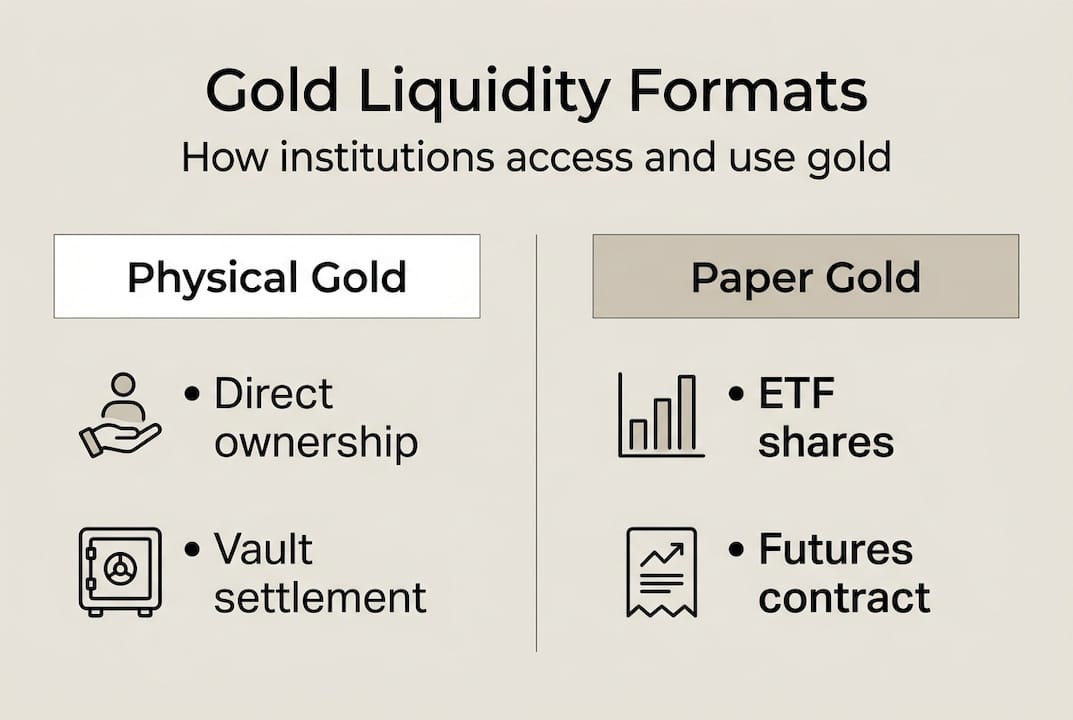
Allocated gold means specific bars are registered in your name at a vault. You own the metal outright. Unallocated gold, by contrast, is a claim on a bullion bank’s gold pool. ETFs are shares in a fund that holds gold. Each has a different liquidity and risk profile.
Physical (allocated) gold:
- No counterparty risk
- Ideal for long-term institutional reserves
- Slower execution due to logistics and settlement
- Best suited for strategic holdings, not tactical trading
Paper gold (ETFs and unallocated):
- Fast intraday execution
- Subject to fund redemption mechanics and potential friction
- Counterparty exposure to the fund or bullion bank
- Excellent for tactical positioning but not a substitute for physical ownership
Redemption risk is real. During the March 2020 market dislocation, some gold ETFs temporarily traded at discounts to net asset value, meaning the paper price diverged from physical gold prices. Institutions holding unallocated positions faced delays in converting to physical metal.
For a thorough review of gold investing risks and practices, including how to structure holdings to avoid liquidity traps, it is worth building an internal framework before scaling exposure. Understanding why gold matters for institutions in 2026 also helps contextualize these structural differences.
Pro Tip: Never assume ETF liquidity equals physical gold liquidity. In normal markets, the gap is small. In stress, it can be significant. Structure your gold allocation so that tactical exposure uses ETFs or futures, while strategic reserves are held in allocated physical form.
A practical institutional take: What actually works for portfolio execution
Here is what most gold liquidity articles skip: the practical tradeoffs that actually show up in execution.
Bullion-backed ETFs and spot gold are the workhorses for institutional liquidity. They offer the best blend of execution speed, pricing transparency, and scalability. For most portfolio management functions, including rebalancing, hedging, and tactical shifts, these instruments deliver. Physical gold is critical for long-term wealth preservation and reserve functions, but it slows execution when speed matters.
Most experienced institutional investors steer clear of gold mining stocks when they want gold liquidity. Mining equities carry operational risk, management risk, and equity market correlation that dilutes the pure gold exposure. They are a different asset class wearing gold’s name.
For optimizing gold transactions at scale, the practical answer is layered: use OTC bilateral channels for block trades, ETFs for tactical speed, and allocated physical for reserves. As research confirms, institutions favor bullion-backed ETFs and spot for liquidity, minimizing operational risks and bypassing mining-exposed vehicles. That is not a conservative view. It is the result of years of execution experience across market cycles.
Connect with reliable gold liquidity solutions
Understanding gold liquidity at this level puts you ahead of most market participants. Putting it into practice requires the right execution infrastructure.

Galami Gold provides audited, high-liquidity institutional gold trading built on transparent supply chains and disciplined execution. Whether you are structuring a new allocation or optimizing an existing position, Galami Gold’s platform connects you with the tools and expertise to execute with confidence. Review the risk disclosure to understand the full framework before engaging. Our team is ready to support institutions seeking reliable, scalable gold liquidity solutions that align with their portfolio objectives.
Frequently asked questions
How is gold liquidity measured?
Gold liquidity is typically quantified by daily trading volume and the ability to execute large trades with minimal price impact. Average daily volume reached approximately $163 billion in 2023, making it one of the most measurable and transparent liquidity metrics in global markets.
Why do institutional investors care about gold liquidity?
Institutional investors rely on gold liquidity to rebalance portfolios quickly, manage risk efficiently, and gain pure precious metal exposure without operational delays. Gold’s execution liquidity rivals US Treasury bills, making it a practical tool for large-scale portfolio management.
What happens to gold liquidity in market stress?
Gold liquidity remains deep during normal times and is typically sourced from broader OTC and futures markets during stress. However, ETF redemptions and unallocated gold positions can face friction, as seen during the March 2020 dislocation when paper gold briefly diverged from physical prices.
Is physical gold as liquid as ETFs or futures?
Physical allocated gold is highly liquid for large institutional trades but involves slower execution and logistics compared to ETFs or futures. Allocated physical gold is best suited for strategic reserves, while ETFs and futures serve tactical and short-term execution needs.
Recommended
- Top institutional gold trading benefits for portfolio growth
- Gold Market News & Analysis | Galami Gold Blog
- Step by Step Gold Transaction Process: 2026 Guide
- Bullion Explained: A Practical Guide for U.S. Investors
Ready to invest in physical gold trade finance?
Both the Zambia–Dubai and Sierra Leone–Dubai programs are open to qualified investors. Minimum investments from $115,000 USD or €125,000 EUR.
Zambia–Dubai Program Sierra Leone–Dubai Program