
What gold aggregators actually do in Ghana’s gold supply chain
Gold aggregators are licensed entities authorized under Ghana’s Gold Board Act, 2025 (Act 1140) to purchase and consolidate gold exclusively from licensed small-scale miners and approved Tier 1 and Tier 2 buyers, then supply that gold onward to the Ghana Gold Board, known as GoldBod. They sit at the center of Ghana’s formal gold market, acting as the critical link between thousands of artisanal and small-scale mining (ASM) operators and the state’s sole authorized purchasing authority.
The aggregator model is not simply a middleman arrangement. GoldBod provides seed financing to aggregators, and in return, every gram that passes through the system is documented, assayed, and traceable. That traceability is the whole point. Ghana’s gold sector had long suffered from fragmented, informal trade that bled value out of the country through smuggling and underreporting. The aggregator framework closes that gap by funneling production through a controlled, state-backed channel.
Two companies have received aggregator licenses so far: Bawa Rock Limited, the first, and IB Impex Limited, the second. Their licensing signals GoldBod’s deliberate, selective rollout of a framework designed for quality over quantity.
The core functions of a licensed aggregator include:
- Purchasing gold at official prices set and published by GoldBod
- Consolidating supply from licensed miners and Tier 1 and Tier 2 buyers within approved geographic areas
- Maintaining a registered, up-to-date list of all licensed traders in their aggregation network
- Submitting monthly transaction reports covering all purchases, assay results, and sales
- Operating full anti-money laundering (AML) and know-your-customer (KYC) compliance programs
- Receiving and deploying GoldBod seed financing to fund gold purchases
- Channeling all consolidated gold into Ghana’s national purchasing and reserve program
Aggregator license requirements under the Ghana Gold Board Act 2026
Getting an aggregator license is not straightforward, and that is by design. GoldBod’s selective approach means only financially sound, institutionally credible firms qualify. The Ghana Gold Board Act 2025 (Act 1140) sets out the legal framework, and the licensing conditions add further layers of scrutiny.
The key requirements applicants must satisfy:
- Ghanaian ownership: The entity must be Ghanaian-owned, reflecting the Act’s repeal of the prior regime that allowed foreign-held entities to trade in gold and precious metals.
- Demonstrated working capital: Applicants must prove substantial working capital through historical bank statements, not projected figures. GoldBod wants evidence of actual financial capacity, not aspirational numbers.
- Three-year trading history: A documented track record of at least three years in relevant commercial activity is required.
- Bank guarantees: Applicants must furnish an Advance Payment Guarantee backed by a recognized financial institution, along with counter-indemnity arrangements.
- Tax and SSNIT clearances: Valid tax clearance certificates and Social Security and National Insurance Trust (SSNIT) compliance documentation are mandatory.
- Fit-and-proper tests for executives: Directors and senior officers undergo rigorous vetting, including police clearance reports and full disclosure of business interests.
The table below summarizes the core licensing criteria and their legal basis:
| Requirement | Details | Legal Basis |
|---|---|---|
| Ghanaian ownership | Entity must be Ghanaian-owned | Ghana Gold Board Act 2025, Act 1140 |
| Working capital proof | Historical bank statements showing substantial capital | GoldBod Aggregator License Conditions |
| Trading history | Minimum three years of documented commercial activity | GoldBod Aggregator License Conditions |
| Bank guarantee | Advance Payment Guarantee with counter-indemnity from recognized institution | GoldBod Aggregator License Conditions |
| Tax clearance | Valid Ghana Revenue Authority tax clearance certificate | Ghana Gold Board Act 2025, Act 1140 |
| SSNIT clearance | Current SSNIT compliance certificate | Ghana Gold Board Act 2025, Act 1140 |
| Executive vetting | Police reports and business interest disclosures for all directors | GoldBod Aggregator License Conditions |
| Know-your-supplier | Registered list of licensed traders submitted to GoldBod | GoldBod Aggregator License Conditions |
Once licensed, aggregators face ongoing obligations. Monthly reporting of all gold purchases, assay results, and transaction records must be submitted to GoldBod in prescribed formats. Non-compliance can trigger suspension or full revocation of the license under Act 1140. The licensing structure, which also covers refining, transport, export, and storage, creates what amounts to a closed compliance system designed to minimize value leakage at every point in the chain.
Pro Tip: If you are evaluating whether to apply for an aggregator license, start building your compliance documentation well before the application window. GoldBod requires historical bank statements, not projections, so a three-year paper trail of financial activity is non-negotiable from day one.
How aggregators function within Ghana’s gold supply chain
The day-to-day operation of a licensed aggregator involves more than buying and selling gold. Aggregators function as compliance nodes, price-enforcement points, and data-collection hubs within the supply chain.

When a licensed small-scale miner brings gold to an aggregator, the transaction must be recorded on official GoldBod receipts that capture weight, assay results, transaction value, and the seller’s identity. The aggregator purchases at the official price GoldBod publishes, which is linked to international spot market rates. No negotiating below the official rate, no informal side deals. That price discipline is what the system is built on.
Aggregators also carry a network management responsibility that goes beyond their own transactions. They must maintain and regularly update a registered list of all licensed traders operating within their aggregation structure, submitting that list to GoldBod upon licensing and whenever changes occur. This “know your supplier” obligation means aggregators are accountable not just for their own conduct but for the compliance status of every entity feeding into their network.
The interaction between aggregators and GoldBod runs in both directions. GoldBod provides seed financing to fund gold purchases, which reduces the capital burden on aggregators and keeps the formal system competitive against informal buyers who often offer cash on the spot. In return, aggregators supply consolidated, documented gold that flows directly into Ghana’s national purchasing program and reserve accumulation efforts.
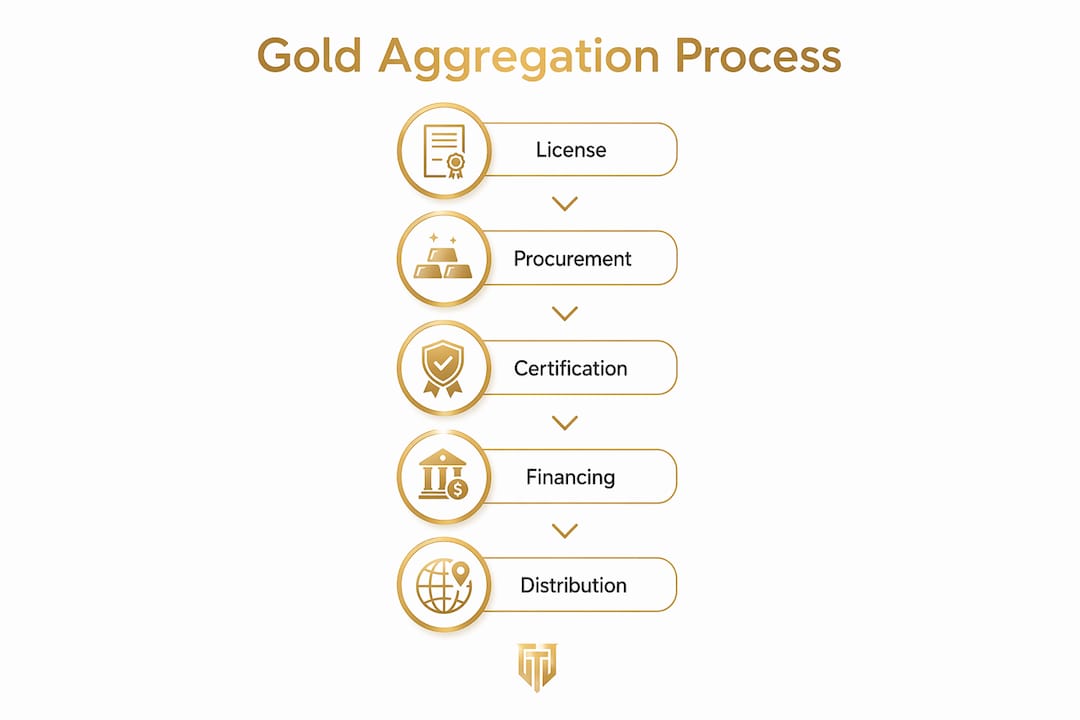
The broader supply chain impact is measurable. By replacing fragmented, informal markets with a transparent, state-backed channel, the aggregation model reduces the opportunity for smuggling and ensures that royalties and taxes are captured at the point of purchase rather than lost to informal export routes. For evaluating gold traders in this environment, understanding whether a counterparty operates within this formal framework is the single most important due diligence question.
How the aggregation model affects Ghana’s gold market and economy
Ghana’s gold aggregation framework is explicitly modeled after COCOBOD’s centralized cocoa pricing and marketing system, adapted for gold’s continuous global price dynamics. The Business & Financial Times has analyzed this parallel in detail, noting that while COCOBOD stabilizes incomes through annual price announcements, GoldBod’s model uses daily pricing linked to international spot markets, making it more responsive but also more complex to manage.
The economic effects of the aggregation model span several dimensions:
- National gold reserve growth: The Bank of Ghana’s gold-backed reserves grew significantly in 2025, directly supported by GoldBod’s formalization efforts.
- Foreign exchange inflows: Sustained ASM formalization could generate substantial annual revenue in legitimate gold exports, according to analysis of the aggregation model’s potential.
- Fiscal revenue: Tax and royalty compliance from the formal ASM sector could contribute substantial fiscal revenues yearly.
- Rural income stability: With millions of people directly engaged in ASM, structured aggregation provides fairer, market-linked pricing that replaces exploitation by informal middlemen.
- Currency stabilization: Increased gold reserves strengthen the Bank of Ghana’s capacity to manage the cedi and control inflationary pressure.
- Reduced smuggling: Transparent, official pricing removes the price gap that informal buyers exploit, keeping gold within the domestic formal economy.
Key statistic: The Bank of Ghana’s gold reserves reached 37.06 tonnes in September 2025, a 21.3% increase from early 2025, driven by GoldBod’s aggregation and formalization program.
The GoldBod model’s macroeconomic lever is arguably stronger than COCOBOD’s because gold is a monetary asset. Every tonne accumulated in national reserves directly reinforces foreign-exchange stability and sovereign creditworthiness, not just rural income. That distinction shapes how Ghana’s government, the Bank of Ghana, and international financial institutions view the aggregation framework’s long-term value.
Galamigold’s perspective on gold aggregation and trading
Galamigold operates at the intersection of physical gold trading, disciplined capital deployment, and supply chain integrity, which makes Ghana’s aggregation framework directly relevant to how sophisticated market participants think about sourcing, compliance, and risk.
From Galamigold’s vantage point, the aggregation model represents exactly the kind of structural formalization that separates credible gold supply chains from opaque ones. Several operational realities stand out:
- Traceability is a trading prerequisite. Gold that cannot be traced from mine to aggregator to refiner carries reputational and regulatory risk that institutional buyers will not accept. The GoldBod framework addresses this directly.
- Price transparency reduces counterparty risk. When aggregators purchase at published official prices, the arbitrage opportunities that fuel informal markets shrink. That price discipline benefits every participant in the formal chain.
- Compliance depth signals institutional quality. The fit-and-proper tests, bank guarantees, and monthly reporting requirements that GoldBod imposes on aggregators mirror the standards that institutional gold trading programs apply to their own counterparties.
- Seed financing changes the competitive dynamic. GoldBod’s provision of working capital to aggregators means the formal system can compete directly with cash-paying informal buyers, which was historically one of the biggest structural weaknesses of formalization efforts.
- Capital deployment discipline matters. Aggregators who deploy GoldBod seed financing carelessly face license revocation. The same principle applies in any gold trading program: capital deployed without documented controls is capital at risk.
Pro Tip: For businesses considering participation in Ghana’s formal gold market, aligning your AML compliance framework with GoldBod’s KYC and CDD requirements before engaging any aggregator is the fastest way to establish credibility with both the regulator and your trading counterparties.
The aggregation model also illustrates a broader principle Galamigold applies across its trading programs: transparency and disciplined execution are not constraints on profitability. They are the conditions that make sustainable profitability possible in regulated commodity markets.
Compliance challenges and enforcement mechanisms for gold aggregators
Compliance under the Ghana Gold Board Act 2025 is demanding, and the enforcement mechanisms are real. GoldBod holds the authority to suspend or revoke licenses for non-compliance, and the monthly reporting cycle means there is no long lag between a violation and its detection.
The most common compliance pressure points for aggregators involve the KYC and AML obligations. Aggregators must apply ongoing Know Your Customer, Customer Due Diligence, and Enhanced Due Diligence processes to every supplier in their network, consistent with Ghana’s Anti-Money Laundering Act, 2020 (Act 1044), the Anti-Terrorism Act, 2008 (Act 762), and directives from the Financial Intelligence Centre and the Bank of Ghana. Managing that obligation across a network of licensed small-scale miners, many of whom operate in remote areas with limited documentation infrastructure, is operationally intensive.
The licensed trader register adds another layer. Aggregators must not only maintain the list but update it whenever their network changes and submit updates to GoldBod on demand. A trader who loses their license but continues supplying an aggregator creates a compliance breach for the aggregator, not just the trader. That shared accountability structure pushes aggregators to actively monitor the licensing status of every entity they buy from.
Enforcement beyond license suspension includes GoldBod’s authority to conduct audits, inspect transaction records, and verify assay documentation. The official receipt system, which captures weight, assay results, transaction value, and seller identity for every purchase, creates a paper trail that auditors can cross-reference against monthly reports. Discrepancies between receipts and reports are the most direct route to regulatory action.
For businesses operating in or adjacent to Ghana’s gold sector, understanding these enforcement mechanisms is not optional. The integrity of financial reporting within the supply chain directly affects whether an aggregator retains its license and whether downstream buyers can rely on the provenance documentation they receive.
How gold aggregators manage risk and conduct due diligence
Risk management for a licensed aggregator is structured around one core obligation: verify every supplier, every time, and document it. The KYC and Enhanced Due Diligence requirements under Act 1140 are not a one-time onboarding exercise. They are ongoing, meaning an aggregator must continuously monitor the compliance status, licensing validity, and transaction behavior of every miner and buyer in its network.
Practically, this means aggregators need internal systems capable of tracking supplier license renewal dates, flagging unusual transaction volumes, and escalating suspicious activity to the Financial Intelligence Centre. Small aggregators working with dozens of suppliers face a manual burden that larger, better-capitalized firms can address with dedicated compliance teams or technology solutions.
The financial risk layer is equally significant. Aggregators deploy GoldBod seed financing to purchase gold, which means a default or fraud event in the supply chain creates a direct liability back to the state. The Advance Payment Guarantee requirement exists precisely to backstop that risk. If an aggregator cannot fulfill its supply obligations to GoldBod, the bank guarantee is called. That financial exposure gives aggregators a strong incentive to vet suppliers thoroughly before any purchase, not after a problem surfaces.
Assay risk is another practical concern. Gold purchased from small-scale miners can vary significantly in purity. Aggregators who pay at official prices without conducting independent assay verification before purchase expose themselves to losses when GoldBod’s assay results come back lower than the purchase price implied. Building reliable assay capacity, either in-house or through accredited third-party labs, is a core operational requirement rather than an optional upgrade.
What gold aggregation means for small-scale miners and local communities
The aggregation model’s most direct economic impact falls on the ASM sector itself. Small-scale miners who sell through licensed aggregators receive official GoldBod prices, which are published and linked to international spot rates. That is a meaningful shift from the informal market, where unlicensed buyers routinely paid well below market value, capturing the margin that should have gone to the miner.
Fair pricing has a compounding effect at the community level. When miners receive closer to market value for their production, more income stays in mining communities, supporting local spending, small business activity, and household investment. The ASM sector in Ghana involves over 5 million people directly, so even modest improvements in per-gram returns translate into broad income effects across rural economies.
Access to the formal system also opens doors that the informal market closes. Miners who sell through licensed aggregators build a documented transaction history, which can support applications for formal credit, equipment financing, and business registration. That documentation trail is one of the less-discussed but genuinely transformative aspects of formalization: it turns subsistence-level gold producers into participants in the formal economy.
The aggregation model also reduces the physical risk that informal gold trading creates in mining communities. Informal buyers operating outside the regulatory framework have historically been associated with price manipulation, debt bondage arrangements, and in some cases, connections to criminal networks that fund illegal mining. Channeling trade through licensed, GoldBod-supervised aggregators removes those actors from the supply chain, improving safety and economic predictability for miners and their communities. For anyone tracking capital deployment in gold trading, the formalization of ASM supply chains is one of the structural factors that makes Ghana’s gold sector increasingly attractive to institutional participants.
Key Takeaways
Ghana’s gold aggregation framework under the Gold Board Act 2025 creates a closed, traceable supply chain that formalizes ASM gold trade, enforces price transparency, and channels production directly into national reserves and fiscal revenues.
| Point | Details |
|---|---|
| Aggregator definition | Licensed entities authorized under Act 1140 to purchase, consolidate, and supply gold exclusively to GoldBod. |
| Licensing threshold | Applicants must prove Ghanaian ownership, three-year trading history, working capital via bank statements, and pass executive fit-and-proper tests. |
| Reserve growth | Ghana’s gold-backed reserves reached 37.06 tonnes in September 2025, up 21.3% from early 2025. |
| Compliance obligations | Monthly transaction reports, ongoing KYC and CDD for all suppliers, and a maintained licensed trader register are mandatory. |
| Community impact | Miners selling through aggregators receive official GoldBod spot-linked prices, replacing informal buyers who historically paid well below market value. |
Recommended
- Galami Gold — Physical Gold Supply & Bullion Trading | Dubai
- Zambia–Dubai Gold Trading Program | Galami Gold
- Sierra Leone–Dubai Gold Trading Program | Galami Gold
- Capital Deployment Guide to Gold for Institutional Investors
Ready to invest in physical gold trade finance?
Both the Zambia–Dubai and Sierra Leone–Dubai programs are open to qualified investors. Minimum investments from $115,000 USD or €125,000 EUR.
Zambia–Dubai Program Sierra Leone–Dubai Program