
An Exchange for Physical (EFP) in gold is a privately negotiated deal that swaps a COMEX futures position for an equivalent position in physical gold, or the reverse, without ever hitting the open market. Three facts matter before anything else. First, the LBMA governs the London physical and spot side of the trade, while CME Group and COMEX run the futures leg and set the registration rules. Second, the negotiated price never becomes public. Third, the trade volume does get reported to the exchange, which means analysts can see that EFP activity happened without ever knowing what price the two sides agreed on.
For a trader or allocator, that combination is the entire point. You get a large transaction executed off the tape, with the size still folded into official exchange statistics for surveillance purposes. That structure supports a short list of outcomes traders actually care about:
- Opening or closing a futures position without moving the visible market
- Converting unallocated physical gold into a futures hedge, or vice versa
- Capturing an arbitrage opportunity when spot and futures drift apart
- Transferring custody of physical metal as part of a larger portfolio rebalance
Key Takeaways
An EFP works because it lets institutions swap futures for physical gold privately while still reporting volume to the exchange, keeping size off the open market without sacrificing regulatory visibility.
| Point | Details |
|---|---|
| Definition stays consistent | An EFP is a privately negotiated swap of COMEX futures for physical gold, registered but not price-disclosed. |
| Reporting is split | Trade volume shows up in exchange totals; the negotiated price never becomes public. |
| Logistics drive spreads | Bar-size mismatches and refinery or transport bottlenecks, as seen in 2020, are what widen the EFP most sharply. |
| Watch the warning signs | A widening EFP alongside falling volume and open interest signals liquidity stress, not necessarily bullish demand. |
| Document everything | Confirm bar specs, custody, and counterparty credit before registering, since an EFP is bilateral risk first. |
| Galamigold’s role | Galamigold supports institutional clients needing custody, logistics, and execution discipline for physical–futures transactions like EFPs. |
Table of Contents
- How Does an EFP Work in the Gold Market?
- When Do Traders Actually Use a Gold EFP?
- How Do EFPs Move the Gold Spot–Futures Spread?
- What Do Exchanges Report on an EFP, and What Stays Private?
- What Are the Risks of Executing a Gold EFP?
- How Does an EFP Differ From an EFS or Cash Settlement?
- What Really Happened During the 2020 Gold EFP Blowout?
- When Should You Actually Consider an EFP?
- How Galami Gold Supports Institutional EFP Execution
- Where to Verify EFP Rules and Market Data
- Sources
- FAQ
How Does an EFP Work in the Gold Market?
An EFP starts as a handshake, not a screen trade. Two counterparties, often a bullion bank and a trading desk or refiner, negotiate the terms bilaterally before either side touches the exchange.
The sequence generally runs like this:
- Identify a counterparty. One side wants to convert futures exposure into physical gold (or the reverse), and finds a willing party on the other side of that need.
- Agree on quantity and location. The parties settle on an ounce amount and specify where the physical metal sits, commonly loco London, loco Zurich, or a COMEX-approved depository in the United States.
- Match the futures leg. They agree on the equivalent number of COMEX futures contracts that offset the physical quantity, adjusting for any basis difference between locations.
- Confirm logistics. Both sides lock down how the physical transfer or futures transfer will actually occur, including bar specifications and delivery timing.
- Register the trade with the exchange. The transaction gets reported to CME Group under its Exchange for Related Positions (EFRP) framework, which covers EFPs specifically.
Location matters more than most newcomers expect. Gold quoted “loco London” sits in London vaults, typically in 400 ounce Good Delivery bars, while COMEX delivery depositories in the US commonly work with 100 ounce or kilobar sizes. That mismatch is also why the “eligible vs registered” distinction trips people up: eligible gold meets COMEX purity and bar-size standards and sits in an approved depository, but registered gold has gone one step further, formally committed for delivery against a futures contract. A bar can be eligible for years without ever becoming registered.
CME Group enforces the registration requirement on the futures side, confirming that the reported trade meets its EFRP rules before it clears. The exchange records that the volume occurred; it does not record, or publish, the price the two parties agreed on.
Pro Tip: Draft your EFP confirmation documents with the exact bar serial numbers, refiner marks, and location terms before you approach the exchange for registration. Vague physical descriptions are the single most common reason registration gets delayed, and delays on a large EFP can leave one side carrying unwanted price exposure overnight.
When Do Traders Actually Use a Gold EFP?
EFPs solve a specific business problem: moving significant size without telegraphing intent to the entire market. A large order routed through the regular futures order book can move the price against the trader before the order even fills. An EFP sidesteps that entirely.
Hedging is the most common driver. A refiner holding large physical inventory can lay off price risk by taking the opposite futures position through an EFP, locking in a rate without ever selling the metal itself. A trading desk sitting on a futures position ahead of expiry can flip that into physical delivery obligations the same way.
Position switching covers the second major use case. Rather than closing a futures position on the open market and separately buying physical gold, a fund can execute both legs in a single EFP transaction, cutting execution risk and transaction costs.
Arbitrage and basis trading show up when the spot–futures spread stretches wide enough to make a privately negotiated swap worth the effort. Basis traders watch that spread closely, and an EFP is often the cleanest way to capture it without moving the market that created the opportunity in the first place.
A vault manager needing to rebalance holdings between London and New York without spooking the spot market. A hedge fund switching a large futures position into physical gold ahead of contract expiry to avoid a costly roll. A refiner locking in a price on freshly cast bars before they even leave the smelter. Each is a different reason to reach for the same mechanism.
Institutional desks also lean on EFPs to manage the basis exposure that naturally builds up when physical inventory is priced in one location and hedged in another, a dynamic common among trading desks working loco London gold against COMEX futures.
How Do EFPs Move the Gold Spot–Futures Spread?
EFPs are the connective tissue between London’s physical spot market and COMEX futures in New York. Under calm conditions, the spread between the two, commonly called the EFP itself, reflects nothing more exotic than financing costs, storage, insurance, and transport. It sits small and stable.
Heavy EFP demand changes that. When a wave of traders all want to convert futures into physical gold at once, and normal arbitrage channels can’t keep up, futures prices can detach from spot in either direction. That detachment is exactly what happened during the COVID-era gold market dislocation in March and April 2020.
Flights carrying gold between refining hubs and delivery points slowed sharply. Refineries in Switzerland, which process a large share of the world’s Good Delivery bars, closed temporarily under lockdown orders. COMEX vaults typically want 100 ounce bars and kilobars, while London holds mostly 400 ounce bars, and with refineries shut, that size conversion bottleneck had nowhere to go. The result was a spread nobody had seen in modern memory.
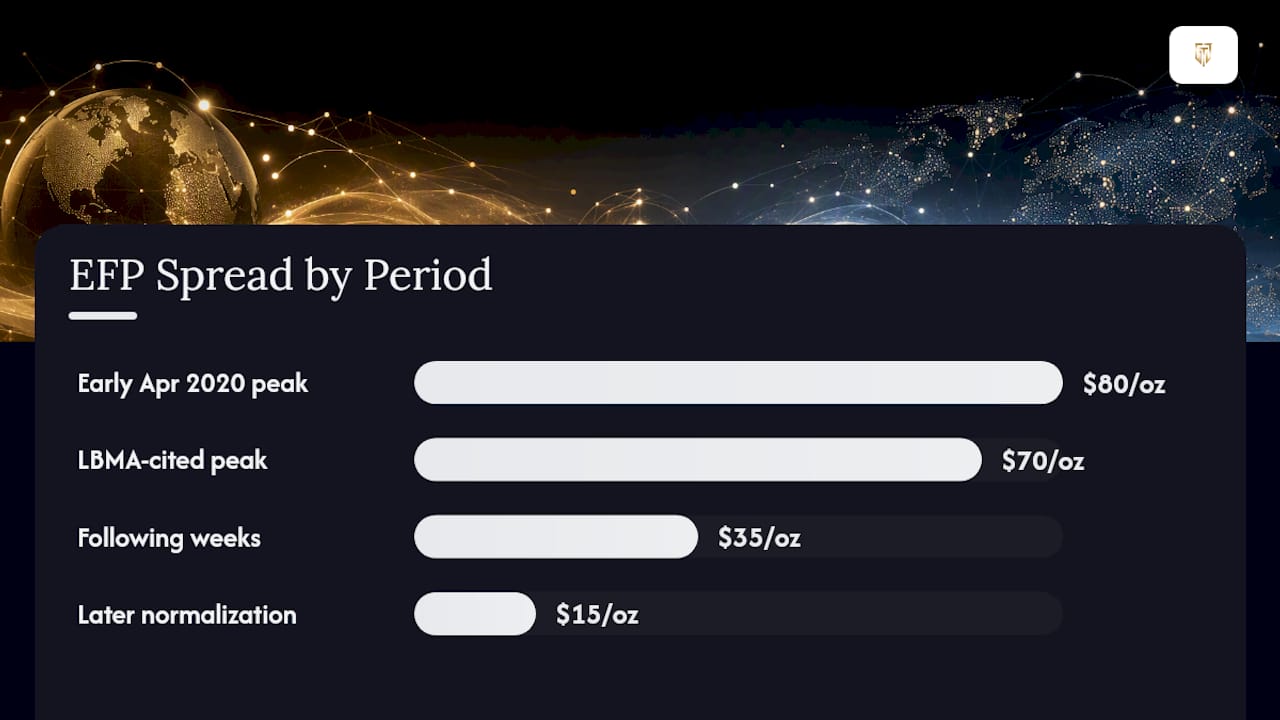
| Period | Reported EFP level | Primary driver |
|---|---|---|
| Early April 2020 (peak) | Roughly $80/oz above spot | Refinery closures, halted transatlantic transport |
| LBMA-cited peak | Around $70/oz | Same logistics bottleneck, London-side view |
| Following weeks | Roughly $35/oz | Partial refinery reopening, early arbitrage flows |
| Later normalization | Roughly $15/oz | CME’s expanded delivery contract, restored logistics |
The $80/oz peak came from constrained physical delivery, not from any change in gold’s underlying value. LBMA’s own account puts the comparable spike near $70/oz, a difference that mostly reflects timing and which side of the Atlantic was measuring.
A stretched EFP has a feedback effect that goes beyond the spread itself. When futures trade at a persistent premium to spot, that premium can pull spot prices upward through pure momentum, even where the physical arbitrage that would normally correct the gap is constrained by logistics rather than economics. That is precisely the liquidity signal sophisticated allocators watch for, since a wide EFP alongside falling volume and open interest tends to point at market structure stress rather than genuine bullish demand.
CME Group’s response was to introduce an expanded delivery contract accepting kilobars and 400 ounce bars alongside the standard 100 ounce specification, giving refiners and vaults more flexibility to satisfy delivery without a full re-casting cycle. That change, combined with reopened refineries and a slow return of transatlantic capacity, narrowed the spread over subsequent weeks, though market participants reported it took months before EFP levels returned to anything resembling normal.
What Do Exchanges Report on an EFP, and What Stays Private?
An EFP’s defining feature is the split between what becomes public and what does not. That split is deliberate, and understanding it is essential if you’re trying to read exchange data correctly.
- The occurrence of the trade and its volume gets folded into CME Group’s daily reported totals under EFRP rules.
- The negotiated price between the two counterparties is never disclosed to the exchange or the public.
- CME Group is the enforcing authority on the futures side, verifying the trade meets registration requirements before it clears.
- The LBMA provides the transparency layer on the physical and spot side, publishing market commentary and structural guidance that helps traders interpret London-market conditions alongside COMEX data.
For anyone doing market surveillance or basis analysis, that structure has a practical consequence: volume tells you activity is happening, but it tells you nothing about the price level at which risk changed hands. Two firms doing an EFP the same week could have priced it at meaningfully different levels depending on when in the day they negotiated, and the exchange print won’t show which one paid more.
This is by design rather than an oversight. CME Group’s own framework is built to preserve price confidentiality for the bilateral parties while still giving regulators and the wider market a signal that off-exchange risk transfer is occurring at scale. A quarter with unusually high EFP volume, even without visible pricing, is itself a data point worth flagging in any market-impact analysis.
What Are the Risks of Executing a Gold EFP?
EFPs move real risk, and the operational side deserves as much attention as the pricing logic.
Delivery logistics sit at the top of the list. Bar size mismatches between London’s 400 ounce Good Delivery standard and COMEX’s typical 100 ounce or kilobar specification can turn a straightforward physical leg into a weeks-long refining bottleneck, exactly what happened in 2020. Chain-of-custody documentation, transport scheduling, and refinery capacity all need confirming before the trade, not after.

Counterparty settlement risk is the second concern. An EFP is a bilateral agreement first and an exchange-registered trade second, which means the credit quality of the party on the other side of the deal matters more than it would on an anonymous exchange match.
Market risk shows up through exchange position limits and unexpected basis moves. A single large EFP can concentrate delivery pressure into a handful of COMEX vaults, and if several institutions try to deliver into the same location around the same expiry window, that pressure compounds fast.
A few compliance notes belong in the same conversation rather than a separate legal section: confirm your documentation matches exchange registration requirements before the trade, verify local market rules if the physical leg sits outside your home jurisdiction, and keep a copy of every confirmation in case of a later surveillance inquiry.
Watch for thin counterparties offering unusually favorable premiums, transport capacity that looks tighter than normal seasonal patterns would suggest, and any EFP level that has widened sharply without a clear operational explanation. Those three signals together are the closest thing to an early warning system this market offers.
How Does an EFP Differ From an EFS or Cash Settlement?
EFP sits inside a broader family of exchange-related position mechanisms, and mixing them up leads to real execution mistakes.
An Exchange for Swaps (EFS) works the same way as an EFP structurally, a private negotiation later registered with the exchange, but the underlying asset on one side is an OTC swap rather than physical metal. EFRP is the umbrella term CME Group uses to cover both EFPs and EFS trades along with a few related structures. Cash settlement closes a futures position for cash based on a reference price at expiry, with no physical delivery or private negotiation involved at all. Physical delivery through the standard COMEX delivery process moves metal against futures contracts through the exchange’s formal delivery notice system, a public, rules-based process rather than a negotiated one.
| Mechanism | Privately negotiated | Price made public | Typical use |
|---|---|---|---|
| EFP | Yes | No | Swap futures for physical gold or the reverse |
| EFS | Yes | No | Swap futures for an OTC swap position |
| Outright futures trade | No | Yes | Standard exchange-matched buy or sell |
| Cash settlement | No | Yes (settlement price) | Close a position at expiry for cash |
| Physical delivery (standard) | No | Yes (delivery notices published) | Formal exchange-run metal delivery process |
The choice between these usually comes down to what you’re trying to avoid. Traders reach for an EFP or EFS specifically to keep size off the visible order book; anyone comfortable with market impact, or needing full price transparency for reporting reasons, uses the outright futures market or standard COMEX delivery notices instead.
What Really Happened During the 2020 Gold EFP Blowout?
The COVID-era dislocation is the clearest real-world case study of how fragile the plumbing behind gold’s spot–futures link can get under stress.
- Onset (March 2020). Global lockdown orders shut major Swiss refineries and sharply cut transatlantic cargo capacity, right as the pandemic spooked markets into a flight toward safe assets including gold.
- Spike (late March through early April 2020). With refining capacity offline and standard 400 ounce London bars unable to convert into COMEX-compatible 100 ounce bars, the EFP spiked to roughly $80/oz above spot on the GoldPrice.org measure, with LBMA’s own figures putting the peak near $70/oz.
- Partial correction (April into May 2020). As refineries began reopening in stages and early arbitrage flows resumed, the spread came down to roughly $35/oz, still far above anything considered normal.
- Structural fix (2020). CME Group introduced its expanded delivery contract accepting kilobars and 400 ounce bars, giving the market more flexibility to satisfy COMEX delivery obligations without a full refining cycle for every bar.
- Normalization (subsequent months). The spread eased further toward roughly $15/oz as transport capacity recovered and the new contract terms took hold, though full normalization took considerably longer than the initial correction suggested.
The lesson institutional traders should take from 2020 isn’t that EFPs are dangerous. It’s that the physical plumbing behind them, refining capacity, bar-size compatibility, and cross-border transport, can seize up faster than most contingency plans assume, and a decent chunk of that risk is invisible until it hits.
When Should You Actually Consider an EFP?
Galami sees EFPs come up most often in three situations: large inventory rebalancing between locations, cross-market hedging where a client’s physical holdings sit in a different jurisdiction than their futures exposure, and constrained-roll situations where closing a futures position on the open market would create more price impact than the position is worth avoiding.
Before negotiating one, get these squared away:
- Verified custody documentation for whichever side of the trade involves physical metal
- Confirmed bar specifications, including whether the metal is eligible, registered, or neither
- A realistic transport and logistics plan, especially if the physical leg crosses jurisdictions
- Credit checks on the counterparty, since an EFP carries bilateral settlement risk that an anonymous exchange match does not
Pro Tip: Negotiate the physical leg’s logistics before you lock the futures leg’s pricing, not the other way around. If a transport or refining constraint surfaces mid-negotiation, you want the flexibility to adjust the physical terms without having already frozen your futures exposure at a rate that no longer makes sense.
How Galami Gold Supports Institutional EFP Execution
Institutions running EFP-type strategies need more than a counterparty willing to negotiate. They need verified custody, clean documentation on bar specifications, and a logistics partner who understands why a 400 ounce London bar can’t simply show up at a COMEX depository overnight. Galamigold works across established gold supply chains with an emphasis on transparent pricing and disciplined execution, the same operational rigor that separates a smooth EFP from a delayed one.

For clients weighing a physical-to-futures switch, an inventory rebalance across locations, or a straightforward allocation into audited physical gold, Galamigold’s institutional-grade execution platform is built around the custody and logistics discipline those transactions demand. Review the firm’s risk disclosure and reach out through the Galamigold site to start a conversation about your allocation or execution needs.
Where to Verify EFP Rules and Market Data
- CME Group’s EFRP education pages cover the exact registration requirements and rules governing EFPs and EFS trades before you execute one.
- LBMA’s futures trading commentary provides the London-side view on physical market conditions and historical spread behavior during stress periods.
- GoldPrice.org’s market analysis offers dated, sourced figures on historical EFP spikes, useful for benchmarking current conditions against past dislocations.
- CME Group’s NYMEX delivery notice pages detail the formal delivery process and depository requirements that affect the physical leg of any EFP.
Always check the exchange’s current rule pages directly before executing a trade. Registration requirements and delivery contract specifications get updated, and the version you remember from a prior cycle may not be the version in force today.
This article is general information, not a substitute for advice from a qualified financial advisor. Consult a qualified financial professional about your own circumstances before acting on anything here.
Sources
- What is an EFRP / EFP? | CME Group
- Goldprice
- Chapter 4 - Futures Trading | LBMA
- Precious Metals Glossary — Gold & Silver EFPs Explained | WatchGold
FAQ
What is an EFP in gold trading? An EFP, or Exchange for Physical, is a privately negotiated transaction where one party swaps a COMEX gold futures position for an equivalent physical gold position, or the reverse. The trade gets registered with the exchange afterward, which reports the volume but not the agreed price.
How is an EFP different from a regular futures trade? A regular futures trade matches anonymously on the open exchange order book, with the price public in real time. An EFP is negotiated bilaterally first and only registered with the exchange afterward, keeping the price private while still reporting the volume.
Why does the gold EFP spread widen during market stress? The spread widens when physical delivery logistics, like refinery capacity, transport availability, or bar-size conversion, can’t keep pace with demand for one side of the trade over the other. The 2020 COVID-era dislocation pushed the EFP to roughly $80/oz above spot for exactly this reason.
What’s the difference between eligible and registered gold on COMEX? Eligible gold meets COMEX purity and bar-size standards and sits in an approved depository, but hasn’t been committed to any specific delivery obligation. Registered gold has taken that additional step and is formally committed for delivery against a futures contract.
Who typically uses gold EFPs? Large commercial traders, bullion banks, refiners, and institutional allocators use EFPs most often, since they allow big, offsetting transactions between futures and physical gold without moving the visible market.
Is a wide EFP always a bad sign? Not automatically, but a persistently wide EFP alongside falling trading volume and open interest often points to reduced liquidity or constrained arbitrage rather than pure demand strength, and it’s a signal worth investigating before assuming it reflects bullish sentiment.
This article provides general market information and does not constitute investment, legal, or trading advice. Confirm current exchange registration rules and delivery requirements directly with CME Group or the LBMA, or consult a qualified financial professional, before executing an EFP or any related transaction.
Recommended
- Bullion Explained: A Practical Guide for U.S. Investors
- What is OTC Gold Trading: A Guide for Institutional Investors | Galami Gold
- Gold Trade Settlement Explained for Investors and Traders
- Top Institutional Gold Trading Benefits | Galami Gold
Ready to invest in physical gold trade finance?
Both the Zambia–Dubai and Sierra Leone–Dubai programs are open to qualified investors. Minimum investments from $115,000 USD or €125,000 EUR.
Zambia–Dubai Program Sierra Leone–Dubai Program